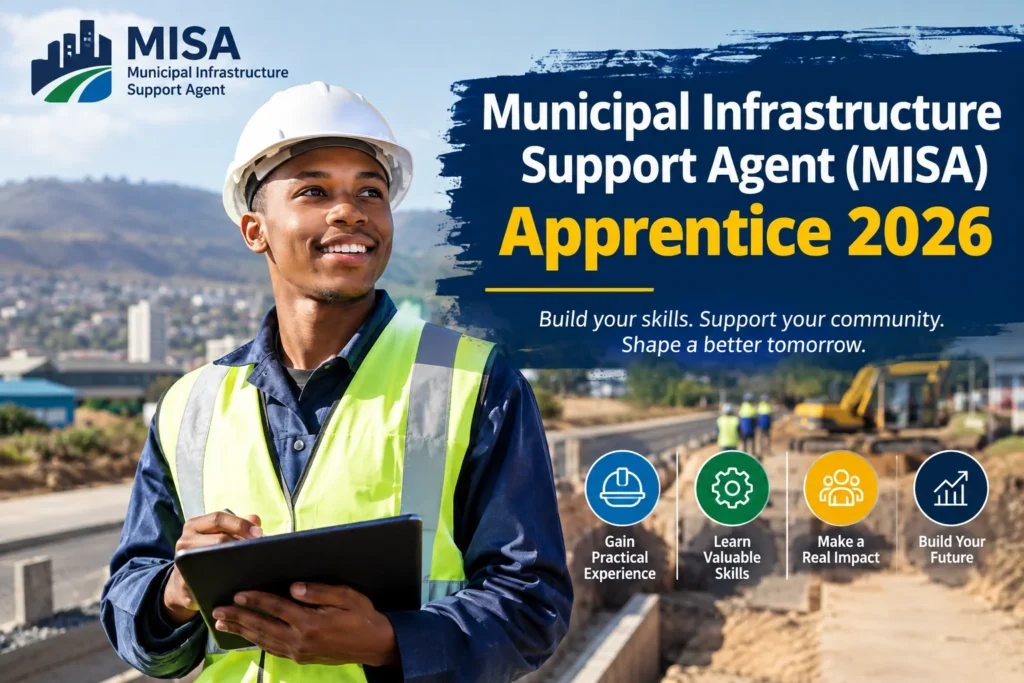

At a TVET college workshop in South Africa, the difference between finishing a technical qualification and becoming employable can sometimes come down to one missing ingredient: real workplace experience.
A student may understand electrical theory, engineering science or technical drawings, but an employer still wants to know whether that person can work safely, follow instructions and solve practical problems on site.
For unemployed young South Africans with the right technical qualifications, the Municipal Infrastructure Support Agent (MISA) Apprentice 2026 programme could provide that bridge.
MISA is recruiting young people for a three-year apprenticeship programme aimed at developing future artisans. Successful candidates will receive a combination of workplace and off-the-job training and will be placed at participating municipalities during the programme. MISA says the apprenticeship specifically targets youth from TVET colleges and accredited training institutions who hold relevant qualifications for the advertised trades.
The advertised closing date is 28 September 2026, making preparation important for anyone who wants to apply.
What the MISA Apprentice 2026 Programme Actually Offers
The first thing applicants should understand is that this is not simply a temporary municipal job.
MISA describes its apprenticeship as a three-year learnership designed to train successful learners to become artisans. Candidates enter three-year learnership contracts with MISA and are placed with municipalities for the duration of the programme. Training combines practical workplace exposure with off-the-job learning.
That structure is particularly relevant to TVET graduates.
A qualification can provide the theoretical foundation for a trade, but practical competence develops through repeated exposure to real equipment, tools, workplace procedures and supervised tasks.
MISA’s wider technical-support work is also closely connected to municipal infrastructure planning, delivery, operation and maintenance. Its technical skills programme facilitates workplace opportunities for apprentices and other learners in municipalities.
This means an apprentice is entering an environment where technical skills have a direct connection to infrastructure and public services.
An electrical apprentice, for example, is not learning technical principles simply for an examination. The broader municipal environment includes infrastructure that communities rely on every day.
The programme is also part of a bigger skills pipeline
MISA’s 2026/27 Annual Performance Plan identifies technical skills development as part of its response to skills shortages affecting municipal infrastructure. The plan identifies shortages across areas including water and sanitation, roads and stormwater, solid waste management, energy and electricity, and local economic development.
That context helps explain why an artisan apprenticeship can matter beyond the individual applicant.
South African municipalities need people who can maintain infrastructure as well as build it. Training young artisans creates a potential pipeline of technical workers who understand the practical side of municipal operations.
Who Should Consider Applying?
The MISA apprenticeship is primarily aimed at unemployed youth with relevant technical qualifications.
The important word is relevant.
Someone interested in becoming an electrician should not assume that any post-school certificate automatically qualifies them. The applicant needs to match their academic background to the specific trade requirements in the official advertisement.
For example, the electrical opportunity includes entry routes involving qualifications such as Engineering Science or full N2 Engineering with relevant trade theory, certain SETA-quality-assured technical programmes, relevant Engineering NC(V) certificates at the specified level, Technical Grade 11 with the required subjects, and relevant N6 or National Technical Diploma qualifications. The exact requirements should be checked against the official 2026/27 advertisement before applying.
This is where applicants can improve their chances of making a technically correct application: do not start with the application form. Start with your qualification.
Ask:
- What trade am I applying for?
- Which qualification do I have?
- Does my qualification appear among the accepted entry routes?
- Do I have the required subjects?
- Can I provide documentary proof?
If the answer to any of these questions is unclear, verify it before submitting.
The municipality you choose also matters
MISA’s 2026/27 apprenticeship information states that successful candidates will be placed at participating municipalities and that the recruitment targets learners from identified municipal areas. Applicants should therefore carefully review the official participating-municipality information rather than choosing a municipality based only on convenience.
A three-year programme is a significant commitment.
Applicants should think realistically about transport, accommodation, family responsibilities and whether they can consistently report to the workplace.

Step-by-Step: How to Apply for the MISA Apprentice 2026 Programme
With the deadline approaching, the application should be treated like a professional recruitment process rather than a quick form-filling exercise.
Step 1: Choose the correct trade
Begin by identifying the apprenticeship trade that matches your existing qualification.
Do not select a trade simply because you believe it has more jobs. Your academic and technical background must support the trade you are applying for.
Read the trade-specific requirements carefully and identify the relevant reference number.
Step 2: Check the participating municipalities
Review MISA’s official list of participating municipalities for the 2026/27 intake.
The municipality is important because applicants need to indicate where they would like to undertake their training.
Before selecting one, consider whether you can realistically complete a three-year placement there.
Step 3: Download the official application form
MISA has published a dedicated 2026/2027 Apprenticeship and Experiential Learnership Application Form on its official website, alongside the apprenticeship advertisement and participating-municipality information.
Use the official form rather than creating your own application format.
DOWNLOAD HERE: (MISA) Apprentice 2026 APPLICATION FORM
Step 4: Enter the correct reference number
This is one of the details applicants should not overlook.
The trade reference number needs to correspond with the apprenticeship being applied for. An incorrect or missing reference number can create unnecessary problems during recruitment.
For example, if applying for the advertised Electrical apprenticeship, the applicant should ensure that the relevant electrical reference number from the current advertisement is correctly recorded.
Step 5: Prepare your CV
Your CV should make your technical background immediately clear.
Include:
- Your contact details
- Matric information
- TVET or technical institution
- Qualification
- Relevant subjects
- Practical training
- Workshop experience
- Relevant certificates
- Driver’s licence, if applicable
- Any previous workplace exposure
Avoid filling the CV with unrelated information.
For an artisan apprenticeship, the recruiter needs to quickly see why your technical background matches the trade.
Step 6: Gather supporting documents
Applicants should prepare clear copies of the documents requested in the official advertisement.
Previous MISA apprenticeship application instructions have required items such as the application form, reference number and municipality, CV, certified copies of relevant qualifications, a certified South African ID and proof of residential address. Because document requirements can change between intakes, applicants should use the 2026/27 advert as the final checklist.
A useful preparation folder could contain:
- Completed MISA application form
- Updated CV
- ID copy
- Matric certificate
- Relevant technical certificates
- Academic records where requested
- Proof of residence
- Other supporting documents specified in the current advert
ALSO APPLY FOR: Feltex Apprentice 2026
What Makes This Apprenticeship Different From a Normal Job Application?
One of the most important differences is the purpose of the programme.
A conventional vacancy is usually focused on filling an existing position with someone who can perform the job.
An apprenticeship is fundamentally about training and occupational development.
MISA’s own technical-support information describes its artisan development programme as placing students recruited from TVET colleges within municipalities to gain practical experience in trades needed for municipal operations and maintenance. MISA also states that the programme provides support such as a monthly stipend, protective clothing, training and trade testing within its artisan-development model. Applicants should confirm the benefits applicable specifically to the 2026/27 advert rather than assuming every historical programme condition remains unchanged.
That distinction is valuable.
The goal should not simply be to “get a stipend”. The real value is developing the practical competence that can support a longer-term artisan career.
Expert Insight: Think Beyond the Three-Year Contract
Technical skills insight: The strongest way to approach an apprenticeship is to treat every month as evidence-building.
A future employer may eventually want to know more than whether you completed an apprenticeship. They may want evidence that you understand workplace safety, can use tools correctly, follow procedures, communicate with supervisors and solve technical problems methodically.
That means apprentices should keep track of what they learn.
Record the types of equipment encountered, practical tasks completed, training modules, safety competencies and technical areas in which experience was gained.
Over three years, that can become a much stronger professional story than simply writing “MISA apprentice” on a CV.
Why Municipal Artisan Training Matters Today
South Africa’s infrastructure challenges make technical maintenance particularly important.
MISA’s 2026/27 planning documents identify water and sanitation and energy supply among major areas of focus, while also identifying technical skills shortages in several municipal service-delivery areas.
This creates an interesting connection between youth employment and infrastructure.
When a young person learns how to maintain electrical, mechanical, plumbing or other infrastructure, that skill can eventually serve both the individual’s career and the broader maintenance needs of communities.
For a TVET graduate who has struggled to obtain workplace experience, an apprenticeship can therefore be more than an entry-level opportunity. It can be the point at which theoretical learning starts becoming occupational competence.
Frequently Asked Questions
1. How long is the MISA Apprentice 2026 programme?
The MISA apprenticeship is structured as a three-year learnership programme aimed at developing successful candidates into artisans.
2. Where will successful applicants train?
Successful candidates will be placed at participating municipalities for the duration of the learnership. Applicants should consult MISA’s official participating-municipality information when completing the application.
3. When does the application close?
The advertised closing date for the 2026/27 apprenticeship intake is 28 September 2026. Applicants should verify the latest official advertisement before submitting
Final Thoughts
For many unemployed TVET graduates, the difficult step is not necessarily obtaining a qualification. It is getting the first opportunity to prove that the qualification can be applied in a real workplace.
The Municipal Infrastructure Support Agent (MISA) Apprentice 2026 programme addresses that gap through a structured three-year pathway combining workplace and off-the-job training.
But applicants should approach it carefully.
Choose a trade that matches your qualifications. Check the participating municipality. Use the official application form. Enter the correct reference number. Prepare a focused CV and complete supporting documents. Then submit well before 28 September 2026.
Most importantly, think beyond the application itself.
An apprenticeship is a period in which technical knowledge can become practical skill. For a young person determined to build an artisan career, that transition may ultimately be more valuable than simply securing another line on a CV.
Official application information: MISA’s apprenticeship page provides the 2026/27 advert, application form and participating-municipality information.