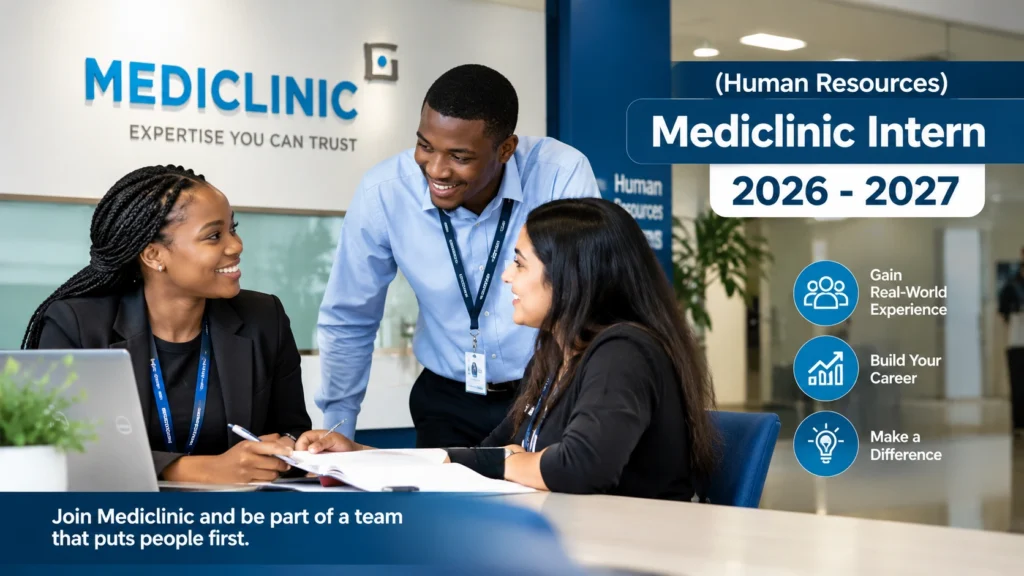

The application form is open on the laptop, but the cursor has stopped moving.
For many South African TVET graduates, this is a familiar moment. You have completed your coursework, earned an N6 certificate and reached the point where the next step should be obvious: gain workplace experience. Yet the entry-level vacancies you find often ask for something you cannot manufacture — previous experience.
That is what makes an internship such as the Mediclinic Intern 2026-2027 in Welkom particularly relevant. For an N6 Human Resources graduate, a structured workplace-learning opportunity can provide something a qualification alone cannot: exposure to how HR actually operates when employees, managers, patients and business requirements all have to be considered at the same time.
Welkom is also an important part of this story. The city sits in the heart of the Free State’s Goldfields and serves as a regional centre for surrounding communities. An internship based there is not simply another corporate opportunity in Johannesburg or Cape Town. For graduates who live in the Free State, it can offer a realistic route into professional work without immediately having to relocate.
But applicants should understand what this opportunity is — and what it is not. An internship is not a guaranteed permanent job. Its real value lies in developing workplace competence, completing the practical component of a qualification and building evidence that you can function in a professional environment.
What makes the Mediclinic Intern 2026-2027 opportunity different?
The first thing to understand is the relationship between the qualification and the workplace.
A TVET qualification can give you theoretical knowledge of areas such as recruitment, employee administration, workplace communication and organisational procedures. Working inside a healthcare organisation introduces another layer: you have to apply those principles accurately, professionally and confidentially.
For an HR intern, even seemingly ordinary administrative tasks can carry considerable importance.
An employee record has to be handled carefully. Information must reach the right person. Documentation needs to be complete. Communication with employees and managers needs to be professional. Deadlines matter because HR administration ultimately affects real people.
That environment can make an internship considerably more educational than simply adding another line to a CV.
The opportunity is particularly relevant to candidates completing TVET Work Integrated Learning (WIL) requirements. WIL exists to connect classroom learning with workplace experience, allowing students to develop competencies that cannot be fully acquired through theory alone.
For an N6 graduate who has been struggling to secure that first opportunity, this distinction matters.
You are not necessarily being asked to arrive as an experienced HR professional. You are being given an opportunity to demonstrate that you can learn, contribute, follow procedures and develop professionally.
What would an HR intern actually learn?
The advertised internship is centred on integrating academic learning with practical workplace experience. Rather than viewing the role as a generic office placement, applicants should think about it as a supervised introduction to the working life of an HR professional.
Depending on the specific duties assigned within the organisation, the experience may expose an intern to areas such as employee administration, HR processes, documentation, communication and general departmental support.
That can teach lessons that textbooks cannot.
For example, an HR student may understand the theory behind employee records. In the workplace, they learn why accurate records matter, how information moves between departments and why confidentiality is not merely a concept discussed in class.
Likewise, studying recruitment is different from seeing how an organisation manages applications, communicates with candidates and supports managers.
The broader lesson is that professional competence is often built through repetition. The first month may involve learning systems and procedures. Later, the intern can become more comfortable handling tasks independently and communicating with colleagues.
That gradual progression is one of the strongest reasons to take WIL seriously.
Why healthcare can be an unusually valuable HR classroom
Healthcare is often associated primarily with doctors, nurses and clinical professionals. Yet a hospital also depends on a large non-clinical workforce.
HR sits behind much of that workforce.
Employees need to be recruited, onboarded, supported and administered. Managers need HR assistance. Policies need to be followed. Records need to be maintained. Workplace matters need to be handled professionally.
This makes healthcare a particularly interesting environment for someone considering a long-term HR career.
The pressure is also different from an ordinary office environment. A healthcare organisation ultimately exists to provide care to patients, which means that administrative functions have consequences beyond the HR department itself.
Expert insight: For a young HR professional, the real value of an internship is not simply learning how to perform administrative tasks. It is learning how an organisation’s people practices connect to its wider purpose. In healthcare, that connection becomes especially visible because workforce effectiveness can influence the quality and continuity of patient services.
That perspective can make an intern more employable later. Employers are not only looking for someone who has completed a qualification; they increasingly need people who understand how their work affects the organisation around them.
The Welkom factor should not be overlooked
There is another reason this opportunity deserves attention from Free State graduates: location.
Many graduate and internship opportunities are concentrated in major metropolitan areas. Candidates from smaller cities and towns can therefore face an additional barrier. Relocating costs money, finding accommodation takes time and moving away from family support is not practical for everyone.
A Welkom-based opportunity changes that equation for local applicants.
It does not eliminate competition, but it can make workplace experience more accessible to candidates who might otherwise struggle to participate in programmes located hundreds of kilometres away.
For someone living in or around Welkom, this is worth considering carefully before dismissing an internship as “just temporary work.”
The experience gained can become useful when applying for future HR administration, recruitment, payroll-support, employee-relations or general office roles.
Who should consider applying?
The strongest candidate is not necessarily the person with the longest CV.
For an internship designed around TVET workplace learning, applicants should first check that their qualification and academic status match the stated requirements. If the opportunity specifically requires an N6 Human Resources qualification or related TVET programme, meeting that requirement should be the starting point.
Beyond eligibility, employers are likely to value workplace behaviours that are difficult to demonstrate through certificates alone.
A strong applicant should be able to show:
- A genuine interest in Human Resources and administration.
- Professional written and verbal communication.
- Willingness to learn from supervisors and colleagues.
- Reliability and attention to detail.
- Respect for confidential workplace information.
- Basic computer and administrative skills.
- The ability to follow instructions and meet deadlines.
One important point is often overlooked: attitude becomes part of your application when experience is limited.
If you have only recently completed your studies, you cannot compete with an experienced HR administrator on years of employment history. You can, however, demonstrate preparation, professionalism, communication skills and a clear understanding of why you want workplace exposure.
Why some applicants may struggle
Having the right certificate does not automatically make an application competitive.
An applicant can meet the academic requirement and still weaken their chances through avoidable mistakes.
Common problems include submitting an incomplete CV, failing to provide requested supporting documents, using an unprofessional email address, sending a generic application or overlooking the location requirement.
Another mistake is treating an internship as though it were a permanent senior position.
The purpose of an internship is development. Employers know that interns have limited workplace experience. What they need to see is evidence that the candidate is ready to learn and capable of behaving professionally.
If your CV says you are “hardworking and passionate” but gives no examples of what you have actually done, those claims carry limited weight.
A better approach is to demonstrate them.
For example, participation in a student project can show teamwork. Completing a group assignment under a deadline can demonstrate organisation. Assisting with administration at a community organisation can provide evidence of responsibility.
Small experiences can become meaningful when presented honestly.

How to approach the application strategically
Before pressing “Apply”, take a few minutes to prepare properly.
Step 1: Confirm eligibility.
Read the official vacancy carefully and check the qualification, location, workplace-learning and any other requirements against your own circumstances.
Step 2: Update your CV.
Keep it clear and focused. Put your relevant qualification, skills, computer proficiency, practical projects and any legitimate experience where recruiters can see them quickly.
Step 3: Highlight your N6 status.
If the internship is intended to support TVET workplace learning, make that information easy to identify.
Step 4: Prepare supporting documents.
Have your relevant certificates and other requested documents available in the format specified by the employer.
Step 5: Check every field before submitting.
Typos, incorrect contact information and missing attachments can create unnecessary problems.
Step 6: Use the official recruitment channel.
Do not pay anyone to “secure” the internship. Genuine employer recruitment processes should not require applicants to make payments in exchange for consideration.
Step 7: Keep your records.
Save the vacancy details, application confirmation and the version of your CV you submitted. This becomes useful if you are contacted for an interview.
APPLY HERE: Mediclinic Intern 2026-2027
ALSO APPLY FOR: Freedom Stationery Intern 2026-2027
The most important part of this process is not speed. It is accuracy.
What this internship could mean beyond 2027
An internship should be viewed as a stepping stone rather than a promise.
There is no guarantee that completing an internship will result in permanent employment with the same organisation. However, successful workplace experience can strengthen a graduate’s position when applying for future vacancies.
Imagine two candidates applying for an entry-level HR position.
Both have an N6 qualification. One has only academic experience. The other can explain how they worked within an HR department, followed workplace procedures, handled administrative responsibilities and communicated with colleagues in a professional setting.
The second candidate has something tangible to discuss during an interview.
That is the deeper value of WIL.
It gives graduates examples.
And examples are powerful during recruitment because they allow an applicant to answer questions with evidence rather than theory.
For a young person who has spent months hearing “experience required”, that change can be significant.
Frequently asked questions
1. Who is the internship aimed at?
The opportunity is particularly relevant to TVET graduates who need practical workplace exposure as part of an N6 Human Resources or related qualification, subject to the official vacancy requirements.
2. Where is the internship based?
The opportunity referenced here is based in Welkom, Free State. Applicants should confirm the exact location in the official vacancy before submitting an application.
3. Does completing the internship guarantee a permanent job?
No. An internship provides structured workplace experience and development, but permanent employment depends on future vacancies, performance and the employer’s recruitment requirements.
The bigger picture for South Africa’s TVET graduates
The story behind an opportunity like the Mediclinic Intern 2026-2027 is bigger than one vacancy.
South Africa continues to face the difficult transition between education and employment. For many young people, qualifications are available but opportunities to obtain meaningful workplace experience remain limited.
That is why properly structured internships matter.
They give graduates a chance to test their knowledge against real workplace expectations. They also give employers an opportunity to identify and develop emerging talent.
For an N6 graduate in Welkom, the opportunity is therefore worth approaching with realistic expectations. It may not solve every career problem overnight, and it should never be presented as a guaranteed route to permanent employment.
But it can provide something that is often missing at the beginning of a career: a first credible piece of professional experience.
And sometimes that is the difference between another application disappearing into the void and a CV finally giving an employer a reason to call.