
For thousands of South African young people, a learnership or internship can be the first real opportunity to gain workplace experience. But there is one question that often comes before everything else:
“How much does it pay?”
That question is important. If you are unemployed, travelling to work every day, buying lunch, paying for data and helping at home, a stipend can make the difference between being able to participate in a programme and having to turn it down.
However, comparing a learnership stipend vs internship stipend is not as simple as choosing whichever opportunity offers the higher monthly amount.
A R5,000 internship may not necessarily be a better opportunity than a R4,000 learnership. One programme may give you valuable industry experience, while the other may include structured learning, assessments and a qualification. Similarly, a programme offering a higher stipend could involve expensive daily transport or provide experience that has little connection to your career goals.
This is why job seekers should look at the full value of the opportunity, not just the amount deposited into their bank account.
In this guide, we explain the difference between learnership and internship stipends, what you should compare before accepting an opportunity, how to calculate whether a stipend is actually enough, and how to use the experience to improve your chances of finding permanent employment.
ALSO APPLY FOR: Pepkor Internship 2026
ALSO APPLY FOR: Harmony Gold Engineering Learnerships 18.2 2026
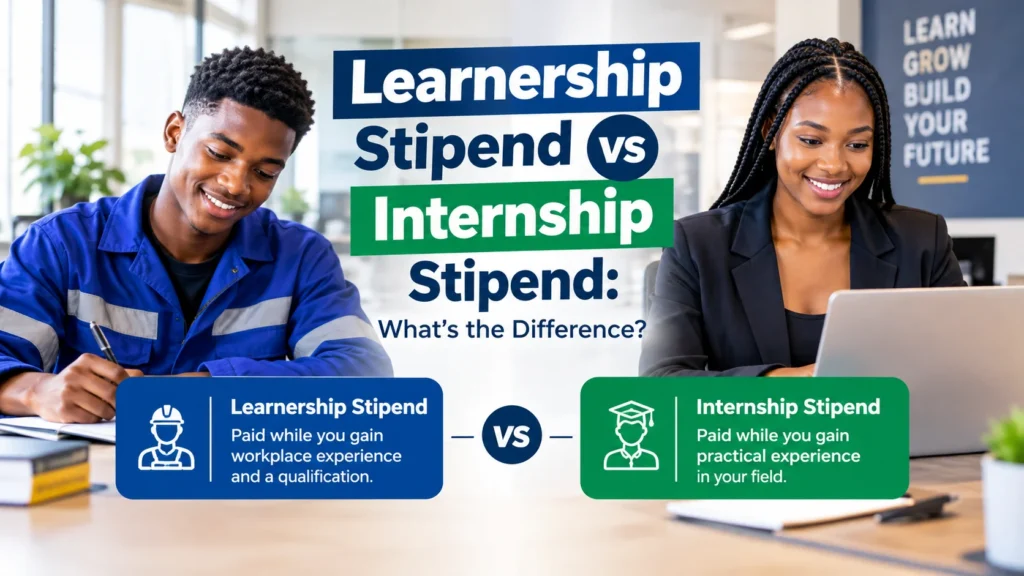
Learnership Stipend vs Internship Stipend: What’s the Difference?
The biggest difference is that learnerships are generally structured around learning and workplace training, while internships generally focus on gaining practical workplace experience.
A learnership normally combines theoretical learning with practical workplace exposure and may lead to a recognised qualification or occupational learning outcome.
An internship is generally intended to give a student or graduate practical exposure to an occupation or industry. The exact structure depends on the organisation and programme.
The stipend is the money paid or provided to support the participant during the programme.
Importantly, there is no single standard stipend amount for every learnership or every internship.
The amount can vary according to:
- Employer.
- Industry.
- Programme.
- Funding arrangement.
- Qualification level.
- Duration.
- Location.
- Responsibilities.
- Programme-specific conditions.
Therefore, applicants should always check the specific official advert or agreement instead of assuming that every programme pays the same amount.
Learnership vs Internship: The Key Differences
| Feature | Learnership | Internship |
|---|---|---|
| Main purpose | Structured learning + workplace experience | Practical workplace experience |
| Formal learning | Usually an important component | Depends on programme |
| Qualification | May lead to a recognised qualification/learning outcome | Usually not the primary purpose |
| Workplace exposure | Yes | Yes |
| Stipend | Varies by programme | Varies by programme |
| Suitable for | School leavers, unemployed youth and people developing occupational skills | Students, graduates and people seeking industry exposure |
| Assessment | Usually part of the learning process | Depends on employer |
| Career benefit | Skills + workplace experience + possible qualification | Workplace experience + professional exposure |
| Permanent employment | Not guaranteed | Not guaranteed |
The table shows why simply comparing the monthly stipend can give you an incomplete picture.
ALSO READ ABOUT: Which Industries Offer the Highest Stipend in South Africa in 2026?
What Is a Learnership Stipend?
A learnership stipend is financial support provided to a participant while they complete a structured learning and workplace programme.
The learner may spend time completing theoretical training and practical workplace duties.
For example, a learnership could involve training in areas such as:
- Administration.
- Information technology.
- Finance.
- Customer service.
- Engineering.
- Construction.
- Manufacturing.
- Business operations.
- Retail.
- Early childhood development.
The exact structure depends on the programme.
What makes a learnership valuable?
The combination of learning + workplace exposure can be particularly useful to someone who has little or no experience.
Instead of leaving a programme with only a certificate of attendance, a good learnership can help you develop evidence of actual workplace capability.
You may gain:
- Technical skills.
- Practical experience.
- Workplace discipline.
- Communication skills.
- Industry knowledge.
- Assessment experience.
- A qualification or occupational learning outcome, where applicable.
- References.
This can make the learnership useful beyond the period during which you receive the stipend.
What Is an Internship Stipend?
An internship stipend is financial support provided to an intern while they gain practical workplace experience.
Internships are commonly aimed at students, graduates or unemployed people who need experience in their field.
For example, a graduate with a qualification in:
- Accounting,
- Marketing,
- Human Resources,
- Information Technology,
- Engineering,
- Journalism,
- Public Management,
may use an internship to gain practical experience related to their studies.
An internship can help bridge the gap between “I have the qualification” and “I have actually worked in this environment.”
That gap can be a major problem for graduates.
Many entry-level vacancies ask applicants for experience, even when they are applying for junior positions. An internship can help create evidence that the applicant has worked in a professional environment.
ALSO READ ABOUT: Fake Stipend Promises
Why This Issue Matters
The stipend matters because participating in an unpaid or low-paid programme can be difficult when you have regular expenses.
Consider someone receiving a R4,500 monthly stipend.
Their expenses could look like this:
| Expense | Example monthly cost |
|---|---|
| Transport | R1,800 |
| Food during working days | R900 |
| Data/airtime | R300 |
| Work-related expenses | R300 |
| Contribution at home | R700 |
| Total expenses | R4,000 |
| Remaining | R500 |
Suddenly, a R4,500 stipend does not look like R4,500 of disposable income.
This is why applicants should calculate their net practical benefit.
Before accepting an opportunity, ask:
- How much will transport cost every month?
- How far is the workplace from home?
- Will I need to buy meals?
- What are the working hours?
- Will I need data for work?
- Is the stipend paid monthly?
- What happens if payment is delayed?
- Is training included?
- Will I gain experience relevant to my career?
- Is there a qualification or certificate?
- What happens when the programme ends?
These questions can prevent you from accepting an opportunity that becomes financially impossible after a few weeks.
Don’t Compare Stipends Without Comparing the Career Value
This is one of the most important lessons for job seekers.
Imagine you have two offers.
Programme A
Stipend: R5,500 per month
But:
- The work is unrelated to your career.
- There is limited training.
- Transport costs R2,000 per month.
- There is little opportunity to build technical skills.
Programme B
Stipend: R4,500 per month
But:
- The work is directly related to your qualification.
- You receive structured training.
- You work with experienced professionals.
- You build practical projects.
- You receive a reference after completion.
- Transport costs R800 per month.
Programme A pays R1,000 more.
But Programme B could potentially give you significantly more career value.
The lesson: compare the entire opportunity, not just the stipend.
ALSO READ ABOUT: Is a R5,000 Stipend Enough to Live on? A Realistic South African Budget Guide
How to Decide Which Opportunity Is Better
Use this simple six-step method before accepting a learnership or internship.
Step 1: Calculate Your Real Monthly Benefit
Start with the stipend.
Then subtract the costs directly associated with participating.
Stipend – transport – meals – data – other work expenses = practical amount remaining.
This gives you a more realistic picture.
Step 2: Check Whether the Opportunity Matches Your Career
Ask:
“Will this experience help me qualify for better jobs in the future?”
For example, if you want to become an IT support technician, an IT learnership or internship could be much more valuable than a better-paying opportunity involving unrelated administrative work.
Look for experience that allows you to develop skills employers actually request.
Step 3: Investigate the Training
Don’t simply ask whether training is available.
Ask what training you will receive.
Look for:
- Formal classes.
- Practical training.
- Mentorship.
- Assessments.
- Software or equipment exposure.
- Workplace projects.
- Technical skills.
- Industry-specific knowledge.
A programme should ideally leave you with something concrete to put on your CV.
Step 4: Look at the Qualification or Certificate
For a learnership, determine exactly what learning outcome or qualification is associated with the programme.
Ask:
- Who provides the training?
- Is the qualification recognised?
- What assessments are required?
- Will I receive proof of completion?
- What level or occupational outcome does it lead to?
Do not rely solely on phrases such as “fully accredited” in advertisements. Verify important claims with the relevant organisation or training provider.
Step 5: Investigate the Workplace Experience
Experience is one of the most valuable things you can gain from an entry-level programme.
A good opportunity should allow you to develop examples you can later discuss during interviews.
For example:
“During my internship, I assisted with monthly reporting and used Excel to prepare financial information.”
is stronger than simply saying:
“I completed an internship.”
Whenever possible, look for programmes where you will actually perform meaningful tasks.
Step 6: Consider What Happens After Completion
Never assume that a learnership or internship automatically becomes a permanent job.
Instead, investigate whether the organisation has:
- Graduate programmes.
- Permanent vacancies.
- Internal recruitment.
- Career progression opportunities.
- Previous participants who were employed.
There is no guarantee of employment, but understanding the organisation’s track record can help you make a more informed decision.
ALSO READ ABOUT: Top Learnerships That Pay Monthly Stipends in South Africa
Learnership or Internship: Which One Is Better for You?
There is no universal answer.
Your current situation matters.
A learnership may be a strong option if you:
- Have Matric and limited workplace experience.
- Want structured occupational training.
- Need to develop practical skills.
- Want to work towards a qualification or learning outcome.
- Are entering an occupation for the first time.
- Want a combination of theory and workplace experience.
An internship may be a strong option if you:
- Have recently completed a diploma, degree or other qualification.
- Need workplace experience in your field.
- Want to understand how your profession operates.
- Need professional references.
- Want exposure to a specific industry.
- Are trying to turn academic knowledge into practical ability.
However, always follow the actual eligibility requirements of the programme.
How to Make a Small Stipend Go Further
A stipend is temporary income, so treating it like a permanent salary can create problems.
A simple strategy is to divide your money into priorities.
Priority 1: Getting to work
Transport should come first because you cannot benefit from the programme if you cannot attend consistently.
Priority 2: Food and basic work expenses
Budget for meals, data and other essential costs.
Priority 3: Emergency savings
Even a small amount can help.
Saving R200 per month for 12 months gives you R2,400.
Saving R500 per month for the same period gives you R6,000.
The goal is not to become wealthy from a stipend. It is to avoid ending the programme with nothing.
Priority 4: Career investment
Where affordable, consider using a small portion of your income for things that improve employability:
- Data for applications.
- Printing important documents.
- Professional clothing.
- Transport to interviews.
- Relevant short courses.
- CV improvements.
ALSO READ ABOUT: Steps to Apply for Internships While Still Studying
The Hidden Value of a Learnership or Internship
The monthly stipend is only one part of what you receive.
You should also think about your career capital.
Career capital includes the things that can make you more valuable to employers later.
A good programme can give you:
1. Experience
You can finally add real workplace experience to your CV.
2. References
A supervisor who can confirm your performance can become an important reference.
3. Professional confidence
Your first workplace experience can make future interviews much easier.
4. Industry contacts
You may meet colleagues, managers, suppliers and other professionals.
5. Practical skills
You can learn how work is actually performed rather than only understanding the theory.
6. Evidence for your CV
Instead of listing generic skills, you can describe specific tasks and achievements.
For example:
- Assisted with customer queries.
- Captured and maintained records.
- Prepared administrative reports.
- Supported stock control.
- Used Microsoft Excel to organise information.
- Assisted with technical maintenance.
- Participated in workplace projects.
Specific evidence is more useful than simply writing “hard worker” or “good communication skills.”
Best Practices Experts Recommend
If you want to get maximum value from a learnership or internship, don’t wait until the final month.
Keep a record of what you learn
Maintain a simple document containing:
- Tasks completed.
- Systems used.
- Projects supported.
- Training completed.
- Certificates earned.
- Positive feedback.
- Problems solved.
This information can later help you update your CV.
Ask questions
If you don’t understand something, ask an experienced colleague.
The purpose of an entry-level programme is to learn.
Build relationships professionally
Be respectful to supervisors and colleagues.
The person sitting next to you today could know about a vacancy tomorrow.
Treat the programme like a real job
Arrive on time.
Meet deadlines.
Communicate when there is a problem.
Take responsibility.
These behaviours can matter just as much as technical skills.
Start applying before the programme ends
Don’t wait until your final day.
Begin looking for your next opportunity several months before completion.
ALSO READ ABOUT: Your Empowering Guide to Internships in 2026
Mistakes People Often Make
1. Choosing the highest stipend automatically
More money today does not always mean greater career value tomorrow.
2. Ignoring transport
A programme may look attractive until you calculate the daily travel cost.
3. Assuming a stipend is a salary
Understand the terms of the programme before signing.
4. Assuming employment is guaranteed
A learnership or internship can improve your employability, but permanent employment is not automatic.
5. Doing the programme without documenting your experience
If you don’t keep track of your achievements, you may struggle to remember them when writing your CV months later.
6. Accepting vague promises
Be cautious of statements such as:
“Complete this programme and you will definitely get a permanent job.”
Ask for official information rather than relying on verbal promises.
7. Paying money to secure a position
Be particularly careful when someone asks for money to process an application, guarantee employment or reserve a place.
Verify the opportunity through the organisation’s official channels.
ALSO READ ABOUT: Top Industries Offering Learnerships in South Africa
A Simple Scorecard for Comparing Two Opportunities
If you’re struggling to choose between two programmes, score each from 1 to 5.
| Factor | Opportunity A | Opportunity B |
|---|---|---|
| Stipend | /5 | /5 |
| Transport affordability | /5 | /5 |
| Career relevance | /5 | /5 |
| Training quality | /5 | /5 |
| Qualification/certificate | /5 | /5 |
| Workplace experience | /5 | /5 |
| Mentorship | /5 | /5 |
| Reputation of organisation | /5 | /5 |
| Employment potential | /5 | /5 |
| Total | /45 | /45 |
This isn’t a scientific measurement. It is simply a way to stop yourself from focusing entirely on the stipend.
Frequently Asked Questions
Is a learnership stipend higher than an internship stipend?
Not necessarily. There is no universal stipend amount that applies to every learnership or internship. The amount depends on the specific programme, employer, funding arrangement and other conditions.
Can I receive a stipend and still be unemployed?
Many learnerships and internships are specifically designed for unemployed participants, but eligibility differs between programmes. Always check the official requirements.
Which is better for someone with Matric and no experience?
A learnership can be particularly useful because it may combine structured learning with workplace experience. However, an internship may also be suitable if the specific programme accepts applicants with your qualifications.
Can an internship become a permanent job?
It can, but there is no automatic guarantee. Your performance, available positions and the employer’s hiring needs all matter.
Final Takeaway: Don’t Chase the Stipend — Build Your Career
The most important lesson from Learnership Stipend vs Internship Stipend: What’s the Difference? is that the monthly payment is only one part of the decision.
For an unemployed South African trying to enter the labour market, the real value of a programme can include:
- Monthly financial support.
- Practical workplace experience.
- Technical skills.
- Professional references.
- Mentorship.
- Industry contacts.
- A qualification or learning outcome.
- Greater confidence.
- A stronger CV.
Before accepting an opportunity, calculate your actual expenses and compare the career value of the programme.
If a slightly lower stipend gives you highly relevant experience, structured training and skills that employers demand, it may be the smarter long-term choice.
At the same time, don’t ignore your financial reality. A programme that leaves you unable to afford transport or food may be difficult to complete successfully.
The best opportunity is therefore the one that creates a sensible balance between what you can afford today and what will make you more employable tomorrow.
Treat your learnership or internship as more than a temporary source of income. Use every month to build skills, relationships, achievements and evidence of what you can do.
The stipend eventually ends. The skills and experience you gain can continue working for you long after the final payment.