
In this environment, submitting a bursary application is only the first step. The real challenge lies in staying informed, proactive, and strategically engaged throughout the decision-making process. Applicants who understand how to monitor their status effectively are better positioned to respond to requests, meet deadlines, and ultimately secure funding.
This article offers a structured, analytical look at how to track your bursary application status, unpacking the systems, behaviors, and trends shaping the process today.
Understanding the Bursary Review Process
Before exploring how to track your bursary application status, it’s essential to understand what happens after submission. Many applicants assume decisions are quick or automated, but in reality, bursary evaluations are layered and often slow-moving.
Most bursary providers follow a multi-stage process:
- Initial screening for eligibility criteria
- Document verification (academic records, financial need, supporting statements)
- Shortlisting based on merit or need
- Final review and approval
Each stage introduces potential delays. For example, incomplete documentation or high application volumes can extend timelines significantly. In South Africa and similar education systems, large national bursary programs may receive tens of thousands of applications annually.
This complexity explains why tracking your application status is not always straightforward—and why passive waiting can be a disadvantage.
ALSO APPLY FOR: Shoprite’s 2026 Bursary Programme
ALSO APPLY FOR: Moore Southern Cape SAICA Bursary 2027
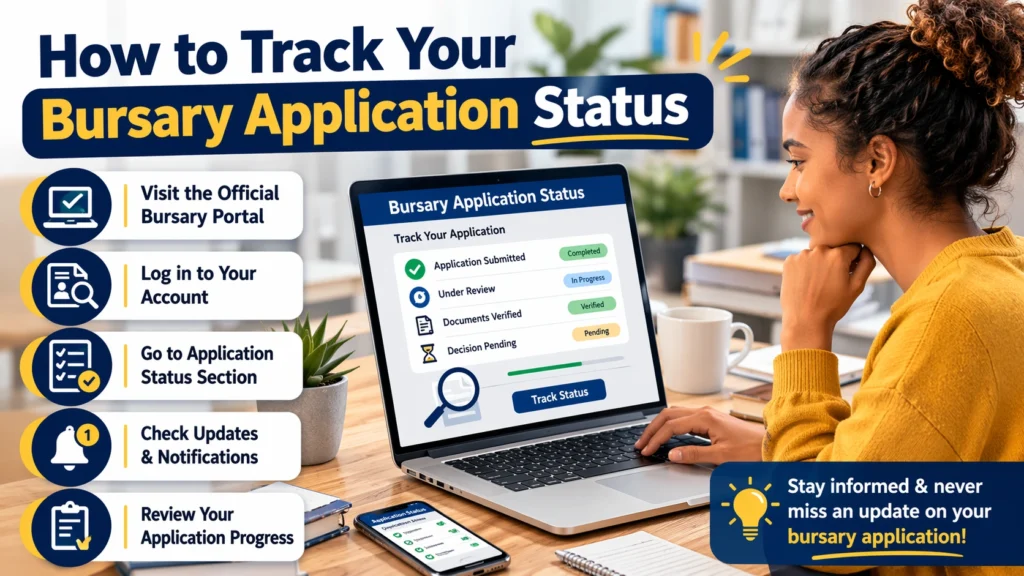
Where and How to Track Your Bursary Application Status
A key insight for applicants is that there is no single universal system. Instead, tracking methods vary depending on the organization offering the bursary. Understanding these channels is critical.
1. Online Portals and Dashboards
Many modern bursary providers now use digital portals where applicants can log in and monitor progress. These systems typically display statuses such as:
- “Application received”
- “Under review”
- “Shortlisted”
- “Successful/unsuccessful”
Applicants should check these portals regularly, as updates are not always accompanied by notifications.
2. Email Communication
Email remains the most common communication channel. However, delays often occur because:
- Emails may be filtered into spam folders
- Institutions send batch updates rather than real-time notifications
- Requests for additional documents can be missed if not checked frequently
A practical approach is to create a dedicated folder or label for bursary-related emails and review it consistently.
3. SMS and Mobile Notifications
Some bursary programs—particularly government-funded ones—use SMS alerts for updates. While convenient, these messages are usually brief and may require follow-up through official channels.
4. Direct Contact Channels
When automated systems fall short, direct contact becomes necessary. This can include:
- Calling the bursary office
- Sending formal inquiry emails
- Engaging through official social media pages
However, timing matters. Contacting providers too frequently can be counterproductive, while waiting too long may cause missed opportunities.
Common Challenges Applicants Face
Even with multiple tracking methods available, many applicants struggle with visibility and clarity. Understanding these challenges helps explain why proactive tracking is essential.
Lack of Transparency
Some bursary providers offer minimal updates, leaving applicants uncertain about their progress. This is especially common in high-volume programs where administrative resources are limited.
Delayed Timelines
Bursary decisions often extend beyond advertised timelines. This creates uncertainty for students who must make alternative financial plans.
Inconsistent Communication
Applicants may receive conflicting information from different channels—for example, an online portal showing “under review” while an email suggests final decisions are imminent.
Technical Barriers
Digital platforms are not always user-friendly. Login issues, system downtime, or incomplete status updates can hinder tracking efforts.
These challenges highlight a broader issue: tracking your bursary application status is not just about access to information, but about navigating imperfect systems.

ALSO READ ABOUT: Can a Learnership Make You an Artisan?
Strategic Approaches to Tracking Your Application Effectively
Knowing how to track your bursary application status is not enough; applicants must also adopt strategic behaviors to stay ahead.
Maintain a Tracking System
Create a simple spreadsheet or document that includes:
- Application submission dates
- Login details for portals
- Contact information for providers
- Expected response timelines
This reduces reliance on memory and ensures no deadlines are missed.
Set Regular Checkpoints
Instead of checking randomly, establish a routine—such as weekly reviews of portals and emails. This balances vigilance with efficiency.
Respond Quickly to Requests
Many bursary providers request additional documents during the review process. Delayed responses can result in disqualification, even for strong candidates.
Diversify Applications
Tracking becomes less stressful when applicants are not dependent on a single bursary. Applying to multiple opportunities increases chances of success and reduces pressure.
Trends Shaping Bursary Tracking in 2026
The process of tracking bursary applications is evolving, influenced by broader technological and institutional trends.
Digital Transformation
More institutions are adopting centralized application systems, making tracking more standardized. However, implementation varies widely, leading to uneven user experiences.
Increased Competition
With more applicants competing for limited funding, bursary providers are becoming more selective. This increases the importance of staying informed and responsive throughout the process.
Data-Driven Decision Making
Some organizations now use automated scoring systems to shortlist candidates. While this speeds up initial screening, it can reduce transparency, as applicants may not understand why they were rejected.
Integration with Educational Platforms
In some cases, bursary tracking is being integrated into university admission systems, allowing applicants to monitor both processes simultaneously.
These trends suggest that while tracking systems are improving, they are also becoming more complex.
How to Track Your Bursary Application Status Without Missing Critical Updates
This remains the central challenge for most applicants: balancing patience with proactive engagement.
A practical framework includes:
- Centralizing information (portals, emails, contacts)
- Monitoring consistently without overchecking
- Escalating inquiries strategically when timelines pass
- Preparing contingency plans in case of delays or rejection
Importantly, applicants should treat tracking as an ongoing process rather than a one-time action. The most successful candidates are those who remain engaged from submission to final decision.
What This Means Going Forward
The growing complexity of bursary systems signals a shift in how students must approach funding opportunities. Tracking your application status is no longer a passive activity—it is an active skill that can influence outcomes.
Looking ahead, several developments are likely:
- Greater automation will streamline tracking but may reduce human interaction
- Improved transparency tools could emerge as institutions respond to applicant demand
- Integration across platforms may simplify the process, particularly for university-linked bursaries
- Increased competition will make responsiveness and organization even more critical
For students, this means adapting to a more dynamic and data-driven funding landscape. Those who understand how to track their bursary application status effectively will have a clear advantage—not just in securing funding, but in managing their broader educational journey.
ALSO APPLY FOR: Shoprite’s 2026 Bursary Programme
ALSO APPLY FOR: Moore Southern Cape SAICA Bursary 2027
ALSO READ ABOUT: Can a Learnership Make You an Artisan?