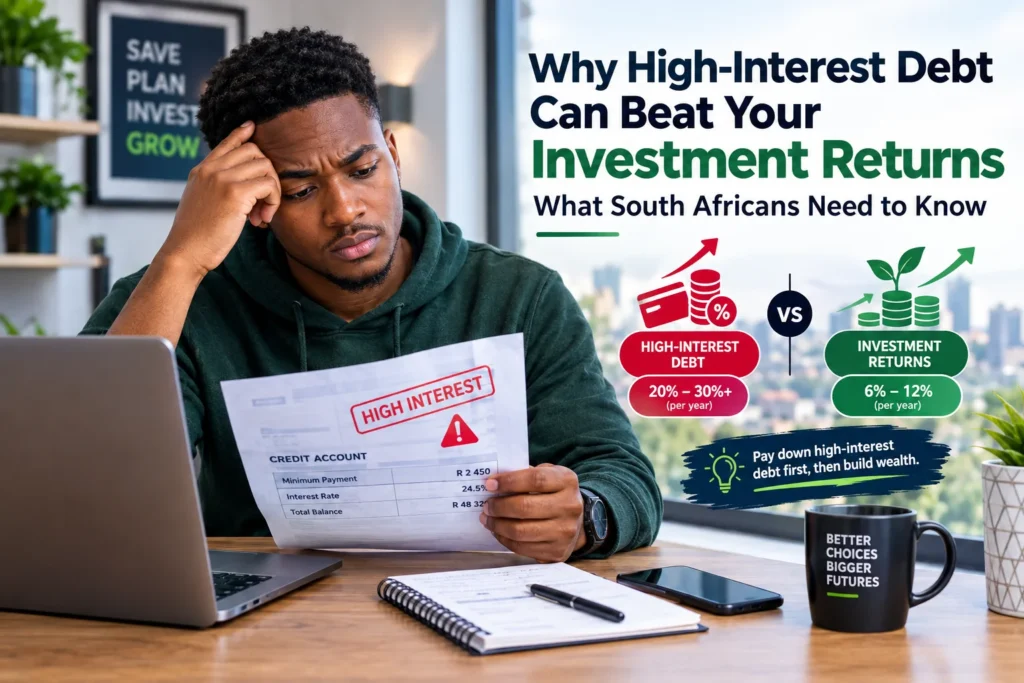

You could be putting money into an ETF every month, watching your savings grow and believing you are moving closer to financial freedom. Yet, behind the scenes, a credit card balance or personal loan could be costing you more than your investments are earning.
Consider someone who has R15,000 invested in the stock market but also owes R15,000 on a credit card charging 24% interest annually. If the investment earns 10% over a year, the investment grows by approximately R1,500 before fees and tax. Meanwhile, the debt could cost around R3,600 in interest if the balance remains unchanged and interest is calculated simply for illustration.
The person has an investment that is growing, but the borrowing is working against their financial progress.
This is one of the most overlooked problems in personal finance. People are often encouraged to start investing early, buy ETFs, save for retirement and benefit from compound growth. Those are worthwhile goals. However, investing without considering the cost of existing debt can leave you working harder to build wealth while expensive interest quietly eats into your money.
Understanding why high-interest debt can beat your investment returns can help you make better decisions about your salary, savings, credit cards, personal loans and long-term investments.
The solution is not necessarily to stop investing or use every cent to repay debt. It is to understand the numbers, protect yourself against financial emergencies and give your money the best chance of improving your overall financial position.
What Does It Mean When High-Interest Debt Beats Investment Returns?
High-interest debt can beat your investment returns when the cost of borrowing is greater than the return you earn on your investments.
The difference is important because debt interest is a cost you generally have to pay under your credit agreement, while investment returns are uncertain.
For example, an investment might generate a positive return this year and lose value the next. Your lender may continue charging interest regardless of what happens in the stock market.
Consider this simplified example:
| Financial item | Amount |
|---|---|
| Credit card debt | R15,000 |
| Illustrative annual interest rate | 24% |
| Approximate interest over one year | R3,600 |
| Investment balance | R15,000 |
| Illustrative investment return | 10% |
| Investment growth before fees and tax | R1,500 |
| Difference between the two amounts | R2,100 |
The R2,100 difference illustrates why expensive debt can undermine your financial progress.
These figures assume an unchanged debt balance and a simple annual calculation. Actual credit agreements may calculate interest daily or monthly, and repayments, fees and compounding affect the result.
The investment return is also hypothetical, not guaranteed. An actual investment could earn more, less or even lose money.
The key lesson is that you should not measure your financial success by looking at your investments alone. You also need to consider what you owe.
Your net worth tells a more complete story
Net worth is the difference between what you own and what you owe.
Suppose you have:
- R20,000 in investments.
- R5,000 in accessible savings.
- R18,000 in outstanding consumer debt.
Your net worth, ignoring other assets and liabilities, is R7,000.
If your investments grow but your debt increases faster, your net worth may fail to improve as expected.
This is why reducing expensive debt can be an important part of building wealth. You are not simply paying a bill; you are working to improve the difference between your assets and liabilities.
ALSO APPLY FOR: Guardrisk Learnership 2026
ALSO APPLY FOR: Transcend Learnership 2026
Why This Issue Matters
High-interest debt affects more than your credit score or monthly instalment. It can determine how much of your income remains available for emergencies, retirement, education and other financial goals.
1. Interest takes money away from your future
Imagine paying R1,000 every month towards interest and related borrowing costs. That is R12,000 over a year if the cost remains constant.
That money could otherwise help fund:
- An emergency savings account.
- A retirement investment.
- A child’s educational expenses.
- A professional certificate or skills course.
- A deposit towards a home or vehicle.
Not every rand saved on interest would automatically become investment profit, but reducing unnecessary borrowing costs gives you more control over your income.
2. High-interest debt can make emergencies more expensive
Consider a worker who uses most of their salary to repay a credit card. An unexpected car repair costs R3,000, but there is no emergency fund.
The worker uses the credit card again.
Even though repayments have been made, the outstanding balance rises once more. The following month, part of the salary goes towards interest on the renewed balance.
This creates a cycle in which debt repayment and new borrowing happen simultaneously.
A modest emergency fund can help interrupt that cycle by reducing the need to borrow whenever an unexpected expense arises.
3. Debt can delay long-term investment goals
The longer expensive debt remains outstanding, the more money may be diverted from other priorities.
A person who wants to build a retirement portfolio might find that monthly repayments leave little room for consistent investing.
This does not mean every loan should be repaid before investing. It means the cost of borrowing should be part of the decision.
4. Debt creates pressure when investment markets fall
Investments can decline in value, sometimes sharply. If you are also carrying expensive debt, a market downturn may create additional financial stress.
You might be tempted to sell an investment at a loss to meet repayments or use additional credit to cover living expenses.
Having manageable debt, accessible savings and a realistic budget can reduce the likelihood of being forced into these decisions.
ALSO READ ABOUT: What Is Compound Interest?
Why High-Interest Debt Can Beat Your Investment Returns: The Comparison That Matters
One of the biggest mistakes people make is comparing a loan’s interest rate with an investment’s advertised return without considering fees, taxes and risk.
The following table shows how the comparison might look.
| Debt interest rate | Illustrative investment return | General consideration |
|---|---|---|
| 25% | 8% | Repaying the debt will often be the stronger financial priority |
| 20% | 12% | The borrowing cost is substantially higher than the illustrative return |
| 15% | 15% | Compare fees, tax, risk and repayment conditions carefully |
| 10% | 12% | The investment may offer a higher potential return, but it is not guaranteed |
| 6% | 10% | Investing while repaying the loan may be reasonable in some circumstances |
These percentages are examples, not forecasts or recommendations for a particular investment.
Even where the expected investment return exceeds the loan rate, investing is not automatically the better choice. Investment returns can be negative, while interest charges can continue accumulating.
Likewise, paying down debt is not always the only sensible financial priority. Emergency savings, employer retirement contributions, tax considerations and loan terms can change the decision.
A useful way to think about debt repayment
When you repay debt, you reduce the balance on which future interest may be charged. This creates an economic benefit because you avoid some of the borrowing costs that would otherwise arise.
For example, if an additional R5,000 repayment reduces a credit card balance charging 24% annually, the simple annual interest equivalent on that amount is R1,200.
That is not a guaranteed investment return or necessarily the exact amount you will save. The actual benefit depends on when the payment is made, how interest is calculated, future repayments, fees and whether you borrow again.
Nevertheless, it demonstrates why reducing an expensive balance can be financially valuable.
ALSO READ ABOUT: How to Turn Career Growth Into Wealth Growth
A Practical Step-by-Step Plan to Pay Off Debt and Build Wealth
You do not need a large salary to start improving your financial position. You need a clear picture of your obligations and a plan that fits your circumstances.
Step 1: Calculate the true cost of your debt
Start by collecting your latest statements and credit agreements.
For every account, record:
- The outstanding balance.
- The interest rate.
- The minimum monthly repayment.
- Monthly service fees and other charges.
- The remaining repayment period, where applicable.
- Any early-settlement fees or special repayment conditions.
Do not assume the advertised interest rate represents the full cost of borrowing. Check the agreement and statements for other charges.
Your goal is to identify which debts are consuming the largest share of your money.
Step 2: Build a realistic monthly budget
Write down your take-home income and essential expenses before deciding how much extra you can afford to repay.
Include rent, groceries, transport, electricity, insurance, school expenses and minimum debt repayments.
Then identify expenses you can reduce without compromising essential needs.
For example, you might discover that unused subscriptions, frequent takeaway meals or avoidable banking charges free up R300 to R600 a month. Your actual savings will depend on your spending habits.
If your budget already falls short of essential expenses, the answer may require more than spending cuts. You may need to negotiate repayment arrangements, seek debt counselling or explore opportunities to increase your income.
Step 3: Keep a basic emergency buffer
Before committing every available rand to additional repayments, consider keeping some accessible money for urgent expenses.
Without a buffer, even a small emergency can force you to borrow again.
Start with an amount you can reasonably afford and build it gradually. The right amount depends on your household responsibilities, income stability and existing support.
Avoid treating money needed for rent, food or upcoming bills as spare cash for debt repayment.
Step 4: Use the debt avalanche method
The debt avalanche method prioritises the debt with the highest interest rate while you continue making the required minimum payments on your other accounts.
Imagine you have three debts:
| Account | Outstanding balance | Illustrative annual rate | Repayment priority |
|---|---|---|---|
| Credit card | R12,000 | 24% | First |
| Personal loan | R25,000 | 18% | Second |
| Store account | R4,000 | 12% | Third |
Assuming comparable terms and no unusual fees or penalties, you would direct additional repayments towards the credit card first.
Once it is cleared, redirect the extra money towards the personal loan, then the store account.
This approach generally reduces total interest compared with prioritising lower-rate debt first, provided the other relevant terms are comparable.
If you struggle to stay motivated, the debt snowball method offers an alternative: pay off the smallest balance first. It can produce quicker visible wins, although it may cost more in interest.
Step 5: Decide how much to invest while repaying debt
You do not necessarily need to stop investing completely.
Consider separating your financial priorities into three groups:
Protect your financial stability
- Pay essential household expenses.
- Keep required debt payments up to date.
- Build an accessible emergency buffer.
Reduce expensive borrowing
- Direct additional money towards high-interest debt.
- Avoid taking on new consumer debt where possible.
- Investigate cheaper borrowing options carefully if refinancing is appropriate.
Protect long-term goals
- Review employer retirement contributions and associated benefits.
- Consider the consequences before changing retirement contributions.
- Resume or increase discretionary investments as expensive debt becomes manageable.
This approach recognises that financial decisions involve trade-offs. For example, giving up an employer retirement contribution may be costly, so compare the benefits before changing an existing arrangement.
Step 6: Think carefully before selling investments
If you already own ETFs, unit trusts or other investments, selling them to repay debt may sometimes make sense, particularly when the borrowing cost is very high.
However, do not make the decision based on interest rates alone.
Check whether selling could result in capital gains tax, withdrawal restrictions, transaction charges or the loss of valuable tax advantages.
If the investment is held in a tax-advantaged account, understand the rules before withdrawing money. The long-term consequences may differ significantly from selling an ordinary investment.
Where the sums are substantial or the tax implications are unclear, consider seeking advice from a qualified financial adviser or tax practitioner.
Step 7: Turn debt repayments into an investment habit
After clearing expensive debt, keep the repayment habit alive.
Suppose you were paying an extra R1,000 a month towards a credit card. Once the account is settled, consider directing that R1,000 towards emergency savings, retirement contributions or a suitable investment.
Do not immediately absorb the freed-up money into additional spending.
This is where debt repayment can become a turning point. The discipline that helped you reduce liabilities can become the foundation of long-term wealth building.
ALSO READ ABOUT: Why “Passive Income” Is Often Misunderstood
Best Practices Experts Recommend
Sound financial planning involves more than choosing between a loan and an investment. It means protecting your ability to manage both current obligations and future goals.
Review your finances regularly
Check your balances, interest rates and repayment progress at least monthly.
Review your budget whenever your income changes, your household expenses increase or you take on a new financial obligation.
Small adjustments made consistently can help prevent manageable debt from becoming overwhelming.
Avoid borrowing to maintain your lifestyle
Using credit to cover recurring groceries, entertainment or other everyday expenses can signal that your spending exceeds your sustainable income.
If you repeatedly reach payday with little money left, examine the underlying problem instead of simply increasing your credit limit.
Understand your rights and seek assistance early
South African consumers who are struggling with debt can contact their creditors to discuss payment arrangements. Eligible over-indebted consumers may also benefit from the formal debt-review process through a registered debt counsellor.
Verify registration and understand the costs and legal consequences before proceeding. Debt review is not a quick debt-erasure service, and it can restrict access to further credit while the process applies.
The National Credit Regulator is a useful starting point for information about credit agreements, consumer rights and registered debt counsellors.
Match investments to your time horizon
Money needed for an upcoming expense should not automatically be placed in a volatile investment.
An accessible savings account may be more suitable for short-term emergency money, while a diversified investment portfolio may be appropriate for certain long-term goals.
Choose investments according to your objectives, risk tolerance, fees and time horizon rather than simply selecting the product with the highest advertised return.
ALSO READ ABOUT: TFSA vs ETF vs Savings Account
Mistakes People Often Make
Mistake 1: Assuming investment growth means you are becoming wealthier
Your investment balance can rise while your overall financial position deteriorates.
Always consider outstanding debt alongside assets. Net worth provides a more complete picture than an investment statement alone.
Mistake 2: Paying only the minimum on expensive credit
Minimum payments may keep an account in good standing, but they can leave a substantial balance outstanding for a long time.
Where possible, pay more than the minimum after covering essential expenses and other required obligations.
Mistake 3: Using every spare rand to repay debt
Paying down debt is valuable, but having no accessible savings can force you to borrow again when an emergency occurs.
Balance additional repayments with an appropriate emergency buffer.
Mistake 4: Chasing unrealistic investment returns
Be cautious of anyone promising guaranteed high returns or claiming that a particular investment will easily outperform your borrowing costs.
Higher potential returns often involve greater risk. No legitimate investment strategy can guarantee that stock market returns will consistently exceed a high-interest credit card rate.
Mistake 5: Ignoring the reason the debt accumulated
If you repay your credit card but continue using it to cover a monthly budget shortfall, the problem may return.
Identify whether the underlying issue is overspending, irregular expenses, inadequate income or an unexpected financial shock. Addressing the cause is just as important as reducing the balance.
Frequently Asked Questions
1. Should I pay off high-interest debt before investing?
In many cases, prioritising high-interest consumer debt is sensible because the interest avoided can outweigh uncertain investment returns. However, maintain an appropriate emergency buffer and consider employer retirement contributions, tax benefits and loan terms before changing existing investments.
2. Is paying off debt better than investing in an ETF?
It depends on the effective interest rate, investment risk, fees, taxes and your circumstances. Paying down a loan charging 24% annually will generally be more attractive than investing additional money in an ETF with an uncertain expected return of 10%. Past performance does not guarantee future returns.
3. How much emergency savings should I keep while repaying debt?
There is no single amount suitable for everyone. Start with an affordable buffer that can cover a realistic unexpected expense, then gradually work towards several months of essential expenses if your circumstances allow. Your income stability and household responsibilities should guide the target.
4. Can I invest and repay debt at the same time?
Yes. Some people maintain important retirement contributions while directing extra money towards expensive consumer debt. The right balance depends on borrowing costs, employer benefits, savings, investment goals and the ability to meet monthly obligations without taking on additional debt.
Final Thoughts: Put Your Financial Priorities in the Right Order
Understanding why high-interest debt can beat your investment returns is an important step towards making smarter financial decisions.
Investing remains a powerful way to work towards long-term goals, but expensive borrowing can undermine that progress. A credit card charging a high interest rate may cost more than a realistic investment return can reliably compensate for.
Start by listing your debts, checking the interest rates and identifying where additional repayments could make the biggest difference. Maintain enough accessible savings to reduce the risk of borrowing again, and review retirement benefits and tax implications before making major changes to your investments.
Once expensive debt is under control, redirect the money you previously spent on repayments towards savings and long-term investments.
Your practical action plan for this month:
- Check every outstanding debt and its interest rate.
- Calculate how much you can afford to repay above the minimum.
- Choose a repayment strategy and set a realistic target.
- Keep a basic emergency buffer.
- Review your progress at the end of the month.
- Turn the money freed up by debt repayment into a consistent saving and investment habit.
Building wealth is not just about how much money you invest. It is also about how much unnecessary interest you avoid, how well you manage financial risks and how consistently you use your income to improve your future.
For many South Africans, paying down expensive debt is not a detour from investing. It is an important part of creating a stronger financial foundation.