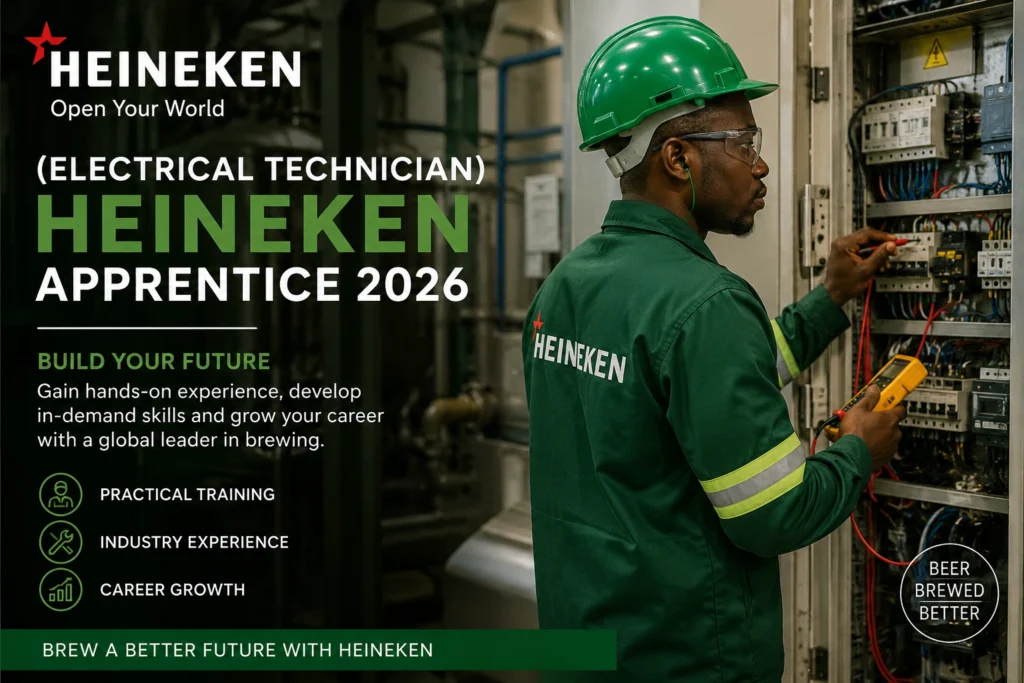

Manufacturing and engineering vacancies rarely dominate conversations among South African job seekers, yet the (Electrical Technician) HEINEKEN Apprentice 2026 opportunity in Springs has quickly become one of the most talked-about technical vacancies of the month.
That isn’t simply because it comes from one of the world’s best-known brewing companies. The excitement reflects something much bigger happening across South Africa’s industrial sector. Skilled artisans, electricians, automation specialists, and maintenance professionals are becoming increasingly valuable as manufacturers continue investing in smarter production lines, digital systems, and operational efficiency.
With applications closing on 24 July 2026, the vacancy has generated significant interest among qualified electricians looking for stable employment within a global manufacturing company.
For many applicants, this isn’t just another job advertisement—it represents an opportunity to build a long-term career inside a modern production environment where technical skills remain in high demand.
Why This Vacancy Is Receiving So Much Attention
South Africa’s employment market remains competitive, especially for permanent positions that combine technical work with career development opportunities.
While entry-level programmes often attract thousands of graduates, experienced artisan positions tend to generate attention for different reasons.
This Electrical Technician role offers something many skilled tradespeople actively seek:
- Permanent employment
- Exposure to advanced manufacturing technology
- Opportunities to work with industrial automation
- Experience within an internationally recognised company
- Continued technical development
These factors make the vacancy attractive not only to unemployed artisans but also to technicians already working elsewhere who are looking for stronger career progression.
The growing interest also reflects a broader trend across manufacturing, where companies increasingly rely on highly skilled technicians to keep automated production facilities operating efficiently.
Understanding the Role Beyond the Job Advertisement
Although the title sounds straightforward, an Electrical Technician in a modern beverage manufacturing plant performs far more than routine electrical repairs.
Today’s production facilities rely on interconnected electrical, electronic and automation systems.
A technician may spend one part of the day diagnosing a motor failure before moving on to troubleshooting programmable logic controllers (PLCs), inspecting control panels, calibrating sensors or assisting production teams during unexpected equipment breakdowns.
The position combines practical electrical work with analytical thinking.
Rather than simply replacing faulty components, technicians are expected to identify the underlying cause of recurring problems and help prevent future failures.
That approach improves production efficiency while reducing costly downtime.
HEINEKEN’s Manufacturing Environment Continues to Evolve
Manufacturing across the beverage industry has changed dramatically over the past decade.
Automation now plays a central role in production.
Modern bottling lines depend on:
- Variable Speed Drives (VSDs)
- Human Machine Interfaces (HMIs)
- Industrial sensors
- PLC-controlled machinery
- Automated filling systems
- High-speed packaging equipment
For technicians, this means the role has become increasingly specialised.
Employers are no longer looking only for electricians who can install wiring.
They also value professionals who understand automation, diagnostics, instrumentation and continuous improvement.
That explains why HEINEKEN specifically highlights experience with electrical automation environments.
Why Springs Remains an Important Manufacturing Hub
Springs has long been recognised as one of Gauteng’s industrial centres.
Its established manufacturing infrastructure continues to attract food, beverage, engineering and production companies.
Working in this environment provides technicians with exposure to large-scale manufacturing operations that often use sophisticated equipment unavailable in smaller facilities.
For artisans interested in expanding their technical expertise, this type of environment can significantly strengthen future career prospects.
Experience gained inside a globally recognised manufacturing company is often highly regarded across the broader industrial sector.
The Skills Employers Are Prioritising
Reading through the advertised requirements reveals an important trend.
Companies increasingly want technicians who combine traditional electrical knowledge with automation capability.
Among the most valuable competencies include:
- Electrical fault diagnosis
- PLC fundamentals
- Industrial instrumentation
- Electrical maintenance
- Motor control
- Control panel maintenance
- Preventative maintenance
- Safety compliance
- Production support
- Problem-solving under pressure
These are practical skills that directly influence production performance.
Rather than working independently, technicians become part of multidisciplinary maintenance teams responsible for keeping production running around the clock.
Why Experience Matters More Than Ever
One detail that stands out is the experience requirement.
Applicants are expected to have 3–5 years of relevant experience within an FMCG electrical or automation environment.
This reflects how modern production facilities operate.
Highly automated machinery leaves little room for inexperienced troubleshooting.
Unexpected downtime can cost manufacturers substantial amounts every hour.
As a result, employers increasingly seek technicians capable of working confidently with minimal supervision while making sound technical decisions under pressure.
Experience with bottling machinery and Siemens S7 systems may not be mandatory, but it certainly strengthens an application.
Safety Is More Than a Compliance Requirement
One aspect that often receives less attention from applicants is workplace safety.
Yet manufacturing employers consistently rank safety among their highest priorities.
Electrical technicians work around live equipment, rotating machinery, compressed air systems and automated production lines.
The advertised emphasis on compliance with the Occupational Health and Safety Act reflects the reality of industrial maintenance.
Employers expect technicians to protect themselves, their colleagues and production equipment by following established procedures every day.
Applicants who demonstrate a genuine commitment to safe working practices often stand out during interviews.
Public Reaction Shows Growing Interest in Skilled Trades
The strong response to this vacancy mirrors wider conversations happening across South Africa.
Many young people are increasingly recognising that artisan careers offer stable employment opportunities.
Unlike some sectors experiencing slower hiring, technical trades continue to experience consistent demand.
Social media discussions around engineering, apprenticeships and artisan development frequently highlight similar themes:
- Permanent employment is highly valued.
- Practical experience matters.
- Automation skills improve employability.
- Trade qualifications remain respected.
- Manufacturing careers continue evolving.
The popularity of this vacancy suggests that skilled technical professions remain attractive career paths despite broader economic uncertainty.
Why This Matters Right Now
South Africa continues encouraging skills development across engineering, manufacturing and technical occupations.
Industries investing in automation require employees capable of maintaining increasingly sophisticated equipment.
This creates opportunities for artisans willing to continuously develop their knowledge.
For experienced electricians, vacancies like this demonstrate that technical qualifications remain relevant in an economy increasingly shaped by technology.
The opportunity also reinforces another important message.
Learning doesn’t stop after earning a Trade Certificate.
Employers increasingly reward professionals who continue expanding their knowledge in PLC programming, industrial automation, diagnostics and digital maintenance systems.
Those additional skills often become deciding factors during recruitment.
APPLY HERE: HEINEKEN Apprentice 2026
ALSO APPLY FOR: Samancor Apprenticeships 2026
What Makes a Competitive Applicant?
Meeting the minimum requirements is only the starting point.
Competitive applicants usually demonstrate evidence of practical achievements.
Examples include:
- Successfully resolving complex electrical faults
- Improving production reliability
- Reducing machine downtime
- Supporting preventative maintenance programmes
- Working effectively during production shutdowns
- Participating in continuous improvement initiatives
Applicants should quantify achievements wherever possible.
Rather than simply stating “performed maintenance,” describe measurable outcomes.
For example:
- Reduced downtime through preventative maintenance.
- Assisted commissioning of new production equipment.
- Diagnosed recurring PLC faults affecting production.
- Improved response times during equipment breakdowns.
Concrete examples make technical experience easier for recruiters to evaluate.
Common Mistakes Applicants Should Avoid
Interest in well-known employers naturally creates competition.
Unfortunately, many otherwise qualified candidates weaken their applications through avoidable mistakes.
Some of the most common include:
Submitting a generic CV
A CV should clearly emphasise electrical maintenance, automation experience and manufacturing exposure.
Ignoring technical achievements
Recruiters want evidence of practical impact, not simply job titles.
Leaving out specialised training
Courses involving PLCs, VSDs, instrumentation or industrial safety deserve prominent placement.
Applying too late
Waiting until the closing date increases the risk of technical submission problems or incomplete applications.
Failing to prepare for interviews
Technical interviews often include practical troubleshooting scenarios rather than general questions.
Preparation makes a noticeable difference.
Practical Application Strategy
Candidates considering this opportunity should prepare carefully.
Before applying:
- Update your CV.
- Highlight Trade Certificate details.
- Include relevant N2 or N3 qualifications.
- Describe automation experience clearly.
- Mention bottling or FMCG exposure where applicable.
- Organise certified supporting documents.
- Review your electrical troubleshooting experience.
- Refresh knowledge of safety procedures.
- Research HEINEKEN’s manufacturing operations.
- Submit well before the deadline.
These simple steps can improve professionalism without exaggerating qualifications.
Could Automation Change Roles Like This?
One interesting discussion within manufacturing concerns automation itself.
Some people worry that automation reduces employment.
In reality, many companies report the opposite for technical positions.
As machinery becomes more advanced, organisations require technicians capable of maintaining increasingly complex systems.
Rather than replacing electricians, automation often changes the nature of their work.
Routine manual tasks become less common.
Analytical problem-solving, diagnostics and system optimisation become more important.
That shift makes continuous learning increasingly valuable throughout an artisan’s career.
What Could Happen Next
Vacancies like this may signal broader recruitment trends within manufacturing.
As companies modernise production facilities, demand for technicians with automation expertise is likely to remain strong.
Future opportunities may increasingly favour candidates familiar with:
- Industrial networking
- Digital maintenance systems
- Predictive maintenance technologies
- Data-driven fault analysis
- Advanced PLC systems
- Robotics integration
For today’s electricians, investing in these skills could improve long-term employability.
At the same time, companies may continue strengthening internal training programmes to help experienced artisans adapt to evolving manufacturing technology.
Final Thoughts
The (Electrical Technician) HEINEKEN Apprentice2026 opportunity represents more than another manufacturing vacancy.
It reflects broader changes taking place across South Africa’s industrial landscape.
Manufacturers increasingly depend on technicians who combine traditional electrical expertise with automation knowledge, structured problem-solving and strong safety awareness.
For qualified electricians who meet the advertised requirements, the position offers the chance to work in a demanding but rewarding production environment where technical skills have a direct impact on operational success.
Competition is likely to remain strong, making preparation essential.
Applicants who present clear evidence of relevant experience, highlight automation capabilities and demonstrate a commitment to continuous improvement will place themselves in a stronger position.
Whether or not this specific opportunity leads to an appointment, one message is becoming increasingly clear: skilled electrical technicians continue to play a vital role in the future of South African manufacturing. As production technology advances, professionals willing to keep learning and adapting are likely to remain among the sector’s most valuable assets.
Those interested should ensure that all supporting documents are ready, tailor their CV to the role, and submit their application before 24 July 2026. In a competitive employment market, careful preparation often makes the difference between being shortlisted and being overlooked.