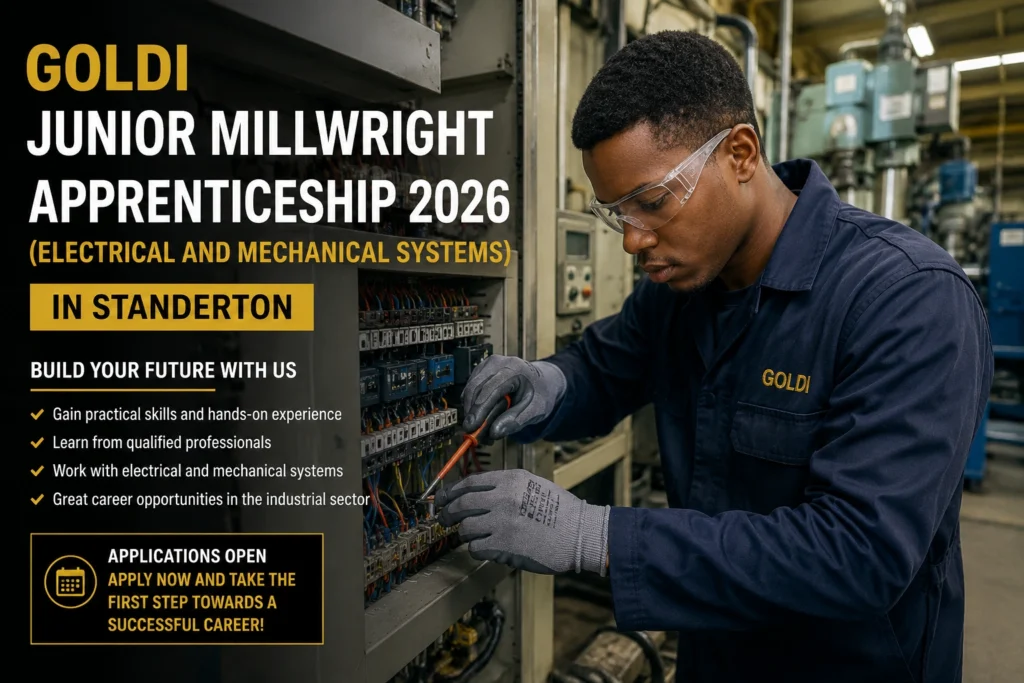

The Goldi Junior Millwright Apprenticeship 2026 is quickly becoming one of the most talked-about artisan development opportunities among South African job seekers, and the reasons are easy to understand.
At a time when many technically skilled individuals are struggling to secure meaningful workplace experience, structured apprenticeship programmes remain one of the most reliable routes into long-term employment. Opportunities that combine formal technical training with practical exposure are increasingly sought after, especially within industries that continue to invest in manufacturing, food production, and engineering infrastructure.
That is precisely why the latest apprenticeship opportunity at Goldi’s Standerton operation is attracting attention.
For aspiring millwrights, the programme offers more than just workplace training. It provides an opportunity to work within a large-scale production environment where electrical systems, mechanical equipment, automation, preventative maintenance, and fault-finding skills are used every day to keep operations running efficiently.
With no specified closing date and applications currently open, many candidates are viewing this apprenticeship as a chance to build a sustainable engineering career in a sector that remains vital to South Africa’s economy.
How Apprenticeships Became More Important Than Ever
Over the past decade, South Africa has experienced growing demand for skilled artisans across multiple industries.
While university qualifications remain valuable, employers continue to report shortages of qualified technicians, electricians, fitters, millwrights, and maintenance specialists. Manufacturing facilities, food processing plants, mining operations, logistics centres, and agricultural businesses all depend heavily on skilled tradespeople.
At the same time, employers increasingly prefer candidates who possess both theoretical knowledge and practical workplace experience.
This shift has elevated the importance of apprenticeship programmes.
Unlike purely academic pathways, apprenticeships place candidates directly into operational environments where they learn industry standards, workplace safety requirements, equipment maintenance procedures, and troubleshooting techniques while earning a stipend.
For many young professionals, apprenticeships serve as the bridge between qualification and career.
The Goldi Junior Millwright Apprenticeship 2026 reflects this broader trend.
Understanding the Opportunity at Goldi
Goldi has established itself as one of South Africa’s leading poultry producers and operates under the umbrella of Astral Foods.
The company’s Standerton facility plays a significant role in poultry processing and production. Running such an operation requires sophisticated machinery, refrigeration systems, conveyor networks, electrical installations, motors, pumps, and automated equipment.
Keeping these systems functioning efficiently demands highly skilled maintenance teams.
This is where millwrights become essential.
The apprenticeship programme is designed to help candidates gain exposure to both mechanical and electrical disciplines while developing the practical skills needed to maintain and repair critical production equipment.
Rather than being limited to classroom learning, apprentices become active participants in real industrial environments where equipment reliability directly affects productivity.
What Makes Millwrights So Valuable?
One reason this opportunity is generating interest is because millwrights occupy a unique position within modern industry.
Unlike some trades that focus on a single discipline, millwrights often work across multiple technical fields.
They may be required to:
- Diagnose electrical faults
- Repair mechanical systems
- Install production equipment
- Conduct preventative maintenance
- Read technical diagrams
- Troubleshoot automation systems
- Perform equipment inspections
- Assist with machinery upgrades
As manufacturing and processing facilities become increasingly automated, employers value technicians who understand both electrical and mechanical systems.
That versatility often translates into stronger long-term career prospects.
For candidates entering the Goldi Junior Millwright Apprenticeship 2026, exposure to these diverse responsibilities can become a significant professional advantage.
Inside the Apprenticeship Experience
One of the most appealing aspects of the programme is its structured learning approach.
The apprenticeship combines workplace training with technical theory blocks delivered through accredited training providers.
This model allows apprentices to immediately apply what they learn in practical situations.
Typical responsibilities may include:
Preventative Maintenance
Preventative maintenance is one of the foundations of modern industrial operations.
Rather than waiting for equipment to fail, maintenance teams conduct scheduled inspections and servicing to prevent breakdowns before they occur.
Apprentices gain valuable experience learning how maintenance schedules are planned and executed.
Breakdown Response
Production downtime can be extremely costly.
When equipment stops unexpectedly, maintenance teams must quickly identify the cause and restore functionality.
This environment provides apprentices with real-world fault-finding experience that is difficult to replicate in a classroom.
Equipment Installation
Industrial facilities constantly evolve.
New machinery is introduced, systems are upgraded, and production processes are improved.
Participation in installation projects exposes apprentices to engineering principles, planning processes, and commissioning procedures.
Root Cause Analysis
Modern maintenance goes beyond fixing problems.
Employers increasingly expect technicians to understand why failures occurred in the first place.
Learning root cause analysis helps apprentices develop analytical thinking skills that remain valuable throughout their careers.
Why Employers Value Candidates with Food Processing Experience
Although experience in food processing is listed as advantageous rather than essential, it remains highly respected within the engineering sector.
Food manufacturing facilities typically operate under strict requirements relating to:
- Hygiene
- Safety
- Quality assurance
- Equipment reliability
- Production efficiency
Working in these environments teaches artisans how to maintain machinery while meeting demanding operational standards.
Many employers view experience gained in food processing plants as transferable to other industries, including pharmaceuticals, packaging, beverage manufacturing, logistics, and industrial production.
As a result, candidates who complete apprenticeships in food production environments often discover broader career opportunities later on.
Public Reaction: Why Job Seekers Are Taking Notice
Across South Africa’s employment landscape, artisan opportunities consistently generate significant interest.
Many job seekers view apprenticeships as offering something that traditional entry-level vacancies often do not: a clear development pathway.
Online discussions around apprenticeship programmes frequently highlight several themes:
- Practical skills are highly marketable.
- Artisan qualifications remain in demand.
- Technical careers often offer stable employment prospects.
- Industry exposure creates networking opportunities.
- Apprenticeships provide structured progression.
The Goldi Junior Millwright Apprenticeship 2026 aligns with all of these factors.
Because the programme combines training, mentorship, workplace exposure, and recognised technical development, it appeals not only to recent qualifiers but also to individuals seeking stronger career foundations.

Why This Matters Right Now
South Africa’s economic environment continues to place significant emphasis on skills development.
Employers, industry bodies, and government stakeholders have repeatedly highlighted the importance of strengthening artisan pipelines to support industrial growth.
At the same time, automation is transforming workplaces.
Modern production facilities increasingly depend on technicians who can understand integrated systems rather than isolated machines.
This creates growing demand for trades such as:
- Millwrights
- Electricians
- Instrumentation technicians
- Mechanical fitters
- Refrigeration specialists
The Goldi Junior Millwright Apprenticeship 2026 arrives at a moment when these skills are becoming increasingly valuable.
For candidates who already possess a Millwright trade certificate and N2 qualification, opportunities like this can provide the practical exposure needed to unlock future advancement.
The timing makes the programme particularly relevant.
APPLY HERE: Goldi Junior Millwright Apprenticeship 2026
ALSO APPLY FOR: Volvo Trucks Diesel Technician Apprentice 2026
What Applicants Should Focus on Before Applying
Competition for quality apprenticeship opportunities can be strong.
Candidates hoping to stand out should pay careful attention to how they present their qualifications and experience.
A strong application should highlight:
Technical Competence
Clearly outline:
- Trade qualifications
- N2 subjects completed
- Practical training experience
- Workshop exposure
- Equipment knowledge
Safety Awareness
Safety remains a top priority in industrial environments.
Employers often look for candidates who demonstrate an understanding of workplace safety principles and compliance standards.
Reliability
Because production facilities operate on strict schedules, dependability matters.
Attendance records, punctuality, and willingness to work shifts can all strengthen an application.
Problem-Solving Ability
Maintenance roles revolve around diagnosing and resolving technical challenges.
Applicants should highlight examples of troubleshooting, repairs, or practical engineering projects whenever possible.
The Long-Term Career Potential
Many candidates view apprenticeships as short-term training opportunities.
In reality, they often represent the beginning of much larger career journeys.
A qualified millwright can potentially progress into positions such as:
- Senior Millwright
- Maintenance Technician
- Maintenance Planner
- Reliability Technician
- Engineering Foreman
- Maintenance Supervisor
- Production Engineering Specialist
- Plant Maintenance Manager
Some professionals later move into consulting, project management, training, or operations leadership roles.
The technical foundation established during apprenticeship years frequently influences career growth for decades.
What Could Happen Next?
Several possible outcomes could emerge from opportunities like the Goldi Junior Millwright Apprenticeship 2026.
First, successful candidates may gain access to long-term employment opportunities within large industrial organisations.
Second, increased demand for artisan skills could encourage more companies to expand apprenticeship programmes in response to ongoing skills shortages.
Third, the continued adoption of automation technologies may increase the value of multi-skilled technicians who can work across electrical and mechanical systems.
For apprentices entering the industry today, this means their skill sets could become even more relevant in the years ahead.
Employers are increasingly seeking adaptable technicians capable of operating within sophisticated production environments.
Those who develop strong maintenance, troubleshooting, and systems-thinking capabilities may find themselves well positioned for future advancement.
A Career Opportunity Worth Serious Consideration
The Goldi Junior Millwright Apprenticeship 2026 represents more than a training programme.
It reflects broader trends shaping South Africa’s engineering and manufacturing sectors: the growing importance of technical skills, the need for practical workplace experience, and the increasing value of adaptable artisans who can thrive in modern industrial environments.
For qualified candidates with a Millwright trade certificate, N2 qualification, computer literacy, and a willingness to work in a demanding production environment, the opportunity offers a chance to gain meaningful industry exposure while building a strong professional foundation.
With no official closing date currently specified, interested applicants may benefit from acting sooner rather than later.
In a competitive employment market, opportunities that combine structured learning, hands-on technical experience, and exposure to a major industrial operation do not remain available indefinitely.
For aspiring millwrights looking to power their future, this apprenticeship could be the next important step in that journey.