

Imagine finishing an electrical qualification, sending out CV after CV and still being told that you need workplace experience before an employer will consider you.
That is the frustrating position many young South Africans find themselves in. They may have the classroom knowledge, but getting the first opportunity to turn that knowledge into practical trade experience can be difficult.
The Ekurhuleni West TVET College (EWC) Apprentice 2026 opportunity could provide a different route.
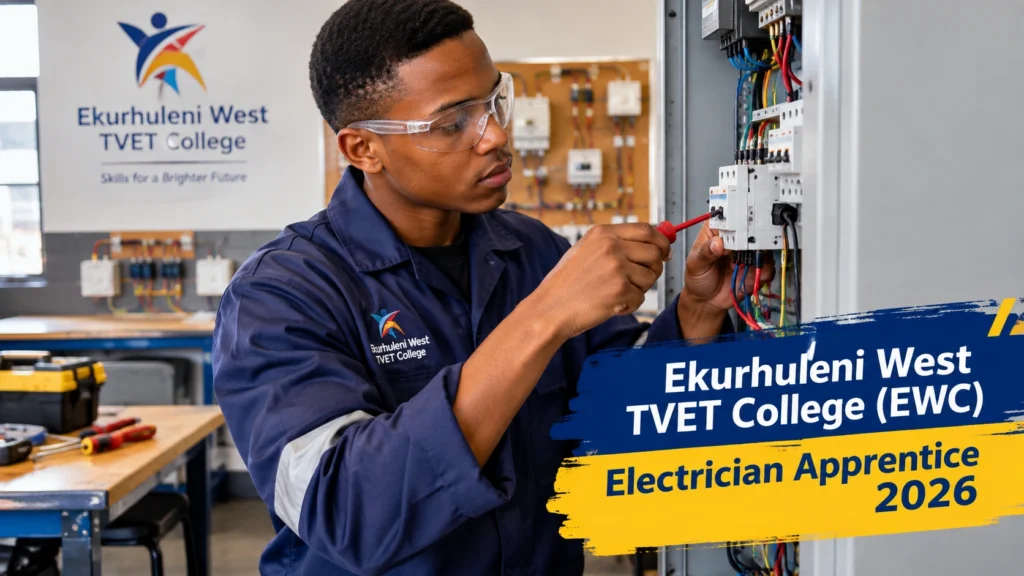
Ekurhuleni West TVET College is recruiting candidates for a three-year Electrician Apprenticeship at its Tembisa Campus. The programme is linked to Red Seal certification, and successful apprentices will receive a stipend during the training period.
Applications close at 12:00 on 18 September 2026, while training is scheduled to start on 1 October 2026.
There is an important detail applicants should not overlook: this is not an online application. Applications must be hand-delivered or sent by courier.
For someone who already has the required electrical background, this could be an opportunity to move from technical education into structured practical training.
Why the EWC apprenticeship is more than a paid opportunity
The word “stipend” will probably be the first thing many job seekers notice.
However, the more important feature of this opportunity is the three-year training pathway.
The college has confirmed that apprentices will receive a stipend, but the monthly amount has not been disclosed in the recruitment information provided. Applicants should therefore avoid budgeting around figures appearing on Facebook, WhatsApp or other unofficial platforms.
The real value lies in gaining practical trade experience while progressing towards a recognised occupational pathway.
Electrical work is one of those careers where theoretical knowledge and practical ability need to work together. Knowing electrical principles is useful, but an aspiring artisan must also learn how those principles apply in actual working environments.
Over three years, an apprenticeship can help bridge that gap.
For an eligible applicant, the potential progression looks something like this:
Electrical education → apprenticeship training → practical workplace experience → trade assessment → Red Seal pathway → stronger employment prospects
This does not mean every apprentice is guaranteed a job or automatic certification. There are requirements and assessments involved in becoming a qualified artisan.
But the apprenticeship can put a serious candidate on a much more practical career path.
What makes this relevant in Gauteng?
Ekurhuleni is closely associated with manufacturing, industrial activity, engineering, logistics, infrastructure and technical services. These sectors require people who can work with electrical systems, equipment and maintenance environments.
That makes trade training particularly relevant for young people who would prefer a technical career rather than following a purely academic route.
It also highlights why applicants should not view an apprenticeship simply as “another learnership”. A three-year electrician apprenticeship is a significant commitment and can become the foundation of a long-term trade career.
(EWC) Apprentice 2026: Who should apply?
The advertised requirements are aimed at candidates who already have an appropriate academic and electrical foundation.
The listed requirements include:
- A National Senior Certificate (NSC) with Mathematics and Science.
- NC(V) Level 4 Electrical.
- N3 Electrical.
Applicants should carefully compare their own qualifications with the official recruitment advertisement.
Having studied one electrical-related subject does not automatically mean that an applicant meets a specific requirement such as NC(V) Level 4 Electrical or N3 Electrical.
This is particularly important for applicants with qualifications from different institutions or training systems.
A useful eligibility test
Before spending money on printing, transport or courier delivery, ask yourself:
Do my certificates clearly demonstrate the electrical qualification requested in the advertisement?
If the answer is yes, proceed with the application preparation.
If your qualification is different, do not simply assume that it will be accepted. Where clarification is necessary, use the official EWC contact details in the recruitment notice rather than relying on social-media comments.
What can an apprentice gain?
The strongest reason to consider the programme is the opportunity to build practical competence.
Depending on the training structure and duties assigned, an electrical apprentice can expect exposure to the practical side of the trade alongside the required theoretical learning.
Potential areas of development include:
- Electrical installation and maintenance principles.
- Understanding electrical equipment and systems.
- Fault-finding and technical problem-solving.
- Safe working practices.
- Reading and understanding technical information.
- Working under supervision in a professional environment.
- Developing workplace discipline and responsibility.
The experience can also teach something that a classroom cannot fully replicate: how to work safely and methodically when real equipment, deadlines and workplace procedures are involved.
Expert insight: think beyond the stipend
The best way to measure an apprenticeship is not by how much money it pays each month, but by what the apprentice can competently do by the end of it.
For a young person entering the labour market, practical experience can be a major differentiator.
An applicant who can demonstrate relevant technical training and workplace exposure may have a stronger foundation when applying for future artisan, maintenance, electrical or industrial positions.
That is why candidates should enter the programme with a learning mindset rather than treating it as temporary paid work.
How to apply for the EWC Electrician Apprenticeship 2026
Step 1: Check the requirements first
Before preparing the final application, confirm that you have the required academic and electrical qualifications.
Check specifically for:
- NSC with Mathematics and Science.
- NC(V) Level 4 Electrical.
- N3 Electrical.
CHECK HERE: (EWC) Apprentice 2026
If your qualification does not clearly match the advertised requirements, verify the situation before submitting.
Step 2: Prepare your application documents
Prepare clear copies of the documents requested in the official advertisement.
As a practical preparation checklist, candidates should have their relevant qualifications and academic records ready, together with identification and any other documents specifically requested by EWC.
Make sure names and details are consistent across documents.
Do not submit altered certificates, misleading information or documents that cannot be verified.
Step 3: Identify the correct apprenticeship
Clearly use the reference:
EWC/TEM/02/COS ELECTRICIAN
This is important because colleges and large organisations may recruit for several programmes at the same time.
Step 4: Check the delivery address
This is a critical step.
Because applications must be hand-delivered or sent by courier, applicants should obtain the exact submission address from the official EWC recruitment advertisement before sending their documents.
Do not rely on an address copied from an unrelated social-media post.
Step 5: Choose hand delivery or courier
You have two stated submission options:
Option 1: Hand-deliver the application.
Option 2: Send the application by courier.
If using a courier, allow sufficient delivery time. Do not wait until the morning of the closing date.
Step 6: Use the deadline correctly
The closing deadline is:
18 September 2026 at 12:00.
The word “12:00” matters.
Applicants should aim to have their application delivered well before the deadline rather than treating midday on 18 September as their personal dispatch time.
Training is scheduled to start on 1 October 2026.
ALSO APPLY FOR: ALPLA Apprentice 2026
EWC apprenticeship at a glance
| Detail | Information |
|---|---|
| Institution | Ekurhuleni West TVET College |
| Opportunity | Electrician Apprenticeship |
| Campus | Tembisa Campus |
| Duration | 3 years |
| Stipend | Paid; amount not disclosed |
| Certification pathway | Linked to Red Seal |
| Reference | EWC/TEM/02/COS ELECTRICIAN |
| Key academic requirement | NSC with Mathematics and Science |
| Electrical background | NC(V) Level 4 Electrical / N3 Electrical |
| Closing date | 18 September 2026 |
| Closing time | 12:00 |
| Application method | Hand delivery or courier |
| Expected start | 1 October 2026 |
Don’t make these application mistakes
A strong application can still fail if the applicant ignores basic instructions.
First, don’t apply through an unofficial channel. If the advertisement requires physical delivery or courier, an email application may not be accepted.
Second, don’t invent a stipend amount. The advertised information confirms payment but does not state the monthly figure.
Third, don’t ignore the qualification wording. Technical recruitment often has specific educational requirements for a reason.
Fourth, don’t leave courier delivery until the last minute. A deadline of 12:00 means applicants need to plan around delivery time.
Finally, watch for scams. Never pay someone who claims they can secure an EWC apprenticeship for you. Be cautious of requests for “registration fees”, “placement fees” or payments to personal bank accounts.
Always verify recruitment information through the institution’s official channels.
Frequently asked questions
Is the EWC Electrician Apprenticeship paid?
Yes. The recruitment information states that apprentices will receive a stipend. However, the amount has not been disclosed, so applicants should not rely on unofficial figures.
How long does the apprenticeship last?
The programme is scheduled to run for three years, making it a substantial technical training commitment rather than a short-term work opportunity.
Does completing the apprenticeship guarantee a Red Seal?
No automatic guarantee should be assumed. The programme is linked to a Red Seal certification pathway, but candidates must still satisfy the applicable training, assessment and certification requirements.
The bigger picture for aspiring electricians
South Africa’s employment market can make it tempting to apply for anything that promises a stipend. But an opportunity like this deserves a different way of thinking.
The objective is not simply to survive three years of training.
It is to emerge with practical technical competence that can be used in a real career.
For an eligible candidate with an electrical background, the EWC apprenticeship could provide an important bridge between studying electrical subjects and becoming capable of working in the trade environment.
That is why the Ekurhuleni West TVET College (EWC) Apprentice 2026 opportunity should be approached strategically.
Check your qualifications. Prepare accurate documents. Confirm the submission address. Use the correct reference. Follow the physical application instructions. And submit early enough to avoid a deadline problem.
The stipend may help while you train, but the longer-term prize is the skills, experience and trade progression that can come from completing the programme successfully.
For young people in Gauteng who want a hands-on technical career, that may be the part of this opportunity that matters most.