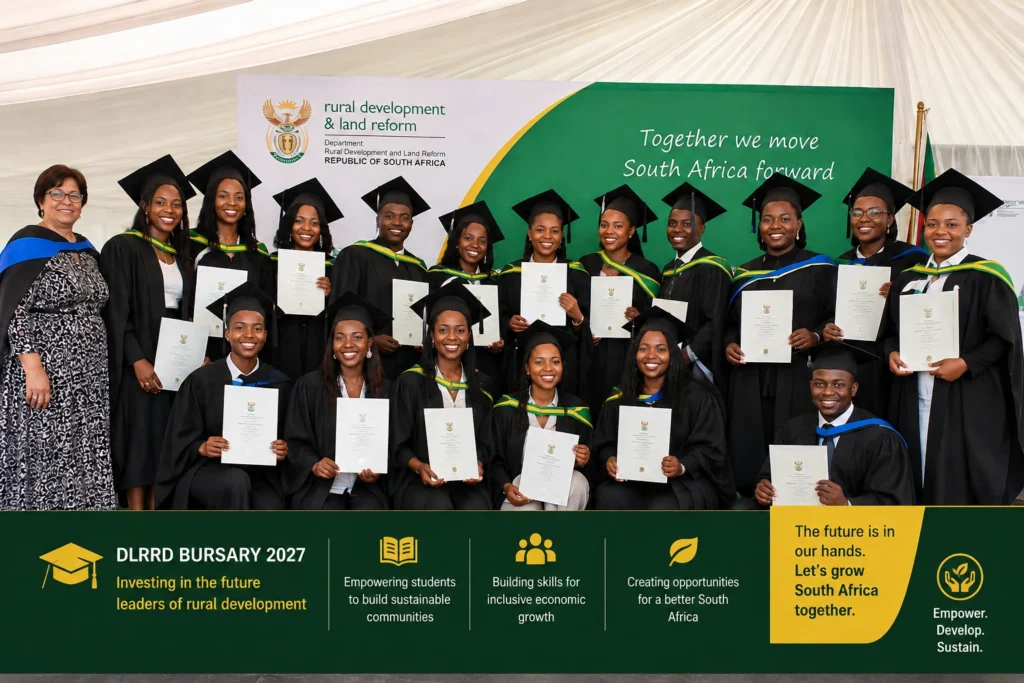

Higher education can be expensive, especially for students from rural communities and previously disadvantaged backgrounds. Tuition fees, accommodation, textbooks, and daily living expenses often make it difficult for talented students to pursue careers that could transform their lives and contribute to South Africa’s development.
The Department of Land Reform and Rural Development (DLRRD) Bursary 2027 aims to remove these financial barriers by supporting eligible South African students who wish to study fields related to land reform, surveying, planning, and geomatics. The bursary covers several major study expenses, allowing students to focus on their education rather than worrying about finances.
If you’re planning to study one of the qualifying programmes in 2027, understanding the eligibility requirements, application process, and important deadlines can significantly improve your chances of submitting a successful application.
What You Should Know First
The Department of Land Reform and Rural Development (DLRRD) Bursary 2027 is a government-funded financial assistance programme for South African students who want to pursue undergraduate or postgraduate studies in selected fields connected to land management, spatial planning, surveying, and geographic information systems.
Here are the key facts at a glance:
- Applications close on 30 September 2026
- Available to South African citizens
- Prioritises students from previously disadvantaged backgrounds and rural communities
- Covers undergraduate and postgraduate qualifications
- Funds tuition, accommodation, books, meals, and a living allowance
- Students must study at accredited South African universities
This bursary is particularly valuable because it supports careers that contribute directly to sustainable land development, infrastructure planning, and rural economic growth.
Understanding the Purpose of the DLRRD Bursary
The Department of Land Reform and Rural Development plays an important role in managing land resources, improving rural livelihoods, supporting spatial development, and strengthening property administration across South Africa.
To achieve these goals, the country needs qualified professionals in areas such as:
- Geomatics
- Geographic Information Science (GIS)
- Land Surveying
- Town Planning
- Urban and Regional Planning
The bursary helps develop these critical skills while creating opportunities for students who may not otherwise be able to afford university education.
Rather than simply funding degrees, the programme invests in future professionals who can help improve communities throughout South Africa.
Fields of Study Covered
The bursary supports both undergraduate and postgraduate qualifications.
Undergraduate Programmes
Students may apply for qualifications such as:
- Geo-informatics
- Geographic Information Science (GIS)
- Geomatics
- Surveying
- Land Surveying
- Town Planning
- Urban Planning
- Regional Planning
Depending on the institution, supported qualifications may include:
- Bachelor of Science (BSc)
- Bachelor’s Degree
- Diploma
These programmes combine classroom learning with practical skills used in mapping, land administration, infrastructure development, and urban planning.
Postgraduate Opportunities
Students who already hold relevant qualifications may also apply for postgraduate funding.
Supported qualifications include:
- Advanced Diploma
- Postgraduate Diploma
- Honours Degree
- Master’s Degree
- PhD
Postgraduate funding focuses mainly on:
- Geomatics
- Planning
- Related specialist fields
This creates opportunities for students who want to specialise further or pursue research careers.
What Expenses Does the Bursary Cover?
One of the biggest advantages of the Department of Land Reform and Rural Development (DLRRD) Bursary 2027 is its comprehensive financial support.
Successful applicants may receive funding for:
Tuition Fees
The bursary covers university tuition costs, reducing one of the largest financial burdens for students.
Accommodation
Students living away from home can receive support for approved accommodation.
Books and Learning Materials
Textbooks, study guides, and other required learning resources are included.
Meals
Financial assistance is provided to help cover daily food expenses during the academic year.
Living Allowance
Students may also receive a living allowance to assist with everyday educational costs.
Together, these benefits allow recipients to concentrate on academic success instead of financial challenges.
Who Can Apply?
Meeting the eligibility requirements is one of the most important parts of the application process.
Applicants must:
- Be South African citizens
- Come from previously disadvantaged backgrounds or rural communities
- Be currently in Matric or have already completed Matric
- Plan to study full-time
- Attend an accredited South African university
- Study one of the approved qualifications
- Not be employees of the Department of Land Reform and Rural Development
Meeting these requirements does not automatically guarantee funding, but failing to meet them may result in disqualification.
Understanding the Academic Requirements
Applicants should also pay attention to the minimum academic standards.
For BSc Programmes
Applicants should achieve at least:
- Level 5 (60–69%) in Mathematics
- Level 5 in Physical Science or Geography
For Bachelor’s Degrees
Applicants need at least:
- Level 4 (50–59%) in Mathematics
- Level 4 in Physical Science
For Diploma Studies
Applicants should also have:
- Level 4 (50–59%) in Mathematics
- Level 4 in Physical Science
For example, a learner applying for a BSc in Geomatics who scores 65% in Mathematics and 63% in Geography would generally satisfy the minimum academic requirement.
Documents You’ll Need
Preparing your documents early can make the application process much smoother.
Applicants should submit certified copies of:
- South African ID
- Parent or guardian ID documents
- Grade 11 results (if currently in Matric)
- Latest Matric results
- Matric certificate (if completed)
- Academic transcripts (for current university students)
- University acceptance or registration letter
- Proof of residential address
Importantly, students waiting for university acceptance letters or final examination results may still submit their applications while those documents are pending.
Always ensure certified documents are recent and clearly readable.

How to Apply for the Department of Land Reform and Rural Development (DLRRD) Bursary 2027
The department allows applicants to choose one application method.
Option 1: Online Application
Applicants may complete the official online bursary application.
APPLY HERE: (DLRRD) Bursary 2027
APPLICATION FORM – (DLRRD) Bursary 2027-PDF
Option 2: Email Application
Applicants may:
- Download the official application form.
- Complete all sections.
- Attach supporting documents.
- Email the application.
- Use “DLRRD Bursary Application 2027” as the email subject line.
Applicants should use only one application method to avoid duplicate submissions.
Submitting applications well before the closing date also reduces the risk of technical problems.
ALSO APPLY FOR: Khobab Wind Farm Bursary 2027
Important Dates You Should Remember
The most important deadline is:
Application Closing Date: 30 September 2026
Late applications are generally not accepted.
Successful candidates are expected to receive feedback within approximately 14 days after the release of Matric results.
Applicants who do not receive communication during that period should consider their application unsuccessful.
Keeping copies of all submitted documents is also recommended.
Why Careers in Geomatics and Planning Matter
Some students may not be familiar with careers in geomatics or spatial planning.
These professions influence many aspects of everyday life.
Examples include:
- Mapping communities
- Planning new housing developments
- Managing land ownership information
- Designing transport systems
- Supporting environmental conservation
- Improving rural infrastructure
- Assisting municipalities with development planning
As South Africa continues investing in infrastructure and land reform, professionals with these skills remain important to both government and private industry.
Common Misunderstandings About Department of Land Reform and Rural Development (DLRRD) Bursary 2027
Many applicants misunderstand certain parts of the bursary programme.
“Only university students can apply.”
Not true.
Current Matric learners who intend to study in 2027 are encouraged to apply.
“The bursary only pays tuition.”
Incorrect.
The bursary also covers accommodation, books, meals, and a living allowance.
“Only undergraduate students qualify.”
False.
Eligible postgraduate students can also receive funding.
“You need your university acceptance letter before applying.”
Not necessarily.
Students waiting for admission decisions may still submit applications while awaiting those documents.
Understanding these points can prevent unnecessary delays or missed opportunities.
Tips for Submitting a Strong Application
Although there is no guaranteed formula for success, these practical tips can improve your application.
- Apply well before the deadline.
- Double-check every section of the application form.
- Ensure all certified copies are clear.
- Verify that supporting documents are included.
- Read the eligibility requirements carefully.
- Use the correct email subject line if applying electronically.
- Keep copies of everything submitted.
Simple mistakes such as missing signatures or incomplete documents can delay processing.
Key Takeaways
The Department of Land Reform and Rural Development (DLRRD) Bursary 2027 offers an excellent opportunity for South African students pursuing careers in geomatics, surveying, GIS, and planning.
The most important points to remember include:
- Applications close on 30 September 2026.
- The bursary supports undergraduate and postgraduate studies.
- It is intended for South African citizens from previously disadvantaged backgrounds and rural communities.
- Funding includes tuition, accommodation, books, meals, and living expenses.
- Applicants should prepare all required supporting documents early.
- Students may still apply while waiting for university acceptance or final results.
Frequently Asked Questions
1. Who qualifies for the Department of Land Reform and Rural Development (DLRRD) Bursary 2027?
South African citizens from previously disadvantaged backgrounds or rural communities who meet the academic requirements and intend studying approved qualifications at accredited South African universities.
2. Which courses are funded?
The bursary mainly supports Geomatics, Geographic Information Science (GIS), Surveying, Land Surveying, Town Planning, Urban Planning, and Regional Planning, along with related postgraduate qualifications.
3. Does the bursary cover accommodation and living expenses?
Yes. Successful applicants may receive funding for tuition, accommodation, books, meals, and a living allowance.
4. Can Matric learners apply before receiving final results?
Yes. Learners currently completing Matric may submit applications while waiting for final examination results and university acceptance.
Final Summary
The Department of Land Reform and Rural Development (DLRRD) Bursary 2027 provides meaningful financial support for students who want to build careers that contribute to South Africa’s future development. By covering major education costs and focusing on high-demand fields such as geomatics, GIS, surveying, and planning, the programme helps create opportunities for talented students from rural and previously disadvantaged communities.
If you meet the eligibility requirements, start preparing your supporting documents early, submit a complete application before 30 September 2026, and carefully follow all application instructions. A well-prepared application could be your first step toward a rewarding career that supports land development, infrastructure planning, and sustainable community growth across South Africa.