
For a young person standing at the beginning of a technical career, the difference between knowing something in theory and being able to apply it in a working industrial environment can be enormous.
You might understand basic mechanical principles from Matric or N2 studies. You might enjoy working with tools, machinery and technical problems. But eventually the question becomes: where do you get the practical experience needed to turn that knowledge into a trade?
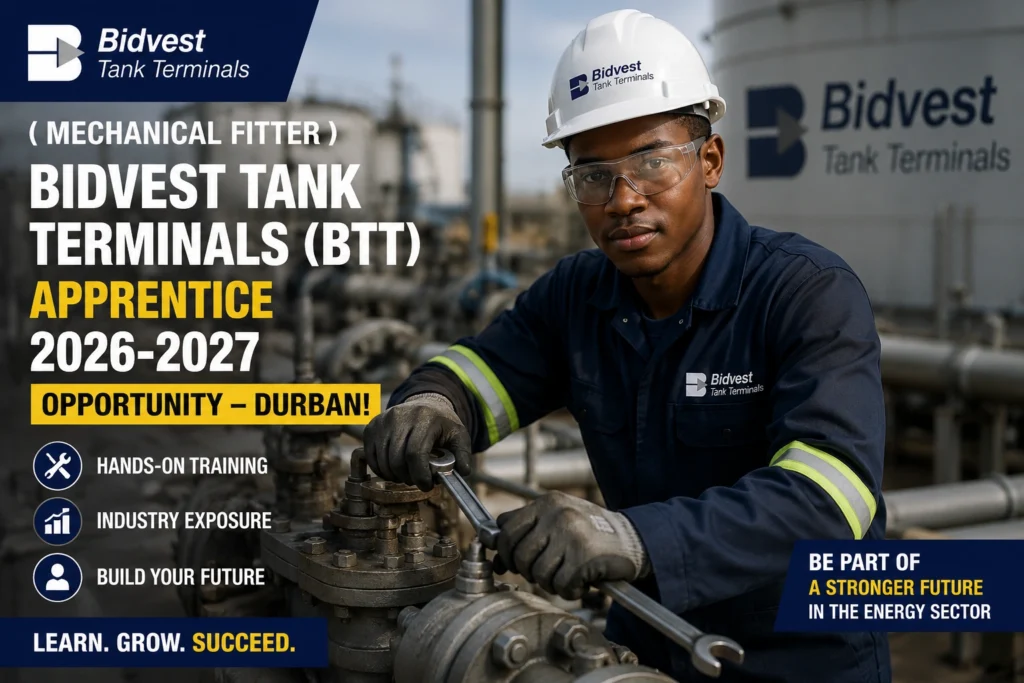
That is where the Bidvest Tank Terminals (BTT) Apprentice 2026-2027 opportunity becomes particularly interesting.
Bidvest Tank Terminals is offering a 36-month Mechanical Fitter Apprenticeship in Durban, KwaZulu-Natal, with two positions available. The opportunity is aimed at technically minded candidates who want to develop their skills in an industrial maintenance environment and work towards a trade-test outcome.
The advertised closing date is 11 September 2026.
For applicants who meet the requirements, this is not simply another entry-level vacancy. It is an opportunity to spend three years developing practical occupational skills in an established industrial business.
Why this apprenticeship deserves serious attention
Bidvest Tank Terminals (BTT), trading as Island View Storage (Pty) Ltd, has operated in the bulk liquid and gas storage industry since 1953. The company forms part of the Bidvest Freight division of the Bidvest Group and operates in a sector where reliability, maintenance and safety are fundamental to daily operations.
BTT handles a wide variety of bulk products, including chemicals, gases, fats and oils, base oils, lubricant additives and petroleum products. The company says it handles more than three billion litres of products annually and serves more than 70 clients.
That background gives the apprenticeship an important advantage: the training takes place in a genuine industrial environment.
A mechanical fitter’s work is closely connected to keeping industrial equipment operating safely and efficiently. Apprentices therefore have the opportunity to learn in an environment where mechanical maintenance is part of a much larger operational system.
This is valuable because employers generally want more than people who understand technical terminology. They need people who can follow procedures, identify problems, work safely, use equipment correctly and communicate with experienced colleagues.
Apprenticeship details at a glance
| Detail | Information |
|---|---|
| Position | Mechanical Fitter Apprentice |
| Employer | Bidvest Tank Terminals (BTT) |
| Location | Durban, KwaZulu-Natal |
| Duration | 36 months |
| Positions | 2 |
| Department | Maintenance |
| Reports to | Foreman |
| Reference | BTT260904-1 |
| Trade outcome | Trade Test at conclusion |
| Closing date | 11 September 2026 |
The limited number of positions means applicants should treat the recruitment process seriously.
What does a Mechanical Fitter Apprentice actually do?
The phrase “Mechanical Fitter” can sound intimidating to someone who has never worked in an industrial maintenance department.
In simple terms, mechanical fitting involves working with machinery and mechanical components to help ensure that equipment is assembled, maintained, repaired and operated correctly.
The precise duties assigned to an apprentice will depend on the employer’s training programme and operational requirements. However, the broader learning journey can involve areas such as mechanical maintenance, component identification, equipment inspection, fitting and assembly, fault-finding, alignment and the correct use of tools and workshop equipment.
The most important point is that an apprentice is there to learn.
You are not expected to arrive as a fully qualified artisan.
Instead, the apprenticeship provides an opportunity to develop competence progressively under workplace supervision and through structured learning.
For example, a candidate may understand from college that mechanical components need to be correctly aligned. Working in an industrial environment provides a chance to understand why that matters in practice: incorrect alignment can contribute to vibration, wear, equipment damage and unnecessary downtime.
That practical connection between theory and consequences is one of the strongest reasons to pursue an apprenticeship.
The qualities BTT applicants should demonstrate
Academic requirements are important, but candidates should not overlook workplace behaviour.
A strong apprentice should be prepared to:
- Follow safety procedures without taking shortcuts.
- Listen carefully to supervisors and qualified artisans.
- Ask questions when instructions are unclear.
- Take care of tools and equipment.
- Arrive reliably and be prepared to learn.
- Accept correction and use feedback to improve.
- Approach mechanical problems logically rather than guessing.
These qualities matter because industrial maintenance is not an environment where carelessness can simply be corrected later.
Who can apply?
The information supplied for the vacancy highlights two educational routes into consideration:
Route 1: Matric
Candidates with Matric should have Mathematics and Physical Science.
Route 2: N2 Mechanical Engineering
Candidates with an N2 Mechanical Engineering qualification may also be considered, subject to the full requirements of the advertised position.
Applicants should read the official vacancy carefully because meeting one educational requirement does not necessarily mean every other selection condition has been satisfied.
It is also important to distinguish between a minimum requirement and a competitive application.
If dozens of technically qualified people apply for two positions, the employer has to choose candidates who demonstrate more than basic eligibility.
This is why your CV and application should make your technical interest easy to understand.
How to apply for the Bidvest Tank Terminals (BTT) Apprentice 2026-2027
One of the biggest mistakes applicants make with apprenticeship opportunities is rushing through the application because they are excited about the vacancy.
Instead, use a simple preparation process.
Step 1: Confirm that you meet the requirements
Before completing the application, compare your qualifications against the advertised requirements.
Check specifically whether you have the required Mathematics and Physical Science subjects if applying with Matric, or whether your N2 Mechanical Engineering qualification meets the stated requirement.
Do not apply based only on the job title.
Step 2: Prepare a focused CV
Your CV should make your technical background immediately visible.
If you have completed mechanical engineering studies, workshop training, technical projects or practical activities, include them.
For example, rather than writing:
“I am hardworking and interested in engineering.”
Give evidence of that interest through your education, practical projects, workshop exposure or technical skills.
Keep the CV easy to read and avoid filling it with irrelevant information.
Step 3: Gather your supporting documents
Prepare the documents requested in the vacancy before you begin the application.
Depending on the employer’s instructions, these may include your CV and qualification or academic documents.
Make sure:
- Your documents are readable.
- Your names are consistent across documents.
- Your contact details are correct.
- Your CV does not contain outdated information.
- You use the correct vacancy reference where requested.
Step 4: Search for the official BTT vacancy
Use the official Bidvest/Bidvest Tank Terminals recruitment channel
APPLY HERE: (BTT) Apprentice 2026-2027
Step 5: Complete the online application carefully
Enter your personal and educational information exactly as requested.
Pay particular attention to your:
- Contact number
- Email address
- Qualification details
- Work or training history
- Vacancy reference
Before pressing submit, review every section.
A simple spelling error in an email address or telephone number can create an unnecessary problem if the recruitment team needs to contact you.
Step 6: Submit before 11 September 2026
The stated closing date is 11 September 2026.
Do not make the deadline your target submission time.
Aim to complete your application well before the closing date so that you have time to deal with technical issues, missing documents or application errors.
ALSO APPLY FOR: DHL Global Apprentice 2026-2027
What can make an apprentice application stronger?
There is a common misconception that apprenticeship applications should be filled with impressive corporate language.
They should not.
For a technical training opportunity, evidence is more useful than exaggerated claims.
If you studied mechanical engineering, explain what you learned.
If you have worked in a workshop, mention it.
If you completed a practical project, describe your contribution.
If you have never worked in an industrial environment, do not pretend that you have. Instead, demonstrate your willingness to learn and connect your academic background to the trade.
A good application effectively answers three questions:
Can this person meet the entry requirements?
Does this person genuinely want to become a mechanical fitter?
Can this person be trusted to learn and work safely in an industrial environment?
That is a much stronger foundation than simply saying you are “passionate” about engineering.
Expert insight: the hidden value of an apprenticeship
The most valuable part of an apprenticeship may not be the first job title you receive after completing it.
It is the development of practical judgement.
A textbook can tell you how a mechanical system is supposed to operate. Workplace exposure teaches you to notice when something does not sound, move, look or behave as expected.
That judgement develops gradually.
An apprentice learns from repetition, supervision, mistakes, corrections and observation. Over time, technical knowledge becomes practical understanding.
This is particularly relevant in South Africa, where skilled artisans play an important role in maintaining industrial infrastructure.
The broader lesson for applicants is simple: do not judge an apprenticeship only by the starting position. Judge it by the skills, discipline and occupational competence you could develop during the training period.
Why Durban makes this a useful opportunity
Durban’s position as a major port, logistics and industrial centre gives the location additional relevance for an aspiring artisan.
KwaZulu-Natal has a significant industrial economy connected to logistics, manufacturing, chemicals, engineering and other technical sectors.
That does not guarantee employment after the apprenticeship. Nor should applicants assume that completing the BTT programme automatically guarantees a permanent position.
However, exposure to a professional maintenance environment can help a developing artisan understand the standards expected in industrial workplaces.
It can also help bridge the gap between formal education and the expectations of employers.
For a young South African deciding between different career paths after Matric, that is an important consideration.
University is not the only route into a technically rewarding career. A structured artisan pathway can offer a different form of professional development, particularly for people who enjoy practical work and problem-solving.
Frequently asked questions
1. How long is the BTT Mechanical Fitter Apprenticeship?
The advertised apprenticeship is structured over 36 months, or three years.
2. Where is the apprenticeship based?
The position is located in Durban, KwaZulu-Natal, within BTT’s maintenance environment.
3. When is the closing date?
Applications are stated to close on 11 September 2026. Candidates should apply early rather than waiting for the final day.
Final thoughts
The Bidvest Tank Terminals (BTT) Apprentice 2026-2027 opportunity is worth considering for candidates who genuinely want to build a career as a mechanical artisan.
Its strongest feature is not simply the employer’s name. It is the combination of a 36-month training period, practical industrial exposure and a trade-test pathway.
For the right candidate, those three elements can provide a meaningful foundation for a technical career.
But applicants should also be realistic. There are only two advertised positions, competition may be significant, and meeting the minimum academic requirement does not guarantee selection.
The best approach is therefore straightforward: verify the requirements, prepare a technically focused CV, gather your documents, apply through the appropriate official recruitment channel and submit before 11 September 2026.
For someone who enjoys understanding how machinery works, solving practical problems and learning from experienced artisans, this could be a worthwhile first step into South Africa’s skilled-trades economy.