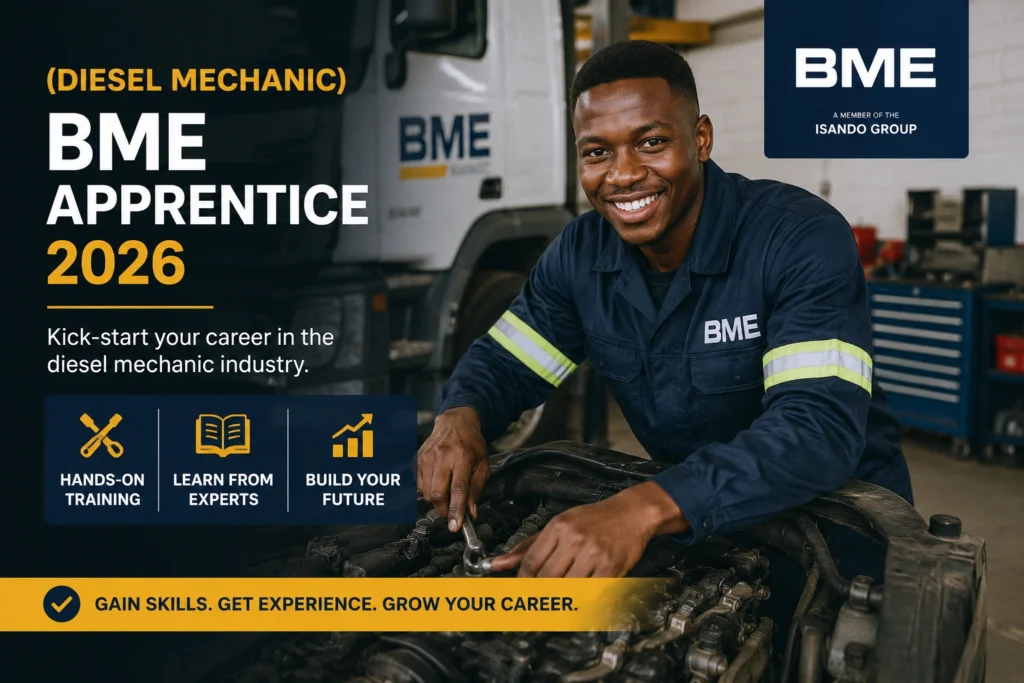

A (Diesel Mechanic) BME Apprentice 2026 opportunity is attracting attention among South African artisans and heavy-equipment specialists, and there is a simple reason why: this is not the kind of vacancy that asks someone to start learning the trade from scratch.
There is another reason this vacancy stands out. BME is part of the Omnia Group and operates in a highly specialised mining environment where equipment reliability is closely connected to safety, productivity and customer service. Omnia describes BME as its mining division and says it provides blasting, mining chemical, technical and technology solutions to the mining, quarrying and construction sectors.
For a qualified Diesel Mechanic, that makes this more than another workshop job.
It is a chance to put an established trade qualification to work in an industry where precision matters.
Why BME makes this vacancy interesting
BME is not a conventional automotive workshop.
Its business operates around mining and blasting solutions, meaning the surrounding operational environment can involve specialised equipment, demanding working conditions and strict safety expectations.
Omnia’s current corporate information describes BME Blasting Solutions as part of its mining segment, with activities covering explosives and initiation systems as well as technology designed to improve mining efficiency and safety.
The company’s broader footprint is another attraction.
Omnia says it operates across multiple international markets and distributes to more than 40 countries. Its careers platform also highlights opportunities across a global business and identifies its core values as Be Safe, Respect and Grow, Achieve Excellence Together, and Do the Right Thing.
For a Diesel Mechanic, those values are not merely corporate language.
Safety, discipline, teamwork and technical accuracy are directly relevant to mechanical maintenance.
What would a Diesel Mechanic actually bring to the operation?
This is where the opportunity becomes more interesting.
A Diesel Mechanic working around mining-related equipment is not simply replacing worn components. The job can involve investigating why equipment has failed, identifying the underlying cause and restoring machinery to a safe operating condition.
That requires a different mindset from simply “fixing what is broken.”
A strong Diesel Mechanic needs to understand engines, fuel systems, cooling systems, transmissions, hydraulics, electrical components and associated mechanical systems. Diagnostic ability is particularly important because modern heavy machinery increasingly combines mechanical systems with electronic controls and monitoring technology.
The best artisans therefore think like investigators.
A machine may refuse to start. A hydraulic system may lose performance. An engine may overheat. An unusual noise may appear under load.
The obvious fault is not always the real fault.
That is why diagnostic precision can be one of an artisan’s most valuable skills.
The mining connection changes the stakes
Mining is an environment where equipment downtime can become expensive very quickly.
A machine that is unavailable can disrupt maintenance schedules, production activities, logistics or other connected processes. At the same time, attempting a rushed repair without properly identifying the problem can introduce further mechanical or safety risks.
BME’s own business model reflects this emphasis on operational performance. Its mining operations combine products, equipment, technical services and digital technologies intended to support safer and more efficient blasting outcomes.
That creates an important expectation for applicants.
You are not simply selling your ability to turn spanners.
You are demonstrating that you can help protect equipment reliability, safety and operational continuity.
Why This Matters Right Now
The timing of this vacancy is significant because skilled technical workers continue to sit at the intersection of South Africa’s industrial and mining economies.
For someone who has invested years into becoming a qualified Diesel Mechanic, the challenge is often no longer acquiring the trade itself. The harder question is finding an employer where that qualification can translate into meaningful experience, stronger technical exposure and long-term career progression.
BME’s current direction makes the company particularly relevant.
Omnia’s recent reporting describes continued investment in the mining segment, international growth and technology-led solutions. It also highlights BME’s role in improving mining yields, blasting and rock-breaking optimisation while reducing environmental impact.
That matters because technological change in mining does not necessarily make mechanical trades less important.
In many cases, it makes them more demanding.
As equipment becomes more sophisticated, artisans need to understand not only physical components but also diagnostics, sensors, electronic controls and increasingly data-driven maintenance environments.
The public reaction: why are applicants paying attention?
There is no need to manufacture a dramatic story around the reported applicant numbers.
It suggests that vacancies connecting a recognised artisan trade with a major mining-related organisation remain highly competitive.
That should change how candidates approach the application.
A generic CV that simply says “Diesel Mechanic” is unlikely to communicate the full value of an experienced artisan. Applicants need to make it easy for recruiters to see the machinery they have worked on, the environments they understand, the diagnostic skills they possess and the type of maintenance work they can perform.
In other words, competition should encourage better applications, not desperation.
What employers are likely to notice
If you are applying for the BME Diesel Mechanic opportunity, your CV should quickly answer several questions.
Are you actually trade tested?
If the vacancy requires a trade certificate, make the qualification easy to find.
What equipment have you worked on?
Do not simply write “heavy machinery.” Where appropriate, identify the categories of machinery, engines, vehicles or equipment you have maintained.
Can you diagnose faults?
Mention fault-finding, testing, troubleshooting and repair experience where it genuinely applies.
Do you understand preventive maintenance?
Mining operations depend heavily on maintenance planning. Show experience with inspections, servicing, component replacement and scheduled maintenance if you have it.
Do you understand safety?
A strong technical candidate who treats safety as an afterthought is not necessarily a strong mining candidate.
A CV mistake that could cost you
One of the most common mistakes technical applicants make is turning their CV into a list of tools.
“Used spanners.”
“Changed oil.”
“Repaired engines.”
Those statements may be technically true, but they do not communicate professional capability very well.
Instead, explain the outcome and responsibility.
For example, rather than simply saying you performed repairs, describe your experience with diagnosing mechanical faults, conducting scheduled maintenance, stripping and assembling components, responding to breakdowns and restoring equipment to operational condition—but only where those duties accurately reflect your background.
The goal is evidence, not exaggeration.
What Could Happen Next
The most immediate possibility is straightforward: recruitment progresses through screening, shortlisting, interviews and technical assessment.
For candidates, that means preparation should begin before anyone calls.
Review your trade qualification. Refresh the fundamentals of diesel engines and mechanical diagnostics. Think through real breakdown situations you have handled and how you identified the fault.
You may also be asked questions that test more than technical knowledge.
How do you respond when equipment fails unexpectedly?
How do you prioritise safety during a breakdown?
How do you communicate a technical problem to a supervisor?
What do you do when the first suspected cause turns out not to be the actual fault?
These questions test judgement as much as mechanical knowledge.
There is also a longer-term possibility worth considering.
Omnia’s careers material explicitly says the organisation invests in education, training and career development, while its early-careers platform highlights technical education through learnerships and apprenticeships.
That does not guarantee promotion or permanent employment from this particular vacancy.
But it does suggest that applicants should view the opportunity within the broader context of technical career development rather than focusing only on getting through the first recruitment stage.
The opportunity is competitive—but that is not a reason to panic
When a vacancy attracts more than 100 applicants, some jobseekers immediately assume they have no chance.
That is the wrong conclusion.
Applicant numbers do not tell you how many people actually meet every requirement.
There may be candidates without the required trade certificate. Others may have weak CVs. Some may lack relevant heavy-equipment exposure. Others may fail to demonstrate their diagnostic abilities.
Your job is not to compete with every person who clicked “apply.”
Your job is to present the strongest truthful case for why you meet the requirements.
That means a focused CV, accurate qualifications, clear work history and evidence of technical competence.
What should applicants prepare?
Before submitting an application, check the following:
- Updated CV with accurate employment history.
- Clear description of relevant mechanical and diagnostic.
- Details of heavy machinery or equipment worked on, where relevant.
- Copies of qualifications if requested.
- Identification and other supporting documents if requested.
- Accurate contact details.
- References where appropriate.
- A professional email address.
- Any additional licences or competencies specifically requested in the vacancy.
APPLY HERE: BME Apprentice 2026
ALSO APPLY FOR: Premier FMCG Apprentice 2026
Most importantly, do not pay anyone who claims they can secure the BME position for you.
BME’s official careers page explicitly warns applicants that the company will never ask for payment to apply for a job, learnership or employment. It also provides an official scam-alert process for suspicious recruitment communications.
That warning is worth taking seriously, particularly when a vacancy begins attracting significant attention.
Final assessment
The (Diesel Mechanic) BME Apprentice 2026 opportunity deserves attention, but not because applicants should view it as a guaranteed career breakthrough.
Its real appeal is more practical.
It connects a specialised artisan skill with a major mining-focused business operating in an industry where machinery reliability, safety and technical performance matter every day.
BME’s position within Omnia adds another layer of interest, particularly as the group continues investing in mining technology, international operations and sustainability-focused solutions.
For a trade-tested Diesel Mechanic, that combination can make the vacancy worth pursuing.
The biggest lesson for applicants is simple: do not let the reported competition push you into submitting a rushed application.
If you have the required trade qualification, relevant mechanical experience and the ability to diagnose and repair equipment safely, give recruiters a clear reason to notice your application.
In a technical career, opportunities are often won long before the interview room.