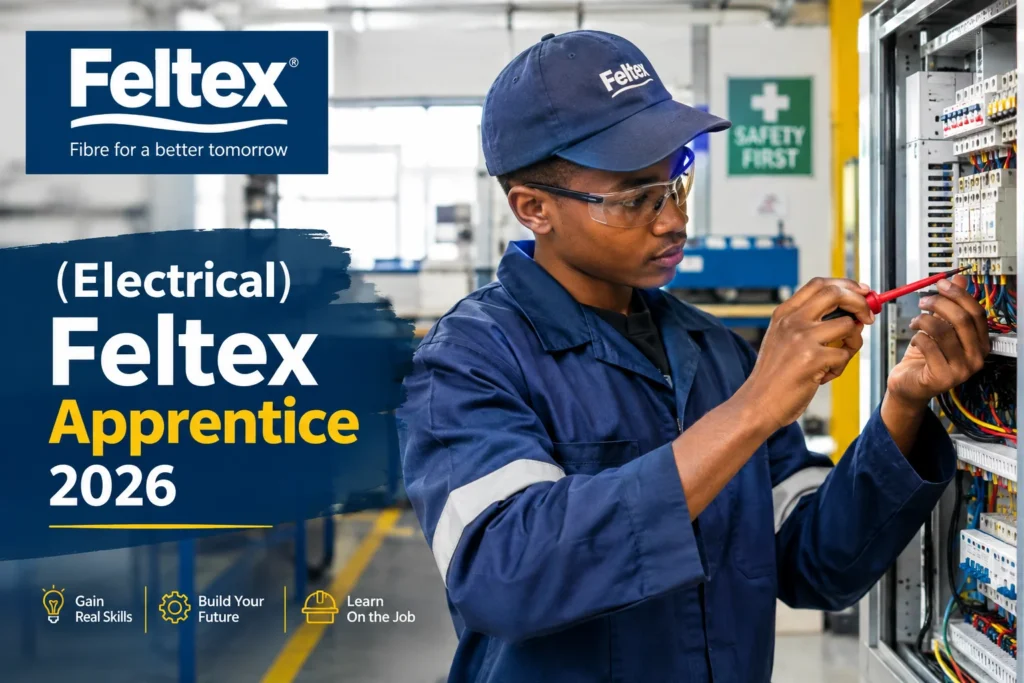

A production line does not wait for a technician to finish thinking.
When an electrical component fails inside a manufacturing plant, the consequences can quickly spread across an entire operation. A motor may stop. A machine may shut down. Sensors may stop communicating. Production staff may be forced to wait while maintenance personnel diagnose the problem.
For a young South African who enjoys working with electrical systems, that environment can become a classroom of its own.
This is what makes the Feltex Apprentice 2026 opportunity worth considering. Feltex Automotive is currently recruiting an Electrical Apprentice for its maintenance team at Connacher in Hammarsdale, KwaZulu-Natal. The current Feltex careers listing shows a closing date of 28 September 2026.
The role is not simply about watching experienced technicians work. The advertisement describes an apprentice who will assist with maintenance work orders involving electrical equipment, including testing malfunctioning equipment, identifying defects, troubleshooting, repairing equipment and replacing defective parts.
For someone trying to turn technical education into practical industrial experience, that distinction matters.
Feltex Apprentice 2026: What you could actually learn
An apprenticeship can be the bridge between knowing electrical theory and understanding how that theory behaves inside a real factory.
The current Feltex advertisement places the apprentice within a maintenance environment. That means the learning experience is connected to equipment that has to operate safely and reliably rather than laboratory exercises designed only for assessment.
A typical maintenance problem might begin with a machine that suddenly stops functioning. The apprentice may learn to approach the problem systematically: understand the symptoms, inspect the relevant equipment, test components, identify the defect and support the repair process under supervision.
That process develops an important professional habit: do not guess when you can diagnose.
The Feltex advertisement specifically mentions:
- Testing malfunctioning electrical equipment
- Identifying defects
- Troubleshooting electrical problems
- Repairing equipment
- Replacing defective components
- Completing maintenance work orders
- Working within a high-performance industrial environment
- Following safety expectations
These are useful skills because industrial employers need technicians who can do more than recognise electrical components. They need people who can investigate problems logically and work safely around production equipment.
Opportunity at a glance
| Detail | Current information |
|---|---|
| Position | Electrical Apprentice |
| Company | Feltex Automotive |
| Business unit | Connacher |
| Location | Hammarsdale, KwaZulu-Natal |
| Department | Maintenance |
| Employment type | Apprenticeship / full-time |
| Main work | Electrical maintenance and fault-finding |
| Application | Online through Feltex’s recruitment portal |
| Closing date | 28 September 2026 |
The current Feltex careers page lists the Electrical Apprentice vacancy under its available positions.
Why this opportunity matters beyond the first job
South Africa’s automotive industry depends on a large network of manufacturers and component suppliers. Feltex has operations positioned close to vehicle manufacturers and has facilities across major automotive manufacturing locations, including East London, Gqeberha, Durban and Gauteng.
That industrial ecosystem creates demand for technical skills.
An electrical apprentice therefore should not think only about the vacancy itself. The bigger question is what happens after the training and experience begin to accumulate.
A person who develops competence in industrial electrical maintenance may eventually have skills relevant to manufacturing plants, engineering environments, production facilities and other industrial operations.
There is another advantage: workplace exposure teaches things that certificates cannot fully demonstrate.
A qualification may show that you completed electrical subjects. Practical experience can demonstrate that you understand workplace discipline, safety procedures, troubleshooting and equipment maintenance.
For young people struggling to get their first technical opportunity because vacancies ask for experience, this can be an important step.
What makes an applicant stand out?
Technical qualifications are important, but apprentices should also demonstrate the behaviours required in a factory.
An applicant can strengthen their profile by showing evidence of:
- Practical technical projects
- Electrical troubleshooting experience
- Workshop exposure
- Reliability and punctuality
- Safety awareness
- Teamwork
- Problem-solving
- Willingness to learn
- Ability to follow technical instructions
Even if you have never worked in a factory, do not automatically assume that your application has nothing to offer.
A college practical, electrical project or workshop assignment can demonstrate how you approach technical problems.
Instead of writing “I have good problem-solving skills”, explain what you actually did.
For example, if you diagnosed a fault during practical training, explain the equipment involved, the problem you identified and how you approached the repair.
Specific evidence is more useful than a list of generic personality traits.
What the current requirements mean for applicants
The current Feltex listing states that applicants can qualify through several educational routes. It specifies a National Senior Certificate with Mathematics and Science, or an N3 qualification including Electrical Trade Theory, Mathematics and Engineering Science, or an NCV 3 or 4 qualification in Electrical.
This is an important point for applicants who often see different versions of apprenticeship requirements online.
Do not rely on an old article if the employer has published a newer vacancy.
Always compare your qualifications with the current employer advertisement.
Candidates should also understand that industrial apprenticeship work can involve conditions that are different from an office environment. The role requires attention to safety, practical work and the ability to function around industrial equipment.
Before applying, ask yourself:
Do I actually want to work with machinery and electrical systems every day?
If the answer is yes, an apprenticeship can provide a much stronger foundation than simply collecting additional certificates without workplace exposure.

How to apply for the Feltex Apprentice 2026 opportunity
The application process is online through the Feltex recruitment system. The company’s careers platform currently lists the Electrical Apprentice vacancy.
Step 1: Open the official Feltex careers portal
Start with the official Feltex recruitment website rather than a WhatsApp link or an unverified third-party application page.
APPLY HERE: Feltex Apprentice 2026
Search the available vacancies for Electrical Apprentice.
Step 2: Check the location and closing date
The current listing identifies the opportunity as Hammarsdale and shows 28 September 2026 as the closing date.
This is particularly important because earlier Feltex apprenticeship advertisements circulated online have referred to different business units and locations.
Do not accidentally apply using information from an old vacancy.
Step 3: Read the requirements before starting
Check whether your qualification matches the current advertisement.
Pay particular attention to the Mathematics, Science and electrical qualification requirements.
If you do not meet a compulsory requirement, do not change information on your CV to make yourself appear eligible.
Step 4: Update your CV
Your CV should make your technical background immediately visible.
Include:
- Full name and contact details
- Matric subjects and results where relevant
- N-level or NCV qualifications
- Electrical subjects
- Technical projects
- Practical training
- Workshop experience
- Computer skills where relevant
- Any previous work experience
Keep the document clean and easy to read.
Step 5: Prepare supporting documents
Have clear electronic copies of the documents requested by the application system.
Depending on the employer’s requirements, these may include:
- South African ID
- Matric certificate
- N-level results
- NCV certificate or results
- Academic records
- Updated CV
- Other supporting documentation requested in the vacancy
Do not upload random documents simply because you have them. Follow the instructions attached to the specific vacancy.
Step 6: Complete the online form carefully
Enter your personal and academic information exactly as it appears on your official documents.
Check your phone number and email address before submitting.
A technically strong applicant can still miss an opportunity because their contact details are incorrect.
Step 7: Save proof of your application
After submitting, save the confirmation page or email if one is provided.
Keep the vacancy reference information and a copy of your CV.
This makes it easier to follow up if Feltex contacts you later.
ALSO APPLY FOR: Nampak Apprentice 2026-2027
Expert insight: treat the apprenticeship as training, not just employment
The most important mindset shift for an aspiring artisan is to stop viewing an apprenticeship purely as a way to get onto a payroll.
The real asset is competence.
An apprentice who learns why a fault occurs, how to test safely and how preventative maintenance reduces equipment failures is building knowledge that can remain valuable long after the first workplace.
This is particularly relevant as manufacturing becomes increasingly dependent on automated equipment and sophisticated production systems.
The future technician will need to combine practical ability with diagnostic thinking.
That is why applicants should focus not only on getting selected, but also on becoming the person who asks good technical questions, follows safety procedures and learns from experienced artisans.
Three mistakes to avoid when applying
1. Using outdated information
Old Feltex apprenticeship advertisements can have different locations, departments, requirements and closing dates. Always check the current vacancy.
2. Sending a generic CV
A CV written for an administrative job will not necessarily communicate your suitability for an electrical apprenticeship. Put your technical education and practical exposure near the top.
3. Waiting until the deadline
The current listing closes on 28 September 2026.
Leaving an application until the final day creates unnecessary risk if you encounter technical problems, missing documents or an incomplete application.
Frequently asked questions
Is the Feltex Apprentice 2026 opportunity in East London?
The current Electrical Apprentice vacancy I found on Feltex’s recruitment platform is listed for Hammarsdale, KwaZulu-Natal, not East London. Feltex does have automotive operations in East London, but applicants should distinguish between the company’s different vacancies and locations.
What qualifications are required?
The current advertisement states National Senior Certificate with Mathematics and Science, or N3 with Electrical Trade Theory, Mathematics and Engineering Science, or NCV 3 or 4 in Electrical.
When does the current vacancy close?
The Feltex careers listing currently shows 28 September 2026 as the closing date.
A practical first step into the artisan economy
For someone standing outside the technical job market, the hardest part can be getting the first opportunity to demonstrate what they can do.
The Feltex Apprentice 2026 vacancy offers a route into an environment where electrical maintenance is connected directly to real production. Instead of learning only from textbooks, an apprentice can develop an understanding of equipment, troubleshooting, maintenance work orders, safety and the discipline of industrial manufacturing.
But applicants should approach the opportunity carefully.
Check the current requirements. Prepare a targeted CV. Gather your documents. Use the official recruitment portal. Review everything before submitting and do not wait until the closing date.
Most importantly, understand what you are applying for.
An apprenticeship is not simply another vacancy to add to a job-search spreadsheet. It is an opportunity to develop a trade, build practical experience and learn how technical work is performed in a demanding industrial environment.
For an aspiring electrician, that practical foundation can become one of the most valuable parts of the early career journey.