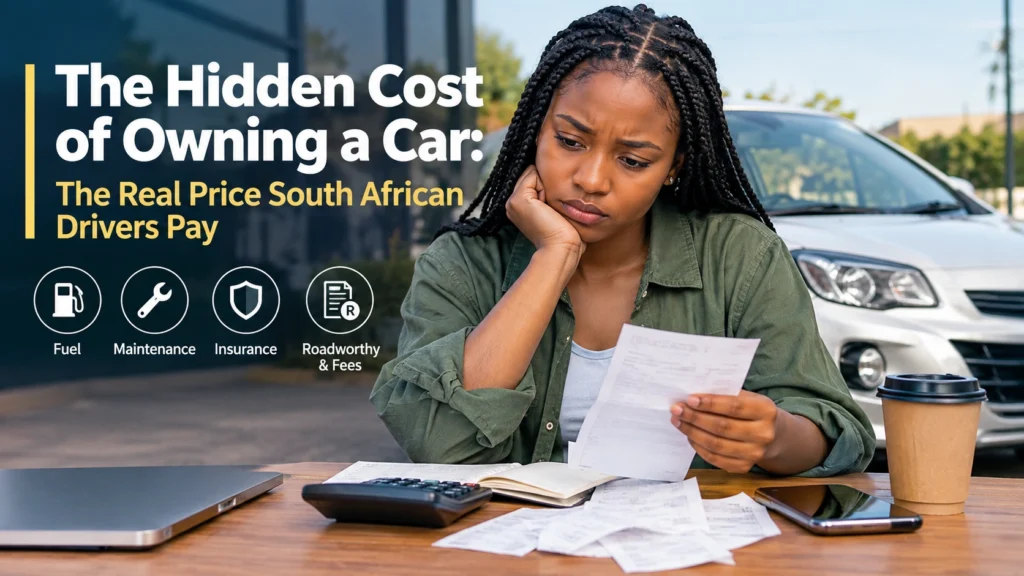

A car can change your life.
It can help you get to work on time, attend job interviews, take your children to school, visit family and accept employment opportunities that would otherwise be difficult to reach. For many South Africans, owning a vehicle is not simply a lifestyle choice — it can be an important part of earning a living.
But there is a financial trap that catches many first-time car owners.
You calculate the vehicle instalment, look at your salary and think, “I can afford this car.”
Then the other bills start arriving.
There is insurance. Fuel. Servicing. Tyres. Brake pads. Licence fees. Parking. Tolls. Unexpected repairs. Finance interest. And, in the background, the vehicle is losing value.
Suddenly, the car that appeared to cost R4,000 or R5,000 a month is consuming considerably more of your income.
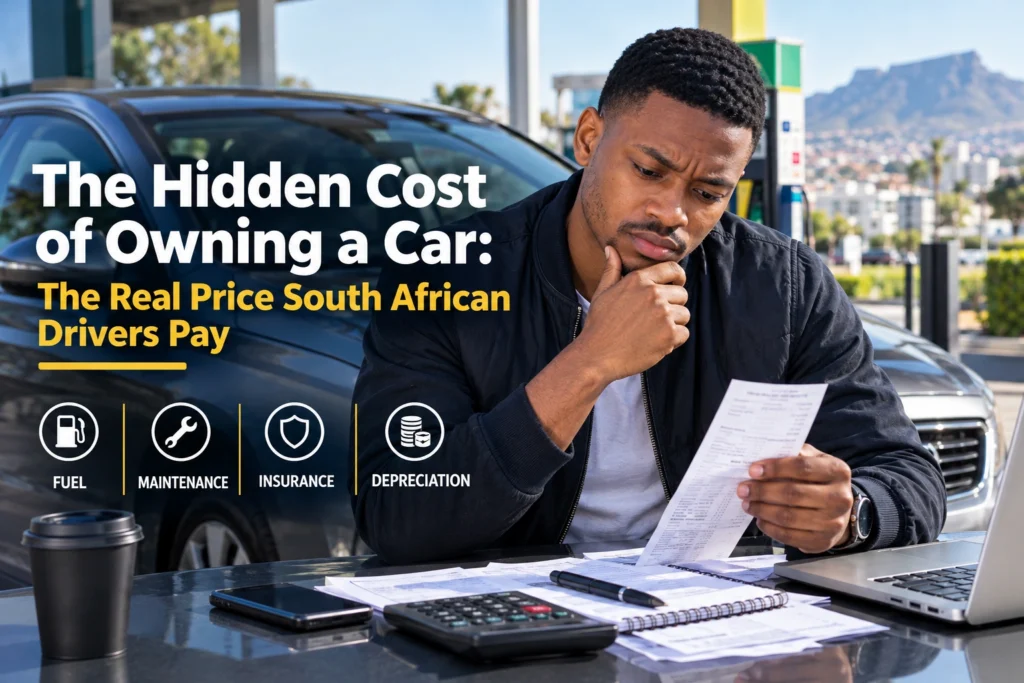
That is The Hidden Cost of Owning a Car.
The most important lesson is that car affordability cannot be measured by the monthly instalment alone. A financially manageable vehicle is one that you can operate, maintain and eventually replace without constantly relying on credit.
This guide explains where the money goes, how to calculate your real vehicle cost and what you can do to prevent your car from quietly damaging your finances.
The Monthly Instalment Is Only the Beginning
When a dealership advertises a car, the monthly repayment is usually one of the easiest numbers to understand.
For example:
Vehicle finance: R4,500 per month
That number can create the impression that the car will cost R4,500 every month.
It won’t.
Consider the other expenses that can accompany vehicle ownership.
| Car expense | Example monthly provision |
|---|---|
| Finance instalment | R4,500 |
| Insurance | R1,200 |
| Fuel | R2,000 |
| Maintenance | R700 |
| Tyres and wear-and-tear | R400 |
| Parking/tolls | R500 |
| Licence/tracking provision | R150 |
| Emergency vehicle reserve | R500 |
| Illustrative monthly cost | R9,950 |
These are illustrative figures, not standard South African prices. Your actual costs will depend on your vehicle, insurer, driving distance, location, fuel consumption and maintenance requirements.
But the example demonstrates an important point.
A vehicle advertised at an instalment of R4,500 can potentially require close to R10,000 a month once the wider ownership costs are considered.
That difference is where many household budgets begin to break down.
ALSO APPLY FOR: Bosch Internship 2026
ALSO APPLY FOR: Double Frame Solutions Intern 2026
The Hidden Cost of Owning a Car: What Your Instalment Doesn’t Tell You
The true cost of a car can be divided into several categories.
1. Finance and Interest
If you finance a vehicle, you are not simply paying for the car.
You are also paying for the cost of borrowing the money.
A longer repayment period may reduce the monthly instalment, but it can increase the total amount paid over the life of the agreement.
Before signing, look at:
- Deposit required
- Interest rate
- Repayment period
- Monthly instalment
- Balloon payment, if applicable
- Total amount repayable
- Additional finance-related charges
Never judge affordability by the instalment alone.
A useful question is:
“How much will this car cost me from the first payment until the finance agreement ends?”
That number is much more revealing.
2. Insurance
Insurance is another expense that can surprise new drivers.
Two people can receive very different premiums for similar vehicles because insurers consider various risk factors.
Before buying a car, obtain an insurance quotation for the specific vehicle you are considering.
Do not assume:
“I will sort out insurance after I buy it.”
Find out first.
A vehicle that looks affordable at the dealership may become much less attractive once the insurance premium is added.
3. Fuel
Fuel is one of the easiest costs to underestimate because drivers tend to think in terms of individual trips.
“It’s only R300 to fill up.”
But what happens when you fill the tank several times a month?
Your fuel bill depends on:
- Distance travelled
- Traffic congestion
- Vehicle fuel consumption
- Fuel price
- Driving habits
- Number of trips
- Commute length
Someone driving a short distance to work may have completely different fuel costs from someone travelling long distances every day.
4. Maintenance
A car does not remain reliable simply because it starts every morning.
It needs preventative maintenance.
Depending on the vehicle, this can include:
- Engine oil
- Oil filters
- Air filters
- Brake inspections
- Coolant
- Spark plugs where applicable
- Belts
- Battery
- Wheel alignment
- General servicing
The mistake is waiting for something to break.
A better strategy is to treat maintenance as a monthly expense even when no service is due.
If you put money aside every month, a service bill becomes a planned expense rather than a financial emergency.
5. Tyres and Brakes
Tyres are another expense that can disappear from your budget because they are not purchased every month.
But when replacement becomes necessary, the bill can be significant.
The same applies to brake pads, discs and other wear-and-tear components.
This is why a good car budget needs a sinking fund.
A sinking fund simply means putting aside a small amount regularly for an expense you know will eventually happen.
6. Licence and Administrative Costs
Vehicle licence and registration-related expenses also need to be considered.
They may be annual rather than monthly, but that does not make them free.
Instead of waiting for the renewal month, divide the expected annual cost by 12 and save that amount each month.
This simple technique works for almost every irregular vehicle expense.
7. Parking and Tolls
For people commuting into business districts, parking can become a major cost.
Tolls can add another layer.
Imagine spending R30 on parking or toll-related costs several times a week. Individually, the amount may appear insignificant.
Over 12 months, however, those small payments can become thousands of rand.
8. Depreciation
Depreciation is one of the most overlooked costs because nobody sends you an invoice for it.
Your vehicle can lose value as it becomes older and accumulates mileage.
This matters particularly when you eventually want to sell or trade in the vehicle.
Suppose you buy a car for R250,000 and later sell it for R165,000.
You have experienced a R85,000 reduction in the vehicle’s value.
That does not mean depreciation is identical for every vehicle. Different models depreciate at different rates.
The important lesson is simply to recognise that the value of your asset can decline while you are still paying for it.
ALSO READ ABOUT: Buying vs Renting
Why This Issue Matters
The cost of owning a car becomes especially important when the vehicle consumes money that should be going towards financial security.
Consider someone taking home R20,000 a month.
If transportation costs are close to R9,000 or R10,000, around half of their take-home income could be committed to getting around.
That leaves less money for:
- Rent or bond payments
- Food
- Electricity
- Medical expenses
- Family responsibilities
- Emergency savings
- Retirement savings
- Debt repayment
- Education
- Investments
This is where a car can become financially dangerous without looking expensive on paper.
The person may never miss the vehicle instalment.
But they may repeatedly use credit cards for groceries.
They may postpone saving.
They may borrow money when tyres need replacing.
They may have no emergency fund.
The car is technically affordable — but the overall financial system is not healthy.
A Better Way to Calculate Car Affordability
Instead of asking how much car finance you qualify for, calculate your total monthly transportation cost.
Use this formula:
Total car cost = finance + insurance + fuel + maintenance + tyres + parking/tolls + annual costs + repair reserve
Then compare that number with your take-home income.
For example:
| Financial calculation | Amount |
|---|---|
| Take-home income | R20,000 |
| Finance | R4,000 |
| Insurance | R1,100 |
| Fuel | R1,800 |
| Maintenance provision | R600 |
| Tyre/wear provision | R350 |
| Parking/tolls | R450 |
| Emergency car reserve | R500 |
| Total transport cost | R8,800 |
| Money remaining before other expenses | R11,200 |
Now the buyer has a much clearer picture.
The question is no longer:
“Can I afford R4,000?”
It becomes:
“Can my household comfortably absorb approximately R8,800 in transportation costs while still meeting all my other responsibilities?”
That is a much better affordability test.
ALSO READ ABOUT: Should Your First Big Purchase Be a Car or a Home?
7 Practical Ways to Reduce the Cost of Owning a Car
1. Get the Full Cost Before Buying
Before signing anything, collect actual numbers.
Get:
- A finance quotation
- An insurance quotation
- Estimated fuel consumption
- Expected service costs
- Tyre prices
- Parking costs
- Toll expenses
- Licence costs
Put everything into one spreadsheet or notebook.
If the numbers do not work on paper, they are unlikely to work in your bank account.
2. Compare Cars on Running Costs
Don’t compare vehicles only by purchase price.
Create a comparison like this:
| Factor | Car A | Car B |
|---|---|---|
| Purchase price | Lower | Higher |
| Fuel efficiency | Moderate | Better |
| Insurance | Quote required | Quote required |
| Maintenance | Check service history | Check service history |
| Tyres | Compare size/prices | Compare size/prices |
| Depreciation | Research model | Research model |
| Finance cost | Calculate | Calculate |
| Overall running cost | Calculate | Calculate |
A vehicle that costs slightly more to buy could potentially cost less to operate.
3. Build a Car Emergency Fund
Do not use your general emergency savings every time the car needs attention.
Create a separate vehicle reserve.
Use it for genuine vehicle expenses such as:
- Unexpected repairs
- Tyres
- Battery replacement
- Major servicing
- Emergency mechanical work
Once the fund reaches a comfortable level, continue contributing a smaller amount to maintain it.
4. Don’t Automatically Choose the Maximum Finance Amount
A lender’s approval tells you what you may qualify to borrow.
It does not tell you what is financially comfortable.
Your personal budget should determine the vehicle price.
5. Consider a Reliable Used Vehicle
A used vehicle can reduce the initial purchase price, although buyers should carefully investigate service history, condition, mileage and potential repair costs.
The goal is not simply to buy the cheapest car.
The goal is to find a vehicle whose total ownership cost fits your circumstances.
6. Drive More Efficiently
Small changes can reduce fuel consumption.
Consider:
- Combining errands
- Avoiding unnecessary trips
- Keeping tyres correctly inflated
- Removing unnecessary weight
- Avoiding excessive idling
- Planning routes
- Carpooling where practical
These savings may appear small, but repeated over a year they can become meaningful.
7. Review Your Car Budget Every Six Months
Your vehicle expenses can change.
Insurance premiums may change. Fuel prices fluctuate. Your mileage may increase. Maintenance requirements may become more expensive as the car ages.
Review the numbers periodically rather than assuming your original budget remains accurate forever.
ALSO READ ABOUT: What Is Compound Interest?
Best Practices Experts Recommend
A financially responsible approach to car ownership starts before the purchase.
Before buying
- Calculate your total transportation cost.
- Obtain an insurance quotation.
- Check the total finance repayment.
- Research expected servicing requirements.
- Compare fuel consumption.
- Check tyre sizes and replacement costs.
- Consider depreciation.
- Keep an emergency fund.
- Avoid using your entire savings balance as a deposit.
After buying
- Service the vehicle according to the manufacturer’s schedule.
- Keep records of maintenance.
- Check tyres regularly.
- Deal with warning lights promptly.
- Review insurance periodically.
- Keep money aside for predictable annual expenses.
- Avoid unnecessary modifications that add to ownership costs.
- Monitor your monthly fuel spending.
The strongest financial habit is planning for expenses before they happen.
Mistakes People Often Make
Mistake 1: “The Instalment Is Affordable”
This ignores the rest of the ownership cost.
Mistake 2: Forgetting Interest
The cash price and the total amount paid through finance can be very different.
Mistake 3: Ignoring Insurance Until the Last Minute
Insurance can materially change whether a vehicle fits your budget.
Mistake 4: Treating Repairs as Emergencies Every Time
Some repairs are unpredictable, but servicing, tyres and other wear items are predictable enough to plan for.
Mistake 5: Spending the Maintenance Fund
Money saved for tyres is not spare spending money.
Mistake 6: Buying for Image
A more expensive vehicle may provide prestige or additional features, but those benefits need to be weighed against the financial commitment.
Mistake 7: Extending the Loan Simply to Lower the Instalment
A smaller monthly payment can make an expensive vehicle appear affordable while increasing the total cost of borrowing.
Mistake 8: Forgetting the Opportunity Cost
Money committed to a car cannot simultaneously be used for another goal.
A large vehicle expense could mean slower progress towards a home deposit, emergency fund or investment portfolio.
The Car Affordability Stress Test
Here is one practical test every prospective buyer should try.
Before buying the car, calculate your expected monthly vehicle cost.
Then, for three months, pretend you already own it.
If you expect the car to cost R7,500 per month, put R7,500 aside every month.
Don’t spend it.
After three months, ask:
- Could I still pay my normal expenses comfortably?
- Did I need to use credit?
- Did an unexpected bill cause problems?
- Could I still save?
- Did I feel financially restricted?
- Could I handle a major repair?
This experiment can reveal affordability problems before you sign a finance agreement.
It is one of the simplest ways to test whether the car fits your real life rather than just fitting a finance calculator.
Frequently Asked Questions
1. What is the hidden cost of owning a car?
The hidden cost includes expenses beyond the monthly instalment, such as fuel, insurance, maintenance, tyres, repairs, parking, tolls, licence costs, finance interest and depreciation.
2. Why is depreciation important?
Depreciation reduces the vehicle’s resale or trade-in value. Even though it is not a monthly cash payment, it represents a real economic cost of owning the vehicle.
3. Should I budget for repairs even if my car is new?
Yes. Newer vehicles may have fewer unexpected repairs, but maintenance, tyres, servicing and other ownership costs still exist. A small vehicle reserve can prevent predictable or unexpected expenses from becoming debt.
4. How can I tell if a car is too expensive for me?
Calculate the full monthly cost of ownership and compare it with your take-home income and existing financial commitments. If the vehicle leaves little room for saving, emergencies or essential expenses, it may be too expensive even if you qualify for the finance.
Final Takeaway: Don’t Buy the Instalment — Buy the Full Cost
A car is more than a monthly finance agreement.
It is a continuing financial commitment.
The person who only considers the instalment sees one number. The person who calculates fuel, insurance, maintenance, tyres, depreciation, finance interest, parking, tolls and unexpected repairs sees the complete picture.
That difference can determine whether car ownership feels manageable or becomes a constant source of financial pressure.
Before buying your next vehicle, take these five steps:
- Calculate the total monthly ownership cost.
- Get real insurance and finance quotations.
- Create separate savings for maintenance and repairs.
- Compare vehicles based on running costs, not appearance or instalment alone.
- Stress-test the budget before signing the agreement.
Most importantly, don’t let a salesperson’s monthly repayment figure become your definition of affordability.
Your salary has to pay for your entire life — not just your car.
A financially sensible vehicle is not necessarily the cheapest vehicle on the market. It is the one that allows you to travel, work and live without preventing you from building a stronger financial future.