
Getting a bursary can feel like a financial breakthrough. After worrying about registration fees, textbooks, accommodation, transport and food, finally having financial support can bring enormous relief.
But there is a less obvious challenge that many students discover later.
Knowing how to receive money is not the same as knowing how to manage it.
A student may receive a monthly allowance or stipend and suddenly have more money available than before. Small purchases begin to add up. Takeaways become regular. Data, transport, clothing and entertainment consume more than expected. Family members may also need assistance.
Then, when the next payment arrives, the cycle starts again.
By graduation, a student can have completed a qualification but still have no emergency savings, no investment portfolio and little understanding of how to make money work for them.
This is why the journey From Bursary Student to Investor: Your First Money Roadmap should start with something more important than choosing an investment.
It should start with a system.
You need to know how much money is coming in, what must be paid, what should be saved, what can be invested and what you can comfortably spend.
The good news is that you do not need a large salary to begin.
Your first investment could be R100, R200 or R500 a month. What matters is learning the process while your financial responsibilities are still relatively manageable.
What the Journey From Bursary Student to Investor Really Looks Like
The internet often makes investing look like opening an account, buying an asset and watching your money grow.
Real life is different.
Before investing, you need a financial foundation.
A sensible progression can look like this:
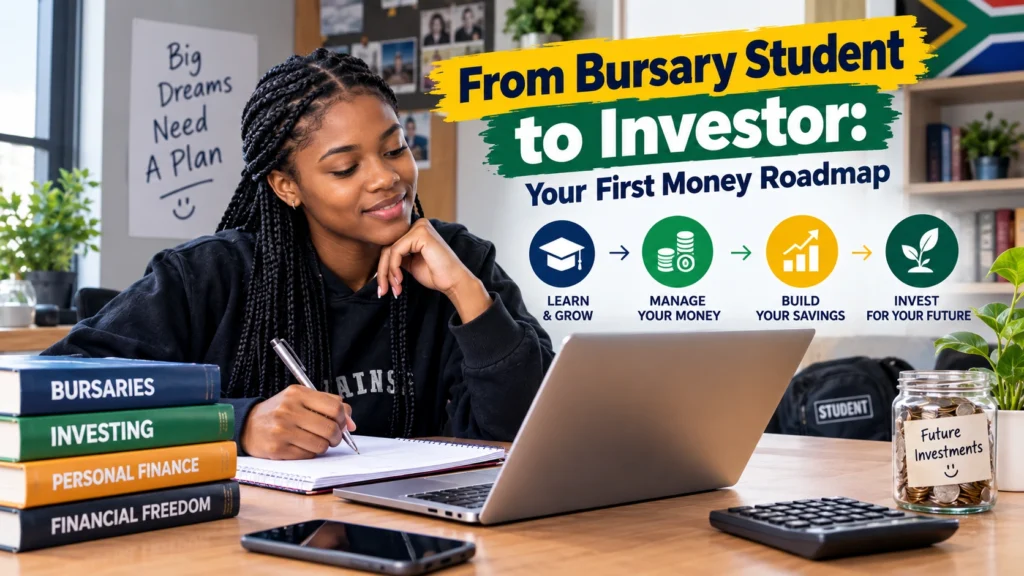
Understand your money → create a budget → build emergency savings → manage debt → learn about investments → start small → invest consistently → increase contributions as income grows.
This is important because investing should not solve a budgeting problem.
If you are regularly running out of money before month-end, putting your last R300 into an investment account may create another problem when an unexpected expense appears.
The objective is to build financial resilience first and then gradually build wealth.
ALSO APPLY FOR: SANRAL Bursary 2027
ALSO APPLY FOR: (DWE) Bursary 2027
Why This Issue Matters
The period between receiving your first bursary allowance and getting your first full-time salary can teach you habits that may follow you for decades.
Consider two graduates.
Both start working at age 23 and earn the same salary.
Graduate A immediately increases lifestyle spending. A more expensive phone, car repayments, restaurants and entertainment consume most of the additional income.
Graduate B keeps some student habits, builds an emergency fund and invests a portion of each month’s income.
Their salaries may be identical, but their financial positions can become very different over time.
This is where compound growth becomes important.
When investment returns remain invested, future growth can occur on both the original contributions and previously accumulated returns. The longer the money remains invested, the more time compounding has to work.
However, compounding is not a magic formula. Investments can lose value, returns are not guaranteed and fees and taxes can affect the outcome.
The lesson is therefore not “invest and become rich.”
The lesson is:
Starting early gives your money more time, while consistency gives your strategy a chance to work.
Step 1: Find Out Where Your Money Is Actually Going
Before thinking about shares, ETFs or a TFSA, conduct a one-month money audit.
For 30 days, record every expense.
Do not only record large payments.
A R25 purchase may seem insignificant. Ten similar purchases are R250.
Track:
- Food and groceries
- Takeaways
- Transport
- Airtime
- Mobile data
- Streaming subscriptions
- Clothing
- Personal care
- Entertainment
- Bank charges
- Study materials
- Family support
- Savings
- Other unexpected expenses
At the end of the month, look for patterns.
You may discover that the expense you considered “small” is actually one of your biggest leaks.
The three-question spending test
Before spending money, ask:
- Do I need it?
- Can I afford it without borrowing?
- Would I rather have this item or the financial goal I am saving towards?
You do not have to eliminate every enjoyable expense.
A realistic budget should include some money for enjoyment.
The goal is controlled spending, not making student life miserable.
ALSO READ ABOUT: What Is Compound Interest
Step 2: Create a Student Money System
Instead of treating your entire allowance as one pile of money, divide it according to its purpose.
For example, a student receiving R5,000 could create a system like this:
| Purpose | Example amount | Why it matters |
|---|---|---|
| Essential expenses | R3,000 | Covers necessary costs |
| Personal spending | R600 | Allows controlled enjoyment |
| Emergency savings | R500 | Builds financial protection |
| Long-term investing | R300 | Starts wealth-building |
| Flexible balance | R600 | Covers changing needs |
| Total | R5,000 |
These figures are examples rather than a recommended budget for every student.
Your actual allocation should depend on your accommodation, transport costs, family responsibilities, bursary conditions and other expenses.
The important concept is separation.
If your investment money sits in the same account as your spending money, it can be surprisingly easy to spend it.
Step 3: Build Your First Emergency Fund
One of the most underrated financial achievements for a student is having money available when something goes wrong.
Your first target does not need to be six months of expenses.
Start with something achievable.
Emergency-fund milestones
Target 1: R500
Target 2: R1,000
Target 3: One month’s essential expenses
Longer-term target: Several months of essential expenses, depending on your circumstances
Your emergency fund can help with unexpected expenses such as:
- Emergency transport
- A broken essential device
- Unexpected academic expenses
- Urgent travel
- Temporary loss of income
- Other genuine emergencies
Keep this money accessible and separate from your long-term investments.
Important distinction
Emergency savings are not investment money.
Your emergency fund exists primarily for accessibility and financial stability. A long-term investment exists for a different purpose.
ALSO READ ABOUT: ETF vs Unit Trust
Step 4: Understand Debt Before You Invest
Debt can quietly undermine your financial progress.
Make a simple debt list if you owe money.
| Debt | Balance | Interest rate | Minimum payment | Priority |
|---|---|---|---|---|
| Credit card | R___ | ___% | R___ | High |
| Store account | R___ | ___% | R___ | High |
| Student-related debt | R___ | ___% | R___ | Depends |
| Other | R___ | ___% | R___ | Depends |
The interest rate matters because expensive debt can grow faster than you expect.
Do not assume that every debt should be treated identically. Some borrowing may have different rates, terms and purposes.
But if you have high-interest consumer debt, understand its cost before putting substantial amounts into investments.
Step 5: Learn the Difference Between Saving and Investing
This distinction is essential.
Saving
Saving is generally suitable for money you expect to need relatively soon.
Examples include:
- Registration costs
- Emergency expenses
- Rent
- A laptop purchase
- A short-term financial goal
Investing
Investing is generally more appropriate for money you can leave untouched for longer periods.
Examples include:
- Building long-term wealth
- Retirement
- Long-term financial goals
- Growing capital over many years
Investments can rise and fall.
Therefore, the question is not simply:
“What investment makes the most money?”
A better question is:
“What financial goal am I investing for, and when will I need the money?”
That question can completely change the appropriate choice.
Step 6: Learn the Main Investment Options
You do not need to become a financial expert before beginning.
Start by understanding a few common options.
Exchange-Traded Funds
An ETF can give investors exposure to a basket of assets through a single investment.
Some ETFs track broad market indexes, while others focus on particular sectors, regions or asset classes.
Before investing in an ETF, investigate:
- What assets it holds
- What index or strategy it follows
- Its fees
- Its level of diversification
- Its historical behaviour
- The risks involved
- Whether it suits your investment horizon
Past performance does not guarantee future returns.
Unit Trusts
A unit trust pools investors’ money into a portfolio managed according to a particular investment strategy.
Different funds can have very different objectives, risks and fees.
Do not select one simply because its recent performance looks impressive.
Understand what you are buying.
Tax-Free Savings Accounts
A TFSA can provide tax advantages under South African tax rules when used within the applicable contribution limits and qualifying investment framework.
The phrase “tax-free” does not mean the investment itself is risk-free.
The underlying product still matters.
Before opening or contributing to a TFSA, understand:
- Contribution limits
- Investment choices available
- Withdrawal implications
- Fees
- The difference between saving and investing
- Your long-term objective
Retirement Investments
Retirement-focused investments are designed around a long-term horizon.
They can become increasingly relevant once you start earning an income.
However, retirement money should not be confused with emergency savings because access and tax treatment can differ.
ALSO READ ABOUT: TFSA vs ETF vs Savings Account
Step 7: Start With an Amount You Can Sustain
One of the biggest mistakes new investors make is starting too aggressively.
A student might invest R1,000 in the first month because they are excited, only to withdraw it two weeks later because they need transport money.
A smaller contribution that happens every month can be more practical than a large contribution that cannot be maintained.
For example:
| Month | Investment |
|---|---|
| January | R100 |
| February | R100 |
| March | R150 |
| April | R150 |
| May | R200 |
| June | R200 |
The numbers are less important than the behaviour.
Once the habit is established, increase the amount when your circumstances improve.

ALSO READ ABOUT: What Is a TFSA
Step 8: Use Your First Salary Differently
Graduation changes the financial picture.
For the first time, you may receive a regular salary instead of bursary support.
This is where lifestyle inflation can become dangerous.
You may suddenly qualify for:
- A car
- A larger apartment
- New furniture
- Expensive clothing
- More restaurants
- Multiple subscriptions
- New credit accounts
There is nothing inherently wrong with improving your lifestyle.
The danger is upgrading everything simultaneously.
Instead, when your income increases, consider increasing these first:
- Emergency savings
- Debt repayments
- Retirement contributions
- Long-term investments
- Professional development
Then decide how much of the remaining income can reasonably fund lifestyle upgrades.
Step 9: Invest in Your Career Too
There is another investment that young people often overlook: themselves.
Your ability to earn more can be one of your most valuable financial assets.
Depending on your career, useful investments could include:
- Professional certifications
- Technical training
- Software skills
- Coding
- Data analysis
- Project management
- Communication skills
- Industry knowledge
- Portfolio projects
- Professional networking
But be careful.
A course is not automatically a good investment because someone promises that it will lead to a high-paying job.
Research the qualification, provider, industry demand and actual career requirements before spending significant money.
A Practical “First R1,000” Roadmap
If you receive your first R1,000 that is genuinely available for financial goals, you could think about it in stages.
For example:
R500 — emergency savings
R300 — financial goal or debt reduction
R200 — long-term investment
This is not a universal formula.
Someone with high-interest debt might allocate differently. Someone without an emergency buffer might prioritise savings. Someone with strong financial reserves might have greater flexibility.
The lesson is to avoid putting your entire surplus into one place without considering your overall financial position.
ALSO READ ABOUT: Best Bank Accounts for Students and Graduates in South Africa
Best Practices Experts Recommend
Good investing is often less about finding a clever product and more about avoiding preventable mistakes.
Build these habits early:
- Know your objective before investing.
- Match your investment to your time horizon.
- Understand the risks.
- Diversify rather than concentrating everything in one asset.
- Pay attention to fees.
- Keep emergency money separate.
- Avoid borrowing money simply to speculate.
- Increase contributions as your income grows.
- Use reputable and appropriately regulated financial providers.
- Keep investment records and statements.
- Understand the tax treatment applicable to your investments.
- Ignore promises of guaranteed high returns.
- Do not make decisions based solely on social-media influencers.
- Review your financial plan periodically rather than constantly reacting to market movements.
A particularly useful habit is to understand why you own an investment.
If you cannot explain what you bought, what it is designed to do and what could cause its value to fall, you probably need to research it further before investing.
Mistakes People Often Make
Spending the entire allowance
A bursary allowance is still money that needs to be managed.
Receiving it does not mean you have to spend it.
Investing emergency money
If you need money next week, exposing it to significant market fluctuations may create unnecessary risk.
Chasing the latest investment trend
An asset becoming popular online does not automatically make it suitable for your financial goals.
Looking only at returns
Fees, risk, diversification, tax and liquidity also matter.
Trying to become rich quickly
Legitimate investing generally involves uncertainty and risk. Be particularly cautious about schemes promising extraordinary returns with little risk.
Comparing yourself with other investors
Someone else’s R10,000 monthly investment does not make your R200 contribution meaningless.
Start from your own circumstances.
Increasing your lifestyle too quickly
Your first salary can disappear surprisingly fast when every new expense becomes a permanent monthly commitment.
Forgetting that your financial plan can change
Your strategy as a student may not be appropriate when you become a graduate, buy a home, support relatives or start a family.
Review your plan as your life changes.
ALSO READ ABOUT: How TFSAs Affect Your Tax in South Africa
Your Student-to-Investor Checklist
Before you describe yourself as an investor, ask whether you have completed these basics:
Money management
- I know how much money I receive each month.
- I track my expenses.
- I have a realistic budget.
- I know where my money is going.
Financial safety
- I have started an emergency fund.
- I understand my debts.
- I know the interest rates I am paying.
- I avoid unnecessary borrowing.
Investment preparation
- I understand the difference between saving and investing.
- I understand my investment time horizon.
- I understand that investments can lose value.
- I have researched fees.
- I understand what the investment actually owns.
- I use a reputable financial provider.
Long-term growth
- I invest an amount I can maintain.
- I intend to increase contributions when income rises.
- I continue developing skills that can improve my earning potential.
This checklist is more valuable than simply downloading an investment app and buying something because it is trending.
Frequently Asked Questions
Can a bursary student really become an investor?
Yes. Investing does not require a large starting balance. If your financial circumstances allow it, a small recurring contribution can help you develop the habit of investing while you are still studying.
The important point is not to invest money needed for essential education and living expenses.
Should I save R1,000 before investing?
There is no universal rule that everyone must reach exactly R1,000 first. However, having some accessible emergency savings can reduce the chance that an unexpected expense forces you to sell a long-term investment.
Your financial circumstances should determine the balance between saving, debt repayment and investing.
Is a TFSA better than an ETF?
They are not necessarily alternatives.
A TFSA is a tax-advantaged account structure under South African tax rules, while an ETF is an investment product. A qualifying ETF may potentially be held within a TFSA, depending on the provider and applicable rules.
The important thing is to understand both the account and the underlying investment.
How much should a graduate invest from their first salary?
There is no single percentage that works for everyone.
Your contribution should account for your income, rent, transport, debt, family responsibilities, emergency savings and financial goals.
A sustainable contribution that increases over time can be more practical than choosing a large percentage that leaves you unable to meet essential expenses.
Final Takeaway: Your First Investment Is Not the Investment Product
The journey From Bursary Student to Investor: Your First Money Roadmap does not begin when you buy your first ETF or open an investment account.
It begins when you stop treating every rand as spending money.
Start by understanding your cash flow.
Then build an emergency buffer.
Understand your debt.
Learn the difference between saving and investing.
Research investment products before putting money into them.
Start with an amount you can afford.
And when your income increases, try to increase your wealth-building contributions before allowing your lifestyle to consume every additional rand.
Most importantly, remember that investing is only one part of financial progress.
Your education, skills, career, savings habits and investment decisions all work together.
A bursary can help you obtain a qualification. Your first salary can help you become financially independent. But the habits you build along the way can determine whether the money you earn simply passes through your hands or starts helping you build a stronger financial future.
You do not need to wait until you earn R20,000, R30,000 or R50,000 a month.
You can begin learning today.
Track one month’s spending. Save your first R500. Learn one investment concept. Research one legitimate investment product. Then take the next sensible step.
That is how the journey from bursary student to investor really begins.