
Saving R500 or R1,000 a month may not feel like a major financial achievement. The balance can appear to grow painfully slowly, especially when you compare it with the amount you need for a car, a home deposit, education or retirement.
But there is a financial principle that can dramatically change what happens to money over a long period: compound interest.
The problem is that many people have heard the term but do not fully understand how it works. Some confuse it with simple interest, while others assume that compound interest only benefits wealthy investors with large amounts of money.
That is not the case.
What is compound interest? In simple terms, it is the process of earning interest on your original money and then earning further interest on the interest that has already accumulated.
This creates a snowball effect. The longer money remains invested or saved, the more opportunity it has to generate additional growth.
However, there is another side to the story. Compound interest can also work against you when interest accumulates on debt.
Understanding the difference can help you make better decisions about savings accounts, investments, loans and everyday finances.
What Is Compound Interest? The Simple Explanation
Compound interest is interest calculated on the original amount of money plus previously accumulated interest.
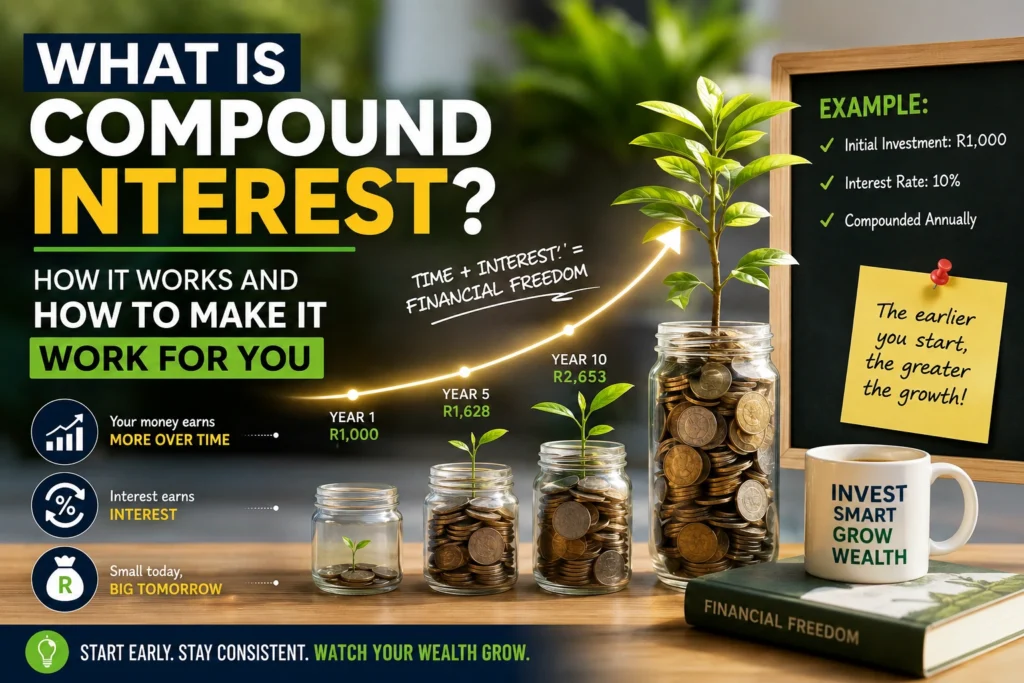
Imagine you put R10,000 into an account that earns 5% annually and leave the money untouched.
After the first year, you earn R500.
Your balance becomes:
R10,000 + R500 = R10,500
In the second year, you are no longer earning 5% only on the original R10,000. The interest calculation can now apply to the R10,500 balance.
Five percent of R10,500 is R525.
Your balance becomes:
R11,025
The extra R25 earned in the second year is the beginning of the compounding effect.
If you continue leaving the money invested, each period starts with a larger balance.
The basic compound interest formula
Where:
- FV represents the future value.
- PV represents the starting amount.
- r represents the interest rate per period.
- n represents the number of compounding periods.
You do not need to calculate this formula manually every time. Online calculators and financial tools can do the mathematics.
What matters most is understanding the factors that influence the outcome.
ALSO APPLY FOR: Momentum Learnership 2027
ALSO APPLY FOR: Tharisa Minerals Learnership 2026-2027
The Four Things That Determine How Much You Can Earn
Compound growth does not happen in isolation. Four important variables influence the result.
1. Your starting amount
The larger the amount you initially save or invest, the greater the potential base for future growth.
However, starting small is still worthwhile.
2. Your interest rate or investment return
A higher rate can accelerate growth, although higher potential investment returns generally come with greater risk.
Never choose a financial product based solely on the highest advertised rate.
3. How often interest compounds
Interest can be compounded at different intervals depending on the financial product.
It may be:
- Daily
- Monthly
- Quarterly
- Annually
The compounding frequency can affect the final result.
4. How long the money remains invested
This is arguably the most important factor for long-term compound growth.
Given enough time, even relatively modest contributions can potentially grow substantially.
Compound Interest vs Simple Interest
The easiest way to understand compound interest is to compare it with simple interest.
With simple interest, calculations are generally based on the original principal.
With compound interest, accumulated interest becomes part of the balance used to calculate future interest.
| Feature | Simple Interest | Compound Interest |
|---|---|---|
| Interest calculated on | Original principal | Principal plus accumulated interest |
| Growth pattern | More linear | Accelerates over time |
| Interest earns further interest | No | Yes |
| Long-term effect | Usually smaller | Can become significantly larger |
| Common lesson | Principal matters | Principal + time + rate matter |
The difference may seem tiny during the first few years.
That is one reason compounding can be misunderstood.
The dramatic difference often appears much later.
ALSO READ ABOUT: How TFSAs Affect Your Tax in South Africa
Why Time Is the Secret Ingredient
Suppose two people invest the same amount of money but start at different ages.
Person A begins at 25.
Person B begins at 35.
Person B may eventually be able to contribute more money each month, but Person A has a 10-year head start.
That additional time allows previous returns to potentially generate further returns.
This is why financial educators often encourage people to start saving and investing as soon as they reasonably can.
It is not about becoming rich overnight.
It is about giving your money more time to work.
A useful way to think about compounding
Imagine planting a tree.
During the first few years, the growth may not look particularly impressive.
But you cannot simply skip the early years and expect the same mature tree immediately.
Money can behave similarly.
The early stage may feel slow. The later stage can become much more noticeable.
A Practical Example: R500 a Month
Consider someone who contributes R500 every month toward a long-term financial goal.
At first, most of the account’s growth comes directly from the person’s contributions.
Over time, however, accumulated returns can become a larger part of the total balance.
This creates an important financial lesson:
You are not only building wealth with the money you put in. You are also giving previous growth an opportunity to produce additional growth.
The actual outcome depends on the return achieved, fees, taxes, market conditions and how long the money remains invested.
For investments, returns are not guaranteed.
ALSO READ ABOUT: Understanding Taxes
Why This Issue Matters
Understanding compound interest can influence everyday financial decisions.
It can help you understand why:
- Starting to save early can be valuable.
- Regular contributions can make a difference.
- Leaving returns invested can increase long-term growth.
- High-interest debt can become increasingly expensive.
- Fees can have a larger impact over long periods.
- Short-term financial decisions can affect long-term wealth.
Perhaps the biggest lesson is that time can be an important financial resource.
Someone who consistently saves a manageable amount for decades may be in a stronger position than someone who waits years before attempting to make much larger contributions.
When Compound Interest Works in Your Favour
Compound growth can be useful in several situations.
Savings
A savings account may pay interest on your deposited money.
If the interest remains in the account and continues earning interest, the balance can benefit from compounding.
Investments
Long-term investments can potentially benefit from reinvesting returns.
For example, dividends or other distributions may be reinvested rather than withdrawn, depending on the investment and strategy.
This can increase the amount of capital participating in future growth.
Retirement savings
Retirement planning is one area where time can be particularly important.
Someone saving consistently over several decades has more time for contributions and potential investment growth to accumulate.
This is one reason starting early can be powerful.
When Compound Interest Works Against You
Here is the part many people overlook.
Compound interest is not automatically good.
It depends on whether you are the person earning the interest or paying it.
Suppose you carry expensive debt and interest is added to your outstanding balance.
If you do not reduce the principal quickly enough, future interest calculations can continue to work from a larger balance.
This can make the debt increasingly difficult to manage.
Debt warning signs include:
- Paying only the minimum amount every month.
- Continually borrowing to cover previous debt.
- Ignoring the interest rate.
- Taking new loans to repay old loans without improving the underlying problem.
- Keeping expensive credit balances for long periods.
- Failing to understand fees and penalties.
This is why understanding compounding is just as important for borrowers as it is for investors.
ALSO READ ABOUT: Do You Declare Investment Income to SARS
How to Make Compound Growth Work for You
You do not need to completely transform your finances overnight.
Instead, focus on a few practical habits.
Step 1: Start with what you can afford
Do not wait until you have thousands of rands available.
A smaller contribution made consistently can establish a valuable financial habit.
For example, you could start by setting aside a realistic amount every payday.
Step 2: Automate your contributions
Automation removes some of the temptation to spend the money first.
Consider arranging an automatic transfer into an appropriate savings or investment account shortly after receiving your income.
Step 3: Reinvest when appropriate
If your financial goal is long-term growth, consider whether withdrawing returns makes sense.
Keeping returns invested gives them an opportunity to contribute to future growth.
Step 4: Increase contributions gradually
You do not have to jump from R500 to R5,000 immediately.
Instead, consider increasing your contribution when:
- Your salary increases.
- You finish paying off a loan.
- You receive a bonus.
- Your monthly expenses decrease.
- You receive additional income.
Even modest increases can make a difference over a long period.
Step 5: Protect yourself from expensive debt
Look carefully at high-interest borrowing.
If you have expensive debt, reducing it may be a priority before aggressively pursuing higher-risk investments.
Step 6: Give your strategy enough time
Avoid judging a long-term strategy based on a few weeks or months.
Compounding is fundamentally a long-term concept.
Best Practices Experts Recommend
A strong compounding strategy is less about finding a magical investment and more about developing disciplined financial habits.
Keep costs under control
Fees reduce the amount of money available to grow.
Before choosing an account or investment, check:
- Monthly fees
- Administration fees
- Investment management fees
- Transaction costs
- Withdrawal charges
- Other applicable costs
A seemingly small recurring fee can become meaningful over many years.
Understand risk
Do not assume a higher potential return is automatically better.
Higher-return investments can involve greater volatility and the possibility of losing money.
Your investment choice should match your:
- Financial goal
- Time horizon
- Ability to tolerate losses
- Need for access to the money
Separate short-term and long-term money
Money needed next month should not necessarily be treated the same way as money intended for retirement decades from now.
A useful approach is to give every major portion of your savings a purpose.
Review your progress
Check your financial plan periodically.
Ask:
- Am I saving consistently?
- Are my fees reasonable?
- Has my goal changed?
- Am I carrying expensive debt?
- Can I increase my contribution?
- Is my investment appropriate for my time horizon?
The goal is not to constantly change investments. It is to make sure your overall strategy remains suitable.
ALSO READ ABOUT: How PAYE Works in South Africa
Mistakes People Often Make
Mistake 1: Believing compounding happens quickly
Compound growth usually needs time.
Do not expect a small deposit to produce dramatic results after a few months.
Mistake 2: Thinking the interest rate is everything
The rate matters, but so do time, contributions, fees, taxes and withdrawals.
Mistake 3: Ignoring inflation
If your money grows at 5% while prices rise significantly, your purchasing power may not increase by the same amount.
Long-term financial planning should therefore consider inflation.
Mistake 4: Constantly withdrawing your returns
Removing interest or investment income may reduce the amount available to generate future growth.
Whether withdrawals make sense depends on your financial objectives.
Mistake 5: Taking unnecessary risks
The desire to achieve faster compound growth can tempt people into investments they do not understand.
Do not confuse compounding with guaranteed high returns.
Mistake 6: Ignoring taxes
Interest and investment income can have tax implications depending on the product and your circumstances.
South African readers should consider the relevant SARS rules and the specific tax treatment of their financial products.
Mistake 7: Forgetting about debt
It makes little sense to celebrate investment growth while simultaneously allowing expensive debt to grow unchecked.
Look at your entire financial picture.
A Simple Compound Interest Checklist
If you are starting from scratch, use this checklist:
Today
- Determine how much you can realistically save.
- List your current debts and interest rates.
- Identify your short-, medium- and long-term goals.
This month
- Open or review an appropriate savings or investment account.
- Set up an automatic contribution if practical.
- Check the fees you are paying.
Over the next year
- Increase your contribution if your income allows.
- Build or strengthen an emergency fund.
- Reduce expensive debt.
- Review whether your financial products still match your goals.
Over the long term
- Remain consistent.
- Reinvest returns when appropriate.
- Avoid unnecessary withdrawals.
- Review your strategy periodically.
- Do not make major decisions based solely on short-term market movements.
ALSO READ ABOUT: TFSA vs ETF vs Savings Account
Compound Interest Is Not the Same as Guaranteed Wealth
This distinction is extremely important.
Compound interest is a mathematical principle. It does not guarantee that an investment will grow at a specific rate.
For example, an illustration might assume an investment earns a fixed annual return for 20 years.
Real investments may experience:
- Positive returns
- Negative returns
- Periods of volatility
- Changing interest rates
- Investment fees
- Inflation
- Taxes
Therefore, compound-interest calculations should generally be treated as illustrations rather than promises when dealing with market-linked investments.
This is particularly important when comparing financial products advertised online.
Frequently Asked Questions
1. What is compound interest in simple terms?
Compound interest means that interest can be earned on your original money as well as interest accumulated previously. Over time, this can create accelerated growth.
2. Is compound interest better than simple interest?
For savings and investments, compound interest can produce greater growth over long periods because accumulated interest can itself generate further interest. The exact outcome depends on the rate, period, contributions and other factors.
3. How often can interest compound?
It depends on the financial product. Compounding may occur daily, monthly, quarterly or annually. Check the product’s terms to understand how the calculation works.
4. Can compound interest work against me?
Yes. Interest accumulating on debt can increase the amount you owe, particularly when repayments are too small to reduce the balance effectively.
Final Thoughts: Start Small, Think Long Term
So, what is compound interest?
It is the process of allowing your money’s accumulated interest or returns to become part of the base that can generate future growth.
Its power does not come from a secret investment trick.
It comes from combining:
Starting capital + regular contributions + time + returns + patience.
For someone trying to improve their finances, the most useful lesson is not to obsess over finding the perfect interest rate.
Instead:
- Start saving as soon as realistically possible.
- Make contributions consistently.
- Understand the fees attached to your financial products.
- Reinvest returns when appropriate.
- Avoid allowing expensive debt to compound unnecessarily.
- Consider inflation and tax when evaluating long-term results.
- Choose investments according to your goals and risk tolerance.
- Give your money sufficient time to work.
A person who understands compound interest is better equipped to see the long-term consequences of everyday financial decisions.
You may not notice a dramatic difference after one month.
You may not even notice one after one year.
But when consistent financial habits are maintained for many years, time can turn small amounts and repeated contributions into something much more meaningful.
That is the real lesson behind compound interest: you are not simply saving money today—you are potentially giving today’s money the opportunity to help create tomorrow’s money.