

The workshop floor is a different kind of classroom.
There are no comfortable rows of desks. Instead, there are vehicles, tools, diagnostic equipment, technical manuals and experienced artisans who expect you to pay attention. A small mistake can mean taking a component apart again. A successful repair, however, can teach something that a textbook cannot: how theory becomes practical skill.
For a technically minded young South African, that environment can be the beginning of a serious career.
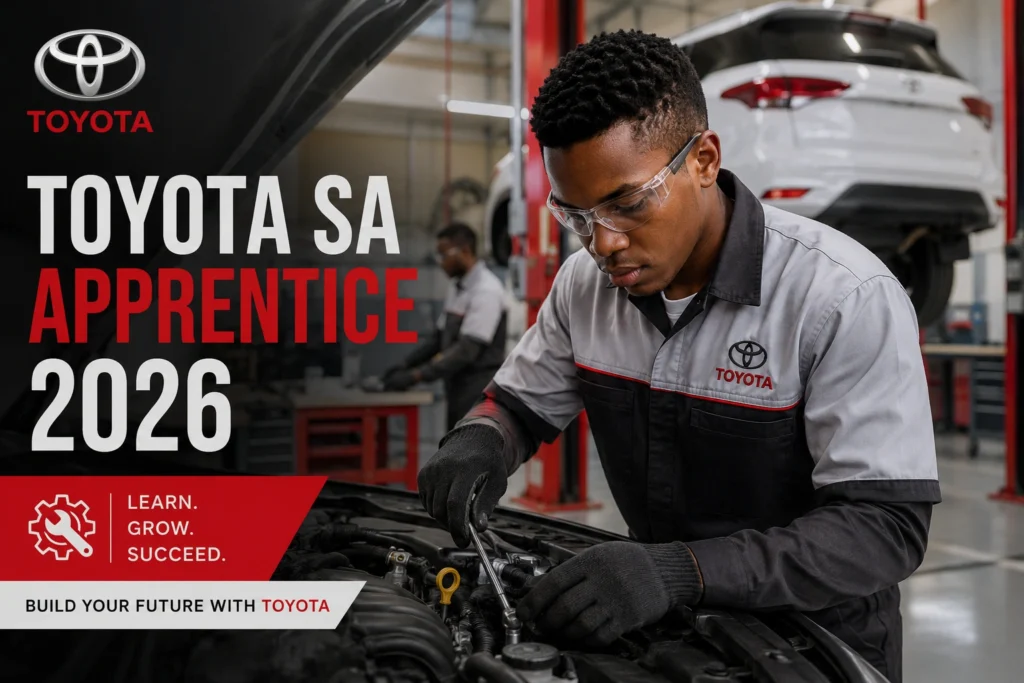
The Toyota SA Apprentice 2026 opportunity is aimed at people who want to develop their skills as Automotive Motor Mechanics. The opportunity is particularly relevant to candidates with a technical school background, including an NQF 4 Technical Matric with subjects such as Mathematics, Engineering Science, Trade Theory and Technical Drawing.
Toyota South Africa’s official careers information lists Motor Mechanic among its apprenticeship trades and explains that the apprenticeship is structured over four years, combining practical workplace development with technical training. Successful apprentices can work towards an NQF Level 4 Trade Test National Certificate.
For applicants, though, the important question is not simply whether Toyota is a respected automotive company.
The real question is: does this apprenticeship fit your qualifications, abilities and career plans — and how do you submit an application correctly?
Toyota SA Apprentice 2026: What the opportunity actually offers
An apprenticeship is fundamentally different from an ordinary entry-level job.
The objective is to develop a person into a competent artisan through structured learning and practical experience. Toyota’s development-programme information says apprentices receive practical training alongside theoretical development, with exposure to experienced industry professionals.
For a Motor Mechanic apprentice, that means learning how vehicles and their systems work rather than simply performing repetitive tasks.
The automotive industry has changed significantly. Modern vehicles contain sophisticated electronic systems, computer-controlled components, sensors and diagnostic technology. Mechanical knowledge remains essential, but today’s automotive technician also needs to think analytically.
That is why a strong technical foundation matters.
Mathematics can help with calculations and measurements. Engineering Science provides a foundation for understanding mechanical principles. Technical Drawing develops the ability to interpret technical information, while trade-related subjects introduce learners to the practical language of engineering.
Toyota’s apprenticeship programme currently lists several technical trades, including Motor Mechanic, Auto Electrician, Millwright and Fitter & Turner.
For someone who wants to build a career in the automotive sector, this combination of formal training and workplace exposure can be more valuable than simply adding another short course to a CV.
Who should apply — and who should think twice?
The biggest mistake applicants can make is applying because they like Toyota vehicles.
An apprenticeship is a technical career decision, not a fan-club membership.
The better candidate is someone who enjoys understanding why something works, enjoys practical problem-solving and is prepared to learn through repetition and correction.
Toyota’s official development-programme information indicates that candidates should have a Technical Matric or NTC3, with relevant technical subjects. Workshop experience in a trade-related discipline is described as advantageous.
The vacancy information supplied for this opportunity specifically highlights:
- NQF 4 Technical Matric
- Mathematics
- Engineering Science
- Trade Theory
- Technical Drawing
Applicants should carefully compare these requirements with their own certificates before applying.
If your qualification does not contain the required technical subjects, do not assume that an ordinary academic Matric automatically meets the requirement.
Practical ability can make a difference
There is another important point that young applicants sometimes overlook.
You do not need to know everything before starting an apprenticeship. That is precisely why the programme exists.
However, practical exposure can demonstrate genuine interest.
Perhaps you have assisted at a local mechanical workshop. Maybe you have worked on machinery, completed practical technical projects at school or spent time learning basic vehicle maintenance.
These experiences can help you understand whether you actually enjoy workshop environments.
They can also give you examples to discuss if you reach an interview or assessment stage.
Why this apprenticeship matters in today’s automotive industry
The automotive industry is becoming increasingly technical.
A modern Motor Mechanic cannot rely exclusively on traditional mechanical knowledge. Vehicles increasingly depend on electronic control units, computerised diagnostics and complex communication between different systems.
That creates an interesting opportunity for technically trained young people.
Expert insight: The strongest future automotive artisans are likely to be those who combine traditional mechanical competence with digital diagnostic skills. Understanding how an engine works is still important, but knowing how to systematically identify an electronic or computer-controlled fault is becoming equally valuable.
This is one reason an apprenticeship can be strategically important.
Instead of choosing between “hands-on work” and “technology”, a modern artisan increasingly needs both.
For South Africa, this has wider implications. The country has a substantial automotive manufacturing and component sector, and skilled technical workers are needed across manufacturing, vehicle maintenance, dealerships, workshops and related industries.
A recognised trade qualification can therefore give an individual a portable technical skill rather than only experience with one employer.
How to apply for the Toyota SA Apprentice 2026 opportunity
This is the section applicants should pay the most attention to.
If you meet the requirements, do not simply search social media for an application link and upload your documents to the first website you find.
Start with Toyota South Africa Motors’ official careers platform.
Toyota’s careers website has a dedicated Development Programmes section containing information about its apprenticeship opportunities.
Step 1: Go to the official Toyota careers website
Open Toyota South Africa Motors’ official careers platform and look for the Development Programmes or apprenticeship vacancies.
APPLY HERE: Toyota SA Apprentice 2026
Step 2: Search for the Motor Mechanic apprenticeship
Look specifically for the Motor Mechanic or Automotive Motor Mechanic apprenticeship.
Do not apply for a different trade simply because it appears in the search results.
Read the complete vacancy description and check:
- Required qualification
- Required school subjects
- Location
- Programme duration
- Any experience requirements
- Application instructions
- Closing date, if one is provided
Step 3: Check your qualification before applying
Take your Matric certificate or latest academic record and compare the subjects against the vacancy requirements.
For this opportunity, particular attention should be given to the technical subjects specified in the advert, including Mathematics, Engineering Science, Trade Theory and Technical Drawing.
If the application asks for a specific qualification level, make sure your qualification genuinely meets it.
This simple check can save you from submitting an application that is automatically screened out.
Step 4: Prepare a targeted CV
Your CV should not be a generic document listing every activity you have ever completed.
For an apprenticeship, make your technical strengths easy to identify.
Include your:
Education: List your Technical Matric or relevant technical qualification and the subjects you completed.
Practical experience: Mention workshop exposure, technical projects, mechanical work, maintenance activities or relevant school practical work.
Technical skills: Include tools, equipment or technical systems you genuinely understand.
Personal strengths: Reliability, safety awareness, willingness to learn, teamwork and attention to detail are particularly relevant in a workshop environment.
Never exaggerate your experience.
If you have never worked in a workshop, say so. You can instead highlight practical school projects or other relevant exposure.
Step 5: Gather your supporting documents
Before starting the online application, place your important documents somewhere easy to access.
Depending on the vacancy instructions, these may include your:
- Updated CV
- Matric certificate or latest academic record
- Relevant technical certificates
- Identity document
- Proof of qualifications or other requested documents
Only upload documents that the official application system requests.
Step 6: Complete the online application carefully
Create or log into your Toyota careers profile if required.
Enter your personal information exactly as it appears on your official documents.
Pay special attention to your:
- Name and surname
- Contact number
- Email address
- Education history
- Qualification information
- Work or practical experience
A spelling mistake in an email address can become a serious problem if recruiters need to contact you.
ALSO APPLY FOR: Epol Electrical Apprenticeship 2026
What can make an apprenticeship application stronger?
There is no legitimate trick that guarantees selection.
However, candidates can improve the quality of their applications by demonstrating that they understand what they are applying for.
A CV that simply says “I love cars” is weak.
A stronger application can demonstrate:
“I completed Technical Mathematics and Engineering Science, have practical exposure to mechanical work, enjoy fault finding and want to develop into a qualified Motor Mechanic.”
The difference is evidence.
Recruiters need to see alignment between your background and the requirements of the programme.
Another useful strategy is to prepare for the possibility of assessments or interviews.
Think about basic questions involving safety, mechanical reasoning, problem-solving and your motivation for becoming an artisan.
Most importantly, be honest.
What applicants should know about the “no closing date” claim
The supplied vacancy information states that no closing date has been specified.
Applicants should not interpret this as an unlimited application period.
Recruitment can close once sufficient applications have been received or when the employer has progressed to the next stage.
The claim that only 19 applicants had applied should also be treated cautiously. Applicant numbers can change quickly, and figures displayed on third-party platforms may not represent the complete pool of candidates.
The sensible approach is therefore to apply promptly if the official Toyota vacancy is still live.
Do not delay because you believe there is plenty of time.
Frequently Asked Questions
Is the Toyota SA Apprentice 2026 programme for Motor Mechanics?
Yes. Toyota South Africa’s official development-programme information lists Motor Mechanic among its apprenticeship trades.
How long is the Toyota apprenticeship?
Toyota states that its apprenticeship programme runs for four years, with practical and theoretical training designed to develop competent artisans.
Where should I apply?
Applicants should use Toyota South Africa Motors’ official careers website and verify the current vacancy before submitting personal documents.
Final thoughts
For a young South African with a Technical Matric, the Toyota SA Apprentice 2026 opportunity deserves consideration for a reason that goes beyond the Toyota name.
It offers a potential route into a recognised skilled trade.
The most important thing is to approach the opportunity realistically. An apprenticeship will require discipline, technical study, practical work, patience and a willingness to accept correction from experienced people.
But those demands are also part of its value.
The goal is not simply to get a job in a workshop. It is to develop the competence, experience and qualifications needed to build a sustainable career as an artisan.
If your technical subjects match the requirements, you enjoy practical problem-solving and you are serious about becoming an Automotive Motor Mechanic, check the official Toyota careers platform and submit your application carefully.
And remember: never pay a recruiter or individual who promises to secure a Toyota apprenticeship for you. Genuine employers do not require applicants to buy their way into recruitment.