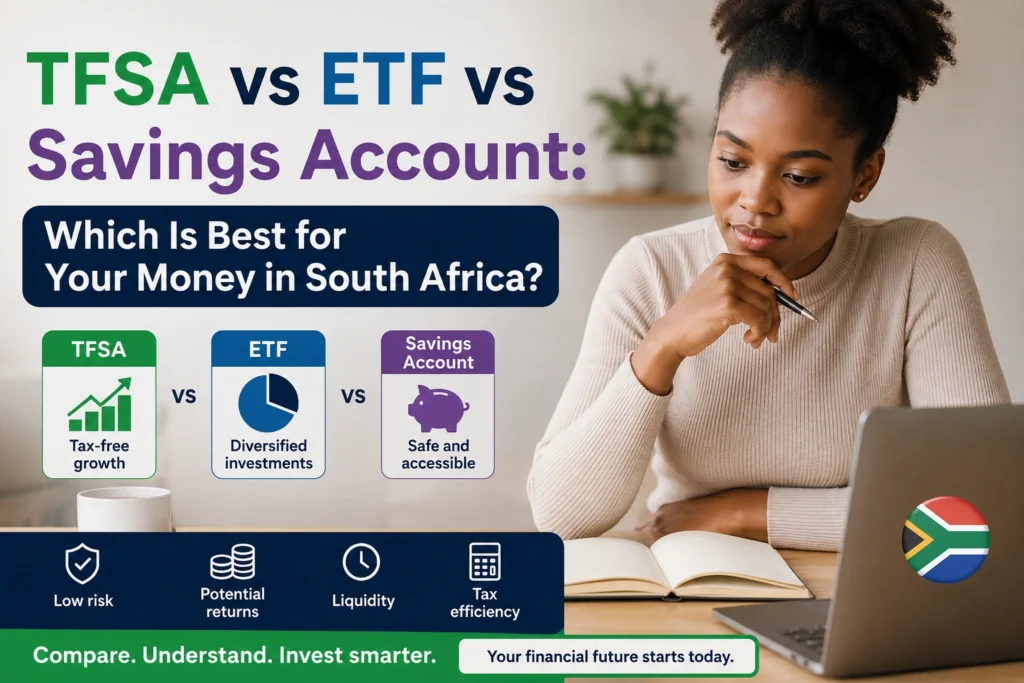

Choosing where to put your money can be surprisingly difficult. A savings account feels safe, an ETF offers the possibility of stronger long-term growth, while a Tax-Free Savings Account (TFSA) promises valuable tax advantages. The problem is that these products are often compared as if they are competing alternatives — when, in reality, they can serve completely different purposes.
For a South African trying to decide what to do with R500, R5,000 or R50,000, the important question is not simply “Which one has the highest return?” It is: What is this money for, when will I need it, and how much risk can I accept?
This guide explains TFSA vs ETF vs Savings Account in practical terms, including how each works, when it makes sense, the tax implications, common mistakes and how you can combine them into a sensible savings and investment strategy.
Important: This is general educational information, not personalised financial advice. Investment returns are not guaranteed, and your circumstances may require advice from a qualified financial adviser.
TFSA vs ETF vs Savings Account: What Are You Actually Comparing?
The first thing to understand is that these three terms do not describe exactly the same type of financial product.
A savings account is primarily a cash-saving vehicle. You deposit money with a bank and receive interest. Depending on the account, you may be able to access the money immediately or after giving notice.
An ETF (exchange-traded fund) is an investment fund that typically holds a basket of assets such as shares, bonds or other securities. ETFs can be bought and sold on a stock exchange and are commonly used by investors seeking long-term capital growth or diversified market exposure.
A TFSA is different. It is a tax-advantaged investment account, not necessarily a particular investment itself. SARS allows qualifying tax-free investments to include certain ETFs, unit trusts, fixed deposits and other approved investment products.
That distinction is crucial.
You can potentially have an ETF inside a TFSA. Therefore, comparing “TFSA vs ETF” can sometimes be like comparing a container with what you put inside the container.
A simple way to think about them
| Option | Main purpose | Risk | Potential growth | Access to money | Tax treatment |
|---|---|---|---|---|---|
| Savings account | Short-term saving/emergency cash | Low | Low to moderate | Usually easy | Interest may be taxable above exemption |
| ETF | Long-term investing | Moderate to high depending on ETF | Higher over long periods, but not guaranteed | Generally accessible, but market value fluctuates | Normal investment tax rules outside TFSA |
| TFSA | Tax-efficient long-term saving/investing | Depends on underlying investment | Depends on underlying investment | Withdrawals are allowed, but contributions cannot simply be restored | Growth, interest and dividends are tax-free within the rules |
The right choice therefore depends heavily on your goal.
ALSO APPLY FOR: Scania Learnership 2026
ALSO APPLY FOR: Liberty Learnership 2026
Why This Issue Matters
The decision can have a meaningful effect on your financial future.
Keeping all your money in cash may provide stability, but over long periods inflation can reduce what that money can actually buy. On the other hand, putting money needed next month into a volatile share-market investment can expose you to the risk of having to sell after a market decline.
Tax also matters.
For the 2027 South African tax year, which runs from 1 March 2026 to 28 February 2027, SARS states that the annual TFSA contribution limit is R46,000, while the lifetime contribution limit remains R500,000. Returns inside qualifying tax-free investments are exempt from income tax, dividends tax and capital gains tax.
This means your decision is not simply about interest versus investment returns. It is also about time horizon, risk, liquidity, inflation and tax efficiency.
1. When a Savings Account Makes the Most Sense
A savings account is usually the most appropriate starting point for money you may need relatively soon.
Think about:
- Emergency expenses
- Rent or household costs
- Medical or family emergencies
- A planned purchase within the next few months
- Money needed while you are between jobs
- Short-term financial goals
The major advantage is stability.
If you put R10,000 into a conventional savings account, you generally expect the capital to remain R10,000 while interest is added. An equity ETF, by contrast, could be worth less than R10,000 when you need the money.
That difference becomes extremely important when your investment horizon is short.
The downside
The main weakness is that your money may not grow quickly enough to stay ahead of inflation over long periods.
Interest earned in a normal savings account can also have tax implications. SARS currently provides an annual South African-source interest exemption of R23,800 for individuals under 65 and R34,500 for those aged 65 and older.
The exemption applies to qualifying interest and is not the same as the complete tax exemption available within a qualifying TFSA.
2. When an ETF Can Be the Better Choice
ETFs are particularly useful for people investing for long-term goals and who can tolerate market fluctuations.
For example, an ETF tracking a broad equity index can give an investor exposure to many companies through one investment instead of buying individual shares separately.
This can make ETFs attractive for goals such as:
- Building long-term wealth
- Retirement-related investing outside retirement products
- Investing for a child over many years
- Long-term financial independence
- Building a diversified investment portfolio
But ETFs are not savings accounts.
The value can rise and fall every day.
A 10-year investment horizon gives you more time to ride out market volatility than a six-month horizon. That does not guarantee a positive return, but it changes the risk you are taking.
Do not choose an ETF simply because its past return looks impressive
Different ETFs have different objectives.
Before investing, check:
- What index or assets does it track?
- Is it local or offshore?
- What are the annual fees?
- How diversified is it?
- Is the fund accumulating or distributing income?
- How liquid is it?
- What tax consequences apply?
- Does it match your investment timeframe?
A low-cost, diversified ETF may be useful for a long-term investor, but “ETF” alone does not tell you whether an investment is suitable.
3. Why a TFSA Can Be Powerful
The biggest advantage of a TFSA is the tax treatment.
SARS states that qualifying returns inside a tax-free investment are exempt from income tax, dividends tax and capital gains tax.
This can make a TFSA particularly valuable when used for long-term compounding.
Imagine, purely as an illustration, that you invest money into a qualifying TFSA and the investment generates dividends and capital growth over many years. You do not pay normal income tax, dividends tax or CGT on qualifying returns inside the account.
However, there is an important limit: the TFSA itself does not determine investment risk.
A TFSA holding a cash-based product can behave very differently from a TFSA holding an equity ETF.
So the better question is often:
“Which investment should I hold inside my TFSA?”
rather than simply:
“Should I choose a TFSA or an ETF?”
TFSA vs ETF vs Savings Account: Which One Should You Choose?
A practical decision framework looks like this:
Choose a savings account if:
- You may need the money soon.
- You are building an emergency fund.
- Losing capital would cause a serious financial problem.
- Your priority is accessibility and stability.
Consider an ETF if:
- Your goal is long term.
- You understand that markets can fall.
- You can leave the money invested during downturns.
- You want diversified exposure to financial markets.
Consider a TFSA if:
- You are investing for the long term.
- You want to make use of South Africa’s tax-free investment allowance.
- You can leave the investment growing for years.
- You want to shelter qualifying investment returns from income tax, dividends tax and CGT.
And importantly, you may use all three.
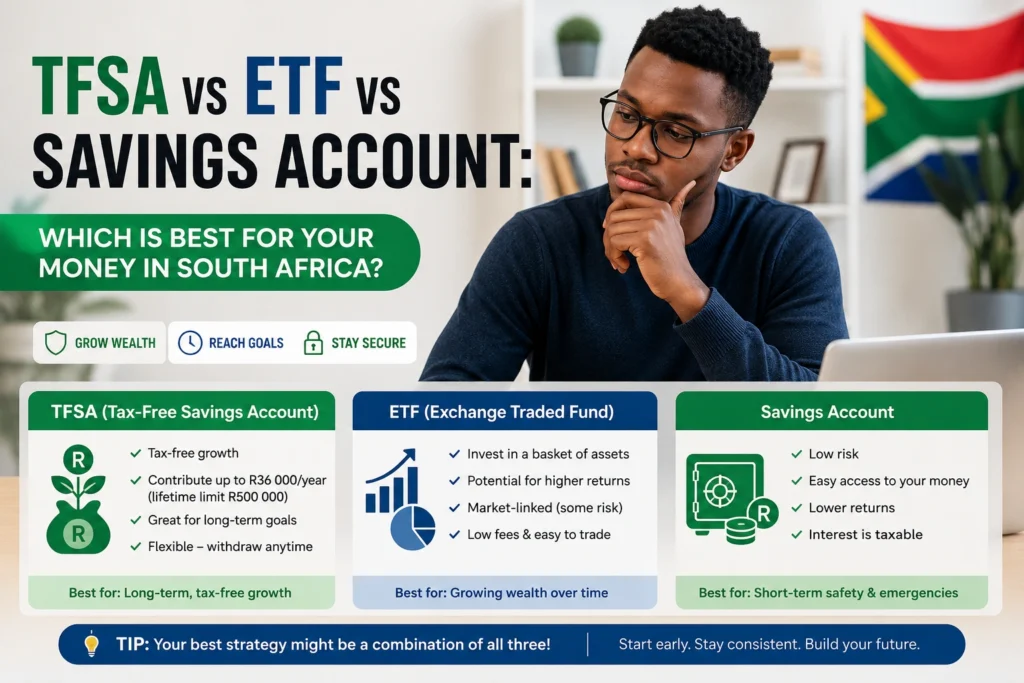
ALSO READ ABOUT: What Is a TFSA
A Practical Step-by-Step Strategy
Step 1: Define the purpose of the money
Do not invest before answering this question.
Ask:
“When am I likely to need this money?”
If the answer is within months, cash may be more appropriate.
If the answer is 10 or 20 years, long-term investments become more relevant.
Step 2: Build your financial safety net
Before aggressively investing, consider creating an emergency fund.
A person with no emergency savings may be forced to sell investments during a market downturn when an unexpected expense arrives.
A savings account can therefore play an important defensive role in your financial plan.
Step 3: Separate short-term and long-term money
Do not treat all your money as one pool.
For example:
Short-term money: savings account.
Long-term investment money: ETF or other suitable investment.
Tax-efficient long-term money: qualifying investment held inside a TFSA.
This separation makes financial decisions much easier.
Step 4: Use your TFSA allowance deliberately
From 1 March 2026, the annual TFSA contribution limit is R46,000 and the lifetime limit is R500,000.
Unused annual contribution space is not carried forward. SARS also states that exceeding the annual or lifetime contribution limits can result in a 40% tax charge on the excess contribution.
That makes record-keeping important.
If you have multiple TFSAs, remember that the annual limit applies to your total contributions across them, not R46,000 per account.
Step 5: Choose the investment inside the TFSA carefully
Do not assume every TFSA offers the same investment options.
Some may offer interest-bearing products, while others may offer unit trusts or qualifying ETFs.
Compare:
- Fees
- Investment choices
- Platform charges
- Withdrawal rules
- Ease of making contributions
- Minimum investment amounts
- Long-term suitability
Step 6: Automate your contributions
A small monthly contribution can be easier to maintain than waiting until the end of the year.
For example, someone targeting R24,000 a year could contribute approximately R2,000 a month.
The objective is not to create a perfect investment strategy on day one. It is to develop a sustainable habit.
Best Practices Experts Recommend
A sensible approach generally starts with matching the product to the purpose of the money.
Keep emergency money separate
Your emergency fund should not depend on the stock market being positive when you need it.
Think in years, not weeks
ETFs are generally more suitable for investors who can tolerate market volatility and remain invested for the long term.
Prioritise diversification
Instead of trying to predict which single company will perform best, diversified funds can spread exposure across multiple securities.
Pay attention to fees
A seemingly small annual fee can have a meaningful effect on long-term wealth because fees reduce the money available for compounding.
Use tax advantages where appropriate
A TFSA can be particularly valuable because qualifying investment returns are sheltered from income tax, dividends tax and CGT.
Keep records of TFSA contributions
Track contributions across every TFSA you hold.
This helps prevent accidental over-contributions.
Avoid emotional investing
Markets will sometimes fall.
Selling purely because prices have dropped can turn a temporary decline into a permanent loss.
Your investment strategy should therefore be based on your goal and timeframe rather than the latest market headline.
Mistakes People Often Make
Mistake 1: Treating a TFSA as an investment
A TFSA is an account structure. The underlying investment determines much of the risk and expected return.
Mistake 2: Putting emergency savings into equities
If you need the money next month, a market-linked investment may be inappropriate because its value could be lower when you need it.
Mistake 3: Assuming ETFs always make money
ETFs can fall in value. Diversification reduces certain risks but does not eliminate investment risk.
Mistake 4: Chasing the highest interest rate
A high savings rate may look attractive, but check whether it comes with conditions such as minimum balances, notice periods or promotional periods.
Mistake 5: Ignoring fees
Two investments with similar market exposure can produce different outcomes because of differences in fees.
Mistake 6: Exceeding the TFSA limit
Do not assume you can contribute R46,000 to every TFSA you have. The annual limit applies collectively. Excess contributions can trigger a 40% tax charge.
Mistake 7: Withdrawing from a TFSA casually
A withdrawal does not simply restore your contribution room. Reinvesting withdrawn money can count as a new contribution and affect your annual and lifetime limits.
A Simple Example
Suppose you have R30,000 available.
You might divide your thinking into three questions:
Do I need the money soon?
If yes, consider keeping an appropriate portion in a savings account.
Is this money for a long-term goal?
If yes, a diversified investment such as an ETF may be worth considering.
Can I invest it within my available TFSA contribution allowance?
If yes, consider whether a suitable qualifying investment inside a TFSA could provide greater tax efficiency.
The key point is that these choices do not necessarily have to compete.
A person could have:
- A savings account for emergencies.
- A TFSA invested for long-term wealth building.
- A normal investment account holding ETFs after using available TFSA capacity.
That can be more logical than trying to force every rand into one product.
Frequently Asked Questions
Is a TFSA better than an ETF?
They are not directly equivalent. A TFSA is a tax-advantaged account, while an ETF is an investment product. A qualifying ETF can potentially be held inside a TFSA, subject to the provider and product rules.
Can I have both a TFSA and a savings account?
Yes. They can serve different purposes. A savings account can provide accessible emergency cash, while a TFSA can be used for longer-term tax-efficient investing.
Is an ETF safer than a savings account?
Generally, no. A savings account normally provides much greater short-term capital stability, while ETFs can fluctuate significantly in value. However, the risk of inflation eroding purchasing power is also important over long periods.
How much can I put into a TFSA in South Africa?
For the tax year beginning 1 March 2026, SARS states that the annual contribution limit is R46,000, while the lifetime contribution limit is R500,000 per person.
Final Takeaway: Don’t Ask Which Product Is “Best” — Ask What the Money Is For
The biggest lesson from the TFSA vs ETF vs Savings Account debate is that there is no universal winner.
A savings account can be valuable because it provides stability and liquidity. An ETF can be useful for long-term market exposure and wealth building. A TFSA can improve tax efficiency by protecting qualifying investment returns from income tax, dividends tax and capital gains tax.
The smartest strategy may involve using all three for different jobs.
Start by building appropriate emergency savings. Then identify your long-term goals. Once you know when you will need the money, decide how much investment risk you can realistically handle. Finally, investigate whether a TFSA can be used to hold a suitable long-term investment within your available contribution limits.
For South African investors, the tax-free allowance is particularly worth understanding: the annual TFSA limit is now R46,000 from 1 March 2026, with a R500,000 lifetime contribution limit.
Most importantly, don’t choose an investment because it sounds popular or promises the highest return. Choose based on time horizon, risk, liquidity, fees, diversification and tax efficiency.
ALSO READ ABOUT: Understanding Taxes
ALSO APPLY FOR: Scania Learnership 2026
ALSO APPLY FOR: Liberty Learnership 2026