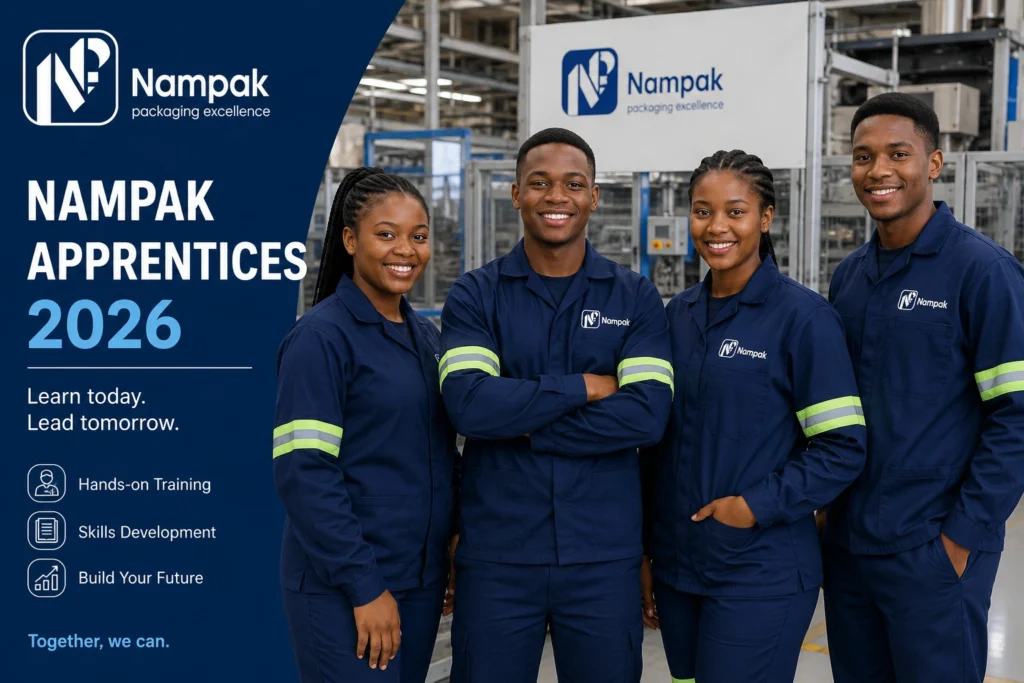

For young South Africans trying to break into engineering, the hardest part is often not choosing a career path. It is finding an opportunity that allows them to turn classroom knowledge into genuine workplace experience.
That is why the Nampak Apprentices 2026 opportunity is attracting attention. Nampak has opened six engineering apprenticeship positions at its Metals Vanderbijlpark operation in Gauteng, giving eligible unemployed youth an opportunity to develop practical skills while working towards engineering trades.
The application window is relatively short. Interested candidates have until 28 August 2026 to apply.
The opportunity is particularly relevant for applicants who already have NTC3-level technical training, because this is not simply an entry-level programme for anyone with Matric. Nampak is looking for candidates who have already started building a technical foundation and can demonstrate knowledge in relevant engineering subjects.
What Is Behind the Nampak Apprentices 2026 Opportunity?
Apprenticeships occupy an important space in South Africa’s skills-development landscape.
A university qualification can open one route into engineering, but technical trades such as mechanical fitting, electrical work and fitting and turning depend heavily on practical competence. An apprentice needs to understand theory, but also learn how equipment behaves in an actual industrial environment.
That distinction matters.
The Nampak Engineering Apprenticeship Programme 2026 is being offered through the company’s Metals Vanderbijlpark operation and sits within the Engineering Department. Six opportunities are available in total:
- Mechanical Fitter – 2 positions
- Electrical – 2 positions
- Fitter & Turner – 2 positions
Successful candidates will receive theoretical and practical workplace training as they develop the skills associated with their respective trades.
For someone who has completed NTC3 but has struggled to secure an opportunity to gain industrial exposure, that combination could be particularly valuable.
The programme therefore sits at an important point between education and employment: it gives technically trained young people a chance to demonstrate that they can apply what they have learned in a working environment.
Why This Matters Right Now
South Africa’s youth employment challenge makes apprenticeship opportunities especially significant.
Having Matric is often not enough to secure a first job. At the same time, many employers want candidates who can demonstrate technical knowledge, workplace discipline and some form of practical exposure.
That creates a frustrating cycle.
A young person needs experience to get a job, but often needs a job or structured training programme to obtain that experience.
Engineering apprenticeships can help break that cycle.
The Nampak Apprentices 2026 programme is therefore more than six vacancies on an application page. It represents a structured route for technically inclined young people to move from NTC-level learning towards occupational competence.
There is also a practical reason why the opportunity deserves attention. Manufacturing operations depend on engineering teams to keep machinery, electrical systems and production equipment functioning safely and efficiently. Mechanical fitters, electricians and fitter-and-turners all contribute to that wider industrial environment.
This means the skills being developed are closely connected to real workplace requirements.
The Requirements Are More Specific Than They First Appear
One of the biggest mistakes applicants make with apprenticeship advertisements is reading only the word “Matric” and assuming they qualify.
The Nampak opportunity goes further.
Applicants should have Matric with Mathematics and Physical Science, together with English as a second language. The required Matric subjects should have been passed with a minimum mark of 50%.
Candidates should also have NTC3 or higher, including relevant trade theory as a subject at NTC3 level.
That requirement changes the applicant pool considerably.
This is not an opportunity aimed at every unemployed school leaver. It is more specifically suited to candidates who have already taken steps towards technical or engineering training.
Applicants are also expected to provide a certificate and transcript showing their NTC3 results. Basic engineering understanding and basic computer literacy are additional requirements.
In practical terms, the ideal applicant is someone who can show both academic preparation and an interest in technical work.
What the Three Trades Could Mean for Applicants
The three available trade categories provide an interesting picture of the kind of technical skills Nampak is seeking.
Mechanical Fitter
Mechanical fitters work with machinery and mechanical systems. Their training can involve understanding components, maintenance procedures, installation, alignment and troubleshooting.
For candidates who enjoy working with machines and solving mechanical problems, this could be a natural fit.
It is also a trade where practical accuracy matters. A theoretical understanding of machinery is useful, but industrial environments require technicians who can follow procedures, identify faults and work carefully.
Electrical
The two electrical apprenticeship positions are likely to appeal to candidates with an interest in electrical systems, equipment and industrial maintenance.
Electrical work requires strong attention to detail and a serious approach to safety. Candidates should not view the apprenticeship simply as a way to get workplace experience; they should understand that engineering environments involve rules, procedures and responsibilities.
Fitter & Turner
Fitter and turner training combines mechanical fitting with machining-related skills.
It can suit applicants who enjoy precision work and have an interest in how engineering components are manufactured, maintained or repaired.
Across all three trades, the common thread is practical problem-solving.
Recent Development: Six Places, But Potentially Many Applicants
The announcement of only six positions is one reason candidates should approach the application carefully.
There are two mechanical fitter positions, two electrical positions and two fitter-and-turner positions. That means applicants are competing for a very limited number of places.
It would be unrealistic to suggest that every qualifying applicant will have a strong chance of selection.
Instead, candidates should concentrate on what they can control.
That begins with meeting every requirement and submitting the correct supporting documentation.
An applicant with NTC3 who forgets to provide the transcript, for example, could create an avoidable problem. Likewise, a candidate who does not meet the Mathematics, Physical Science or minimum-mark requirements should not assume that a strong CV will compensate for missing eligibility criteria.
The six available places make precision particularly important.
Public Reaction: Why Apprenticeships Continue to Attract Attention
There is a broader reason apprenticeship announcements regularly generate interest among South African job seekers.
Young people are increasingly looking beyond traditional university pathways. Technical education, occupational training and apprenticeships can offer alternative routes into industries where practical competence is highly valued.
For many applicants, the attraction is straightforward: they want a qualification or trade pathway that connects directly to workplace skills.
The Nampak opportunity reflects that demand.
At the same time, applicants should remain realistic. An apprenticeship is not a guaranteed permanent job. Completing training can strengthen a candidate’s technical profile, but future employment depends on performance, available opportunities, qualifications and employer requirements.
That distinction is important because responsible career advice should focus on what an opportunity actually promises rather than presenting every apprenticeship as a guaranteed career.
ALSO VISIT: https://www.nampak.com
Who Should Apply?
The strongest candidates are likely to be those who can answer three questions positively.
Do I meet the academic requirements?
The applicant should have Matric, Mathematics, Physical Science and the required minimum marks, as well as NTC3 or higher.
Do I have relevant technical preparation?
The NTC3 requirement means candidates should already have a technical foundation connected to the trade.
Do I genuinely want to work in an engineering environment?
This matters because apprenticeship training can involve practical work, workplace rules, technical procedures and ongoing learning.
Someone applying simply because “Nampak is hiring” may not be as well prepared as someone who understands why mechanical fitting, electrical work or fitting and turning interests them.
How to Apply
Applications must be submitted by email to:
ALSO APPLY FOR: BME Apprentice 2026
What Could Happen Next?
The immediate priority is the 28 August 2026 closing date.
After applications close, the recruitment process could move towards screening and selection of candidates who meet the stated requirements. Applicants should therefore keep their phones and email accounts monitored after submitting their applications.
Candidates should also retain copies of everything they submit.
The longer-term outcome is more interesting.
For successful apprentices, the programme could become an important bridge between technical education and industrial experience. Exposure to an established manufacturing operation can help candidates understand the standards expected in a professional engineering environment.
For Nampak, apprenticeships can also contribute to developing technical skills within its operations.
The success of the programme will ultimately depend on how effectively apprentices are trained, supported and assessed during their workplace experience.
Application Strategy: Do Not Leave This Until the Last Day
Applicants should approach the Nampak engineering apprenticeship application as a professional recruitment process.
Start by checking every requirement against your own qualifications.
Then gather your documentation, particularly the NTC3 certificate and transcript. Make sure the information on your documents is clear and consistent.
Your CV should be concise and focused on technical education, relevant subjects, practical exposure and engineering-related abilities. There is no need to fill it with unrelated information simply to make it longer.
Before sending the application, check the email address and instructions provided in the official vacancy notice.
Most importantly, do not wait until 28 August if you can apply earlier.
Technical recruitment opportunities can attract large numbers of applications, and leaving the process until the deadline creates unnecessary pressure.
Common Mistakes Applicants Should Avoid
Several mistakes can weaken an otherwise eligible application.
The first is ignoring the NTC3 requirement. Matric alone does not appear to meet the stated technical requirement.
The second is failing to provide proof of qualifications. The advertisement specifically refers to the certificate and transcript showing NTC3 results.
The third is using a generic CV. An engineering apprenticeship application should make relevant technical education easy to identify.
Another mistake is applying for a trade without understanding what the work involves.
Candidates should think carefully about whether they are more interested in mechanical systems, electrical work or fitting and machining.
Finally, applicants should avoid assuming that being unemployed automatically makes them eligible. The stated academic and technical requirements still apply.
A Strong Opportunity, But Not a Shortcut
The Nampak Engineering Apprenticeship Programme 2026 is worth taking seriously, particularly for South African youth who already have NTC3-level technical training and want to develop practical engineering skills.
But it should not be marketed as a shortcut to guaranteed employment.
There are only six opportunities.
Competition is therefore likely to be meaningful, and eligibility alone will not necessarily secure selection. Candidates need to present themselves professionally, provide accurate documentation and demonstrate genuine interest in their chosen trade.
For those who do succeed, however, the opportunity could be significant.
Mechanical fitting, electrical work and fitting and turning are practical disciplines that require technical knowledge, precision and workplace competence. Developing those capabilities in an industrial environment can give an apprentice a much clearer understanding of what a technical career actually demands.
Final Assessment
The Nampak Apprentices 2026 opportunity stands out because it offers something many technically trained young South Africans are looking for: a chance to move beyond classroom theory and develop practical workplace capability.
With six positions available in Vanderbijlpark—two Mechanical Fitter, two Electrical and two Fitter & Turner—the programme is small, which means applicants should take the requirements seriously.
The closing date is 28 August 2026.
For eligible candidates, the sensible approach is simple: check the requirements, prepare the NTC3 certificate and transcript, tailor the CV, follow the application instructions carefully and submit before the deadline.
The opportunity may be limited to six apprentices, but for the successful candidates, it could represent an important first step into South Africa’s engineering and manufacturing sector.