
Every year, thousands of engineering graduates leave university with solid theoretical knowledge but face the same difficult question: How do you gain experience when every employer asks for experience first?
It’s a challenge that many young South Africans know all too well. A graduate may have spent years studying production systems, lean manufacturing, quality management and industrial engineering principles, only to discover that breaking into the country’s competitive manufacturing sector requires far more than academic results.
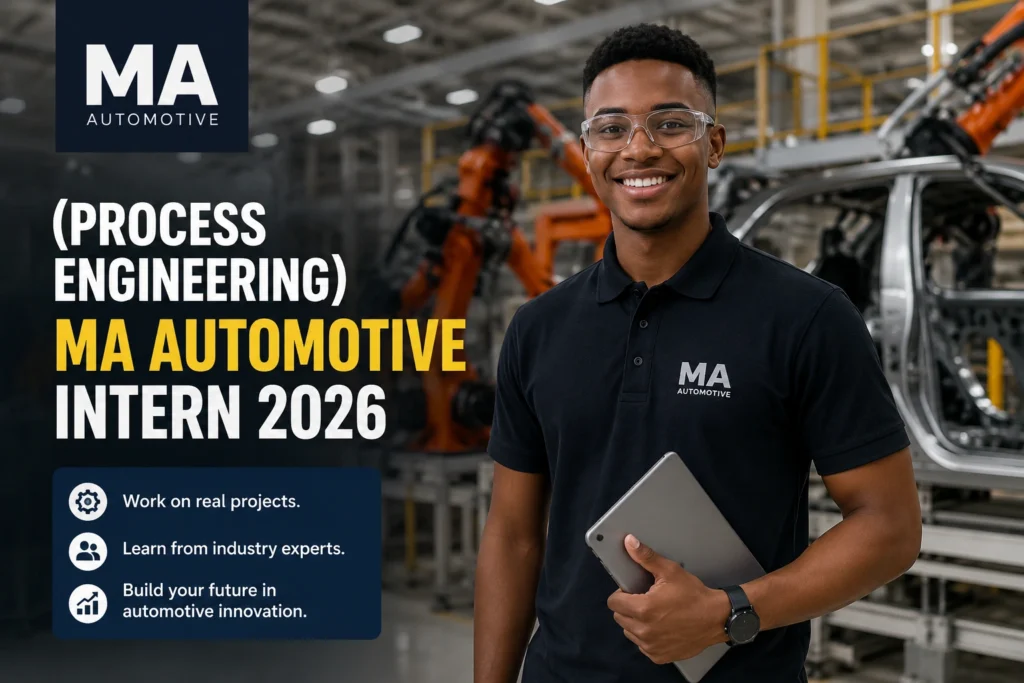
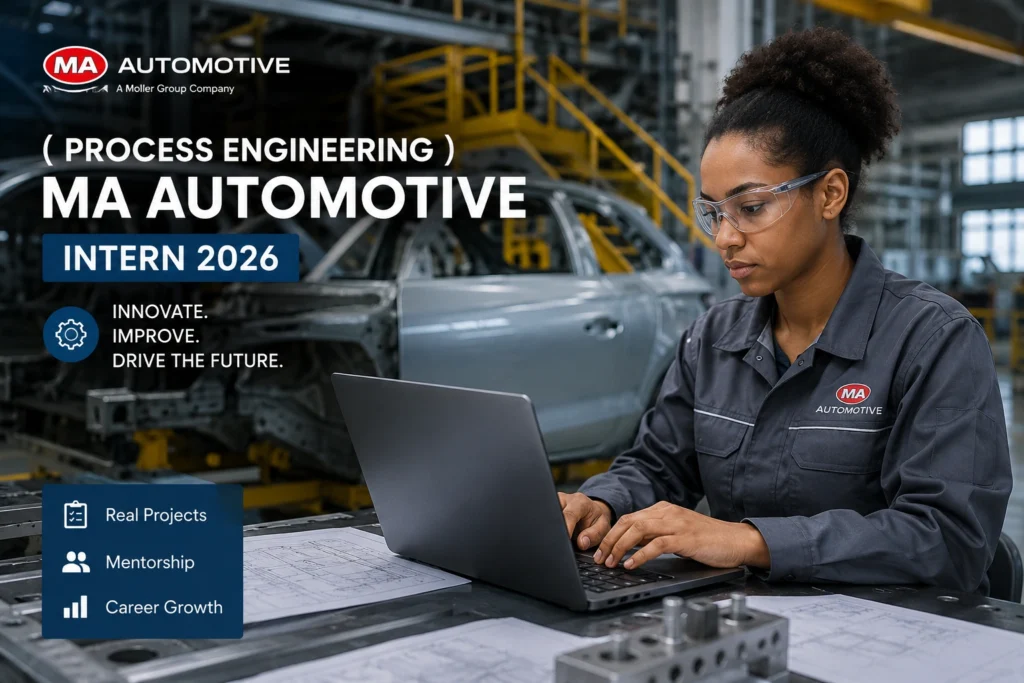
That is why opportunities like the Process Engineering MA Automotive Intern 2026 deserve attention. Rather than offering classroom learning alone, this 12-month internship places an industrial engineering graduate inside a real automotive manufacturing environment where production efficiency, quality standards and continuous improvement are everyday priorities.
MA Automotive Tool and Die has opened applications for its latest process engineering internship at its Rosslyn headquarters in Pretoria, with applications closing on 31 July 2026. Although the company has not disclosed the internship stipend, the experience itself could become a valuable stepping stone into one of South Africa’s most advanced manufacturing industries.
Why the Process Engineering MA Automotive Intern 2026 matters
South Africa’s automotive industry remains one of the country’s strongest manufacturing sectors. Vehicle production supports thousands of direct and indirect jobs while supplying both local buyers and international export markets.
Factories producing automotive components operate under demanding production schedules where even small process improvements can reduce costs, improve quality and increase productivity. This is exactly where industrial engineers make a difference.
The Process Engineering MA Automotive Intern 2026 gives one graduate an opportunity to experience this environment firsthand.
Rather than learning from textbooks, the successful candidate will spend a full year observing production systems, supporting manufacturing processes and understanding how engineering decisions influence efficiency on the factory floor.
For graduates who eventually hope to become production engineers, operations managers, manufacturing specialists or continuous improvement professionals, this type of exposure can be difficult to replace.
Inside MA Automotive’s manufacturing environment
MA Automotive Tool and Die is well known within South Africa’s automotive supply chain for producing steel and aluminium stampings and assemblies used by vehicle manufacturers.
Unlike many manufacturing businesses that serve only local customers, automotive suppliers frequently operate according to global production standards. Components manufactured in Rosslyn may ultimately become part of vehicles sold across international markets.
That creates constant pressure to improve:
- Production efficiency
- Product quality
- Manufacturing consistency
- Workplace safety
- Cost management
Process engineering exists to solve these challenges.
Although the internship advertisement does not describe daily responsibilities in detail, graduates can reasonably expect to gain insight into production workflows, manufacturing systems, process optimisation and engineering problem-solving.
These are practical skills that employers across manufacturing industries continue to value.
Who should consider applying?
The academic requirement is refreshingly straightforward.
Applicants must have completed a National Qualifications Framework (NQF) Level 7 Bachelor of Engineering Technology in Industrial Engineering.
That qualification forms the foundation of the internship because process engineering relies heavily on analytical thinking, production planning and manufacturing optimisation.
The company also asks applicants whether they have previously completed an internship.
Importantly, the advertisement does not state that previous internship participation automatically disqualifies candidates. Graduates should therefore answer honestly rather than assuming they no longer qualify.
Beyond qualifications, MA Automotive is looking for individuals who demonstrate personal qualities that often determine success in manufacturing environments.
These include:
- Self-motivation
- Independence
- Good people-management skills
- Strong Microsoft Office knowledge
- Accountability for individual performance
These characteristics matter because engineering work rarely involves technical knowledge alone. Process engineers frequently collaborate with production teams, technicians, supervisors and quality personnel to solve operational problems.
More than grades: what employers really notice
Many graduates believe their university marks will determine whether they receive an interview.
Academic performance certainly matters, but employers increasingly look for evidence that candidates can apply knowledge to real situations.
For industrial engineering graduates, this means demonstrating practical thinking.
Instead of simply listing completed university modules, applicants should explain projects where they:
- Analysed manufacturing processes
- Reduced waste
- Improved workflow
- Used engineering software
- Collected operational data
- Applied lean manufacturing techniques
- Solved production problems
- Worked successfully in project teams
Recruiters often remember practical examples far more easily than long lists of subjects completed during university.
A well-written curriculum vitae tells the story of how an applicant approaches engineering challenges rather than simply proving they attended lectures.
The automotive sector continues evolving
The timing of this internship is significant.
South Africa’s automotive manufacturing industry continues adapting to changing technologies, stricter quality requirements and increasing pressure for operational efficiency.
Manufacturers are investing in smarter production methods, digital monitoring systems and continuous improvement strategies to remain globally competitive.
That creates growing demand for graduates who understand both engineering principles and practical manufacturing realities.
Industrial engineers increasingly work alongside automation specialists, production planners, quality engineers and data analysts.
An internship inside an established automotive supplier therefore offers exposure to an industry undergoing rapid transformation.
Graduates entering today are unlikely to spend their careers doing exactly what previous generations of engineers did.
Instead, they are entering workplaces where data, technology and process optimisation play increasingly important roles.
Expert insight: Why process engineering experience carries long-term value
One of the overlooked advantages of process engineering internships is that they develop transferable skills rather than company-specific knowledge.
A graduate who learns how to analyse production bottlenecks, improve workflow, reduce waste and support quality systems can apply those principles across numerous industries—including food manufacturing, mining, pharmaceuticals, logistics and consumer goods.
In other words, while MA Automotive operates within vehicle manufacturing, the engineering mindset developed during the internship can remain valuable throughout an entire career.
Employers often hire experienced process engineers because they know how to improve systems rather than simply operate them.
Preparing a stronger application
Because applications close shortly after the vacancy opened, preparation becomes especially important.
Applicants should avoid rushing through the online form at the last minute.
Before beginning the application, it helps to prepare:
- An updated CV
- A professional cover letter
- Academic transcript
- Qualification certificates
- Identification document or passport
- Accurate employment history
- Professional profile photograph (PNG, JPG or JPEG under 2 MB)
Equally important is ensuring uploaded files have clear names that recruiters can recognise easily.
For example:
- Surname_Name_CV.pdf
- Surname_Name_Transcript.pdf
- Surname_Name_Degree.pdf
Small organisational details demonstrate professionalism before anyone even opens the documents.
APPLY HERE: MA Automotive Intern 2026
ALSO APPLY FOR: Ericsson Graduate Intern 2026
Rosslyn remains one of South Africa’s manufacturing centres
The internship is based in Rosslyn, north of Pretoria, a region that has become synonymous with automotive manufacturing.
Over several decades, Rosslyn has attracted major manufacturers and component suppliers, creating an industrial ecosystem where engineering, logistics and advanced manufacturing intersect.
For graduates, working within this environment offers exposure beyond a single employer.
Daily interaction with production systems, suppliers, quality standards and manufacturing operations provides insights into how South Africa’s broader automotive value chain functions.
That experience can strengthen future applications across the manufacturing sector.
Looking beyond the internship itself
Graduates sometimes focus exclusively on whether an internship guarantees permanent employment.
While permanent positions are never guaranteed unless explicitly stated, that perspective can overlook the broader value of professional experience.
Employers recruiting graduate engineers often compare candidates who have:
- University qualifications only
versus
- University qualifications plus practical manufacturing exposure.
Even a one-year internship can significantly improve future employability because candidates gain examples they can discuss during interviews.
Questions like:
“Tell us about a production problem you helped solve.”
become much easier to answer after spending time inside a working manufacturing operation.
That practical confidence frequently distinguishes graduates competing for similar positions.
Frequently Asked Questions
Does the internship require an Industrial Engineering qualification?
Yes. Applicants must have completed an NQF Level 7 Bachelor of Engineering Technology in Industrial Engineering.
Is a monthly stipend mentioned?
No. The vacancy advertisement does not disclose a stipend amount.
When do applications close?
Applications close on 31 July 2026, making early submission advisable.
Final thoughts
The Process Engineering MA Automotive Intern 2026 is more than another graduate opportunity—it reflects the continuing importance of practical engineering skills within South Africa’s manufacturing economy.
Industrial engineering graduates often spend years developing analytical abilities, learning about production systems and studying process optimisation. Opportunities like this provide the missing link between academic theory and industrial practice.
While only one internship cannot solve the broader challenge of graduate unemployment, programmes like this remain an important pathway into industries where technical expertise continues to drive innovation, productivity and competitiveness.
For graduates who meet the qualification requirements and hope to build careers in automotive manufacturing, applying before the deadline could represent the beginning of a much larger professional journey.