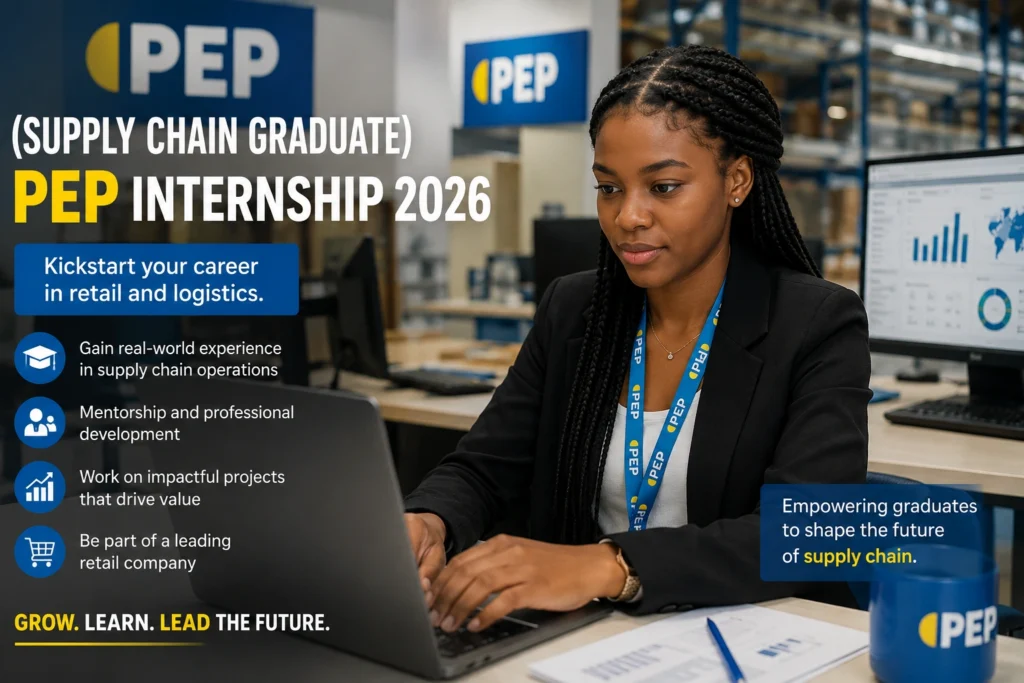

A graduate sits in front of a laptop on a Tuesday afternoon, refreshing job websites while checking emails for interview invitations that never seem to arrive. The qualification is complete, the CV has been updated several times, and dozens of applications have already disappeared into online recruitment systems without a response. Then a new opportunity appears: the (Supply Chain Graduate) PEP Internship 2026. The problem is that the application closes in only a few days.
That situation is familiar to thousands of South African graduates. Every year, many complete diplomas and degrees in logistics, supply chain management and operations management, yet securing meaningful workplace experience remains one of the biggest hurdles before entering the labour market.
PEP’s latest graduate internship arrives at a time when practical experience is becoming almost as valuable as formal qualifications. For graduates between the ages of 18 and 32, the programme represents more than another vacancy—it is an opportunity to step inside one of South Africa’s largest retail operations and understand how products move from suppliers to shelves across the country.
With applications closing on 17 July 2026, eligible graduates have little time to prepare.
Why the (Supply Chain Graduate) PEP Internship 2026 deserves attention
Graduate internships are often viewed simply as temporary contracts, but retail internships can provide exposure to one of the country’s most complex business environments.
Every item stocked in a PEP store has travelled through multiple stages before reaching customers. Planning inventory, managing suppliers, forecasting demand, coordinating warehouses and ensuring deliveries happen on schedule all form part of an enormous supply chain that operates behind the scenes.
That means graduates joining this internship are likely to see how classroom concepts translate into everyday business decisions.
Unlike many graduate opportunities that quietly expect previous work experience despite advertising entry-level positions, the published requirements for this internship focus on education, potential and personal qualities instead.
For recent graduates who have struggled to obtain their first professional opportunity, that distinction matters.
South Africa’s retail supply chains are changing rapidly
Supply chains have become one of the most important functions inside modern retail businesses.
Consumer expectations continue to evolve. Customers expect products to be available, prices to remain competitive and deliveries to happen efficiently. Behind those expectations sits an increasingly sophisticated logistics network supported by technology, forecasting tools and operational planning.
South African retailers have also had to adapt to challenges including:
- transport disruptions
- rising operating costs
- changing consumer buying patterns
- digital inventory management
- increasing demand for operational efficiency
As a result, companies continue investing in graduates who understand both business operations and modern supply chain principles.
The (Supply Chain Graduate) PEP Internship 2026 reflects that broader industry trend.
More than warehouse work: Understanding modern supply chain careers
One of the biggest misconceptions among graduates is that supply chain careers are limited to warehouses or transport.
In reality, modern supply chain professionals contribute to almost every stage of retail operations.
Depending on business needs, graduates may gain exposure to areas such as:
- inventory planning
- procurement support
- logistics coordination
- distribution operations
- demand forecasting
- supplier management
- operational reporting
- process improvement
Retail organisations increasingly rely on data-driven decision-making. Computer literacy, familiarity with Microsoft Office and digital collaboration tools such as Google Suite are therefore becoming basic workplace expectations rather than optional skills.
PEP specifically lists computer literacy among its minimum requirements, highlighting how technology now forms part of everyday operational work.
What applicants need to know before applying
The internship has been advertised as a 12-month fixed-term graduate programme based in the Northern Suburbs of Cape Town.
Published details include:
Organisation: PEP
Programme: Supply Chain Graduate Internship
Reference Number: PEP-2808
Contract Duration: 12 months
Work Level: Student/Graduate
Location: Northern Suburbs, Cape
Closing Date: 17 July 2026
Salary: Market-related
Eligible applicants should:
- Be South African citizens.
- Be between 18 and 32 years old.
- Hold a degree or diploma in Supply Chain Management, Logistics or Operations Management.
- Be computer literate.
- Demonstrate strong written and verbal communication.
- Show willingness to learn and work independently.
The relatively straightforward eligibility criteria mean competition is likely to be strong.

The documents that often determine whether applications succeed
One overlooked reality of graduate recruitment is that many applications fail long before recruiters evaluate qualifications.
Administrative issues remain one of the most common reasons applications become incomplete.
PEP requires supporting documentation that includes:
- Updated CV
- Certified ID copy
- Certified Matric certificate
- Certified qualification or latest academic transcript
Certification dates matter.
Many employers require certified copies issued within the previous three months, and outdated certifications may result in applications being regarded as incomplete.
Graduates should also ensure scanned documents are legible, correctly oriented and clearly labelled before uploading them.
Small preparation mistakes can become major obstacles during short recruitment windows.
APPLY HERE: PEP Internship 2026
ALSO APPLY FOR: Swiss Re Internships 2026
Looking beyond qualifications
Retail employers increasingly recruit for attitude as much as technical ability.
PEP highlights qualities including integrity, cooperation, flexibility, planning ability, initiative and willingness to learn.
These are not simply desirable personality traits.
Large retail operations depend on teams working across departments where communication and reliability directly affect business performance.
Graduates sometimes underestimate how effectively they can demonstrate these qualities.
Volunteer work, student leadership roles, academic group projects, tutoring experience or organising campus events can all provide evidence of planning, teamwork and accountability.
Recruiters often look for examples rather than adjectives.
Saying “I am hardworking” carries less weight than describing how you coordinated a university logistics project or balanced studies with part-time responsibilities.
Expert insight: Why graduate internships matter more than ever
South Africa’s graduate employment landscape continues to evolve.
Many employers now expect applicants to possess workplace experience before entering permanent positions. This creates a difficult cycle for first-time job seekers.
Graduate internships help bridge that gap.
For employers, internships reduce recruitment risk by allowing organisations to develop talent within their own operational environment.
For graduates, they provide practical exposure that strengthens future job applications.
In supply chain professions particularly, understanding how theoretical concepts operate inside real distribution networks often becomes a decisive advantage during later recruitment.
The value of an internship therefore extends well beyond twelve months of employment.
Timing could be the biggest challenge
Perhaps the most unusual aspect of the (Supply Chain Graduate) PEP Internship 2026 is the short application period.
Published on 13 July with applications closing on 17 July, candidates have only a limited number of days to prepare.
That compressed timeline creates pressure.
Graduates who wait until the final evening may encounter internet problems, document upload errors or difficulties obtaining certified copies.
Experienced recruiters consistently advise submitting applications several days before deadlines whenever possible.
Early submissions also provide time to correct unexpected technical issues if necessary.
Retail remains one of South Africa’s largest graduate employers
Retail may not always receive the same attention as engineering, finance or technology sectors, but it continues to employ thousands of South Africans across multiple professional disciplines.
Behind every successful retail store sits an extensive operational network requiring expertise in:
- planning
- logistics
- inventory management
- procurement
- forecasting
- data analysis
- distribution
Graduate internships therefore offer exposure to industries that remain fundamental to South Africa’s economy.
Companies such as PEP operate nationwide, creating supply chain systems that support stores across urban centres, townships and rural communities.
Understanding these operational environments can become valuable experience regardless of where graduates eventually build their careers.
Frequently Asked Questions
Who can apply for the (Supply Chain Graduate) PEP Internship 2026?
South African citizens aged 18–32 who hold a degree or diploma in Supply Chain Management, Logistics or Operations Management and meet the published requirements.
Does PEP require previous work experience?
The published minimum requirements do not list previous workplace experience, making the internship particularly suitable for recent graduates seeking their first professional opportunity.
When is the application deadline?
Applications close on 17 July 2026. Because the recruitment window is short, applicants should prepare documents and submit well before the deadline.
Looking at the bigger picture
Graduate internships often arrive quietly.
They rarely generate national headlines, yet for individual applicants they can become career-defining opportunities.
The (Supply Chain Graduate) PEP Internship 2026 is one of those programmes. It combines practical workplace exposure, industry relevance and accessible entry requirements at a time when many graduates continue searching for their first professional opportunity.
What makes this intake particularly important is not only the organisation behind it, but also the timing. The brief application window means preparation becomes just as important as eligibility.
For graduates who already meet the academic requirements, delaying until the final day could mean missing an opportunity that may significantly strengthen future employment prospects.
As South Africa continues investing in supply chain efficiency, logistics capability and retail operations, programmes like this help develop the skilled professionals needed to keep those systems moving.
For eligible graduates, acting promptly may prove to be the most important step of the entire application process.