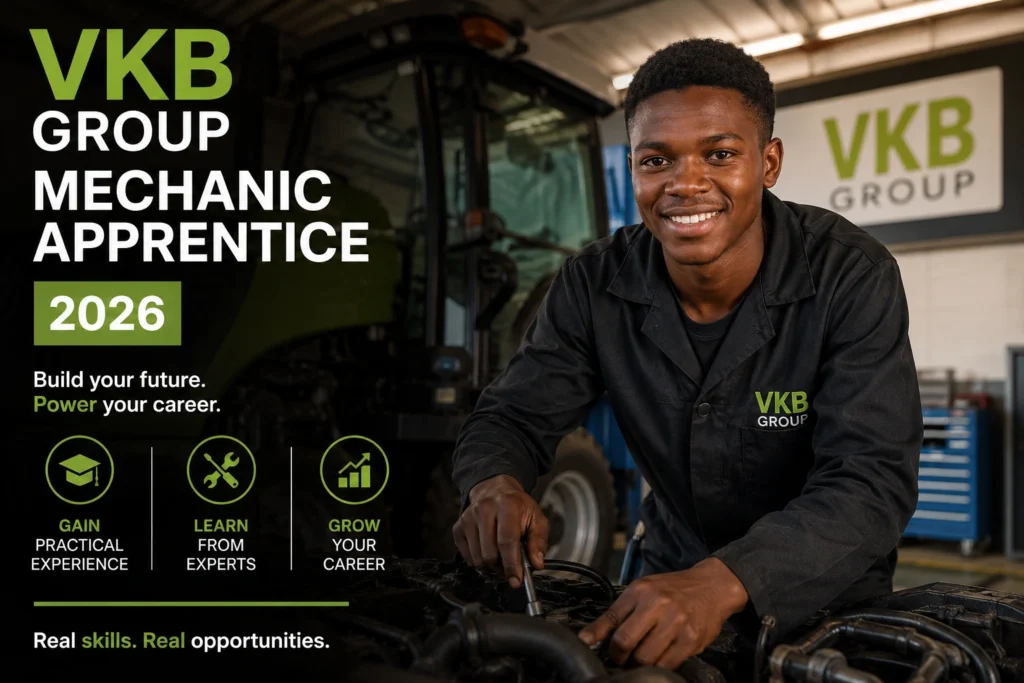

The VKB Group Mechanic Apprentice 2026 opportunity is attracting attention because it arrives at a time when many South African school leavers are searching for careers that lead directly to practical skills and long-term employment. With online applications closing on 11 July 2026, interested candidates have very little time to prepare, making the apprenticeship one of the most talked-about agricultural training opportunities this week.
Unlike many entry-level vacancies that ask for years of experience, this apprenticeship starts from a different position. It recognises that enthusiasm, willingness to learn and technical curiosity can sometimes be just as valuable as previous workshop exposure.
That approach reflects a broader trend across South Africa’s engineering and agricultural sectors. Employers increasingly understand that developing artisans requires investing in new talent rather than expecting every applicant to arrive with extensive practical experience.
For Grade 12 graduates who enjoy fixing engines, understanding machinery or working with their hands, this apprenticeship could become the first step towards becoming a qualified artisan in one of the country’s most important industries.
Why Agricultural Engineering Is Receiving More Attention
Agriculture has always relied on machinery, but modern farming has become far more technologically advanced than many people realise.
Today’s farms depend on sophisticated equipment including:
- Modern tractors
- Harvesters
- Irrigation systems
- Precision planting equipment
- Mechanical loaders
- Hydraulic machinery
- Electronic diagnostic systems
When this equipment fails, farms cannot simply pause operations indefinitely. Every hour of downtime can affect productivity, planting schedules and harvests.
That reality has created growing demand for mechanics who understand agricultural equipment rather than only passenger vehicles.
The VKB Group apprenticeship reflects this changing landscape by preparing new entrants specifically for machinery used in commercial farming environments.
Instead of learning only general mechanical principles, successful applicants gain exposure to equipment that keeps agricultural businesses operating efficiently.
Understanding the Opportunity
The apprenticeship forms part of VKB Commercial Services within the Mechanisation business unit.
Rather than classroom-only learning, participants spend their time inside a working agricultural workshop alongside experienced mechanics.
Their responsibilities gradually expand as their confidence and skills develop.
Training includes:
- Assisting with servicing agricultural machinery
- Supporting scheduled maintenance
- Learning repair procedures
- Performing supervised mechanical work
- Using workshop equipment safely
- Recording workplace learning
- Following safety procedures
- Helping maintain workshop standards
This combination of practical experience and structured learning is one of the defining features of formal apprenticeships.
Instead of simply observing, apprentices become active participants under supervision.
Why Employers Continue Investing in Apprenticeships
South Africa has experienced ongoing shortages of qualified artisans across several industries.
While universities remain important, many employers have recognised that economic growth also depends on electricians, fitters, diesel mechanics, boilermakers and vehicle technicians.
Agricultural businesses face an additional challenge.
Modern farming equipment continues becoming more sophisticated, yet experienced agricultural mechanics are not being replaced quickly enough as older artisans retire.
This skills gap has encouraged companies like VKB Group to invest directly in developing future tradespeople.
Rather than competing endlessly for experienced mechanics, businesses are helping create the next generation themselves.
That strategy benefits both employers and young South Africans seeking meaningful careers.
A Career That Starts With Grade 12
One of the most attractive aspects of the programme is its relatively accessible entry requirements.
Applicants need:
- Grade 12
- Willingness to complete a formal apprenticeship
- Interest in mechanics
- Commitment to learning
Mathematics and Physical Science strengthen an application but are described as advantageous rather than compulsory.
That distinction matters.
Many technical careers become inaccessible because candidates believe they needed perfect school results.
This apprenticeship instead places considerable value on attitude, motivation and practical interest.
Someone who enjoys repairing bicycles, maintaining family vehicles or completing school technical projects may already possess qualities employers appreciate.
Practical Skills Matter More Than Many Realise
Workshop experience certainly helps.
However, VKB Group specifically indicates that previous experience is not essential.
That message is significant because many first-time applicants mistakenly rule themselves out before even applying.
Practical interest can be demonstrated in many ways.
Examples include:
- Repairing small engines
- Assisting family members with vehicle maintenance
- School engineering assignments
- Technical hobbies
- Experience using basic hand tools
- Community workshop projects
These activities show curiosity and willingness to develop—qualities often valued during apprentice selection.
Recent Developments
Several aspects of this opportunity have generated discussion among applicants.
The first is timing.
The vacancy opened on 10 July 2026, with applications closing just one day later on 11 July 2026.
That unusually short application window means candidates must prepare documentation immediately rather than waiting until the last minute.
Another point attracting attention is the workplace location.
The vacancy heading lists Bethlehem, Free State, while the written description references the Mechanisation team in Vrede.
Prospective applicants are therefore encouraged to verify the exact workplace with VKB Group before making relocation decisions.
Although this may simply reflect administrative wording, confirming details before accepting an offer remains sensible.
Public Reaction
Online discussions around apprenticeships often follow familiar themes.
Many young South Africans express frustration about vacancies requiring experience they have never had the opportunity to gain.
Opportunities like the VKB apprenticeship tend to receive positive reactions because they offer structured workplace learning instead of expecting applicants to already possess advanced technical skills.
Career advisers also frequently encourage school leavers to consider apprenticeships alongside university pathways.
Qualified artisans remain essential across manufacturing, mining, transport and agriculture.
As a result, many industry observers see formal apprenticeship programmes as valuable investments in South Africa’s future workforce.
At the same time, experienced applicants caution newcomers not to underestimate the commitment involved.
Mechanical apprenticeships involve physical work, continuous learning and strict adherence to safety standards.
They are rewarding, but they also require discipline and persistence.
What the Workshop Experience Could Look Like
A typical day is unlikely to involve sitting behind a desk.
Instead, apprentices may find themselves:
Inspecting tractors before servicing.
Handing tools to qualified mechanics.
Learning how hydraulic systems operate.
Replacing worn mechanical components.
Cleaning workshop equipment.
Observing diagnostic procedures.
Recording completed training activities.
Assisting with scheduled maintenance programmes.
Every task contributes towards building practical confidence.
Over time, apprentices gradually progress from simple responsibilities to more technically demanding work.
That steady progression is one reason apprenticeships remain highly respected training pathways.
The Importance of Workplace Culture
Technical ability alone rarely determines success.
VKB Group highlights several personal qualities alongside mechanical interest.
These include:
- Humility
- Initiative
- Teamwork
- Problem-solving
- Attention to detail
- Positive attitude
- Willingness to learn
Those characteristics matter because workshops depend heavily on collaboration.
Large machinery repairs often require multiple technicians working together safely.
Communication becomes just as important as technical knowledge.
Employers therefore look for individuals who contribute positively to the workshop environment rather than focusing only on mechanical ability.
Why This Matters Right Now
South Africa’s youth unemployment challenge continues encouraging more school leavers to explore alternatives beyond traditional academic routes.
Apprenticeships offer something many graduates struggle to obtain later—real workplace experience.
The VKB Group Mechanic Apprentice 2026 opportunity also reflects broader shifts in employer recruitment.
Companies increasingly recognise potential rather than looking exclusively at previous employment history.
That creates opportunities for motivated candidates who may not have had access to formal workshop experience.
For the agricultural sector, developing skilled mechanics also supports long-term productivity.
Reliable machinery maintenance contributes to food production, equipment reliability and operational efficiency across farming businesses.
Viewed from that perspective, apprenticeships support both individual careers and wider economic development.
APPLY HERE: VKB Group Mechanic Apprentice 2026
ALSO APPLY FOR: Enviri Apprenticeship 2026
Application Tips Worth Taking Seriously
Because the closing date arrives quickly, applicants should focus on presenting organised documentation.
Useful preparation includes:
Updating the CV with recent achievements.
Mentioning practical mechanical activities, even informal ones.
Checking contact information carefully.
Uploading supporting documents separately where requested.
Using clear electronic document formats.
Reviewing every application section before submitting.
Applicants should also avoid assuming incomplete applications will be accepted later.
Meeting the published deadline remains essential.
Common Mistakes Applicants Should Avoid
Many otherwise suitable candidates reduce their chances through avoidable errors.
Some of the most common include:
Submitting handwritten CVs.
Uploading poor-quality scanned documents.
Leaving employment or education dates incomplete.
Ignoring application instructions.
Providing outdated telephone numbers.
Combining all supporting documents into a single file when separate uploads are requested.
Waiting until the final hours before applying also creates unnecessary risk, especially if technical issues occur.
Could This Lead to Long-Term Employment?
The apprenticeship itself does not guarantee permanent employment.
However, structured apprenticeships often improve future employability because participants gain recognised workplace experience.
Successful completion may strengthen opportunities within:
- Agricultural engineering
- Equipment maintenance
- Commercial farming
- Vehicle workshops
- Heavy machinery servicing
- Mechanical contracting
Trade-tested artisans frequently remain in demand across multiple industries.
The skills developed therefore have value beyond a single employer.
What Could Happen Next
As South Africa continues promoting artisan development, opportunities like this may become increasingly important.
Businesses facing technical skills shortages are likely to expand structured workplace learning rather than relying solely on experienced external recruits.
Agriculture itself is also becoming more technology-driven.
Future mechanics may increasingly work with:
- Electronic diagnostics
- GPS-guided machinery
- Automated farming equipment
- Advanced hydraulic systems
- Digital maintenance records
That evolution means today’s apprentices could eventually maintain equipment that looks very different from machinery currently operating on farms.
For applicants, completing a recognised apprenticeship now could provide a foundation for adapting to future technological advances.
A Balanced Perspective
The VKB Group apprenticeship should not be viewed as a shortcut to instant career success.
Apprenticeships require patience.
Learning mechanical skills takes time.
Mistakes become learning opportunities under supervision.
Progress happens gradually rather than overnight.
Yet that structured development remains one of the strongest aspects of formal artisan training.
Instead of entering employment without guidance, apprentices build experience while learning directly from qualified professionals.
For motivated candidates willing to commit themselves, that combination can prove extremely valuable.
Final Thoughts
The VKB Group Mechanic Apprentice 2026 stands out because it offers something increasingly valuable in today’s labour market: an opportunity to learn while working in a real engineering environment.
By focusing on practical training rather than extensive previous experience, the programme opens doors for Grade 12 graduates who are genuinely interested in mechanics and agricultural machinery.
The short application period means interested candidates should act promptly, prepare accurate documentation and carefully follow the online application instructions.
Although permanent employment is not guaranteed, the apprenticeship offers practical exposure, structured learning and experience that could support a long-term career in agricultural engineering and mechanical maintenance. For young South Africans looking beyond traditional academic pathways, it represents a realistic and credible starting point into the skilled trades.