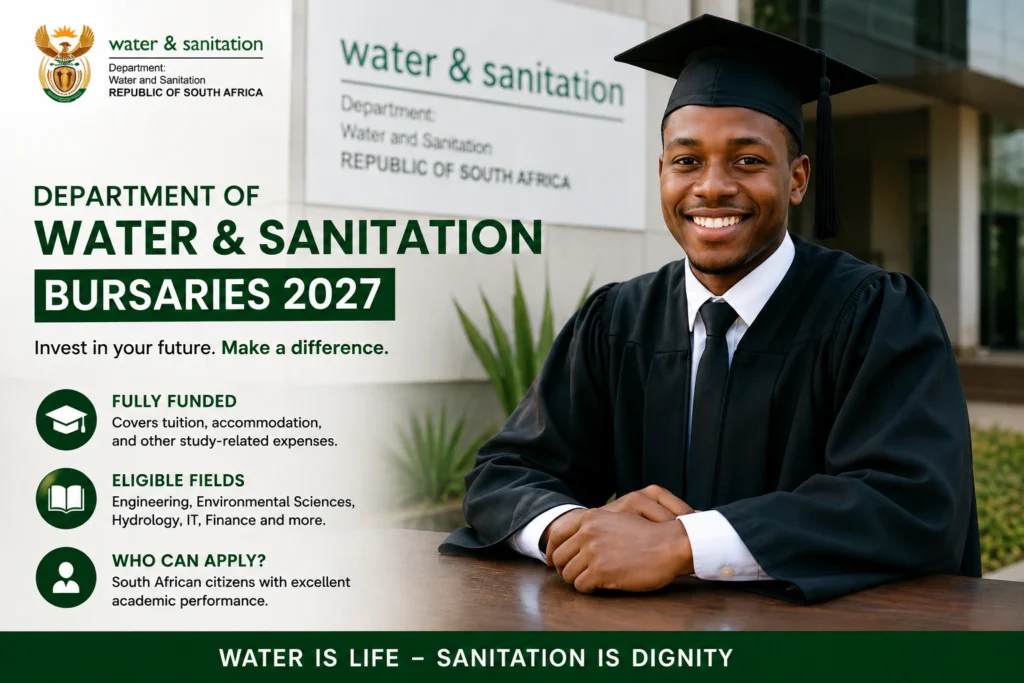

The Department of Water and Sanitation (DWS) Bursaries 2027 provide financial support for South African students who want to study qualifications that contribute to the country’s water and sanitation sector. If you’re planning to pursue engineering, environmental sciences, hydrology, geology, or another water-related qualification, this bursary could remove many of the financial barriers associated with university education.
Unlike many bursaries that simply pay tuition, the DWS bursary is designed to develop future professionals who can help South Africa manage one of its most important natural resources—water. It also offers graduates an opportunity to gain practical workplace experience through the Department’s Water Learning Academy after completing their studies.
Whether you’re finishing Grade 12, already studying at university, or considering postgraduate studies, understanding how this bursary works can help you prepare a stronger application before the 30 September 2026 closing date.
What You Should Know First
Before completing your application, here are the most important facts:
- Applications close on 30 September 2026
- The bursary is available to South African citizens
- It supports undergraduate and postgraduate studies
- Applicants must study at a participating South African public university
- Only qualifications that support the water sector are funded
- The bursary covers much more than tuition fees
- Graduates may be required to complete workplace training through the Water Learning Academy
The programme focuses on developing skills that South Africa needs to improve water security, sanitation services, environmental protection, and infrastructure development.
Understanding the Department of Water and Sanitation (DWS) Bursaries 2027
The Department of Water and Sanitation (DWS) Bursaries 2027 are government-funded financial assistance programmes aimed at producing highly skilled professionals for the country’s water sector.
South Africa faces ongoing challenges including:
- Water shortages
- Climate change impacts
- Aging water infrastructure
- Growing population demands
- Environmental conservation
- Water quality management
To address these challenges, the Department invests in students who are willing to study fields that directly support water management and infrastructure development.
Instead of recruiting professionals only after graduation, DWS helps students complete their studies while creating a pipeline of future experts.
Why South Africa Needs Water Professionals
Water affects almost every part of daily life.
Communities need safe drinking water.
Farmers need reliable irrigation.
Industries depend on water for production.
Municipalities require engineers and scientists to maintain infrastructure.
Environmental specialists help protect rivers, wetlands, and groundwater.
Without enough trained professionals, maintaining and expanding these essential services becomes increasingly difficult.
This is why the Department prioritises qualifications that solve real national challenges rather than funding every field of study.
What Expenses Does the Bursary Cover?
One of the biggest advantages of the DWS bursary is its comprehensive financial support.
Successful applicants may receive funding for:
Full Registration Fees
Students do not need to worry about paying annual university registration costs.
Tuition Fees
The Department covers approved tuition costs for the duration of the funded qualification.
Residence Accommodation
Students living in university residences may receive accommodation funding.
Meal Allowance
The bursary includes support for meals, helping students focus on their studies instead of worrying about daily living expenses.
Book Allowance
Textbooks and study materials can be expensive, especially in engineering and science programmes.
The bursary helps cover these costs.
Personal Allowance
Students may also receive an annual personal allowance to assist with other educational expenses.
Together, these benefits significantly reduce the financial burden of university education.
Which Qualifications Are Funded?
The Department funds qualifications that contribute directly to South Africa’s water sector.
Examples include:
- Analytical Chemistry
- Aquatic Sciences
- Biochemistry
- Civil Engineering
- Mechanical Engineering
- Electrical Engineering (Heavy Current)
- Environmental Science
- Environmental Management
- Hydrology
- Water Resource Management
- Water Care
- Water Utilisation
- Geo-hydrology
- Geology
- Geographical Information Systems (GIS)
- Geo-chemistry
- Microbiology
- Project Management
The official application form should always be consulted because funded fields may change according to the Department’s skills priorities.
Who Can Apply?
Meeting the basic requirements is the first step.
Applicants should generally:
- Be South African citizens
- Study or intend studying full-time
- Register for undergraduate or postgraduate qualifications
- Attend a participating public university
- Choose a qualification linked to the water sector
- Meet university admission requirements
- Meet Departmental selection requirements
Meeting these minimum requirements does not automatically guarantee selection.
Competition is expected to be strong.
How Applications Are Evaluated
Many students assume that marks alone determine selection.
In reality, the Department considers several factors.
These may include:
Academic Performance
Strong results demonstrate that applicants can successfully complete demanding programmes.
Financial Need
Students from financially disadvantaged households may receive additional consideration.
Skills Demand
Some qualifications are prioritised depending on national workforce shortages.
Equity Considerations
Selection may also consider race and gender in line with government transformation objectives.
Applicants should therefore submit complete and accurate information that reflects both their academic achievements and financial circumstances.
Participating Universities
The bursary supports students studying at many South African public universities, including:
- University of Pretoria
- University of Johannesburg
- University of Cape Town
- University of KwaZulu-Natal
- Stellenbosch University
- University of the Western Cape
- University of Limpopo
- University of Venda
- University of the Witwatersrand
- Rhodes University
- Nelson Mandela University
- Walter Sisulu University
- University of Fort Hare
- University of Mpumalanga
- University of Zululand
- University of the Free State
- North-West University
- Tshwane University of Technology
- Durban University of Technology
- Cape Peninsula University of Technology
- Central University of Technology
- Vaal University of Technology
- Sol Plaatje University
Applicants should confirm that both their university and qualification are eligible before applying.
Understanding the Water Learning Academy Obligation
One feature that makes this bursary different from many others is the post-study development programme.
Graduates may be required to join the Water Learning Academy after completing their qualifications.
This placement may last for up to three years on a fixed-term contract.
Rather than viewing this as an obligation, many graduates see it as an opportunity because it offers:
- Practical work experience
- Professional mentoring
- Exposure to government projects
- Career development
- Industry networking
Many employers value graduates who already have workplace experience.
Step-by-Step Application Process
Applying becomes much easier when broken into manageable steps.
Step 1: Confirm Eligibility
Ensure you meet all citizenship, university and qualification requirements.
Step 2: Download the Official Application Form
DOWNLOAD HERE: APPLICATION FORM
Only use the latest Department of Water and Sanitation bursary application form.
Step 3: Gather Supporting Documents
Prepare all required documentation before starting your application.
Typical documents include:
- Certified South African ID
- Latest academic results
- Matric certificate (where applicable)
- University acceptance letter or proof of registration
- Academic transcript
- Proof of household income
- Completed application form
Step 4: Double-Check Everything
Many applications fail because documents are missing or incorrectly certified.
Review everything carefully.
Step 5: Submit Before the Deadline
Applications must be emailed before 30 September 2026.
Late submissions may not be considered.
ALSO APPLY FOR: Tomorrow Trust Tertiary Bursary 2027
Tips for Preparing a Strong Application
Although no applicant can guarantee selection, a few practical habits can improve your chances.
Start preparing early instead of waiting until September.
Keep certified copies of important documents ready.
Ensure all academic records are up to date.
Write clearly when completing forms.
Use accurate contact information.
Respond honestly to financial information requests.
Read every instruction carefully before submitting.
Common Misunderstandings About (DWS) Bursaries 2027
Many applicants misunderstand how the bursary works.
“Only engineering students can apply.”
Not true.
Engineering is only one group of funded disciplines.
Environmental sciences, hydrology, geology, chemistry and several related fields may also qualify.
“Only first-year students are eligible.”
Incorrect.
Both undergraduate and postgraduate students may apply if they meet the programme requirements.
“Good marks automatically guarantee funding.”
Academic performance is important, but financial need and departmental skills priorities are also considered.
“The bursary only pays tuition.”
The funding package is much broader and may include accommodation, meals, books and personal allowances.
“The Water Learning Academy is a punishment.”
It is actually designed to provide valuable workplace experience that can improve future career prospects.
Why This Bursary Can Make a Difference
University costs continue rising each year.
Many capable students struggle to complete degrees because of financial constraints.
Government bursaries like this allow students to focus on learning rather than worrying about fees.
At the same time, South Africa benefits by developing professionals who can improve water supply systems, sanitation infrastructure, environmental protection and resource management.
The programme therefore supports both individual career development and national development.
Key Takeaways
The Department of Water and Sanitation (DWS) Bursaries 2027 offer comprehensive financial support for students pursuing water-related qualifications.
Remember these important points:
- Applications close on 30 September 2026
- The bursary covers registration, tuition, accommodation, meals, books and personal allowances
- Undergraduate and postgraduate students may qualify
- Only approved water-related qualifications are funded
- Applicants must study at participating South African public universities
- Selection considers academic performance, financial need and departmental priorities
- Graduates may complete practical workplace training through the Water Learning Academy
Preparing your documents early and submitting a complete application can significantly reduce avoidable mistakes.
Frequently Asked Questions
Can Grade 12 learners apply?
Yes. Learners planning to study an approved qualification at a participating public university may apply if they meet the admission requirements.
Is financial need considered?
Yes. Financial need is one of several factors considered during the selection process alongside academic performance and departmental skills requirements.
Can postgraduate students apply?
Yes. The programme supports both undergraduate and postgraduate studies where the qualification aligns with the Department’s funding priorities.
What happens after graduation?
Successful bursary recipients may be required to join the Water Learning Academy on a fixed-term contract of up to three years to gain practical workplace experience.
Final Summary
The Department of Water and Sanitation (DWS) Bursaries 2027 represent more than financial assistance—they are an investment in South Africa’s future water professionals. By covering major study costs and providing potential workplace experience after graduation, the programme helps talented students build careers that contribute to sustainable water management and improved public services. If your chosen qualification aligns with the Department’s priority fields, preparing a complete application well before the 30 September 2026 deadline could be an important step toward achieving your educational and career goals.