
On graduation day, many engineering students celebrate years of hard work knowing another challenge is waiting just around the corner: finding meaningful work experience. A degree opens doors, but in South Africa’s competitive engineering sector, employers increasingly look for graduates who can combine technical knowledge with practical problem-solving.
Imagine a civil engineering graduate standing beside a bridge construction site in Pretoria, watching months of university theory come alive through real design decisions. Or a young data science graduate helping analyse infrastructure performance to improve public services. These are the kinds of experiences that shape careers—not just by building technical ability, but by developing confidence, teamwork and professional judgement.
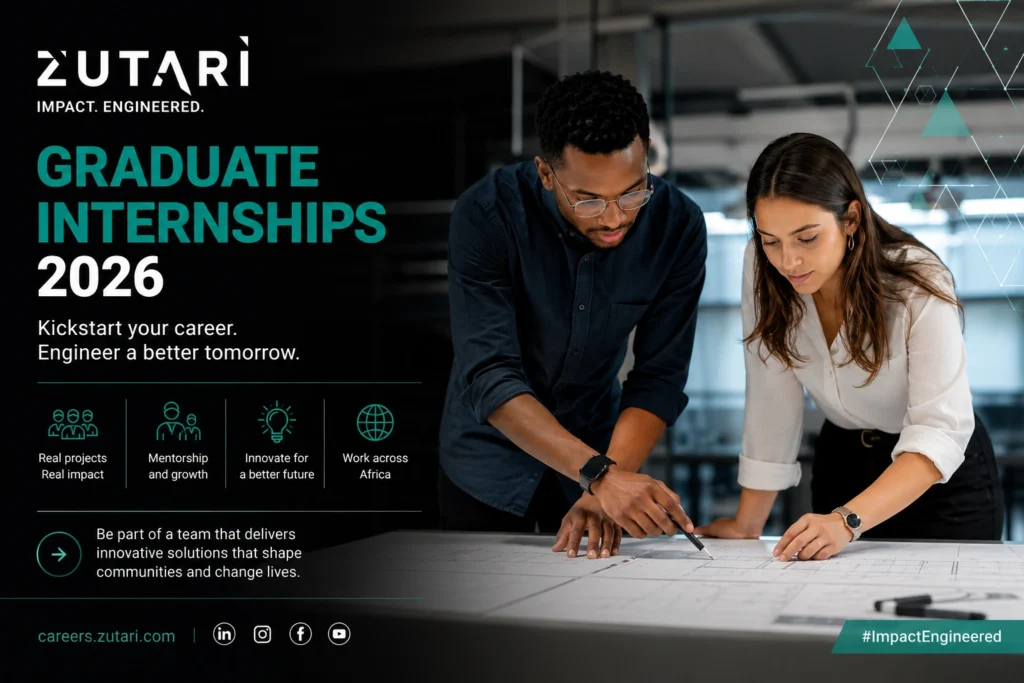
That is exactly where Zutari Graduate Internships 2026 stand out.
Rather than offering graduates routine administrative work, Zutari’s Graduate Talent Community aims to immerse young professionals in projects that influence transport systems, water infrastructure, environmental sustainability and urban development across South Africa. For graduates eager to contribute to infrastructure that serves communities, the programme represents far more than a first job—it offers a professional foundation.
More than graduate recruitment—it is a long-term investment
South Africa continues to face significant infrastructure demands. Municipalities require improved water systems. Growing cities need better transport planning. Renewable energy projects require innovative engineering solutions. At the same time, organisations are searching for professionals who can combine engineering expertise with digital thinking.
This broader context makes graduate programmes increasingly important.
The Zutari Graduate Internships 2026 initiative reflects a growing industry trend: investing early in talented graduates who can develop into registered engineers and technical specialists over time rather than simply filling immediate vacancies.
Zutari has built its reputation around multidisciplinary consulting, meaning graduates are likely to work alongside engineers, environmental specialists, geologists, digital experts and infrastructure planners. Exposure to multiple disciplines often becomes one of the biggest advantages for young professionals entering consulting engineering.
Instead of seeing only one aspect of a project, graduates gain insight into how technical decisions affect communities, budgets, environmental sustainability and long-term infrastructure resilience.
Why Zutari Graduate Internships 2026 matter in today’s job market
South Africa produces thousands of engineering graduates every year, yet many struggle with the transition from university to professional practice.
Employers frequently identify a gap between academic knowledge and workplace readiness. Graduate programmes help bridge that gap by introducing structured mentoring, project exposure and practical learning.
For many graduates, this transition can determine the direction of an entire career.
Zutari’s programme is designed for final-year BSc, BEng and Master’s students who have maintained an overall average of at least 65%. That academic benchmark signals the organisation’s focus on strong technical foundations while recognising that future success also depends on curiosity, adaptability and continuous learning.
Graduate opportunities are available across several South African locations, including:
- Pretoria
- Johannesburg
- Cape Town
- Paarl
- Durban
Having opportunities across multiple regions increases accessibility for graduates who may wish to begin their careers closer to home while still working within one national organisation.
Engineering that extends beyond calculations
Many students enter engineering because they enjoy mathematics and science. Yet experienced professionals often discover that successful engineering is equally about communication, collaboration and understanding people.
Infrastructure projects affect everyday life.
A better transport system shortens commuting times.
Improved water infrastructure supports public health.
Reliable electrical systems strengthen businesses.
Environmental engineering helps communities adapt to climate challenges.
The Zutari Graduate Internships 2026 recognise this broader reality. Graduates are expected to contribute technical knowledge while developing practical thinking and professional judgement.
Eligible disciplines include:
- Civil Engineering (Infrastructure, Structures, Water and Transport)
- Structural Engineering (Bridges)
- Mechanical Engineering
- Electrical Engineering
- Electronic and Mechatronic Engineering
- Industrial Engineering
- Chemical Engineering
- Data Science and Engineering
- Geoinformatics
- Geotechnical Engineering
- Environmental and Engineering Geology
This wide variety reflects the increasingly interdisciplinary nature of modern infrastructure development.
Today’s engineers rarely solve problems alone. Data scientists work alongside transport engineers. Environmental specialists collaborate with civil engineers. Digital technologies increasingly support engineering design, monitoring and decision-making.
Graduates entering this environment gain exposure to how different disciplines combine to deliver practical outcomes.
Building professional confidence from day one
One of the biggest differences between university and professional consulting lies in responsibility.
At university, assignments usually have one correct answer.
Real infrastructure projects rarely do.
Instead, graduates learn to balance technical requirements with financial constraints, environmental regulations, client expectations and community needs.
That complexity develops professional confidence over time.
Rather than expecting graduates to know everything immediately, structured graduate programmes create opportunities to ask questions, receive mentorship and gradually assume greater responsibility.
This learning environment is particularly valuable for graduates aiming to pursue professional engineering registration in future.
Professional registration remains an important career milestone within South Africa’s engineering sector because it demonstrates competence, accountability and recognised industry standards.
Graduate programmes often provide practical experience that supports this long-term journey.
An expert perspective: Why multidisciplinary experience creates stronger engineers
One of the most significant shifts in engineering over the past decade has been the growing integration of technology, sustainability and collaborative design.
Graduates who understand only their own technical discipline may struggle when projects require digital modelling, environmental assessment, stakeholder engagement or data-driven decision-making.
Programmes like Zutari’s expose graduates to multidisciplinary teams early in their careers. That experience develops broader professional judgement, helping young engineers understand not only how to solve technical problems but why certain solutions create better long-term outcomes for clients and communities.
As infrastructure projects become increasingly complex, this broader perspective may prove just as valuable as technical excellence itself.

Preparing a stronger application
Competition for graduate opportunities is always high, especially within established consulting engineering firms.
Applicants should ensure their submissions demonstrate both academic achievement and genuine motivation.
Required documentation includes:
- A comprehensive Curriculum Vitae
- South African ID or passport
- Academic qualifications
- Academic transcripts
Incomplete applications may not be considered, making attention to detail especially important.
Beyond documentation, graduates should think carefully about how they present themselves.
Employers increasingly value applicants who can explain why engineering matters to them, describe practical university projects and demonstrate a willingness to keep learning.
Leadership roles, volunteer activities, student engineering societies or research projects can also strengthen an application by illustrating initiative beyond academic performance.
APPLY HERE: Zutari Graduate Internships 2026
ALSO APPLY FOR: Apex Group Internship Programme 2026
The bigger picture for South African infrastructure
Graduate programmes should not be viewed only from the perspective of individual career development.
They also contribute to national skills development.
South Africa continues to invest in infrastructure modernisation across transportation, water management, energy systems and urban development. These projects require experienced professionals today—but they also require a pipeline of future engineers capable of leading projects over the coming decades.
Graduate development therefore serves both economic and social purposes.
Every successful engineering graduate entering professional practice contributes additional technical capacity to industries that influence national growth.
That broader impact often receives less attention than salary discussions or employment statistics, yet it remains one of the strongest arguments for structured graduate programmes.
Young professionals entering engineering today will help design infrastructure that communities may depend upon for generations.
Looking beyond your first position
Many graduates naturally focus on securing their first permanent role.
While understandable, experienced professionals often recommend thinking five or even ten years ahead.
Questions worth considering include:
- Will this employer provide structured mentoring?
- Will I gain diverse project exposure?
- Can I work alongside experienced professionals?
- Will I continue learning after graduation?
- Does the organisation encourage professional registration?
These questions often matter more than starting salary alone.
Graduate programmes offering structured development frequently provide stronger long-term career progression because they prioritise professional growth rather than immediate productivity.
For ambitious young engineers, that investment can produce lasting benefits throughout an entire career.
Frequently Asked Questions
Who can apply for Zutari Graduate Internships 2026?
The programme is open to final-year BSc, BEng and Master’s students studying eligible engineering, data science, geoinformatics or related technical disciplines who have achieved an overall academic average of at least 65%.
Is there a closing date for applications?
No specific closing date has been announced. Interested applicants are encouraged to apply as early as possible rather than waiting until recruitment demand increases.
Which cities offer graduate opportunities?
Graduate positions are available across several Zutari offices, including Pretoria, Johannesburg, Cape Town, Paarl and Durban, allowing applicants to consider opportunities across multiple regions of South Africa.
A career built one project at a time
Every experienced engineer remembers the project that changed how they viewed their profession.
It might have been designing a bridge, improving a municipal water system or contributing to a transport network that thousands of commuters rely on each day. Those experiences rarely happen overnight. They begin with structured opportunities where graduates are trusted to learn, contribute and grow.
The Zutari Graduate Internships 2026 represent that kind of opportunity. They combine technical development, multidisciplinary collaboration and exposure to infrastructure projects that have tangible effects on communities across South Africa.
For final-year students preparing to leave university and recent graduates looking to establish themselves in consulting engineering, the programme offers more than workplace experience. It provides an introduction to the responsibilities and possibilities of building infrastructure that supports economic growth, environmental sustainability and better public services.
As South Africa continues investing in infrastructure and digital transformation, organisations will increasingly need professionals who can combine engineering excellence with innovative thinking. Graduate programmes that nurture these capabilities today are helping shape the engineers who will solve tomorrow’s most important challenges.