

The Denel Technical Academy (DTA) Apprenticeship Programme is attracting growing attention in 2026 as more young South Africans rethink traditional career paths and turn toward technical trades that offer practical skills, industry-recognised qualifications, and direct routes into employment.
At a time when graduate unemployment remains a major concern and industries continue searching for qualified artisans, apprenticeship programmes have become increasingly relevant. The renewed interest is not only about finding a job—it is about securing a career that remains valuable in a rapidly changing economy.
For many school leavers, the appeal of becoming an aircraft technician, electrician, fitter, welder, or solar technician is stronger than ever. These are professions tied directly to infrastructure, manufacturing, aviation, energy, and industrial development—sectors that continue to require highly skilled workers regardless of economic cycles.
Against this backdrop, the Denel Technical Academy has emerged as one of South Africa’s most recognised technical training institutions, offering apprenticeships that blend classroom learning with real workplace experience.
A Programme Built on More Than Four Decades of Experience
The story behind the Denel Technical Academy helps explain why its apprenticeship programme continues to attract interest.
For more than 40 years, the academy has focused on developing technical skills in aviation, engineering, mechanical trades, electrical systems, and emerging technologies. Over time, it has built a reputation not only within South Africa but across the African continent.
Unlike short courses that focus primarily on theory, DTA’s model centres on practical competence. Apprentices are trained using industry-standard equipment and methods that mirror real workplace environments.
This approach reflects a broader shift occurring globally. Employers increasingly want candidates who can demonstrate practical ability from day one rather than relying solely on academic qualifications.
The academy’s long-standing presence in technical education positions it well within this changing landscape.
Understanding the DTA Apprenticeship Structure
One of the strongest features of the Denel Technical Academy (DTA) Apprenticeship Programme is its structure.
The programme typically runs for 36 months, allowing apprentices to progressively develop their skills over an extended period rather than rushing through training.
This combination of classroom instruction and workplace exposure creates a more comprehensive learning experience.
Students are introduced to technical concepts in controlled training environments before applying them in practical settings. This gradual progression helps apprentices build confidence while developing the competencies required by employers.
Importantly, the programme is accredited by recognised industry and education bodies, including:
- Quality Council for Trades and Occupations (QCTO)
- South African Civil Aviation Authority (SACAA)
- Relevant Sector Education and Training Authorities (SETAs)
These accreditations provide assurance that training standards align with national industry requirements.
For prospective apprentices, this matters because recognised qualifications often carry greater weight when seeking employment opportunities after training.
The Wide Range of Career Paths Available
One reason the programme continues to generate interest is the diversity of available trades.
Not every student wants the same career, and DTA offers pathways across several technical disciplines.
Aircraft Avionician
Modern aircraft rely heavily on sophisticated electronics, communication systems, and navigation equipment.
Aircraft avionicians specialise in installing, maintaining, troubleshooting, and repairing these critical systems.
As aviation technology continues advancing, demand for highly trained avionics specialists remains significant worldwide.
Aircraft Maintenance Mechanic
Aircraft maintenance mechanics play a crucial role in ensuring aircraft remain safe and airworthy.
Their responsibilities include inspections, repairs, servicing, and maintenance of various aircraft components.
This field appeals to individuals fascinated by aviation and precision engineering.
Aircraft Structural Worker II
Aircraft structures endure immense pressure during operation.
Structural workers focus on maintaining the integrity of aircraft frames, fuselage sections, and supporting components.
Their work directly contributes to aviation safety and reliability.
Electrician
Electricians remain among the most versatile artisans in modern economies.
They install, maintain, and repair electrical systems in residential, commercial, and industrial environments.
As South Africa continues investing in infrastructure and energy projects, qualified electricians remain highly sought after.
Fitter and Turner
Precision engineering lies at the heart of manufacturing.
Fitters and turners assemble mechanical systems, fabricate components, and operate specialised machinery.
Their expertise supports industries ranging from mining to manufacturing and transportation.
Mechanical Fitter
Mechanical fitters focus on assembling, testing, maintaining, and repairing mechanical equipment.
Their skills are valuable across industrial sectors where machinery reliability directly impacts productivity.
Photovoltaic (Solar Technician)
Few trades reflect current economic and environmental trends as clearly as solar technology.
With energy security becoming a national priority, solar installations continue expanding across residential, commercial, and industrial sectors.
Solar technicians design, install, maintain, and troubleshoot photovoltaic systems.
For many observers, this trade represents one of the most future-focused options available within the programme.
Welder
Welding remains a foundational trade supporting construction, manufacturing, engineering, and infrastructure development.
Skilled welders continue to enjoy strong demand because virtually every industrial economy depends on metal fabrication and structural assembly.
Why Technical Careers Are Becoming More Attractive
A decade ago, many young people viewed university as the primary route to career success.
Today, perceptions are shifting.
Several factors are driving renewed interest in apprenticeship opportunities.
First, employers increasingly report shortages of qualified artisans.
Second, practical trades often provide clearer pathways into employment compared to some oversaturated academic fields.
Third, technical careers frequently offer opportunities for entrepreneurship, contracting, and self-employment.
A qualified electrician, welder, or solar technician may eventually establish an independent business, creating additional income streams and employment opportunities.
These realities have encouraged many students and parents to reconsider traditional assumptions about career success.
Entry Requirements: Opening Doors to More Young People
One notable aspect of the DTA apprenticeship model is that entry requirements vary according to the chosen trade.
For trades such as:
- Aircraft Mechanic
- Fitter and Turner
- Mechanical Fitter
- Welder
- Solar Technician
- Aircraft Structural Worker II
Applicants generally need Grade 10 (N1) with Mathematics, Science, and English proficiency.
For more specialised aviation-related fields including:
- Aircraft Radiotrician
- Aircraft Electrician
- Aircraft Avionician
Applicants typically require Grade 11 (N2) with Mathematics, Science, and English proficiency.
This structure provides opportunities for students who may not possess a matric certificate but have demonstrated competence in technical subjects.
In a country where educational pathways are often viewed narrowly, this flexibility creates valuable alternatives.
Recent Developments Driving Interest in Apprenticeships
The growing visibility of apprenticeship programmes is not occurring in isolation.
Several broader developments are influencing public attention.
South Africa continues to emphasise artisan development as part of economic growth and industrialisation strategies.
At the same time, sectors such as renewable energy, manufacturing, aviation maintenance, logistics, and infrastructure development require increasing numbers of technically skilled workers.
The expansion of renewable energy projects, in particular, has created new conversations around future-proof careers.
Trades linked to solar energy and electrical systems are frequently highlighted as areas with long-term growth potential.
As a result, institutions offering accredited technical training have found themselves receiving increased interest from young job seekers looking for stable and practical career options.
Public Reaction: A Shift in Mindset
Public attitudes toward apprenticeships have evolved significantly.
For years, vocational education was sometimes unfairly viewed as a secondary option compared to university education.
That perception appears to be changing.
Parents, employers, and students increasingly recognise that technical skills remain essential to economic development.
Online discussions around apprenticeships often highlight the advantages of gaining practical experience while working toward a recognised qualification.
Many young people also appreciate the tangible nature of technical careers.
Unlike some occupations where results may be difficult to see, artisans can directly observe the outcomes of their work—whether repairing an aircraft system, installing solar panels, maintaining industrial machinery, or constructing infrastructure.
This sense of purpose continues to resonate with many prospective applicants.
Why This Matters Right Now
South Africa faces a complex challenge.
On one hand, unemployment remains high among young people.
On the other, employers frequently report difficulties finding qualified technical workers.
This mismatch creates both a problem and an opportunity.
Programmes like the Denel Technical Academy (DTA) Apprenticeship Programme help bridge the gap between education and employment by providing industry-relevant skills training.
The timing is particularly significant because technological change is reshaping labour markets worldwide.
Jobs that require practical problem-solving, technical expertise, maintenance skills, and hands-on competency often prove more resilient than many people expect.
At the same time, sectors such as renewable energy, aviation, manufacturing, and engineering continue evolving rather than disappearing.
Training programmes that prepare individuals for these industries therefore carry growing importance.
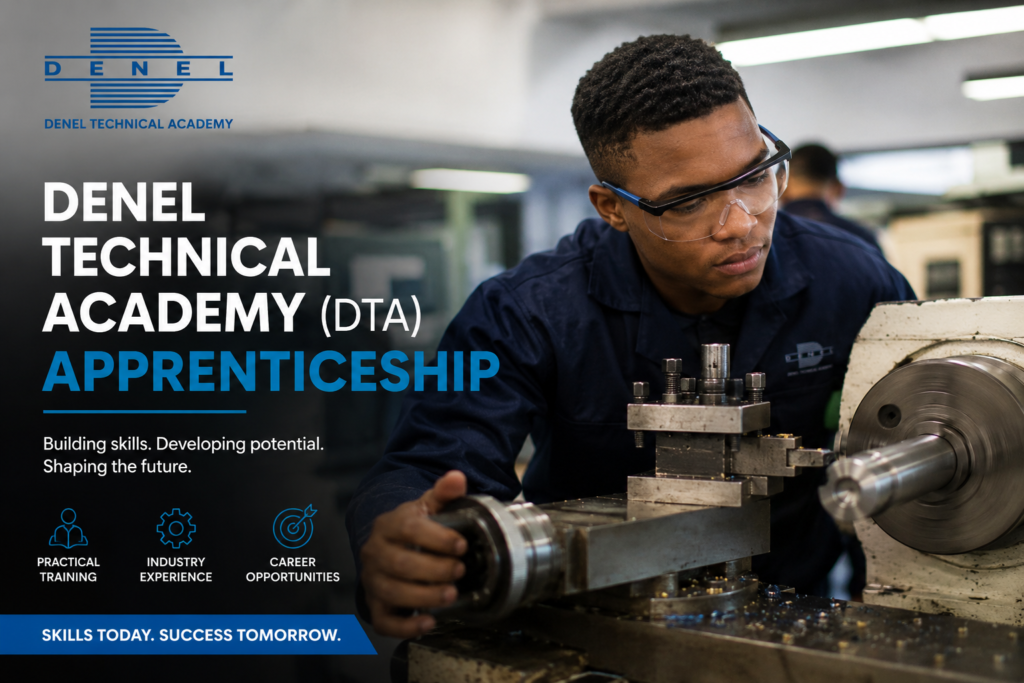
ALSO VISIT: http://www.deneltechnicalacademy.co.za
The Application Process
For interested applicants, the process is relatively straightforward.
Applications are generally accepted throughout the year, although early submission is advisable whenever opportunities become available.
Applicants are typically required to provide:
- Certified copy of South African ID
- Certified copies of school results or N2/N3 certificates
- Updated curriculum vitae (CV)
- Motivation letter explaining interest in the programme
Applications may be submitted through:
Email: Registrations-DTA@denel.co.za
WhatsApp: 083-459-6051
VISIT: (DTA) Apprenticeship Programme
The academy is located near OR Tambo International Airport in Kempton Park, Gauteng.
Prospective applicants should ensure all documentation is complete and certified before submission.
ALSO APPLY FOR: (ACRA) Apprenticeships 2026
Recognition of Prior Learning Expands Opportunities
An often-overlooked feature of DTA’s offerings is Artisan Recognition of Prior Learning (ARPL).
This pathway allows individuals already working within technical industries to have existing skills formally assessed and recognised.
For workers who have gained experience on the job but lack formal certification, ARPL can provide a route toward obtaining recognised qualifications.
This reflects a broader trend in skills development where practical experience is increasingly valued alongside formal education.
What Could Happen Next
Looking ahead, several developments could further increase the relevance of technical apprenticeship programmes.
The continued expansion of renewable energy projects may create greater demand for electricians, solar technicians, and mechanical specialists.
Growth in aviation maintenance across Africa could strengthen opportunities for aircraft-related trades.
Infrastructure development initiatives may sustain demand for welders, fitters, and engineering artisans.
At the policy level, there is likely to be ongoing emphasis on vocational education and artisan development as governments seek solutions to youth unemployment.
If these trends continue, programmes like DTA’s may become even more important in addressing skills shortages while creating career pathways for young South Africans.
The larger question may no longer be whether apprenticeships are valuable, but whether enough young people are aware of the opportunities available.
Final Thoughts
The Denel Technical Academy (DTA) Apprenticeship Programme represents more than a training opportunity. It reflects a growing recognition that technical expertise remains one of the strongest foundations for long-term career success.
As industries evolve and employers seek practical, job-ready talent, apprenticeship programmes are increasingly viewed as strategic investments rather than alternative options.
For young South Africans interested in engineering, aviation, renewable energy, electrical systems, manufacturing, or mechanical trades, DTA offers a pathway built on recognised qualifications, practical experience, and industry relevance.
In an economy where skills matter more than ever, programmes that combine education with hands-on learning may prove to be among the most valuable opportunities available today.