
On a cold weekday morning in Gauteng, hundreds of graduates are refreshing career portals before sunrise, hoping to find one opportunity that finally moves them from qualification to employment. Some hold National Diplomas in Logistics or Purchasing. Others spent years studying Mechanical Engineering while imagining themselves working around heavy equipment, production systems and real industrial operations.
For many of them, the biggest challenge is no longer getting a qualification. It is getting meaningful workplace exposure.
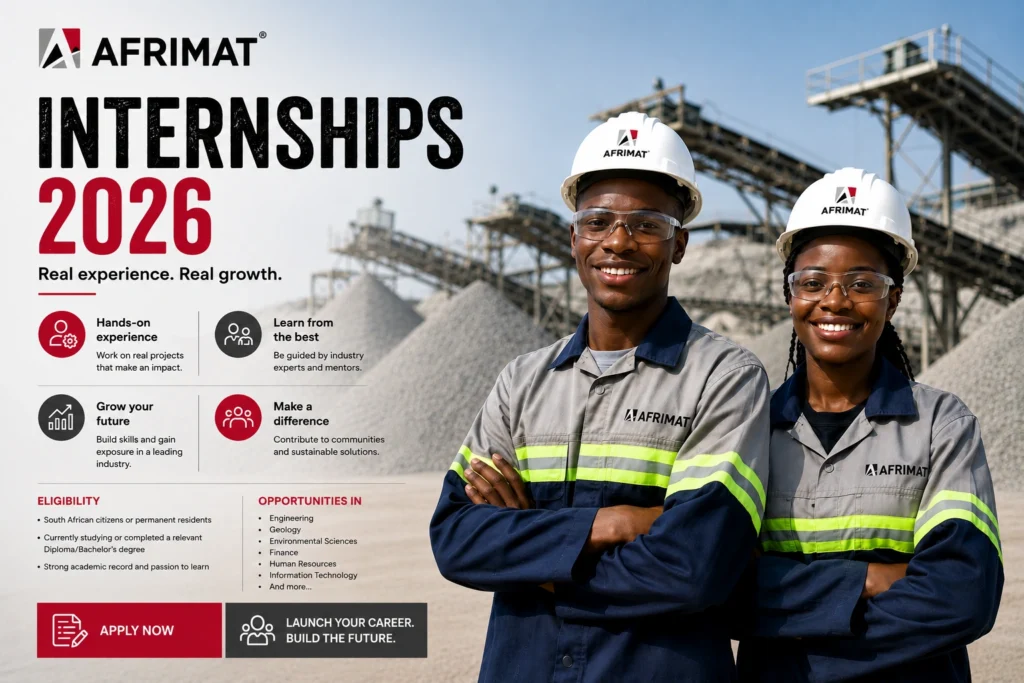
That is why the Afrimat Internships 2026 announcement has drawn attention among South African graduates looking for entry points into mining, manufacturing and industrial operations. Unlike internships built around administrative observation or generic office support, these roles appear closely connected to the day-to-day realities of operational business environments.
Afrimat has opened applications for two graduate opportunities: a Procurement and Logistics Graduate Internship and a Mechanical Engineering Internship. While both sit within the broader industrial and mining economy, they offer very different experiences and career pathways.
The Procurement and Logistics opportunity closes on 28 May 2026, while the Mechanical Engineering Internship closes on 25 May 2026.
Why the Afrimat Internships 2026 Matter Right Now
South Africa’s graduate unemployment problem has become increasingly tied to experience gaps rather than qualifications alone. Employers regularly ask for “practical exposure” even for entry-level positions, leaving many graduates trapped between study and employment.
In sectors like mining, construction materials and manufacturing, companies are often looking for candidates who already understand operational pressure, compliance culture, procurement systems or site discipline. That creates a difficult situation for young professionals who have theoretical knowledge but little workplace access.
The Afrimat Internships 2026 arrive at a time when many graduates are actively searching for opportunities that can strengthen their CVs before the second half of the year begins.
Afrimat itself operates across several sectors linked to South Africa’s industrial economy, including construction materials, bulk commodities and mining-related activities. Exposure inside such environments can help graduates understand how technical operations, supply chains and production systems interact in real business conditions.
For young professionals trying to enter mining or industrial careers, that type of exposure can carry long-term value beyond the internship period itself.
A closer look at the Procurement and Logistics Graduate Internship
The Procurement and Logistics Graduate Internship is particularly interesting because it touches multiple business functions at once.
The vacancy references Bedfordview, Gauteng, while also mentioning Afrimat CM Eastern Cape in Gqeberha. Candidates are therefore encouraged to carefully follow the location guidance provided on the official application platform.
At first glance, procurement may seem like a purely administrative field. In practice, however, procurement departments inside mining and manufacturing businesses often influence operational continuity directly.
A delayed supplier delivery can halt production. Incorrect purchasing decisions can affect costs across entire sites. Weak stock management can disrupt maintenance schedules or operational planning.
That means procurement graduates entering these environments are not simply processing paperwork. They are learning how industrial businesses actually keep moving.
The internship is aimed at candidates with a recognised National Diploma in Purchasing or Logistics. Afrimat also mentions that experience within a purchasing environment — especially in manufacturing or mining — would be advantageous.
ERP software familiarity is another important detail. Experience with systems such as SAP or SAGE is listed as beneficial, reflecting how modern procurement operations increasingly rely on digital systems for supplier management, requisitions and financial tracking.
The role itself includes responsibilities such as:
- Assisting with sourcing and placing orders
- Supplier communication
- Reviewing quotations
- Supporting requisition-to-pay processes
- Assisting with stock counts
- Maintaining records and filing
- Supporting contract administration
For graduates trying to build careers in supply chain management, procurement or operations coordination, this type of hands-on exposure can be more valuable than short-term administrative internships with limited operational involvement.
The hidden value of procurement experience
One overlooked reality in South Africa’s job market is how transferable procurement experience can become over time.
Graduates who learn supplier coordination, ERP systems, purchasing controls and logistics processes often find opportunities in industries far beyond mining. Retail, manufacturing, transport, warehousing and even healthcare procurement all rely on similar operational principles.
That makes internships like this strategically useful for graduates who want flexibility in future career moves.
It also reflects a broader shift in the labour market where operational efficiency roles are becoming increasingly important during economic pressure and cost-conscious business cycles.
Mechanical Engineering graduates entering the real industrial world
The Mechanical Engineering Internship presents a completely different environment.
Unlike office-focused graduate programmes, this role is positioned as site-based and operational. Afrimat Mining Services lists Henley-on-Klip, Gauteng, as the location, and the internship appears designed for graduates prepared to work in practical industrial conditions rather than corporate office settings.
For many engineering graduates, that distinction matters.
A growing number of young engineers leave university with strong theoretical foundations but limited exposure to actual mining or maintenance environments. The transition from classroom engineering concepts to site-level reliability work can be difficult without structured workplace exposure.
This internship seems intended to bridge that gap.
Afrimat notes that successful candidates may work alongside artisans and operational teams while learning equipment reliability, inspections, maintenance coordination and component repairs.
The internship also references root cause analysis and oil health activities, both of which are critical in maintenance-heavy industrial environments where equipment downtime directly affects productivity and profitability.
Importantly, the company states that interns may be expected to understand mechanical systems deeply enough to supervise or guide maintenance and production personnel when required.
That signals a level of operational seriousness that engineering graduates should pay attention to.
What mining-sector internships are teaching graduates in 2026
Across South Africa’s mining and industrial sectors, internships are increasingly being used as operational readiness programmes rather than observational learning experiences.
Employers are no longer looking only for technical knowledge. They are looking for adaptability, problem-solving ability and site discipline.
Graduates entering industrial workplaces today are expected to understand:
- Safety culture
- Production pressure
- Equipment reliability
- Communication within technical teams
- Reporting structures
- Maintenance planning
- Operational accountability
The Afrimat Internships 2026 reflect this broader industry trend.
Mechanical Engineering graduates, in particular, are entering a market where practical competence often matters as much as academic distinction. Companies want engineers who can function inside real operational environments, communicate with artisans and identify reliability issues before breakdowns occur.
That is especially relevant in mining-related businesses where equipment failure can lead to major operational and financial consequences.
Expert-style insight: Why site readiness now matters more than academic marks
One of the biggest shifts happening in South Africa’s graduate hiring market is the growing emphasis on “site readiness.”
In industrial sectors, employers increasingly prioritise graduates who can adapt quickly to operational conditions instead of relying solely on academic performance.
This includes factors such as:
- Willingness to work in outdoor or industrial environments
- Understanding of workplace safety culture
- Ability to work with technical teams
- Practical communication skills
- Reliability under operational pressure
That may explain why Afrimat’s Mechanical Engineering Internship highlights medical fitness, site-based work and operational exposure so strongly.
For employers in mining and manufacturing, workplace readiness has become a competitive advantage.
Documentation mistakes still eliminate many applicants
One detail repeated across both internships is the requirement to upload documents correctly in a single file under 3 MB.
This may sound minor, but recruiters frequently mention that incomplete or incorrectly formatted applications remain one of the biggest reasons candidates are excluded early.
Applicants for the Procurement and Logistics role must submit:
- CV
- Certified ID copy
- Certified academic transcript
- Certified qualifications
Mechanical Engineering applicants must provide:
- Updated CV
- Certified ID copy
- Latest academic record
- Certified Matric certificate
- Certified tertiary qualification
Both internships also require candidates to meet medical fitness standards aligned with the Mine Health and Safety Act.
That requirement reflects the realities of industrial and mining-linked workplaces, where health and safety compliance is taken seriously.
The regional significance of industrial graduate opportunities
Internships linked to mining, logistics and industrial production remain especially significant in provinces like Gauteng, Northern Cape, Limpopo and Eastern Cape, where mining and manufacturing activity continues to shape local economies.
While South Africa’s technology and finance sectors often dominate graduate career discussions online, industrial sectors still employ large numbers of technically trained professionals.
Companies connected to materials, mining and infrastructure continue to require:
- Engineers
- Procurement specialists
- Logistics coordinators
- Maintenance planners
- Supply chain professionals
That makes opportunities like the Afrimat Internships 2026 particularly relevant for graduates looking beyond traditional office careers.
There is also growing awareness among graduates that industrial sectors may offer stronger long-term technical career development than some overcrowded white-collar graduate pathways.
What candidates should focus on before applying
Many graduates underestimate how specifically recruiters read internship applications.
Generic CVs often struggle because they fail to connect academic learning with operational relevance.
Procurement candidates should emphasise:
- ERP system exposure
- Excel and reporting skills
- Supplier communication
- Purchasing-related coursework
- Administrative accuracy
APPLY HERE: Afrimat Internships 2026 Mechanical Engineering Internship
APPLY HERE: Afrimat Internships 2026 Procurement and Logistics Graduate Internship
Mechanical Engineering graduates should focus on:
- Technical projects
- Maintenance exposure
- Workshop or plant experience
- Driver’s licence details
- Practical engineering problem-solving
Candidates should also ensure that certifications are current and clearly scanned.
ALSO APPLY FOR: BCE Graduate Internship Programme 2026
FAQ
What are the closing dates for the Afrimat internships?
The Procurement and Logistics Graduate Internship closes on 28 May 2026, while the Mechanical Engineering Internship closes on 25 May 2026.
Do candidates need work experience to apply?
The internships are aimed at graduates, but Afrimat notes that purchasing-related experience and ERP exposure may be advantageous for Procurement and Logistics applicants.
Is the Mechanical Engineering Internship office-based?
No. Afrimat describes it as a site-based operational role linked to mining services and equipment reliability work.
Final Thoughts
The Afrimat Internships 2026 reflect a larger reality about South Africa’s graduate employment landscape: qualifications alone are no longer enough in many technical and operational sectors.
Employers increasingly want graduates who can move from theory into practical environments with confidence, discipline and adaptability.
For Procurement and Logistics graduates, this internship offers exposure to supplier systems, purchasing operations and industrial business processes that underpin large-scale operations every day.
For Mechanical Engineering graduates, the opportunity is even more hands-on, offering exposure to equipment reliability, maintenance systems and operational problem-solving in real industrial conditions.
Perhaps the most important takeaway is that these internships are not positioned as symbolic graduate programmes. They appear structured around operational contribution and workplace readiness.
In a labour market where practical experience remains one of the hardest barriers for graduates to overcome, opportunities like these may provide more than temporary exposure. They may become the first real bridge between qualification and long-term industrial careers.