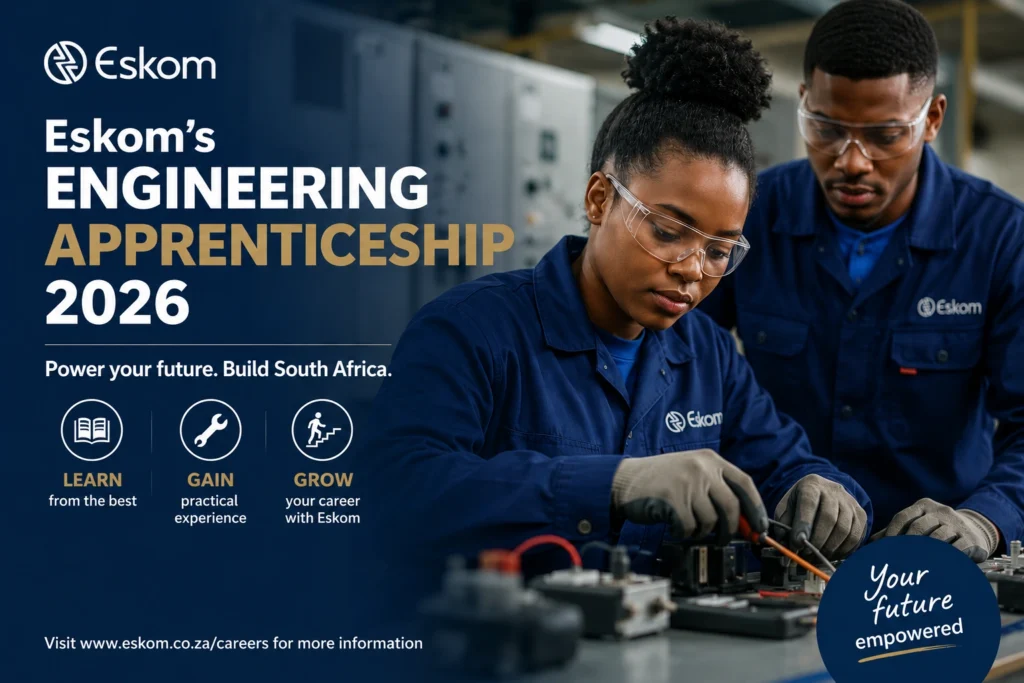

For thousands of young South Africans searching for a stable career path in a difficult economy, Eskom’s Engineering Apprenticeship 2026 is suddenly attracting major attention — and not just because it offers a stipend.
The renewed buzz around Eskom’s apprenticeship programmes comes at a time when youth unemployment remains one of the country’s biggest social and economic challenges. At the same time, South Africa’s energy sector is under pressure to modernise, maintain ageing infrastructure, and prepare for a more diversified power future.
That combination has turned technical trades into something far more valuable than many people realised a few years ago.
Instead of chasing oversaturated office jobs, more school leavers and unemployed youth are now looking toward artisan careers, engineering support roles, and practical technical training that can lead directly into employment. And few names carry more weight in that space than Eskom Holdings SOC Ltd.
The utility’s apprenticeship programme is increasingly viewed as a gateway into South Africa’s industrial economy — especially for candidates interested in electrical systems, mechanical maintenance, control technologies, and heavy engineering operations.
In many ways, the growing interest around Eskom’s 2026 intake reflects a larger shift happening across the country: practical technical skills are becoming highly strategic again.
Why Eskom’s Apprenticeship Is Suddenly Trending
Part of the excitement comes from the simple reality that artisan careers are making a comeback.
For years, university degrees dominated career conversations. But rising graduate unemployment has forced many young people to rethink what long-term career security actually looks like. Skilled artisans — electricians, millwrights, fitters, welders, and instrumentation specialists — remain in demand across mining, manufacturing, logistics, construction, utilities, and renewable energy sectors.
Eskom sits at the centre of that demand.
As the company continues maintaining existing power stations while investing in transmission upgrades and future energy infrastructure, it needs technically trained workers capable of operating in highly specialised environments.
That is why Eskom continues investing heavily in artisan development programmes and structured engineering training pipelines.
Unlike many short-term learnerships, Eskom’s apprenticeship pathway is designed to produce fully qualified artisans through a three-year structured programme that combines theory, practical workplace learning, safety training, and supervised technical experience.
And the biggest attraction?
The programme leads toward a nationally recognised Red Seal Trade Certificate — one of the most respected technical qualifications in South Africa.
The Big Appeal: Earn While You Learn
One reason Eskom’s apprenticeship programmes generate so much public interest is because they solve two major problems at once.
Young people need qualifications.
But they also need income.
Traditional study routes often require families to carry massive financial pressure for years before graduates see any return. Apprenticeships work differently. Candidates receive practical training while earning a monthly stipend, reducing some of the financial burden that blocks many talented students from entering technical careers.
For many households, that matters enormously.
The “earn while you learn” structure also changes how candidates experience education. Instead of studying only in classrooms, apprentices work inside real industrial environments, learning directly from qualified artisans and engineering teams.
That hands-on exposure can become a major advantage later in the job market.
Employers consistently value candidates who already understand workplace systems, industrial safety standards, equipment handling, and operational discipline.
Understanding the Different Trade Paths
One of the strongest features of Eskom’s Engineering Apprenticeship 2026 is the variety of technical disciplines available.
The apprenticeship intake typically includes several specialised trade streams, each connected to different parts of Eskom’s operations.
Electrical Trade
This remains one of the most sought-after pathways.
Electrical apprentices focus on heavy-current systems, substations, power distribution networks, electrical maintenance, and infrastructure repair. Considering South Africa’s ongoing grid challenges, electrical artisans remain critically important across the entire energy sector.
Mechanical Trade
Mechanical apprentices work on industrial equipment such as turbines, boilers, pumps, compressors, valves, and rotating machinery.
These systems are essential inside power stations, where continuous maintenance determines operational stability.
Control & Instrumentation (C&I)
C&I is increasingly attracting candidates interested in automation, digital systems, and industrial technology.
This trade focuses on monitoring and control systems used to regulate power station operations, including PLC systems, SCADA technology, and advanced instrumentation equipment.
As energy infrastructure becomes more digitised, these technical skills are likely to become even more valuable.
Fitting, Turning, and Welding
These specialised mechanical support trades remain essential in industrial maintenance environments.
Precision machining, fabrication, structural repair, and metalwork continue playing a central role in large-scale engineering operations.
Why Eskom Still Carries Massive Industry Value
Despite years of public frustration over load shedding and operational challenges, Eskom still carries enormous weight within South Africa’s technical training ecosystem.
That distinction matters.
An Eskom trade qualification is often viewed by employers as proof that candidates have trained under demanding industrial standards.
Power stations are complex, high-risk environments where safety, technical precision, and operational discipline are non-negotiable. Apprentices trained within these systems develop experience that transfers well into mining operations, manufacturing plants, municipal utilities, petrochemical industries, and renewable energy projects.
For many young people, the apprenticeship is therefore not only about Eskom itself.
It is about long-term employability across multiple industries.
The Academic Requirements Are Strict — And Deliberately So
One of the biggest discussion points online involves Eskom’s academic thresholds.
Unlike some entry-level programmes, Eskom’s engineering apprenticeships require strong technical subject performance.
Applicants generally need one of the following:
- Grade 12 with Mathematics, Physical Science, and English
- An N3 Engineering Certificate
- NCV Level 4 with appropriate technical subjects
Importantly, Mathematics Literacy is not accepted.
That requirement has sparked debate among some applicants, but industry experts argue that the technical demands of artisan training make strong mathematical foundations essential.
Electrical calculations, mechanical measurements, fault diagnosis, instrumentation logic, and engineering theory all depend heavily on mathematical understanding.
The high entry standards are part of what protects the value of the qualification itself.
The Safety Culture Is Not Optional
One aspect of Eskom training that candidates often underestimate is the company’s intense focus on safety culture.
Inside power stations and industrial facilities, mistakes can become fatal.
That is why Eskom’s “Zero Harm” approach shapes nearly every part of apprentice training. Candidates are expected to understand safety protocols, protective equipment procedures, hazard identification, lockout systems, confined-space procedures, and operational discipline from the beginning.
Shortlisted applicants are often assessed not only for technical potential but also for attitude, responsibility, and safety awareness.
This emphasis reflects broader trends across global engineering industries, where safety compliance increasingly determines employability.
Public Reaction: Why So Many Young South Africans Are Paying Attention
Social media discussions around Eskom apprenticeship opportunities reveal a mixture of hope, urgency, and frustration.
Many young people see artisan careers as one of the few realistic routes into stable employment without accumulating massive university debt.
Others are drawn by the credibility attached to Red Seal qualifications.
But there is also concern about the intense competition.
Eskom receives extremely high application volumes whenever apprenticeship positions open. Limited spaces mean many qualified applicants still do not get selected.
That reality has led career advisors to encourage students to strengthen their profiles early through:
- Technical school subjects
- TVET college programmes
- Short engineering courses
- Basic workshop exposure
- Safety certifications
- Mechanical or electrical practical experience
The stronger a candidate’s practical exposure and technical understanding, the better their chances during recruitment.
Why This Matters Right Now
South Africa’s infrastructure economy is entering a critical period.
Energy generation, transmission upgrades, industrial maintenance, transport logistics, mining expansion, and renewable energy projects all require technically skilled workers.
At the same time, artisan shortages remain a major challenge in several sectors.
That creates a situation where technical apprenticeships are becoming strategically important — not just for individuals, but for the country’s broader economic recovery.
Eskom’s apprenticeship programme sits directly inside that larger national conversation.
The utility needs skilled workers to maintain existing infrastructure while preparing for future energy transitions. Meanwhile, young South Africans need pathways into sustainable employment.
Those two realities are now colliding in a very visible way.
It also explains why artisan development programmes are increasingly receiving attention from policymakers, employers, training institutions, and communities alike.

How the Application Process Works
Applicants must apply through the official Eskom Careers Portal.
The process is fully online, and candidates are strongly advised to avoid unofficial recruitment links circulating on social media.
Typical application requirements include:
- Updated CV
- Certified ID copy
- Certified Matric, N3, or NCV certificates
- Additional technical certificates if available
Candidates should search for vacancies using keywords like “Apprentice” or “Learner Artisan” and carefully check reference numbers attached to specific postings.
Accuracy matters during the application stage.
APPLY HERE: Eskom’s Engineering Apprenticeship 2026
ALSO APPLY FOR: Unitrans Junior Diesel Mechanic Apprentice
Incomplete documentation, incorrect uploads, or missing qualifications can immediately disqualify applicants.
Scam Warnings Continue to Spread
Another reason Eskom apprenticeship discussions keep trending is the rise of fake recruitment advertisements online.
False claims about massive youth recruitment drives frequently circulate across WhatsApp groups and social media pages. Some scams ask applicants to pay fees or submit personal details through unofficial channels.
Eskom has repeatedly warned candidates that legitimate recruitment processes happen only through official platforms.
That warning has become increasingly important as desperate job seekers remain vulnerable to fraudulent schemes.
Alternative Eskom Opportunities Also Drawing Interest
Not everyone qualifies for the apprenticeship pathway.
Fortunately, Eskom also offers other technical development programmes targeting candidates with higher-level engineering qualifications.
These include:
- Engineer in Training (EIT) programmes
- Plant Maintenance Learnerships
- Learner Artisan opportunities
- Graduate engineering development programmes
These alternatives create multiple entry points into the energy and engineering sector depending on educational background.
For diploma and degree holders, these programmes may provide faster routes into specialised technical careers.
What Could Happen Next
The long-term importance of technical training in South Africa is likely to grow even further.
As the country modernises energy infrastructure and expands renewable energy capacity, demand for electrical, mechanical, and instrumentation skills could increase significantly.
That may eventually make artisan careers even more competitive and valuable.
Eskom itself also faces pressure to strengthen succession planning as experienced technical staff retire over time. Apprenticeship programmes therefore serve a strategic workforce function beyond simple youth development.
We may also see closer collaboration between Eskom, TVET colleges, engineering institutions, and private-sector employers to strengthen artisan pipelines nationally.
For candidates entering these programmes now, the timing could prove highly significant.
Those who qualify as artisans during the next few years may enter a labour market increasingly hungry for verified technical competence.
The Bigger Shift Happening Behind the Headlines
What makes Eskom’s Engineering Apprenticeship 2026 especially interesting is that it reflects a deeper shift in how South Africans are starting to think about careers.
Technical skills are regaining prestige.
Artisan work is no longer viewed only as an alternative path for students who avoid university. In many industries, these careers now offer stronger employment prospects than overcrowded graduate sectors.
That mindset shift may become one of the most important workforce trends of the next decade.
And Eskom’s apprenticeship programme sits right at the centre of it.
Conclusion
For young South Africans looking for a realistic pathway into engineering and industrial careers, Eskom’s apprenticeship programme represents far more than a training opportunity.
It offers structured workplace exposure, recognised qualifications, industry credibility, and practical technical experience inside one of the country’s most important industrial systems.
Competition will remain intense.
The academic requirements are demanding.
And the recruitment process is highly selective.
But for candidates with the right technical mindset, discipline, and commitment to safety, the programme could become a life-changing opportunity with long-term career value far beyond Eskom itself.
As South Africa’s energy sector evolves, skilled artisans are likely to become even more important to the country’s future.
And that makes this apprenticeship programme one of the most closely watched engineering opportunities of 2026.