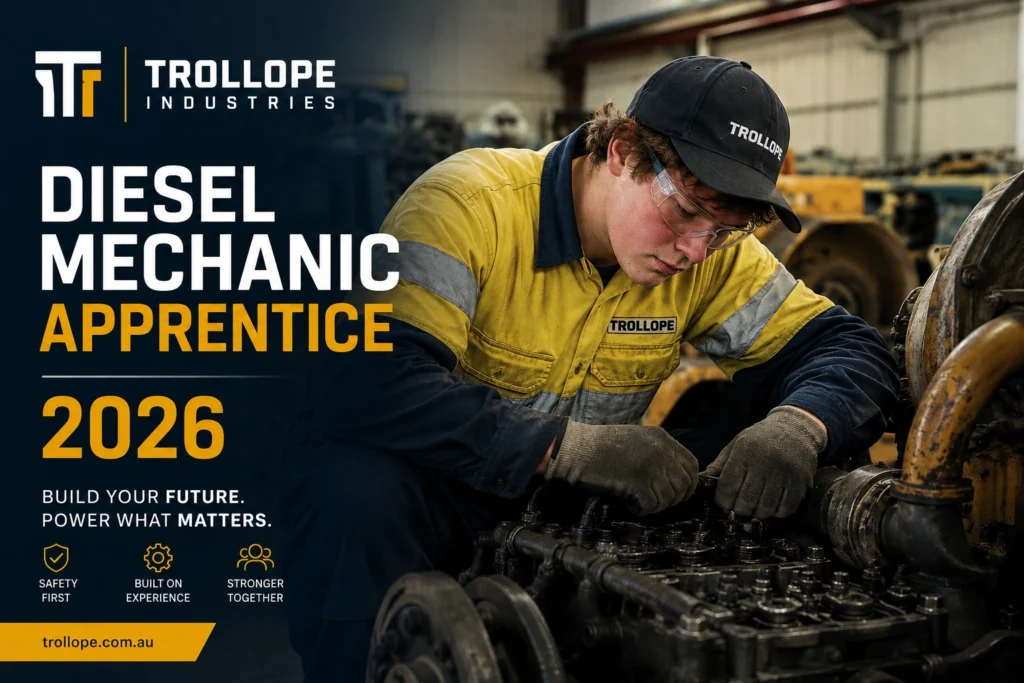

The sudden rise in searches for the Trollope Diesel Mechanic Apprentice programme says a lot about where South Africa’s youth employment conversation is heading in 2026.
For years, university degrees dominated the national career narrative. But with unemployment still placing pressure on young people — especially first-time job seekers — more school leavers and TVET graduates are beginning to look toward artisan careers that offer something many industries no longer guarantee: practical training linked directly to real jobs.
That shift is one reason the latest apprenticeship intake from Trollope Mining Services is attracting attention far beyond the mining sector itself.
The company has officially opened applications for its 2026 Apprentice Diesel Mechanic Programme, offering structured artisan training for South Africans aged 19 to 25 who want to build careers around heavy machinery, engineering maintenance and industrial equipment.
And in a country where technical skills shortages continue to affect mining, logistics and infrastructure development, opportunities like this are becoming increasingly important.
A Different Kind of Career Conversation Is Emerging
Not long ago, many young South Africans viewed artisan work as a “backup plan” rather than a first-choice career.
That perception has changed dramatically over the past few years.
The growth of infrastructure projects, renewable energy developments, transport expansion and large-scale mining operations has pushed technical trades back into the spotlight. Employers are actively searching for qualified artisans who can maintain complex machinery and keep operations running.
Diesel mechanics sit at the centre of that demand.
Without them, massive mining haul trucks, excavators, bulldozers and construction vehicles simply stop functioning — and when machinery stops, entire operations can lose millions.
That reality has turned heavy equipment mechanics into one of the country’s most valuable technical professions.
The Trollope Diesel Mechanic Apprentice programme arrives at a moment when many young people are rethinking what long-term career security actually looks like.
Why Mining Apprenticeships Still Matter
South Africa’s mining industry has changed significantly over the last decade.
Automation, safety standards and advanced engineering systems have transformed modern mine sites into highly technical environments. Today’s mining operations rely on sophisticated hydraulic systems, electronic diagnostics and specialised diesel machinery that require trained professionals to maintain.
That means companies are no longer simply looking for “general workers.” They need technically competent artisans with certified trade skills.
Apprenticeships remain one of the few career pathways that combine:
- Practical workshop experience
- Structured technical training
- Mentorship from experienced artisans
- Long-term trade preparation
- Exposure to real industrial environments
For many unemployed youth, that combination can be far more valuable than short-term casual work.
Unlike some entry-level programmes that focus only on theory, apprenticeships immerse learners in daily operational realities from the beginning.
That practical exposure often becomes the difference between remaining unemployed and becoming employable.
Inside the Trollope Apprentice Programme
According to the programme details, successful applicants will enter a structured artisan development process expected to run between 36 and 40 months.
The apprenticeship is aligned with QCTO trade development standards and focuses on heavy equipment diesel mechanics within mining and engineering environments.
Training phases are expected to include:
- Basic technical training
- Advanced practical development
- Workplace rotations
- Pre-trade test preparation
- Final trade testing
The long duration matters.
In today’s fast-moving online culture, many people expect “quick skills” programmes to deliver instant career success. But artisan development works differently.
Becoming a qualified heavy equipment mechanic requires years of practical repetition, fault diagnosis training and exposure to increasingly complex machinery systems.
That is why experienced diesel mechanics remain highly respected across industrial sectors.
What Heavy Equipment Mechanics Actually Do
The public often imagines diesel mechanics simply “fixing engines.”
The reality is much broader.
Modern heavy equipment mechanics work with highly specialised systems that combine hydraulics, electronics, computer diagnostics and precision mechanical engineering.
Their daily work may involve:
- Diagnosing engine failures
- Repairing hydraulic systems
- Conducting preventative maintenance
- Testing equipment safety systems
- Replacing mechanical components
- Troubleshooting electrical faults
- Inspecting mining machinery
The equipment itself can be enormous.
Machines commonly serviced in mining and construction environments include:
- Excavators
- Front-end loaders
- Bulldozers
- Dump trucks
- Haul trucks
- Graders
- Earthmoving machinery
In many operations, a single mechanical failure can halt production entirely. That pressure makes skilled maintenance teams essential.
And it explains why artisan shortages continue to concern major industrial employers.
Why This Matters Right Now
South Africa’s youth unemployment crisis remains one of the country’s most urgent economic challenges.
But another issue often receives less attention: the growing mismatch between available jobs and available skills.
Many industries still struggle to recruit technically trained workers even while large numbers of young people remain unemployed.
That contradiction is pushing companies, policymakers and training institutions to rethink workforce development strategies.
The Trollope Diesel Mechanic Apprentice programme reflects that wider shift.
Instead of focusing purely on academic qualifications, programmes like this prioritise practical capability, technical competence and industry readiness.
That matters because artisan careers continue to offer:
- Stronger long-term employability
- Mobility across industries
- Competitive earning potential
- Opportunities for specialisation
- International career prospects
A qualified diesel mechanic can potentially work in:
- Mining
- Construction
- Transport fleets
- Agriculture
- Manufacturing
- Infrastructure projects
- Equipment servicing companies
For many young South Africans, that versatility makes artisan careers increasingly attractive.
The Growing Public Reaction Around Skilled Trades
Online discussions around apprenticeships have changed noticeably in recent years.
There was a time when social media conversations focused almost entirely on corporate internships, office careers and university pathways. Now, more young people are openly discussing technical trades as realistic routes into stable employment.
Part of that shift comes from economic reality.
Graduates across multiple sectors continue facing intense competition for limited entry-level positions. At the same time, qualified artisans often secure employment faster because their skills directly support operational industries.
This has led to growing interest in:
- Learnerships
- Apprenticeships
- TVET qualifications
- Artisan development programmes
- Technical short courses
Many career advisors are now encouraging learners to explore engineering trades earlier instead of viewing them as secondary options.
The popularity of mining and engineering apprenticeship content online reflects that change in public thinking.
The Requirements Reveal What Employers Want
The eligibility criteria for the Trollope programme also tell an important story about the future workforce.
Applicants must:
- Be South African citizens
- Be between 19 and 25 years old
- Hold Grade 10–12 with technical subjects or engineering N-level qualifications
- Possess a valid driver’s licence
- Be medically fit
- Demonstrate communication and teamwork skills
What stands out is that employers are no longer looking only at academic marks.
Soft skills matter too.
Mining and engineering environments require workers who can:
- Follow safety procedures
- Work under pressure
- Communicate effectively
- Manage time responsibly
- Operate within teams
How to Apply
Applications must be submitted by email.
Email Address
Application for Trollope Apprenticeship Programme 2026
Application for Trollope Apprenticeship Programme 2026
recruitment@trollopegroup.co.za
ALSO VISIT: https://trollopegroup.co.za
That broader evaluation process reflects how industrial workplaces are evolving.
Technical ability alone is no longer enough.
ALSO APPLY FOR: Feltex Millwright Apprenticeship 2026
Technical Subjects Are Becoming More Valuable Again
For years, some technical school subjects were underestimated compared to traditional academic streams.
Now, subjects like:
- Mathematics
- Physical Science
- Engineering Graphics and Design
- Mechanical Technology
- Diesel Trade Theory
are regaining importance in the labour market.
TVET College graduates are also seeing renewed relevance as industries increase demand for practical engineering skills.
This shift may gradually reshape how young South Africans think about education pathways after Matric.
Instead of asking only, “Which degree should I study?” more learners are beginning to ask, “Which skills are industries urgently looking for?”
That is a very different national conversation.
ALSO VISIT: https://trollopegroup.co.za
The Reality Behind the Competition
Of course, apprenticeship opportunities remain highly competitive.
Large employers can receive thousands of applications for a single intake.
That means small mistakes can quickly eliminate candidates before interviews even begin.
Recruitment specialists consistently warn applicants about common problems such as:
- Incorrect email subject lines
- Incomplete documents
- Blurry certificates
- Unprofessional CV formatting
- Missing qualification records
The Trollope application process specifically emphasises correct subject line formatting — something many applicants overlook.
This highlights a broader issue affecting youth employment: job readiness now includes administrative professionalism, not just qualifications.
Even basic digital communication skills can influence application outcomes.
Scam Warnings Continue Across South Africa
Another reason apprenticeship announcements attract attention is the growing concern around recruitment scams.
Fake learnerships and fraudulent training opportunities continue targeting desperate job seekers online.
Trollope Mining Services has reportedly warned applicants that no payment is required during the recruitment process.
That warning matters.
Across South Africa, many young people lose money to fake “registration fees,” fraudulent placement promises and unofficial recruitment agents.
As demand for opportunities rises, scams tend to rise too.
Career experts increasingly advise applicants to:
- Verify company websites
- Avoid payment requests
- Confirm official email addresses
- Research recruitment processes carefully
- Be cautious of social media “agents”
The rise of scams has unfortunately become part of the broader youth employment landscape.
Why Diesel Mechanics Could Become Even More Important
The future of heavy equipment maintenance may become even more specialised over the next decade.
Mining companies are investing heavily in:
- Advanced diagnostics systems
- Hybrid machinery
- Automated equipment
- Fleet monitoring technologies
- Fuel efficiency improvements
That evolution means future diesel mechanics may require stronger electronic and diagnostic skills in addition to traditional mechanical expertise.
The role is becoming increasingly technical.
In many ways, modern artisans are now highly specialised industrial technicians rather than traditional workshop mechanics.
That could improve long-term career prospects for qualified tradespeople.
What Could Happen Next
If interest in technical careers continues growing, South Africa could see major changes in workforce development over the next few years.
Possible developments include:
Increased Investment in Artisan Training
More companies may expand apprenticeship programmes as skills shortages intensify.
Greater Demand for TVET Graduates
Technical education institutions could gain stronger industry relevance as employers prioritise practical training pathways.
Higher Competition for Apprenticeships
As awareness grows, programmes like the Trollope Diesel Mechanic Apprentice intake may become even more competitive.
Expanded Industrial Career Mobility
Qualified artisans may increasingly move between industries including mining, energy, logistics and infrastructure development.
Improved Perception of Skilled Trades
Public attitudes toward technical careers may continue shifting positively, especially among younger generations.
These changes will likely shape how South Africa approaches employment creation in the years ahead.
A Career Path Built Around Real Skills
One reason apprenticeship programmes continue resonating with young people is simple: they offer visible, practical progression.
You learn.
You practice.
You improve.
You qualify.
That pathway feels tangible in a labour market where many young people struggle to gain experience at all.
For technically minded youth who enjoy machinery, problem-solving and hands-on environments, diesel mechanics can provide both challenge and long-term opportunity.
The work is demanding.
Mining environments are not easy spaces.
But the skills gained are highly transferable and often respected across industries.
Final Thoughts
The growing attention around the Trollope Diesel Mechanic Apprentice programme reflects something bigger than one company’s recruitment drive.
It reflects a national shift in how many young South Africans are thinking about work, stability and career growth.
Artisan careers are no longer being viewed simply as alternatives.
Increasingly, they are becoming strategic career choices tied directly to industries that continue driving economic activity.
At a time when many sectors face uncertainty, technical skills remain difficult to replace.
And for young people willing to commit to years of training, discipline and practical development, apprenticeships like this may offer something increasingly valuable: a genuine pathway into long-term employability.