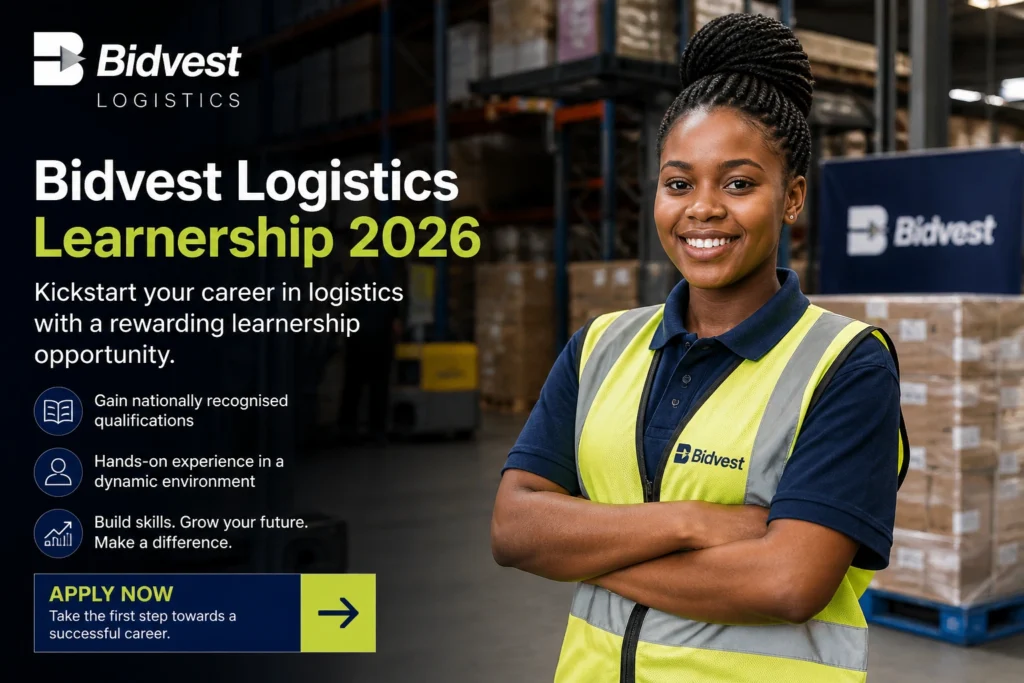

In a job market where “entry-level” often quietly demands experience, the Bidvest Logistics Learnership 2026 is gaining attention for a simple reason: it offers something many young South Africans have been locked out of—real access.
Not just a stipend. Not just a certificate. But a structured, 12-month pathway into an industry that quietly powers everything from supermarket shelves to global trade routes.
And right now, it’s trending because the gap it addresses—between education and employment—has never felt wider.
A Shift in How Opportunities Are Being Designed
For years, young job seekers have faced a frustrating paradox: you need experience to get a job, but you need a job to get experience.
Learnerships were meant to solve this. But not all of them have delivered meaningful exposure or long-term value.
The Bidvest Logistics Learnership 2026 stands out because it leans into a more deliberate model—one that blends formal qualification, digital learning, and workplace immersion within a major logistics company.
This isn’t a short course or a casual internship.
It’s a structured programme tied to a recognised qualification through the Quality Council for Trades and Occupations (QCTO), which signals a shift toward more credible, outcome-based training.
And that matters.
Because increasingly, employers are not just asking what you studied, but what you can actually do.
APPLY HERE: Bidvest Logistics Learnership 2026
Why Logistics Is Quietly Becoming a High-Value Career Path
If you asked most students five years ago about career options, logistics might not have made the top ten.
Today, that’s changing.
Logistics is no longer just about trucks and warehouses. It sits at the centre of:
- E-commerce growth
- Global trade disruptions
- Supply chain resilience
- Retail and distribution efficiency
Every product that moves—from imported electronics to locally produced food—relies on systems that logistics professionals help manage.
This means the industry is no longer invisible. It’s essential.
And for young people entering the workforce, it offers something rare: multiple entry points and long-term progression.
The Bidvest programme taps directly into this reality, positioning learners inside a system that is actively evolving.
A Targeted Opportunity—and a Necessary One
One of the most talked-about aspects of the programme is its focus.
The learnership is specifically aimed at African females living with disabilities—a group that has historically faced multiple layers of exclusion in the labour market.
This isn’t accidental.
It reflects a broader shift in how companies are approaching transformation—not just as a compliance exercise, but as a structured pipeline for inclusion.
There’s growing recognition that access alone is not enough. Opportunities must be designed with intention.
By narrowing the intake criteria, the programme is doing something important: it is prioritising access where it has been most limited.
That decision has sparked conversation.
Some see it as necessary redress. Others question how opportunities are distributed.
But in a country still grappling with inequality, targeted programmes like this are becoming more common—and more closely watched.
What the Programme Actually Offers (Beyond the Headline)
Strip away the buzzwords, and the structure of the learnership reveals why it’s attracting attention.
Participants will:
- Spend 12 months in a full-time learning and work environment
- Complete theoretical modules through a digital platform
- Gain exposure across multiple logistics divisions
- Build a portfolio of evidence to demonstrate competence
- Earn a registered qualification at the end
This combination matters.
Because it doesn’t just teach concepts—it requires proof of application.
And in industries like logistics, where precision and accountability are critical, that kind of training is far more valuable than passive learning.
There’s also an unspoken benefit: workplace familiarity.
For many first-time entrants, the biggest hurdle isn’t the work itself—it’s adapting to corporate expectations.
Deadlines. Communication. Professional conduct.
A structured learnership creates space to learn these norms without the immediate pressure of permanent employment.
The Deadline Pressure and Rising Interest
With applications closing on 22 May 2026, there’s a noticeable surge in interest across job platforms and social media discussions.
Part of this is seasonal—mid-year opportunities always attract attention.
But there’s something else at play.
Young job seekers are becoming more selective.
They’re not just applying everywhere. They’re looking for programmes that:
- Offer recognised qualifications
- Provide real workplace exposure
- Improve long-term employability
The Bidvest Logistics Learnership checks these boxes.
And in a competitive environment, that makes it stand out.
Public Reaction: Hope, Skepticism, and Practical Questions
As with many high-visibility opportunities, the reaction has been mixed—but engaged.
Optimism
For many, this is exactly the kind of opportunity they’ve been waiting for.
A structured programme. A known company. A clear outcome.
There’s a sense that this could be a “foot in the door” moment—something that leads to more than just temporary placement.
Skepticism
Others are more cautious.
There’s ongoing concern about whether learnerships translate into permanent jobs.
The question often asked: What happens after the 12 months?
It’s a valid concern.
Not all learnerships guarantee employment, and expectations need to be realistic.
Practical Curiosity
Then there are the practical questions:
- What kind of work will learners actually do?
- How demanding is the programme?
- What level of support is provided?
These questions reflect a more informed applicant base—people who are no longer just looking for any opportunity, but the right one.
Why This Matters Right Now
South Africa’s youth unemployment crisis isn’t new—but its urgency is intensifying.
Traditional pathways—university, internships, entry-level jobs—are no longer sufficient on their own.
What’s needed are bridges.
Programmes that connect:
- Education to employment
- Theory to practice
- Potential to opportunity
The Bidvest Logistics Learnership 2026 represents one of those bridges.
Not because it solves the problem entirely, but because it demonstrates a model that can work:
- Structured learning
- Industry alignment
- Targeted inclusion
- Measurable outcomes
It also reflects a broader shift in how young people are approaching careers.
There’s less emphasis on prestige, and more on practical entry points.
Logistics, once overlooked, is now part of that conversation.

APPLY HERE: Bidvest Logistics Learnership 2026
The Hidden Lesson: Commitment Still Matters
One detail in the programme description is easy to overlook, but important.
This is a full-time, 12-month commitment.
That means:
- Consistent attendance
- Completion of coursework
- Active participation in the workplace
In other words, it’s not a passive opportunity.
And that’s where some applicants struggle.
Learnerships demand discipline.
They require balancing learning and work, often for the first time.
But that’s also what makes them valuable.
Because completing a programme like this signals something to employers that no CV line alone can: reliability.
APPLY HERE: Bidvest Logistics Learnership 2026
ALSO APPLY FOR: R&D WIL Learnership 2026
The Risk of Scams—and Why It’s Being Highlighted
Another reason this opportunity is gaining attention is the explicit warning about recruitment scams.
The company has made it clear:
- No applications via WhatsApp or Telegram
- No payment required
- No requests for financial information
This isn’t just a formality.
It reflects a growing problem in the job market, where fake opportunities exploit desperate applicants.
By addressing this upfront, the programme is doing something important: protecting applicants before they even apply.
It’s also a reminder that credibility matters.
And in a crowded landscape of opportunities, trust is becoming a deciding factor.
What Could Happen Next
The real impact of the Bidvest Logistics Learnership 2026 will only become clear after the first cohort completes the programme.
But there are a few likely scenarios.
1. Increased Demand for Logistics Learnerships
If the programme delivers strong outcomes, more companies may invest in similar models.
Logistics is growing, and the need for skilled workers is increasing.
Structured pipelines like this could become more common.
2. More Targeted Programmes
The focus on African females with disabilities could influence how future programmes are designed.
Expect more opportunities that are not just open to everyone, but intentionally inclusive.
3. Higher Expectations from Applicants
As awareness grows, applicants will become more selective.
They’ll look beyond stipends and focus on:
- Accreditation
- Practical exposure
- Career progression
This could push organisations to improve the quality of their programmes.
4. A Shift in Career Narratives
If more learners transition into stable roles, logistics could shed its “backup option” label and become a first-choice career path.
That would mark a significant shift.
A Realistic Perspective: Opportunity, Not a Guarantee
It’s important to stay grounded.
The Bidvest Logistics Learnership 2026 is an opportunity—not a guaranteed job.
Success will depend on:
- Individual performance
- Industry demand
- Organisational capacity
But that doesn’t reduce its value.
Because in a system where access is limited, even a single structured entry point can change a trajectory.
Final Thoughts
The reason this learnership is getting attention isn’t just because it exists.
It’s because it represents something larger:
A shift toward practical, inclusive, and industry-aligned pathways into employment.
For the right candidate—someone committed, adaptable, and interested in logistics—it could be more than a 12-month programme.
It could be the beginning of a career that operates behind the scenes, but keeps the world moving.
And in today’s economy, that kind of role is more important than ever.
ALSO APPLY FOR: R&D WIL Learnership 2026
APPLY HERE: Bidvest Logistics Learnership 2026