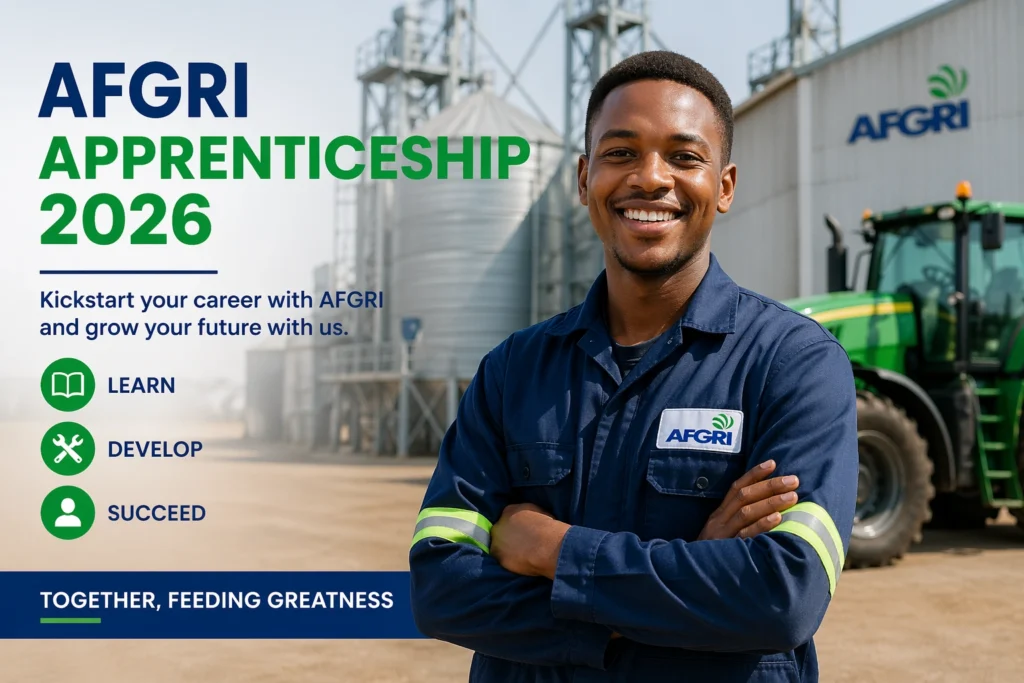

The AFGRI Apprenticeship 2026 arrives at a critical moment for South Africa’s labour market. Youth unemployment remains persistently high, while industries such as agriculture, construction, and logistics continue to report shortages of qualified artisans. This mismatch—between unemployed youth and unfilled technical roles—has become one of the country’s most pressing economic challenges.
Against this backdrop, AFGRI’s decision to open 40 AgriSETA and MerSETA-backed apprenticeship opportunities is more than a routine recruitment drive. It represents a targeted intervention in the skills pipeline, offering structured, industry-aligned training in tractor and earthmoving mechanics. For many aspiring artisans, this programme is not just an opportunity—it is a rare, clearly defined entry point into a long-term profession.
Understanding the AFGRI Apprenticeship 2026 Programme
At its core, the AFGRI Apprenticeship 2026 is designed to bridge the gap between theoretical education and practical industry requirements. The programme focuses on two high-demand specialisations:
- Tractor Mechanics
- Earthmoving Mechanics
These are not entry-level jobs but technical career paths that require a blend of mechanical knowledge, diagnostic ability, and hands-on experience. AFGRI’s model integrates these elements through a three-year in-service training structure, supported by formal accreditation bodies.
What distinguishes this programme is its dual alignment with AgriSETA and MerSETA, ensuring that training is not only practical but also nationally recognised. In a labour market where informal experience often fails to translate into formal qualifications, this structured approach significantly enhances employability.
Moreover, AFGRI’s longstanding role in supplying and maintaining agricultural and heavy equipment means apprentices are trained in environments where operational efficiency and technical accuracy are non-negotiable. This exposure is difficult to replicate in purely academic settings.
APPLY HERE: AFGRI Apprenticeship 2026
Why Artisan Development Matters More Than Ever
The relevance of the AFGRI Apprenticeship 2026 becomes clearer when viewed through broader economic trends. South Africa has, for years, emphasised the need to rebuild its artisan base. According to multiple industry reports, the country faces a shortage of thousands of qualified mechanics, technicians, and engineers across sectors.
This shortage has tangible consequences:
- Delays in infrastructure development
- Increased maintenance costs for machinery
- Reduced productivity in agriculture and mining
At the same time, many young people remain excluded from the labour market due to a lack of experience. Apprenticeships like AFGRI’s directly address this paradox by combining training with employment.
Importantly, mechanical trades—particularly those linked to agriculture and earthmoving—are becoming more technologically advanced. Modern tractors and heavy machinery incorporate digital diagnostics, precision systems, and automated controls. This evolution raises the bar for technical competence, making structured training programmes even more essential.
In this context, AFGRI’s initiative aligns with a broader shift toward skills-based employment, where practical expertise is increasingly valued alongside formal education.
Inside the Training Model: A Hybrid Approach to Skills Development
One of the most compelling aspects of the AFGRI Apprenticeship 2026 is its hybrid training structure. Unlike traditional apprenticeships that rely heavily on workshop exposure alone, AFGRI integrates multiple learning channels:
- Practical workshop training
- Distance learning through accredited institutions
- Product-specific training from suppliers
- Internal technical instruction
- Occasional Saturday classes
This layered approach reflects an understanding that modern artisans require both theoretical grounding and real-world application.
The inclusion of distance learning is particularly noteworthy. It allows apprentices to engage with technical subjects at their own pace while continuing to gain hands-on experience. This flexibility is crucial in accommodating different learning styles and ensuring that knowledge gaps are addressed early.
Equally important is the six-month probation period. While it may appear as a risk for applicants, it serves a strategic purpose. It allows both the apprentice and the employer to assess compatibility before committing to a long-term contract. In an environment where dropout rates can undermine training programmes, this mechanism helps improve overall completion rates.
From an industry perspective, this structured yet adaptable model increases the likelihood that apprentices will emerge as competent, job-ready artisans.
Access and Barriers: Who Gets In—and Who Doesn’t
While the AFGRI Apprenticeship 2026 offers significant opportunities, it also highlights ongoing challenges in access to technical careers.
The minimum requirements include:
- Grade 12 with Mathematics or Technical Mathematics
- A valid driver’s licence
- Basic computer literacy and administrative skills
Notably, Mathematical Literacy is not accepted. This requirement alone excludes a large portion of school leavers, particularly those from under-resourced educational backgrounds.
On one hand, this reflects the technical demands of the trade. Mechanical work requires strong numerical reasoning, particularly in diagnostics and measurements. On the other hand, it raises questions about how the education system prepares learners for such opportunities.
The programme does provide some flexibility by not making subjects like Engineering Science or Diesel Trade Theory mandatory. However, candidates with these backgrounds are likely to have a competitive advantage.
Beyond academic criteria, AFGRI emphasises personal attributes such as motivation, attention to detail, and the ability to work under pressure. These qualities are often overlooked in formal education but are critical in technical environments where errors can have significant consequences.
In essence, the programme is accessible—but not universally so. It rewards preparedness, both academically and personally.
APPLY HERE: AFGRI Apprenticeship 2026
The Economic Value of Work-Back Contracts
A defining feature of the AFGRI Apprenticeship 2026 is its work-back agreement. Apprentices are required to remain with the company for a period equivalent to their training duration after qualifying, or repay training costs if they leave early.
This model is common in technical training programmes but often misunderstood. From AFGRI’s perspective, it serves as a safeguard against talent loss. Training an artisan is a costly investment, and without such agreements, companies risk losing skilled workers immediately after qualification.
For apprentices, the arrangement has both advantages and limitations:
Advantages:
- Guaranteed employment during the work-back period
- Continued professional development within the company
- Stability in the early stages of a career
Limitations:
- Reduced flexibility to pursue alternative opportunities
- Financial risk if the programme is not completed
However, when viewed strategically, the work-back period can be seen as an extension of training rather than a constraint. It allows newly qualified artisans to consolidate their skills in a familiar environment before exploring broader career options.
In a labour market where job security is increasingly uncertain, this structured pathway can be a significant benefit.
Geographic Reach and Industry Integration
Another strength of the AFGRI Apprenticeship 2026 is its national footprint. With opportunities spread across multiple regions—from Mpumalanga and Gauteng to the Western Cape and KwaZulu-Natal—the programme is not confined to a single economic hub.
This geographic diversity has two key implications:
- Regional Skills Development
Apprenticeships in smaller towns and agricultural regions help decentralise skills development, ensuring that technical expertise is not concentrated only in major cities. - Industry Relevance
Training in different locations exposes apprentices to varied operational contexts, from commercial farming to construction projects. This broadens their experience and adaptability.
AFGRI’s integration across sectors—agriculture, forestry, construction, and turf management—further enhances the programme’s value. Apprentices are not limited to a narrow skill set but gain exposure to a range of machinery and applications.
This cross-sector experience is increasingly important in a global economy where versatility is a key asset.
AFGRI Apprenticeship 2026 in the Context of Youth Employment Trends
South Africa’s youth employment crisis has led to a surge in initiatives aimed at creating pathways into work. However, not all programmes are equally effective.
Short-term internships and learnerships often provide limited exposure and do not always lead to sustainable employment. In contrast, apprenticeships—particularly those aligned with industry needs—offer a more robust solution.
The AFGRI Apprenticeship 2026 stands out because it combines:
- Long-term training (three years)
- Formal accreditation
- Practical experience
- A clear career trajectory
This aligns with global best practices in vocational education, where apprenticeships are seen as a cornerstone of workforce development.
Countries with strong apprenticeship systems, such as Germany and Switzerland, consistently report lower youth unemployment rates. While South Africa’s context is different, programmes like AFGRI’s move the system closer to these models.
APPLY HERE: AFGRI Apprenticeship 2026
ALSO APPLY HERE: Epiroc Millwright Apprenticeships 2026
What This Means Going Forward
The implications of the AFGRI Apprenticeship 2026 extend beyond the 40 positions currently available.
First, it signals a growing recognition among employers that investing in skills development is essential for long-term competitiveness. As industries become more technologically advanced, the demand for skilled artisans will only increase.
Second, it highlights the importance of partnerships between companies and training authorities like AgriSETA and MerSETA. These collaborations ensure that training is standardised, accredited, and aligned with national priorities.
Third, it underscores the need for better alignment between the education system and labour market requirements. If more learners are to benefit from such opportunities, greater emphasis must be placed on mathematics, science, and technical subjects at school level.
Finally, the programme sets a benchmark for what effective apprenticeship training can look like in South Africa. If replicated at scale, similar initiatives could play a significant role in reducing youth unemployment and closing the skills gap.
Final Thoughts
The AFGRI Apprenticeship 2026 is not a quick fix for South Africa’s employment challenges. However, it represents a meaningful step toward a more skills-driven economy.
By offering structured training, real-world experience, and a pathway into recognised mechanical trades, the programme provides aspiring artisans with something that is often missing: clarity. It defines what the journey looks like, what is required, and what the potential outcome can be.
For candidates willing to commit to the demands of the programme, the rewards are substantial. Not just in terms of employment, but in the development of a profession that remains essential to the functioning of multiple industries.
In a landscape where many young people struggle to find direction, initiatives like this do more than create
APPLY HERE: AFGRI Apprenticeship 2026
ALSO APPLY HERE: Epiroc Millwright Apprenticeships 2026