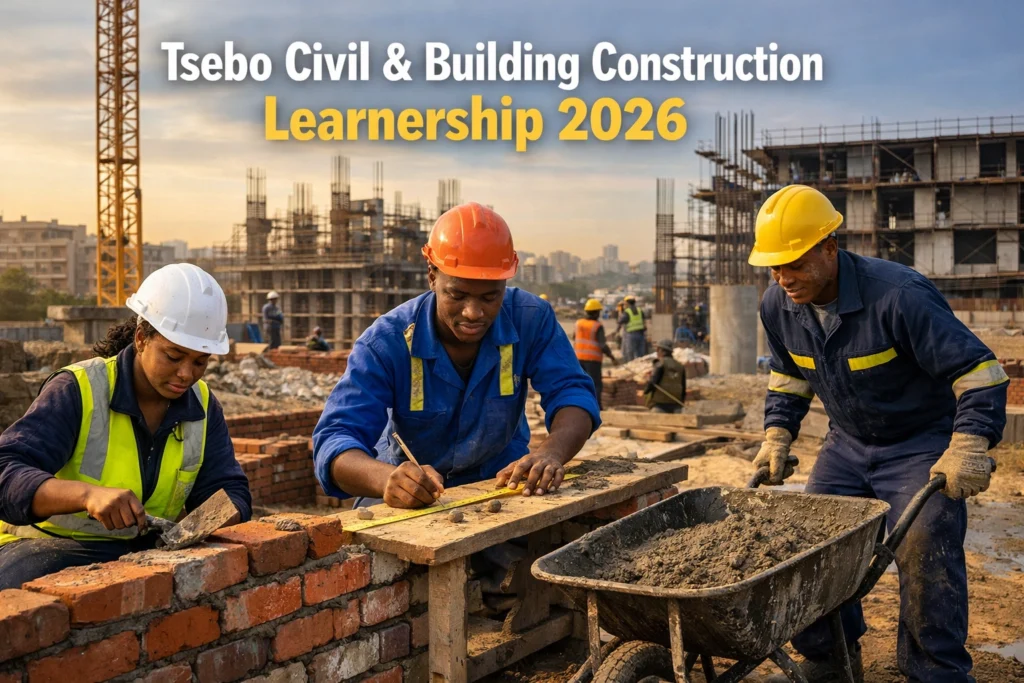

In a country where youth unemployment continues to dominate headlines, opportunities like the Tsebo Civil & Building Construction Learnership 2026 are suddenly getting more attention than usual. It’s not just another learnership announcement—it’s part of a broader shift in how companies are responding to South Africa’s growing demand for practical, skills-based pathways into employment.
Right now, as thousands of matriculants and unemployed young people search for ways to enter the workforce without formal experience, this Pretoria-based programme is emerging as a realistic stepping stone. The timing couldn’t be more relevant.
A Learnership That Arrives at the Right Moment
The Tsebo Civil & Building Construction Learnership 2026 comes at a critical intersection of two major trends: the urgent need for job creation and the increasing emphasis on vocational training.
South Africa’s education system has long been criticised for producing graduates who struggle to transition into employment. At the same time, industries like construction and facilities management continue to face a shortage of entry-level skilled workers.
This is where companies like Tsebo Facilities Solutions step in—not just as employers, but as training providers.
As part of the broader Tsebo Solutions Group, Tsebo operates across multiple sectors, including catering, cleaning, engineering, and facilities management. This gives learners exposure beyond just construction—it opens doors to an entire ecosystem of workplace services.
APPLY HERE: Tsebo Civil & Building Construction Learnership 2026
How the Learnership Model Has Evolved
A decade ago, learnerships were often seen as secondary options—fallbacks for those who didn’t pursue university education. That perception is slowly changing.
Today, structured workplace programmes are increasingly recognised as viable career entry points, especially in technical and trade-based industries. The Tsebo Civil & Building Construction Learnership 2026 reflects this evolution.
Instead of focusing purely on classroom learning, the programme blends:
- Practical, hands-on experience
- Workplace exposure
- Industry-relevant training
- Formal assessment toward a recognised qualification
This hybrid model is designed to produce work-ready individuals—not just certificate holders.
What Participants Will Actually Experience
At its core, this learnership is about immersion into a real working environment.
Participants won’t just observe—they’ll contribute. From assisting with basic electrical and mechanical tasks to following health and safety protocols, learners are expected to engage actively with daily operations.
They’ll also develop soft skills that are often overlooked but highly valued:
- Communication in professional settings
- Team collaboration
- Time management
- Workplace discipline
In many ways, these soft skills become the differentiator between candidates who remain unemployed and those who successfully transition into long-term roles.
ALSO APPLY FOR: Rohlig-Grindrod Learnerships 2026
Why Pretoria Is a Strategic Location
The programme is based in Pretoria, a city that has quietly become a hub for government infrastructure projects, property development, and facilities management services.
For local youth, this matters.
Access to opportunities within commuting distance reduces barriers like transport costs—one of the biggest hidden challenges facing unemployed job seekers.
It also allows learners to build networks within their own communities, increasing the likelihood of future employment after completing the programme.
The Entry Barrier: Low Requirements, High Competition
One of the most striking aspects of the Tsebo Civil & Building Construction Learnership 2026 is its accessibility.
Applicants need:
- A Grade 12 (Matric) certificate
- To be between 18 and 35 years old
- South African citizenship
- Unemployed status
No prior experience is required.
On paper, this inclusivity is a positive step toward addressing inequality. In reality, it also means competition will be intense.
Learnerships with low entry barriers tend to attract thousands of applicants. The short application window—closing on 9 April 2026—only adds to the urgency.
Public Reaction: Hope, Skepticism, and Urgency
Whenever opportunities like this are announced, they spark a familiar mix of reactions.
For many young South Africans, it represents hope.
Social media conversations often highlight how rare it is to find programmes that don’t demand prior experience.
Others remain cautious.
There’s an ongoing concern about whether learnerships consistently lead to permanent employment.
This skepticism isn’t unfounded. While many programmes provide valuable training, not all guarantee job placement afterward.
Then there’s urgency.
With unemployment rates remaining high, even short-term opportunities are seen as worth pursuing.
The result? Application portals become flooded within days.
Why This Matters Right Now
The significance of the Tsebo Civil & Building Construction Learnership 2026 goes beyond a single programme.
It reflects a broader shift in how South Africa is tackling unemployment—moving away from purely academic pathways and toward skills-based development.
Here’s why this matters in 2026:
1. The Job Market Is Changing
Employers are increasingly prioritising practical experience over theoretical knowledge.
2. Youth Unemployment Remains Critical
Millions of young people are still locked out of the workforce due to lack of experience.
3. Skills Shortages Persist in Key Industries
Construction, maintenance, and facilities management continue to need entry-level talent.
4. Learnerships Offer a Bridge
They connect education with employment in a way that traditional systems often fail to do.
In this context, the programme isn’t just an opportunity—it’s part of a larger solution.
The Bigger Picture: Workplace Experience as Currency
One of the most valuable outcomes of a learnership isn’t the qualification—it’s the experience.
In today’s job market, experience functions almost like currency.
Candidates who have spent time in a professional environment—even in entry-level roles—often have a significant advantage over those who haven’t.
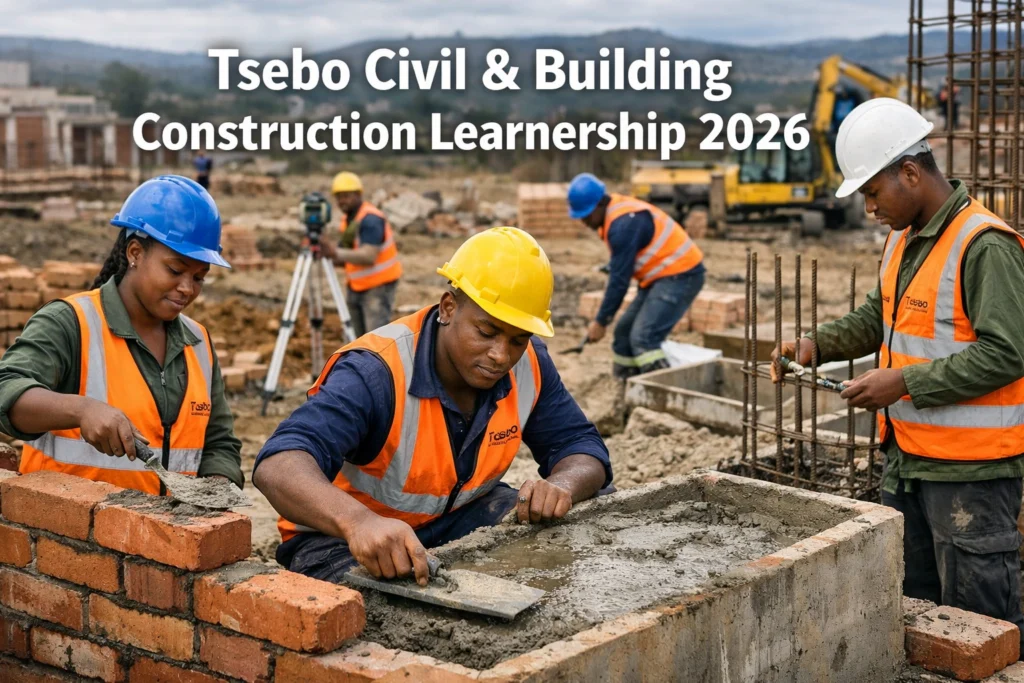
The Tsebo Civil & Building Construction Learnership 2026 provides exactly that:
- Exposure to real projects
- Understanding of workplace expectations
- Practical application of technical skills
For many participants, this could be the first line on their CV that truly matters.
APPLY HERE: Tsebo Civil & Building Construction Learnership 2026
What Could Happen Next
Looking ahead, several possible outcomes could shape the impact of this learnership.
Increased Demand for Similar Programmes
If the programme proves successful, it may encourage more companies to invest in structured learnerships.
Expansion Across Regions
Currently based in Pretoria, future iterations could extend to other provinces, increasing access nationwide.
Higher Expectations from Applicants
As awareness grows, candidates may begin preparing more strategically—improving their CVs, communication skills, and readiness for workplace environments.
Stronger Industry Partnerships
Collaboration between private companies, training providers, and government could strengthen the overall learnership ecosystem.
However, challenges remain.
Without consistent pathways into permanent employment, learnerships risk being seen as temporary fixes rather than long-term solutions.
A Realistic Perspective: Opportunity vs Outcome
It’s important to approach opportunities like this with both optimism and realism.
The Tsebo Civil & Building Construction Learnership 2026 can open doors—but it doesn’t guarantee where those doors lead.
Success often depends on how participants use the opportunity:
- Do they build relationships?
- Do they demonstrate reliability?
- Do they actively learn beyond the minimum requirements?
In many cases, employers use learnerships as informal recruitment pipelines. Those who stand out are more likely to be considered for future roles.
Application Essentials: What You Need to Know
For those planning to apply, preparation is key.
Reference Number: TSE260402-13
Location: Pretoria, Gauteng
Closing Date: 9 April 2026
Required documents:
- Certified copy of ID
- Matric certificate
- Updated CV
Applications are submitted through the official Tsebo online portal, and early submission is strongly advised.
More Than Just a Learnership
At first glance, the Tsebo Civil & Building Construction Learnership 2026 might seem like just another listing in a sea of opportunities.
But viewed in context, it represents something bigger.
It’s part of a growing movement toward practical, inclusive pathways into the workforce—especially for young people who have long been excluded from traditional career routes.
Whether it leads directly to employment or serves as a stepping stone, the value lies in the exposure, the skills, and the experience gained.
In a job market where opportunity is often the hardest thing to find, that alone can make all the difference.
ALSO APPLY FOR: Rohlig-Grindrod Learnerships 2026
APPLY HERE: Tsebo Civil & Building Construction Learnership 2026