
The last Friday of an internship often feels quieter than expected.
You submit your final report, clear your desk, and exchange a few “keep in touch” messages with colleagues. Maybe there’s a small farewell moment—cupcakes in the break room or a quick handshake from your supervisor. Then, just like that, it’s over.
But for many interns, especially across South Africa’s competitive early-career landscape, that final day is not the end—it’s a turning point. What you secure in those last days and weeks can shape your next opportunity, your CV, and even your long-term career path.
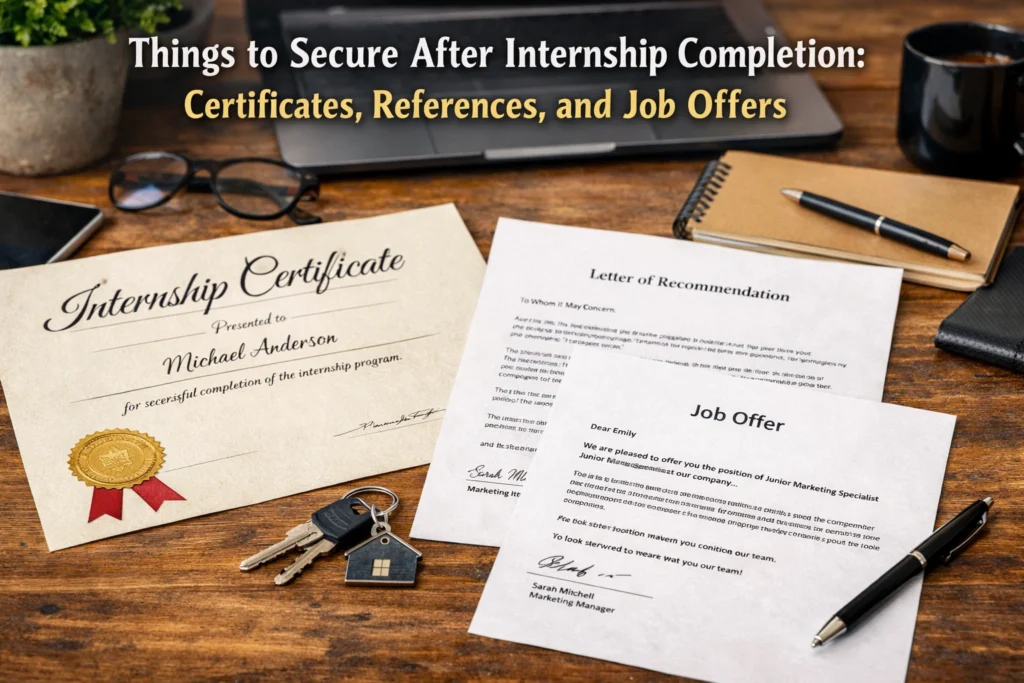
Understanding the Things to Secure After Internship Completion: Certificates, References, and Job Offers is no longer optional—it’s essential. In a job market where experience matters as much as qualifications, what you walk away with can determine how quickly you move forward.
The Quiet Gap Between Experience and Opportunity
Internships have become a critical bridge between education and employment. Yet many interns leave without fully capturing the value of what they’ve just completed.
In South Africa, where youth unemployment remains a pressing issue, internships are often seen as stepping stones—but not all stepping stones are equal. Some lead directly into employment, while others leave candidates struggling to prove their worth on paper.
The difference often lies in preparation at the very end.
Too many interns focus on finishing strong but forget to formalize their experience. They assume their work speaks for itself. In reality, employers rely heavily on documented proof—certificates, references, and clear signals of employability.
ALSO APPLY FOR: Takealot N6 Internship 2026
ALSO APPLY FOR: ABB Graduate Internships 2026
What “Things to Secure After Internship Completion” Really Means
The phrase Things to Secure After Internship Completion: Certificates, References, and Job Offers may sound straightforward, but each element carries deeper weight than most people realize.
It’s not just about collecting documents—it’s about securing credibility.
A certificate confirms participation.
A reference validates performance.
A job offer signals trust and future potential.
Together, they form a professional narrative that employers understand instantly.
Without them, even the most valuable internship risks becoming a vague line on a CV.
ALSO READ ABOUT: Steps to Apply for Internships While Still Studying
Certificates: More Than a Formality
At first glance, an internship certificate might seem like a routine administrative item. But in practice, it’s one of the most powerful tools you can carry forward.
In many industries—engineering, finance, logistics, IT—employers want proof of structured experience. A well-written certificate does more than confirm attendance; it highlights:
- Your role and responsibilities
- The duration of your internship
- The department or division you worked in
- Sometimes even your performance level
In South Africa’s corporate and public sectors, HR departments often filter candidates based on documented experience. Without a certificate, your internship may not even be counted.
The overlooked detail:
Ask for a detailed certificate, not a generic one. A single extra line describing your tasks can make a significant difference when applying for jobs later.
References: The Human Proof Behind Your Work
If certificates are formal proof, references are personal proof.
A strong reference transforms your internship from a claim into a trusted endorsement. It answers the question every employer silently asks: “Can this person actually perform in a real work environment?”
In practice, references can take different forms:
- A written letter of recommendation
- A LinkedIn recommendation
- A referee willing to take calls from employers
But here’s where many interns make a mistake—they wait too long.
Supervisors are more likely to provide meaningful references immediately after your internship, when your work is still fresh in their minds. Months later, details fade, and recommendations become generic.
A practical approach:
Before your internship ends, schedule a short conversation with your supervisor. Ask for feedback, and then request a reference while that feedback is still relevant.
Job Offers: Not Always Immediate, But Always Possible
Not every internship leads directly to a job offer—but many create the possibility.
In industries like mining, manufacturing, and finance, companies often use internships as extended interviews. Even if there isn’t an immediate vacancy, strong interns are remembered.
In South Africa, where companies balance transformation goals, budgets, and hiring cycles, timing plays a big role. A company may not hire you today—but could reach out in six months.
That’s why securing clarity is just as important as securing an offer.
Before you leave, try to understand:
- Is there potential for future employment?
- Would the company consider you for upcoming roles?
- Can you stay in touch for opportunities?
Sometimes, the most valuable outcome is not a job offer—but a clear path toward one.
A Short Checklist Before You Walk Out
To avoid leaving opportunities behind, it helps to keep things simple and intentional.
Before your final day, make sure you have:
- A signed internship certificate (preferably detailed)
- At least one strong reference or referee
- Contact details of key colleagues or mentors
- Feedback on your performance
- Clarity on future opportunities or openings
This small checklist can significantly improve your transition from intern to job seeker.
Why This Matters More in 2026
The importance of securing these essentials has grown in recent years.
After shifts in hiring trends, remote work, and skills-based recruitment, employers are placing more emphasis on verified experience. Degrees alone are no longer enough.
At the same time, platforms like LinkedIn and digital portfolios have made it easier—and more necessary—to present proof of your work.
In South Africa, this shift is particularly visible among young graduates competing for limited roles. Those who can demonstrate structured experience with clear documentation stand out immediately.
Internships are no longer just about learning—they’re about positioning.

ALSO READ ABOUT: Steps to Apply for Internships While Still Studying
Expert Insight: The Long-Term Impact of Exit Strategy
Career advisors often highlight a simple truth: how you leave an internship matters as much as how you perform during it.
A strong exit strategy does three things:
- Locks in your achievements – ensuring your work doesn’t disappear into memory
- Strengthens your professional network – turning colleagues into future opportunities
- Signals professionalism – showing employers you understand workplace expectations
From a long-term perspective, interns who actively secure certificates, references, and potential job pathways tend to transition faster into full-time roles.
It’s not just about documentation—it’s about momentum.
Beyond the Basics: Turning Experience Into Opportunity
Securing the essentials is only the first step. The real value comes from how you use them.
A certificate should support your CV.
A reference should reinforce your applications.
A potential job offer should guide your next move.
Think of these elements as tools—not trophies.
For example, a well-worded reference can help you:
- Negotiate better opportunities
- Stand out in competitive graduate programmes
- Build credibility in new industries
Similarly, maintaining contact with your internship employer can lead to unexpected openings—sometimes months later.
FAQ:
1. What if my company doesn’t provide an internship certificate?
You can request one formally from HR or your supervisor. If unavailable, ask for a signed letter confirming your role and duration
2. How many references should I have after an internship?
At least one strong reference is essential, but having two—especially from different roles—can strengthen your applications.
3. Can an internship really lead to a job offer later?
Yes. Many companies revisit strong interns when positions open, even if there was no immediate offer at the time.
The Bigger Picture: Leaving With More Than You Came With
An internship is often described as a learning experience—but in reality, it’s also a transaction.
You give your time, effort, and skills. In return, you should leave with tangible value.
The Things to Secure After Internship Completion: Certificates, References, and Job Offers are not just administrative details—they are the bridge between where you are and where you want to go.
Too often, interns walk away with memories but no proof. Others leave with documents but no direction.
The goal is to leave with both.
Because in today’s evolving job market, what you secure at the end of an internship doesn’t just reflect your past—it shapes your future.
ALSO APPLY FOR: Takealot N6 Internship 2026
ALSO APPLY FOR: ABB Graduate Internships 2026
ALSO READ ABOUT: Steps to Apply for Internships While Still Studying