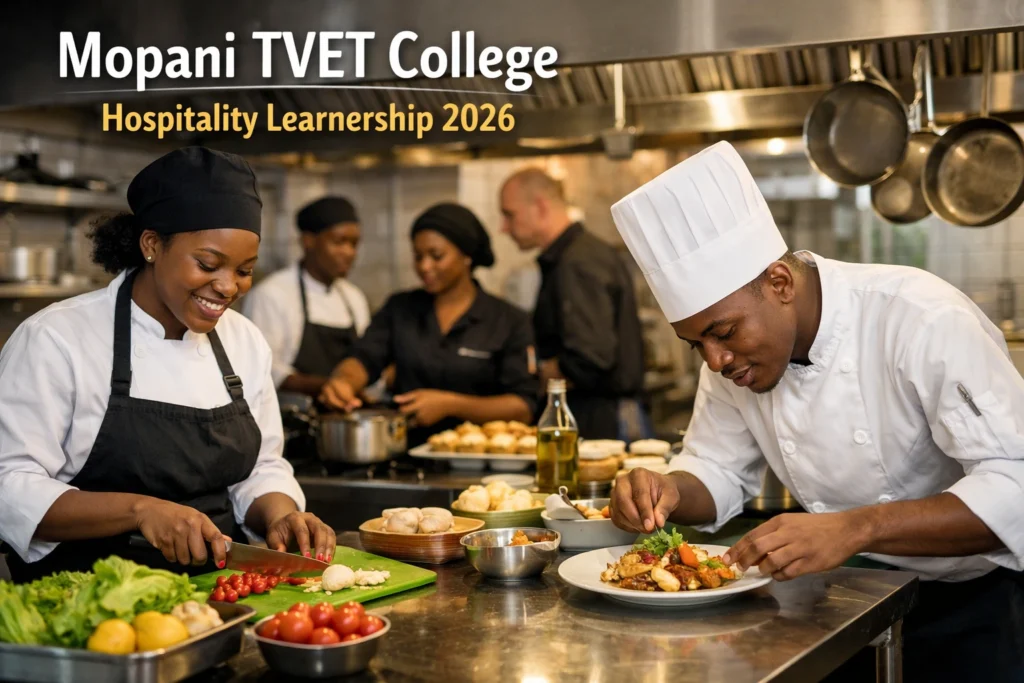

Mopani TVET College Hospitality Learnership 2026: The Hospitality Learnership 2026 offered by Mopani TVET College is a skills programme designed to prepare young South Africans for entry-level roles in the hospitality sector. It blends classroom learning with workplace training so that participants gain both theory and real practical experience.
The programme takes place in the Mopani District in Limpopo and leads to a nationally recognised NQF qualification in hospitality-related skills.
Application deadline: 17 March 2026 (midnight).
What this programme is (plain English explanation)
A hospitality learnership is a structured training programme that combines formal education and on-the-job experience. Instead of studying only in a classroom, learners spend part of their time learning theory and part working in real hospitality environments.
In this case, the learnership focuses on key areas such as:
- Professional cookery
- Food preparation and kitchen operations
- Food safety and hygiene
- Customer service
- Basic hospitality management
The goal is to produce work-ready hospitality staff who can work in restaurants, hotels, lodges, and catering companies.
For many participants, this type of programme becomes their first step into the tourism and hospitality industry, which remains an important employment sector in South Africa.
What you’ll actually do (real-world examples)
Participants won’t only sit in lectures. Much of the learning involves practical activities that mirror real hospitality work.
Typical training experiences may include:
Kitchen training
- Preparing ingredients and learning knife skills
- Cooking basic dishes under supervision
- Plating food professionally for service
Food safety practices
- Learning how to store food safely
- Understanding hygiene protocols used in commercial kitchens
- Following food safety guidelines similar to those used in restaurants
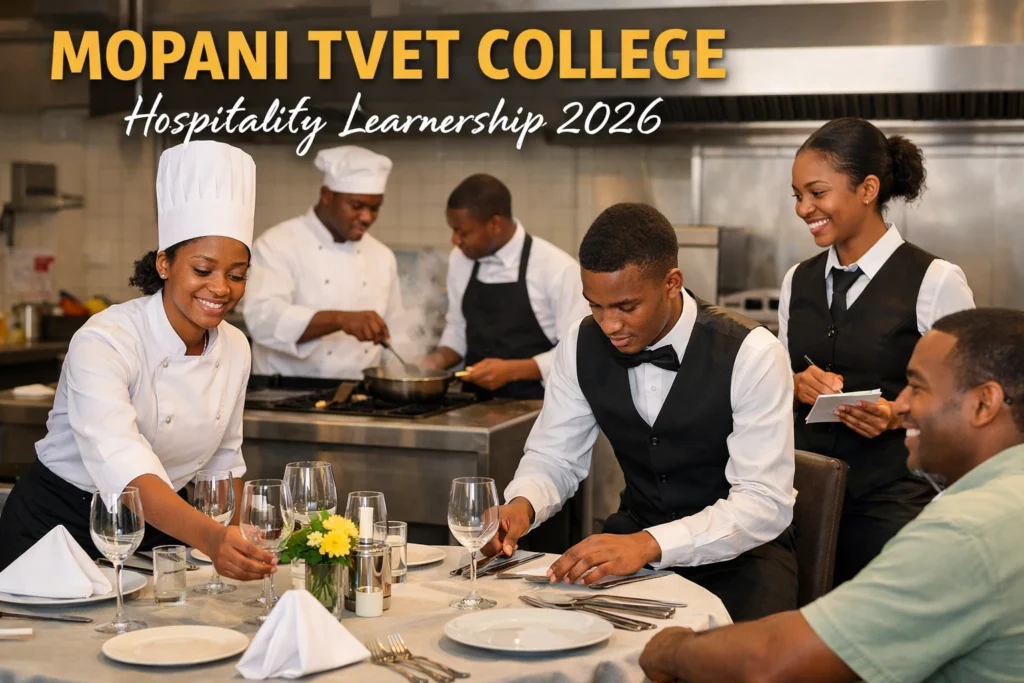
Customer service training
- Greeting guests and taking orders
- Handling customer complaints professionally
- Learning table service standards
Hospitality operations
- Understanding how restaurants and hotels run daily operations
- Working as part of a kitchen or service team
- Learning time management during busy service periods
This combination helps learners build confidence in real working environments.
Who qualifies (minimum requirements checklist)
Applicants typically need to meet these core requirements:
- South African citizen
- Completed Grade 12 (Matric) or equivalent qualification
- Interest in hospitality, cooking, or customer service
- Willing to complete both classroom learning and workplace training
- Able to work in a team environment
- Available for the full learnership duration
Preference may be given to applicants living in or near the Mopani District, as TVET colleges often prioritise local economic development.
Why applicants get disqualified (realistic reasons)
Many applications fail because of simple issues rather than lack of potential.
Common disqualification reasons include:
- Missing certified documents
- Uploading unclear scans or photos
- Submitting an incomplete application form
- Not meeting the minimum Grade 12 requirement
- Applying after the closing date
- Providing incorrect contact details
- Submitting duplicate applications through multiple profiles
Another common issue is generic CVs with no hospitality interest shown.
Who should apply (expert perspective)
This learnership is particularly suitable for:
School leavers who enjoy hands-on work
Hospitality training involves practical tasks, long shifts, and teamwork. It suits people who prefer active work rather than office-based roles.
Young people interested in cooking or food service
If you enjoy cooking at home or want to become a chef, this type of training provides foundational skills.
Applicants looking for a structured entry into the tourism sector
Hospitality learnerships often act as stepping stones into restaurants, hotels, and lodges.
It may be less suitable for applicants who prefer purely academic study or who are not comfortable with shift work, standing for long hours, or busy environments.
Competition level
Competition Level: Medium
Reasons:
- Hospitality programmes usually attract many Matric graduates seeking their first opportunity.
- However, programmes located in specific districts like Mopani typically receive fewer applications than large metropolitan opportunities.
- Applicants from outside the district may be disadvantaged if local preference is applied.
Strong applications with clear hospitality interest and complete documents generally stand a better chance.
Tips to improve selection chances
Practical ways to stand out:
1. Tailor your CV
Mention any experience related to hospitality:
- Cooking
- School events catering
- Helping in family restaurants
- Customer service roles
2. Highlight teamwork
Hospitality is team-driven. Mention:
- Sports teams
- School group projects
- Community work
3. Write a short motivation
If the application allows it, explain:
- Why you want to work in hospitality
- What skills you hope to learn
4. Ensure perfect documents
Clear scans and certified copies often make the difference.
5. Apply early
Last-day applications often fail due to system overload or incomplete uploads.
Common mistakes applicants make
Some recurring errors include:
- Uploading uncertified copies of ID or Matric certificate
- Submitting low-resolution phone photos of documents
- Copy-pasting generic CVs with no hospitality interest
- Using incorrect email addresses
- Forgetting to upload proof of residence
- Waiting until the final hours to apply
Another common mistake is ignoring instructions on the official portal.
Application strategy (verification-first approach)
Follow a careful process instead of rushing the application.
Step 1 — Confirm the programme
Check the learnership on the official site of Mopani TVET College.
APPLY HERE: Mopani TVET College Hospitality Learnership 2026
Step 2 — Prepare documents first
Have all files ready before starting the application.
Step 3 — Create your applicant profile
Register using your South African ID number.
Step 4 — Complete the online form carefully
Double-check spelling, contact numbers, and education details.
Step 5 — Upload documents
Ensure each document is:
- Certified
- Clear
- Correctly labelled
Step 6 — Review everything
Many errors happen during rushed submissions.
Step 7 — Submit before midnight
Applications close 17 March 2026.
ALSO APPLY FOR: Sandvik Apprenticeships 2026
Documents checklist
Typical documents required (some assumed based on standard TVET learnership applications):
Required
- Certified copy of South African ID
- Certified copy of Matric certificate or latest results
- Updated CV
- Proof of residence
Sometimes requested
- Academic transcripts (if studying further)
- Motivation letter
- Affidavit if documents differ in name spelling
Always confirm document requirements on the official application portal.
Safety & Scam Check (important)
When applying for learnerships in South Africa, follow these safety rules:
- Never pay application fees for funded learnerships or TVET programmes
- Confirm that the application uses the official domain of Mopani TVET College
- Check the official programme reference if provided
- Be cautious of WhatsApp-only recruitment messages
- Avoid sending documents to unofficial Gmail or personal email accounts
- Apply through official college portals whenever possible
Legitimate TVET learnerships do not charge recruitment fees.
FAQ (Frequently Asked Questions)
1. When is the application deadline?
Applications close 17 March 2026 at midnight.
2. Do I need hospitality experience?
No. The programme is designed for beginners.
3. Will I receive a stipend?
Most learnerships include a monthly training stipend, although the exact amount may vary.
4. Where does training take place?
Training takes place at campuses of Mopani TVET College within the Mopani District.
5. Can applicants from other provinces apply?
Yes, but preference may be given to applicants living in the Mopani District.
6. What qualification will I receive?
A nationally recognised NQF certificate in hospitality.
7. How long do hospitality learnerships usually last?
Typically 12 months, although exact duration can vary.
8. Will this lead to a permanent job?
Employment is not guaranteed, but the qualification and experience improve job prospects.
9. Can I study further after completing the learnership?
Yes. Many graduates continue with hospitality diplomas or advanced chef training.
10. What careers can this lead to?
Possible roles include: Commis chef, Kitchen assistant, Catering assistant, and Restaurant service staff
Final assessment
The Mopani TVET College Hospitality Learnership 2026 offers a practical pathway into the hospitality sector, especially for Matric graduates interested in cooking, food service, or tourism.
Strengths of the programme include:
- Practical workplace training
- Recognised NQF qualification
- Entry pathway into a growing industry
However, applicants should also consider:
- Hospitality work can involve long hours and physically demanding tasks
- Employment after completion is not guaranteed
Mopani TVET College Hospitality Learnership 2026
For motivated applicants who enjoy working with food and people, this learnership can serve as a useful first step into hospitality careers.
APPLY HERE: Mopani TVET College Hospitality Learnership 2026
Applications close 17 March 2026