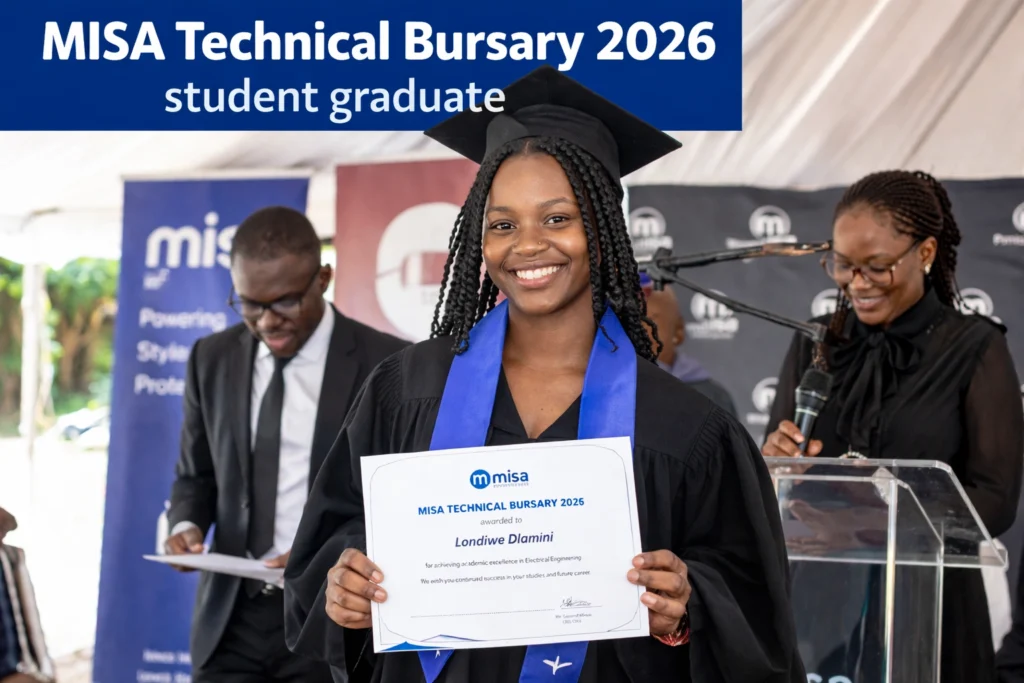

There’s a growing buzz around the MISA TECHNICAL BURSARY 2026, and it’s not just another government funding announcement lost in the noise. In a year where access to education funding feels increasingly competitive—and often uncertain—this bursary has struck a nerve for a very specific reason: it sits at the intersection of skills shortages, infrastructure failure, and youth unemployment in South Africa.
For many, it looks like a straightforward opportunity. A government-funded bursary. Technical fields. A clear pathway into employment. But beneath that surface lies a deeper story about how South Africa is trying—again—to fix its infrastructure crisis by investing in people rather than just projects.
And that’s exactly why it’s trending now.
A Bursary Built on a Bigger Problem
To understand why the MISA TECHNICAL BURSARY 2026 matters, you have to zoom out.
South Africa’s municipalities have been under pressure for years. Service delivery protests, aging infrastructure, water shortages, electricity instability—these are no longer isolated issues. They’re systemic.
The Municipal Infrastructure Support Agent (MISA) was created to address this exact problem: a shortage of technical skills inside local government. Not just engineers, but planners, project managers, and environmental specialists who can actually execute infrastructure projects effectively.
This bursary is not new in concept—but its urgency has grown.
Instead of reacting to failing infrastructure, MISA is trying to build a long-term pipeline of professionals who can prevent those failures in the first place. That’s a shift from short-term fixes to structural reform.
And that’s what makes this intake different.
APPLY HERE: MISA TECHNICAL BURSARY 2026
ALSO APPLY FOR: SAC Bursary Funding 2026
What the 2026 Intake Tells Us
The structure of the MISA TECHNICAL BURSARY 2026 reveals a lot about government priorities right now.
Here’s how the funding is distributed:
- Civil Engineering: 20 slots
- Electrical Engineering: 25 slots
- Project & Construction Management: 5 slots
- Urban & Regional Planning: 15 slots
- Environmental Management: 5 slots
At first glance, it’s just numbers. But look closer, and a pattern emerges.
Engineering dominates. Civil and electrical engineering alone account for the majority of positions. This signals a clear priority: fixing physical infrastructure—roads, water systems, electricity networks.
Urban planning and environmental management are included, but in smaller numbers. These fields are critical for long-term sustainability, yet they remain secondary in allocation.
It’s a reflection of where the pressure is most intense: immediate service delivery.
The Rural Focus: A Strategic Shift or a Persistent Gap?
One of the most notable aspects of the programme is its preference for applicants from rural areas and low-income households (earning less than R600,000 annually).
On paper, this aligns with transformation goals.
But in practice, it highlights a deeper issue: rural municipalities are often the most under-resourced—and the most affected by infrastructure challenges.
By prioritising students from these areas, MISA may be attempting to create a “return loop”—fund students from underserved communities who may later work in those same areas.
It’s a compelling idea.
But it raises a question that has followed similar programmes before:
Will these graduates actually return to rural municipalities, or will they move toward urban opportunities once qualified?
The answer could determine whether this bursary becomes a long-term solution—or just another well-intentioned intervention with limited local impact.
The Application Barrier: Opportunity vs Accessibility
On paper, the eligibility criteria are standard:
- Certified ID and matric certificate
- Academic records
- Proof of registration
- Financial documentation
- Household income verification
But for many applicants, especially those in rural or disadvantaged areas, these requirements are not as simple as they appear.
Obtaining certified documents, accessing institutional records, or even proving household income (especially in informal economies) can be a barrier.
There’s a paradox here.
The programme is designed for disadvantaged students—but the application process can unintentionally exclude the very people it aims to help.
This tension isn’t unique to MISA. It reflects a broader challenge in public-sector bursary programmes: balancing accountability with accessibility.
Public Reaction: Hope, Skepticism, and Quiet Optimism
Online discussions around the MISA TECHNICAL BURSARY 2026 show a mix of reactions.
Some see it as a rare opportunity:
- A funded path into high-demand careers
- A chance to enter government-backed employment pipelines
- A practical alternative to oversubscribed university programmes
Others are more cautious.
There’s skepticism about whether bursary recipients will actually secure employment within municipalities after graduating. South Africa has seen many cases where graduates, even in technical fields, struggle to transition into stable jobs.
Then there’s a third perspective—perhaps the most telling.
Quiet optimism.
Not loud excitement, but a sense that this programme might be one of the more “serious” efforts to align education with real economic needs.
The Skills Pipeline Problem
At the heart of the MISA TECHNICAL BURSARY 2026 is a concept that doesn’t get enough attention: the skills pipeline.
South Africa doesn’t just have an unemployment problem—it has a mismatch problem.
There are graduates without jobs.
And there are jobs without qualified candidates.
Municipalities, in particular, often struggle to recruit and retain technical professionals. Engineers and planners are in demand across both public and private sectors, and local government doesn’t always compete well on salary or working conditions.
So the bursary is not just about funding education—it’s about influencing career pathways.
If successful, it could help redirect talent toward areas where it’s needed most.
If not, it risks feeding into the same cycle: qualified graduates leaving the public sector for better opportunities elsewhere.
Why This Matters Right Now
The timing of the MISA TECHNICAL BURSARY 2026 is critical.
South Africa is at a point where infrastructure challenges are no longer abstract policy issues—they affect daily life.
Water outages.
Electricity instability.
Road deterioration.
These are lived realities.
At the same time, youth unemployment remains persistently high, especially among matriculants and graduates.
This bursary sits at the intersection of those two crises.
It represents an attempt to solve both:
- Equip young people with in-demand technical skills
- Strengthen municipal capacity to deliver essential services
That dual purpose is what gives it relevance in 2026.
It’s not just about education—it’s about rebuilding systems.
A Quiet Policy Experiment
In many ways, the MISA TECHNICAL BURSARY 2026 can be seen as a policy experiment.
Instead of focusing solely on infrastructure funding, it invests in human capital.
Instead of importing skills or outsourcing projects, it aims to develop local expertise.
But like any experiment, its success depends on execution.
Key questions remain:
- Will students receive adequate support during their studies?
- Will there be structured pathways into municipal employment?
- Will municipalities be able to absorb and retain these graduates?
Without answers to these questions, even the best-designed bursary risks falling short of its goals.
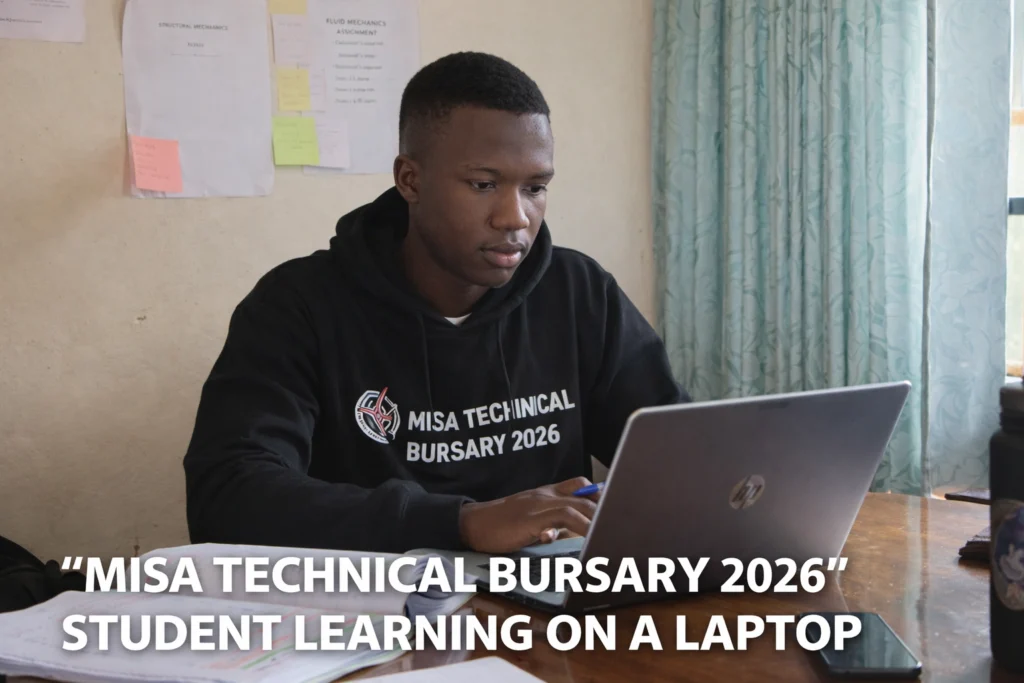
APPLY HERE: MISA TECHNICAL BURSARY 2026
The Role of TVET Colleges and Universities of Technology
Another interesting feature of the programme is its inclusion of Universities of Technology and TVET colleges, particularly for electrical engineering.
This signals a recognition that traditional university pathways are not the only route to technical expertise.
In fact, TVET graduates often bring more practical, hands-on skills—exactly what municipalities need for infrastructure maintenance and operations.
If supported properly, this could elevate the role of vocational education in South Africa’s development strategy.
But it also depends on perception.
TVET institutions still face stigma compared to universities, and changing that narrative will be essential for the long-term success of programmes like this.
What Could Happen Next
Looking ahead, several scenarios could unfold from the MISA TECHNICAL BURSARY 2026:
1. Expansion of the Programme
If the 2026 intake shows positive results, MISA could scale up the number of bursaries in future years, particularly in high-demand fields like civil and electrical engineering.
2. Stronger Municipal Integration
There may be increased efforts to link bursary recipients directly to municipal internships or graduate programmes, creating a clearer transition from study to employment.
3. Policy Replication
Other government departments could adopt similar models, focusing on sector-specific bursaries tied to national priorities—such as healthcare, energy, or digital infrastructure.
4. Ongoing Challenges
If structural issues remain—such as limited municipal budgets or poor working conditions—the programme may struggle to retain graduates in the public sector.
The Bigger Picture
Ultimately, the MISA TECHNICAL BURSARY 2026 is about more than funding students.
It’s about whether South Africa can build the technical capacity it needs from within.
It’s about whether young people can see a future in public service—not just as a fallback option, but as a meaningful career path.
And it’s about whether long-term investment in skills can succeed where short-term interventions have struggled.
There are no guarantees.
But in a landscape often dominated by quick fixes, this bursary represents something different: a slower, more deliberate approach to change.
Whether that approach works is something South Africa will be watching closely.
ALSO APPLY FOR: SAC Bursary Funding 2026
APPLY HERE: MISA TECHNICAL BURSARY 2026