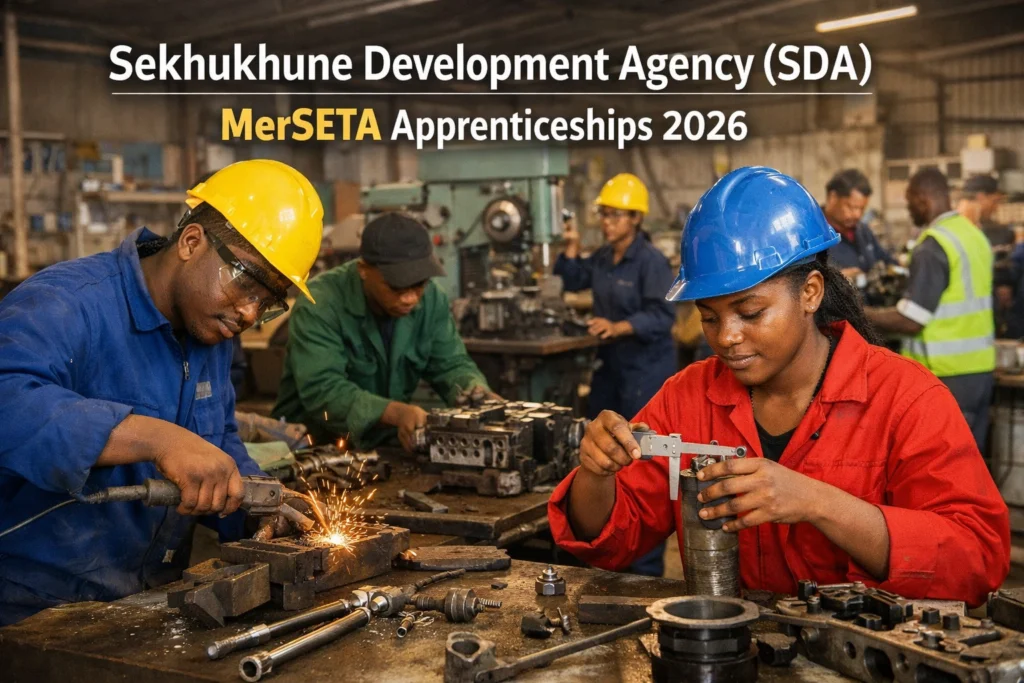

The Sekhukhune Development Agency (SDA): MerSETA Apprenticeships 2026 announcement is suddenly gaining traction, not because it promises quick wins, but because it speaks to something deeper: a growing urgency to rebuild the country’s technical skills pipeline.
At a time when youth unemployment remains stubbornly high and industries are quietly battling a shortage of certified artisans, this programme has landed with unusual weight.
It’s not just another opportunity. It’s part of a bigger story.
The Backdrop: A Skills Gap Years in the Making
South Africa’s artisan shortage didn’t happen overnight.
For years, policymakers and industry bodies like the Manufacturing, Engineering and Related Services Sector Education and Training Authority have warned that the country is producing too few qualified tradespeople. Electricians, diesel mechanics, welders—these are the backbone of infrastructure and industrial growth, yet they’ve been in critically short supply.
At the same time, thousands of young people graduate from school without clear pathways into employment. University isn’t always accessible—or even the right fit. Technical training, once seen as a fallback, is now being reframed as a frontline solution.
This is where agencies like the Sekhukhune Development Agency step in.
Their latest partnership with merSETA signals a deliberate attempt to bridge that gap—by creating structured, accredited routes into the trades.
APPLY HERE: MerSETA Apprenticeships 2026
What’s Being Offered — And Why It’s Different
On the surface, the programme looks straightforward: apprenticeships and Artisan Recognition of Prior Learning (ARPL) opportunities for 2026.
But the details reveal something more strategic.
Diesel Mechanic Apprenticeship Programme
This is the flagship offering—28 positions aimed at young South Africans eager to enter the technical workforce.
- Qualification: Occupational Certificate – Diesel Mechanic
- Duration: 36 months
- Stipend: R3 000 per month
It’s a long-term commitment, combining theory and hands-on training. And that matters.
Unlike short courses that flood the market with partially trained candidates, this programme aligns with national occupational standards. It’s designed to produce fully qualified artisans—not just job seekers with certificates.
ARPL: Recognition for the Experienced
Then there’s the ARPL component—arguably the most overlooked but impactful part of the initiative.
This stream targets individuals who already have years of experience but lack formal certification. Trades include:
- Diesel Mechanic
- Motor Mechanic
- Electrician
- Welding
With 24 total opportunities (20 unemployed, 4 employed), ARPL offers something powerful: validation.
For many artisans, especially those trained informally or on the job, this could mean the difference between stagnation and career mobility.
Why Now? The Timing Feels Intentional
There’s a reason programmes like this are emerging in 2026—and not five years ago.
South Africa is at an inflection point.
Infrastructure investment is slowly picking up. Energy challenges have exposed the need for skilled technicians. Logistics, mining, and construction sectors are all quietly competing for the same limited pool of artisans.
At the same time, the government and training authorities are under pressure to show real outcomes—not just policy frameworks.
The SDA–merSETA collaboration reflects a shift toward implementation over intention.
And importantly, it’s happening outside major metros.
By anchoring the programme in Sekhukhune District, the initiative decentralises opportunity—bringing skills development closer to communities that are often left behind.
Public Reaction: Hope, Skepticism, and Real Questions
Whenever opportunities like this are announced, the reaction is rarely one-dimensional.
Optimism from Young Job Seekers
For many unemployed youth, especially those with matric or N2 qualifications, this feels like a lifeline.
The appeal is clear:
- A recognised qualification
- Structured training
- A monthly stipend (even if modest)
In a tough job market, that combination is rare.
Frustration Over Limited Slots
But optimism is tempered by reality.
With only 28 apprenticeship positions, competition will be intense. Thousands may apply, but only a fraction will be selected.
This raises familiar questions:
- Are these programmes scalable?
- How many young people are still left without opportunities?
Mixed Views on the Stipend
The R3 000 monthly stipend has also sparked debate.
For some, it’s a necessary support mechanism. For others, it’s insufficient given the rising cost of living.
Yet industry insiders argue that apprenticeships are fundamentally about earning while learning—not full employment salaries.
ALSO APPLY FOR: Apprentice Level One (Renault Fourways)
The Application Process: Access vs Barriers
The application requirements are standard but strict:
- Certified ID and qualifications (not older than 3 months)
- Comprehensive CV
- Application letter
For ARPL candidates, additional proof of experience is required, including employer letters.
Applications must be submitted via email or hand delivery to the SDA office in Groblersdal.
On paper, it’s simple.
In practice, there are barriers:
- Access to certification services
- Transport for hand delivery
- Reliable internet for email submissions
These small hurdles often determine who applies—and who doesn’t.
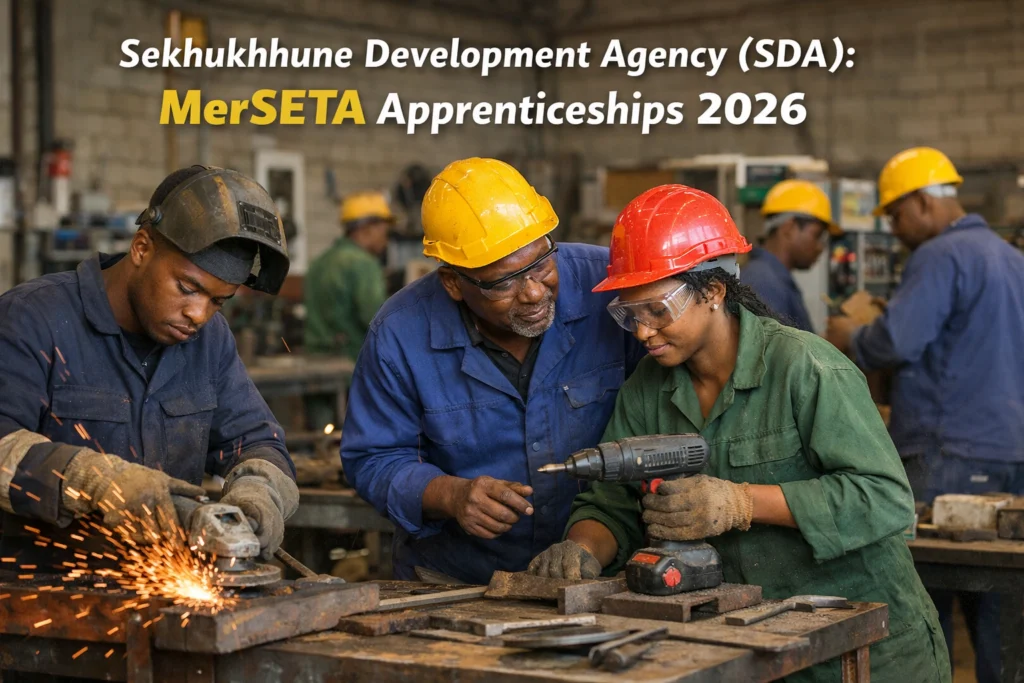
APPLY HERE: MerSETA Apprenticeships 2026
Why This Matters Right Now
This isn’t just about 52 opportunities (28 apprenticeships + 24 ARPL slots).
It’s about what they represent.
South Africa’s economic recovery depends not only on policy but on people with practical skills—people who can fix engines, maintain equipment, build infrastructure, and keep industries running.
The Sekhukhune Development Agency (SDA): MerSETA Apprenticeships 2026 programme sits at the intersection of three urgent priorities:
- Youth Employment
With millions of young South Africans unemployed, structured training pathways are critical. - Skills Development
The artisan shortage is no longer theoretical—it’s affecting productivity and growth. - Economic Inclusion
By targeting unemployed individuals and recognising informal experience, the programme broadens access to opportunity.
In that sense, this isn’t just a training initiative.
It’s a small but meaningful intervention in a much larger system.
What Could Happen Next
The real story will unfold after the application deadline: 30 April 2026 at 16:30.
Here are a few possible outcomes worth watching.
1. Increased Demand for Similar Programmes
If interest in the SDA initiative is high—and it likely will be—it could push other regional agencies and SETAs to expand their offerings.
Success tends to replicate.
2. Pressure to Scale
Limited slots may trigger calls for expansion. Policymakers could face increased pressure to:
- Fund more apprenticeships
- Partner with private sector employers
- Increase intake capacity
3. Greater Focus on ARPL
If the ARPL component proves effective, it could reshape how South Africa approaches skills recognition.
Formalising informal experience is one of the fastest ways to grow the skilled workforce—without starting from scratch.
4. Long-Term Employment Outcomes
The ultimate test will be job placement.
Do these apprentices transition into stable employment after 36 months?
If yes, the programme becomes a model.
If not, it risks being seen as another temporary intervention.
A Broader Reflection: Rethinking Career Pathways
Perhaps the most important takeaway isn’t about SDA or merSETA alone.
It’s about how South Africans are beginning to rethink success.
For years, the narrative centred on university degrees as the primary route to opportunity.
But the reality is shifting.
Technical careers—diesel mechanics, electricians, welders—are no longer secondary options. They’re essential, viable, and increasingly respected.
Programmes like this reinforce that shift.
They send a message:
There are multiple paths to building a future—and some of them start in a workshop, not a lecture hall.
Final Thoughts
The Sekhukhune Development Agency (SDA): MerSETA Apprenticeships 2026 programme may not solve South Africa’s unemployment crisis.
It’s too small for that.
But it does something equally important—it shows what targeted, practical intervention can look like.
It connects policy to people.
It links training to real skills.
And it creates a bridge—however narrow—between unemployment and opportunity.
In a landscape often dominated by big promises, that kind of grounded, tangible initiative stands out.
And that’s exactly why it’s worth paying attention to.
APPLY HERE: MerSETA Apprenticeships 2026
ALSO APPLY FOR: Apprentice Level One (Renault Fourways)