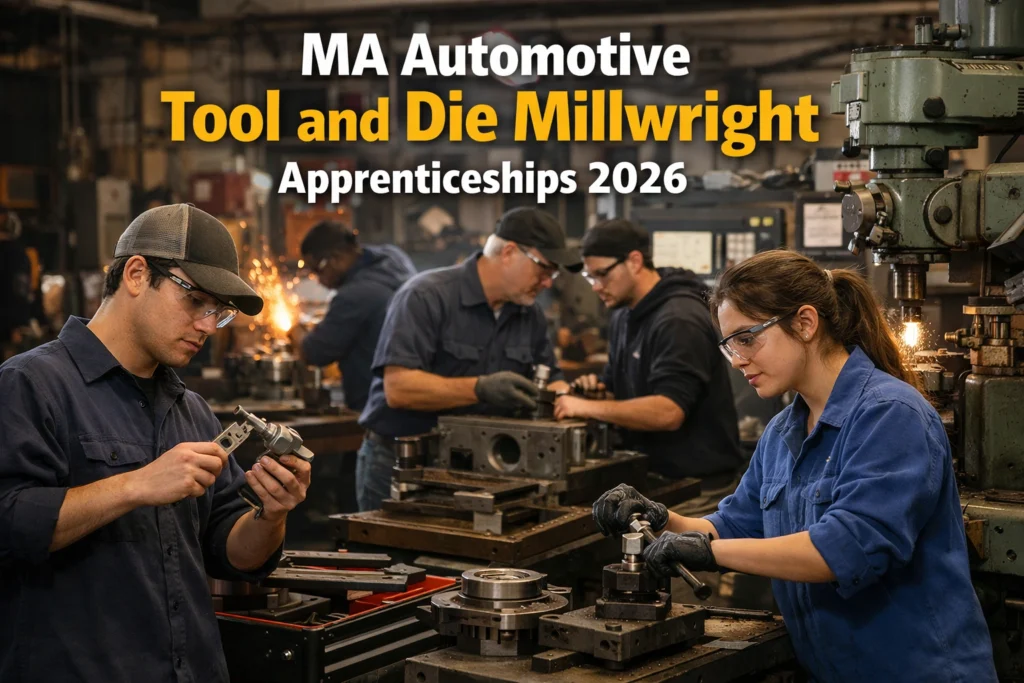

The demand for skilled technical artisans is rising rapidly across South Africa’s manufacturing sector, yet many young people still struggle to access structured, credible pathways into these careers. That gap between education and employment has made programmes like the MA Automotive Tool and Die Millwright Apprenticeships 2026 especially significant right now. At a time when the country is prioritising industrial growth and skills development, this apprenticeship offers more than training—it represents a direct bridge into a high-demand, future-proof profession.
For technically minded individuals, particularly those with a background in mathematics and science, this opportunity in Pretoria (Rosslyn) provides rare access to hands-on industrial experience within the automotive manufacturing ecosystem. The programme aligns with broader economic needs while offering individuals a clear, structured path toward becoming a qualified Millwright—one of the most versatile and sought-after artisan roles in modern industry.
Understanding the Apprenticeship in Context
The MA Automotive Tool and Die Millwright Apprenticeships 2026 is positioned within South Africa’s evolving technical training landscape. Unlike traditional academic routes, apprenticeships combine theoretical instruction with workplace immersion, allowing candidates to develop practical competencies while earning experience.
In industries such as automotive manufacturing, the role of a Millwright has become increasingly complex. Modern production lines rely on automated systems, robotics, and integrated electrical-mechanical processes. This means employers are no longer looking for narrowly skilled workers—they need multi-disciplinary artisans capable of diagnosing, maintaining, and optimising entire systems.
This apprenticeship directly responds to that shift. Participants are trained to:
- Install and maintain industrial machinery
- Troubleshoot both mechanical and electrical faults
- Work within high-volume production environments
- Develop problem-solving skills under real operational conditions
Rosslyn, where the programme is based, is one of South Africa’s key automotive hubs. Its proximity to major manufacturers and suppliers creates an ideal training ground where apprentices are exposed to real-world industrial challenges rather than simulated environments.
Why the MA Automotive Tool and Die Millwright Apprenticeships 2026 Stands Out
Not all apprenticeships are equal. What differentiates the MA Automotive Tool and Die Millwright Apprenticeships 2026 is its alignment with both industry demand and structured artisan development standards.
1. Entry-Level Accessibility with High Impact
One of the most notable aspects is that no prior work experience is required. This lowers the barrier to entry for school leavers who meet the academic criteria. In a country where youth unemployment remains a critical issue, entry-level programmes with clear career outcomes are particularly valuable.
2. Integration into the Automotive Value Chain
The automotive sector is one of South Africa’s most industrialised and export-driven industries. Apprentices trained in this environment gain exposure to:
- Lean manufacturing principles
- Quality control systems
- Advanced machinery and automation
This kind of exposure significantly enhances employability compared to generic technical training.
3. Structured Pathway to Trade Qualification
Unlike informal training routes, this programme leads toward a nationally recognised trade test. Becoming a qualified Millwright opens doors not only in automotive manufacturing but also in mining, energy, and heavy industry sectors.
4. Real Workplace Learning
There is a critical difference between classroom-based technical education and workplace training. Apprentices in this programme learn by doing—working alongside experienced artisans, solving real problems, and adapting to production pressures.
Skills Development and Industry Relevance
The MA Automotive Tool and Die Millwright Apprenticeships 2026 reflects a broader shift in how technical skills are defined in the Fourth Industrial Revolution era.
Multi-Skilling as a Competitive Advantage
Traditionally, trades were siloed—electricians handled electrical systems, while fitters focused on mechanical components. Today, those boundaries are increasingly blurred. A Millwright must understand:
- Electrical circuits and control systems
- Mechanical assembly and alignment
- Pneumatics and hydraulics
- Preventative maintenance strategies
This hybrid skillset is exactly what employers are prioritising, particularly in automated manufacturing environments.
Alignment with National Skills Priorities
South Africa has consistently identified artisan development as a key driver of economic growth. Programmes like this contribute directly to:
- Reducing the artisan skills shortage
- Supporting industrial productivity
- Enhancing global competitiveness
From a policy perspective, apprenticeships are not just training initiatives—they are economic interventions.
Eligibility Requirements: A Filter for Technical Readiness
The entry requirements for the MA Automotive Tool and Die Millwright Apprenticeships 2026 are deliberately specific. Candidates must have either:
- Grade 12 with Pure Mathematics, Physical Science, and Technical Drawing
or - NCV Level 4 with relevant technical subjects
This requirement often raises questions, particularly among applicants with Maths Literacy. However, the emphasis on Pure Mathematics and Physical Science is not arbitrary—it reflects the technical demands of the role.
Why These Subjects Matter
- Mathematics develops analytical thinking and problem-solving ability
- Physical Science provides foundational knowledge of mechanics and electricity
- Technical Drawing enhances spatial awareness and engineering interpretation
Together, these subjects ensure that candidates can cope with the complexity of modern industrial systems.
The Rosslyn Advantage: Location as a Strategic Asset
The apprenticeship’s location in Rosslyn is more than a logistical detail—it is a strategic advantage.
Rosslyn is widely recognised as a manufacturing hub within Pretoria, hosting major automotive production facilities and supply chain operations. This concentration of industry creates:
- Exposure to high-end manufacturing technologies
- Opportunities for networking within the sector
- Potential pathways to employment beyond the apprenticeship
For apprentices, being trained in such an environment significantly enhances both experience and career prospects.
Application Strategy: Competing Effectively
With a closing date of 31 March 2026, competition for the MA Automotive Tool and Die Millwright Apprenticeships 2026 is expected to be strong. Meeting the minimum requirements is only the starting point—successful applicants typically differentiate themselves through preparation and presentation.
Key Application Insights
1. Academic Alignment Matters
Ensure that your subject choices clearly meet the stated requirements. Applications that do not meet these criteria are unlikely to progress.
2. Technical Orientation Should Be Evident
Your CV should highlight any exposure to technical subjects, projects, or practical activities—even at school level.
3. Attention to Detail Is Critical
Errors in applications can signal a lack of precision, which is a critical skill in engineering environments.
4. Document Readiness
Prepare certified copies of:
- ID document
- Academic qualifications
- Updated CV
APPLY HERE: MA Automotive Tool and Die Millwright Apprenticeships 2026
ALSO APPLY FOR: Sandvik Apprenticeships 2026
Submitting a complete and accurate application reflects professionalism and readiness.
Industry Trends Shaping Millwright Careers
Understanding the broader industry context provides deeper insight into why the MA Automotive Tool and Die Millwright Apprenticeships 2026 is particularly valuable.
Automation and Smart Manufacturing
The rise of automation has increased the demand for technicians who can manage integrated systems rather than isolated machines. Millwrights are uniquely positioned to fill this role due to their combined mechanical and electrical expertise.
Maintenance as a Strategic Function
Modern manufacturing prioritises predictive and preventative maintenance to reduce downtime. This shifts the role of a Millwright from reactive repair to proactive system optimisation.
Global Mobility of Skilled Artisans
Qualified Millwrights are not limited to local opportunities. The skills developed are internationally recognised, opening doors to work in other industrialised economies.
Challenges and Realities of the Apprenticeship Path
While the MA Automotive Tool and Die Millwright Apprenticeships 2026 offers significant benefits, it is important to approach it with realistic expectations.
Physically and Mentally Demanding Work
Working in a manufacturing environment requires stamina, focus, and adherence to safety protocols. It is not a desk-based career.
Learning Curve
Apprentices must adapt quickly to both technical concepts and workplace expectations. The transition from school to industry can be challenging.
Competitive Progression
Not all apprentices will secure permanent positions immediately after completion. Performance, attitude, and adaptability play a critical role in long-term success.
What This Means Going Forward
The MA Automotive Tool and Die Millwright Apprenticeships 2026 reflects a broader transformation in South Africa’s approach to skills development and employment creation. As industries become more technologically advanced, the demand for multi-skilled artisans will continue to grow.
For individuals, this means that choosing a technical career path—particularly one rooted in practical, hands-on training—can offer long-term stability and upward mobility. Unlike many traditional academic routes, artisan careers provide:
- Direct entry into the workforce
- Continuous skills development
- Opportunities across multiple industries
For the economy, programmes like this contribute to building a resilient industrial base capable of competing globally.
Looking ahead, we can expect:
- Increased investment in apprenticeship programmes
- Greater emphasis on workplace-based learning
- Stronger links between education and industry
In this context, applicants who secure a place in the MA Automotive Tool and Die Millwright Apprenticeships 2026 are not just starting a job—they are positioning themselves at the forefront of a critical economic sector.
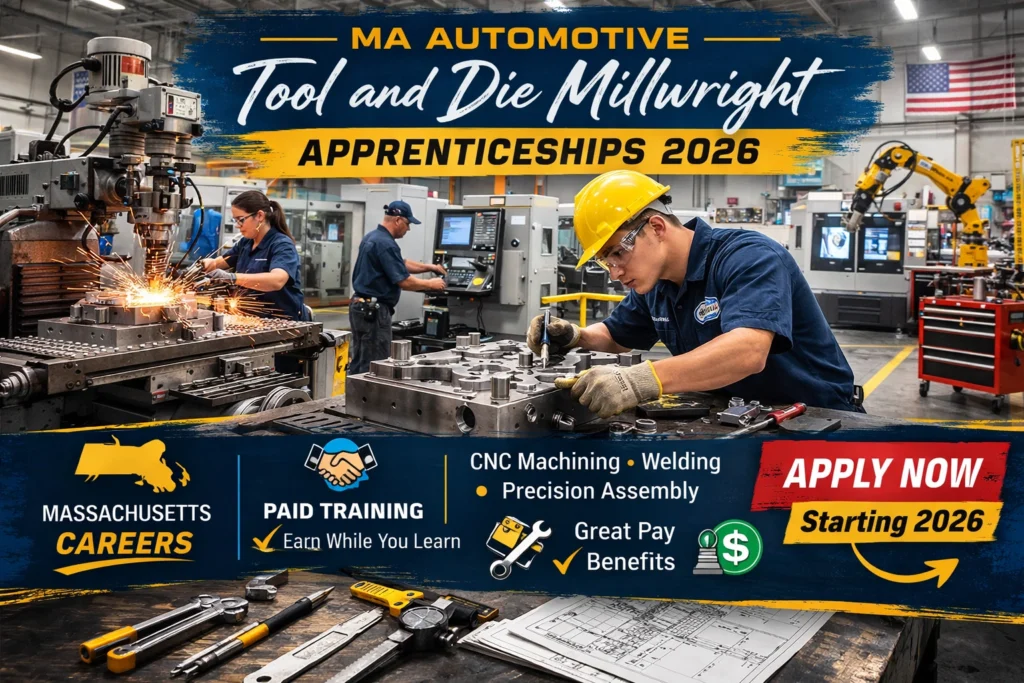
Frequently Asked Questions (FAQs)
Q1: I have Maths Literacy, not Pure Maths. Can I apply?
A: The requirement is Pure Mathematics. Maths Literacy does not meet the criteria for this apprenticeship .
Q2: I have an N3 qualification. Can I apply?
A: The requirements specify Grade 12 or NCV Level 4. If you have N3 with the relevant subjects, contact the company to confirm eligibility.
Q3: Do I need previous experience?
A: No. This is an entry-level apprenticeship – no prior experience required .
Q4: What is a Millwright?
A: A Millwright is a multi-skilled artisan who works with both mechanical and electrical systems, installing, maintaining, and repairing industrial machinery .
Q5: Is this a permanent position?
A: This is a contract apprenticeship. Upon successful completion and trade testing, you may be considered for permanent employment .
Q6: Where is Rosslyn?
A: Rosslyn is an industrial area in Pretoria, Gauteng, home to major automotive manufacturers
Q7: When will I know if my application is successful?
A: Only shortlisted candidates will be contacted. If you do not hear back within a reasonable time after the closing date, consider your application unsuccessful.
A Strategic Career Move
The MA Automotive Tool and Die Millwright Apprenticeships 2026 is more than an entry-level opportunity—it is a structured, industry-aligned pathway into one of the most in-demand technical professions. With its combination of hands-on training, exposure to advanced manufacturing systems, and a clear route to qualification, the programme offers a compelling option for young South Africans seeking practical, future-oriented careers.
However, success requires more than meeting the minimum requirements. Applicants must demonstrate technical aptitude, attention to detail, and a willingness to learn in a demanding environment.
With the 31 March 2026 deadline approaching, those interested should act decisively—preparing strong applications and ensuring they meet all criteria. In a competitive job market, opportunities like this are not just valuable—they are transformative.