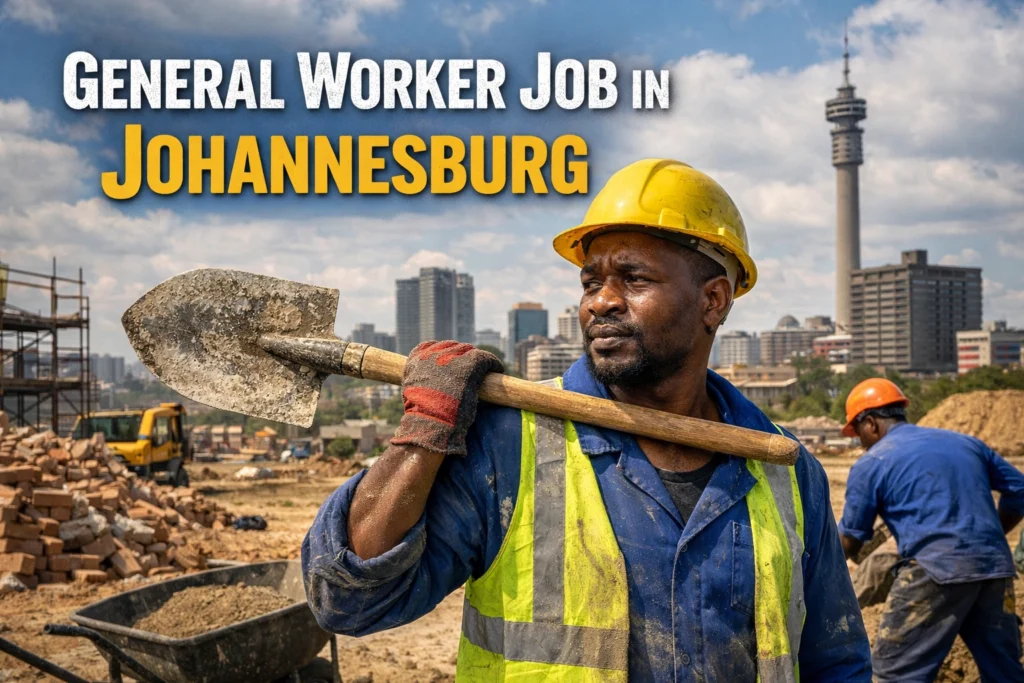

At 7:45 a.m., the glass doors of Umnotho House on Eloff Street slide open as employees trickle in, balancing coffee cups and morning fatigue. Upstairs, a meeting is about to begin—chairs need arranging, the projector must work, and the room must quietly reflect order and professionalism before the first executive walks in.
No one notices the person who made it happen.
That invisible hand belongs to a GENERAL WORKER—a role often overlooked in job listings but essential to keeping public institutions functioning. In a city like Johannesburg, where opportunity and unemployment coexist uneasily, this position tells a much bigger story about access, dignity, and the realities of entry-level work in South Africa’s public service.
The Quiet Backbone of Public Service Operations
The advertised GENERAL WORKER position under the Department of Environment may appear simple on paper. With a salary of R138,486 per year and a requirement of just a Grade 12 certificate, it opens the door to applicants who might otherwise struggle to enter formal employment.
But the simplicity is deceptive.
This role sits within Facilities Management’s Auxiliary Services—an operational nerve centre. The duties range from setting up boardrooms to managing audiovisual equipment, assisting with copier contracts, and supporting day-to-day copy shop operations. These are not glamorous tasks, yet they form the infrastructure that allows government departments to function efficiently.
In practical terms, a delayed meeting because of faulty equipment or a disorganised workspace can disrupt decision-making at high levels. A GENERAL WORKER ensures that doesn’t happen.
More Than “No Experience Required”
One of the most striking elements of this opportunity is the phrase: “No experience required.”
For many job seekers in South Africa, especially youth and first-time applicants, this is the difference between applying and giving up. But while formal experience isn’t needed, the competency list tells another story.
Applicants are expected to have:
- Basic computer literacy
- Communication skills (both written and verbal)
- Planning and organising abilities
- Customer service awareness
- Problem-solving skills
This reflects a broader shift in the labour market. Even entry-level roles now demand functional intelligence—the ability to adapt, communicate, and handle small but critical responsibilities.
In other words, this is not unskilled work. It is foundational work.
Apply via Gauteng Professional Job Centre
A Day in the Life of a GENERAL WORKER
To understand the role, imagine a typical day.
It begins with checking the schedule: meetings, workshops, internal briefings. Boardrooms must be arranged according to specific instructions—sometimes formal layouts, sometimes collaborative setups.
Next comes the technical check. Projectors, microphones, and screens must be tested. In an era where hybrid meetings are common, a malfunctioning system can derail an entire session.
Then there’s inventory work: identifying broken items, compiling disposal lists, and ensuring replacements are tracked properly. Add to this the management of water coolers, assistance with copier contracts, and supporting copy shop operations.
It’s a role that requires movement, awareness, and constant responsiveness.
And importantly, it requires trust. These workers operate behind the scenes but handle resources and spaces critical to government operations.
Why This Role Matters Right Now
South Africa’s unemployment rate—particularly among youth—remains one of the highest globally. Opportunities like this GENERAL WORKER position are not just job listings; they are entry points into the formal economy.
In South Africa, public service jobs carry additional weight. They offer:
- Stability in uncertain economic conditions
- Exposure to structured work environments
- Opportunities for internal growth
For many, this is a first step toward long-term employment. A GENERAL WORKER today can become an administrative clerk, facilities coordinator, or even move into specialised roles with experience and additional training.
This is how careers often begin—not with grand titles, but with consistent, reliable work.
The Application Process: Where Many Fall Short
Despite being entry-level, the application process is strict—reflecting the formal nature of government recruitment.
Applicants must use the new Z83 form, a standard document required for public service jobs. Submitting an outdated version automatically disqualifies the application. A detailed CV is also essential.
Applications can be submitted online via the government portal or hand-delivered to Umnotho House in Johannesburg. Notably, email and fax submissions are not accepted.
There are also compliance requirements:
- Shortlisted candidates must provide certified documents
- Foreign qualifications require evaluation by South African Qualifications Authority
- Security clearance is mandatory
- Any undisclosed legal or disciplinary issues can lead to disqualification
These steps may seem bureaucratic, but they ensure accountability and transparency in public sector hiring.
Apply via Gauteng Professional Job Centre
A System Built on Fairness—At Least in Principle
The job advertisement also highlights employment equity goals. The department aims to promote representation across race, gender, and disability categories.
This reflects South Africa’s broader transformation agenda—an attempt to address historical inequalities through structured hiring practices.
However, the reality is complex.
While policies encourage inclusivity, the high volume of applications—often hundreds for a single post—means competition remains intense. Many qualified candidates never receive feedback, a common frustration in public service recruitment.
Still, the system offers something rare: a transparent framework where requirements and processes are clearly outlined.
Expert Insight: What This Role Says About the Labour Market
From a labour market perspective, the GENERAL WORKER role highlights a key trend: the blending of manual and cognitive tasks in entry-level jobs.
In the past, roles like this might have been purely physical—cleaning, lifting, basic maintenance. Today, they include administrative awareness, technical handling (like audiovisual systems), and customer interaction.
This shift has two implications:
- Employability now depends on adaptability, not just qualifications.
- Entry-level jobs are becoming training grounds for broader skill development.
For policymakers, this raises important questions about education and skills alignment. For job seekers, it signals the importance of developing soft skills alongside basic qualifications.
also apply for: Chief Works Inspector in Johannesburg
Navigating the Opportunity: Practical Advice
If you’re considering applying, here are a few grounded tips:
- Treat your CV as a professional document, even without experience
- Highlight school projects, volunteer work, or informal responsibilities
- Demonstrate reliability and willingness to learn
- Double-check application requirements—especially the Z83 form
Small details often determine whether your application progresses or gets filtered out early.
Frequently Asked Questions
1. Do I really need computer skills for a GENERAL WORKER role?
Yes. Even basic tasks like managing schedules or assisting with equipment require familiarity with computers
2. Can I apply if I have no work experience at all?
Yes. The position explicitly states that no experience is required, but you must demonstrate relevant competencies.
3. What happens if I don’t hear back after applying?
If there’s no response within three months, your application is considered unsuccessful. This is standard for many public service roles.
The Bigger Picture: Work, Dignity, and Opportunity
It’s easy to overlook a job titled GENERAL WORKER. The name doesn’t promise prestige or rapid advancement. It doesn’t stand out in a crowded job market filled with internships, graduate programmes, and specialised roles.
But in a city like Johannesburg, where the gap between opportunity and access remains wide, this role represents something fundamental.
It represents entry.
Entry into structured employment. Entry into skill development. Entry into a system that, despite its flaws, offers stability and a path forward.
Behind every organised meeting room, every functioning piece of equipment, and every smooth-running office, there are workers whose contributions go unnoticed—but not unfelt.
And sometimes, that’s where real careers begin.