
Don’t Let These Mistakes Kill Your Learnership Application: Applying for a learnership can be one of the most important steps toward building your career—especially if you’re a young job seeker trying to gain experience in a competitive job market. Learnerships combine classroom learning with practical workplace training, making them a powerful opportunity to earn while you learn.
But here’s the reality: thousands of applicants compete for a limited number of learnership positions every year. And often, it’s not lack of qualifications that causes rejection—it’s simple, avoidable mistakes.
This guide will help you understand the most common errors that can ruin your chances and, more importantly, how to avoid them. If you want your application to stand out for the right reasons, keep reading.
What You Should Know First
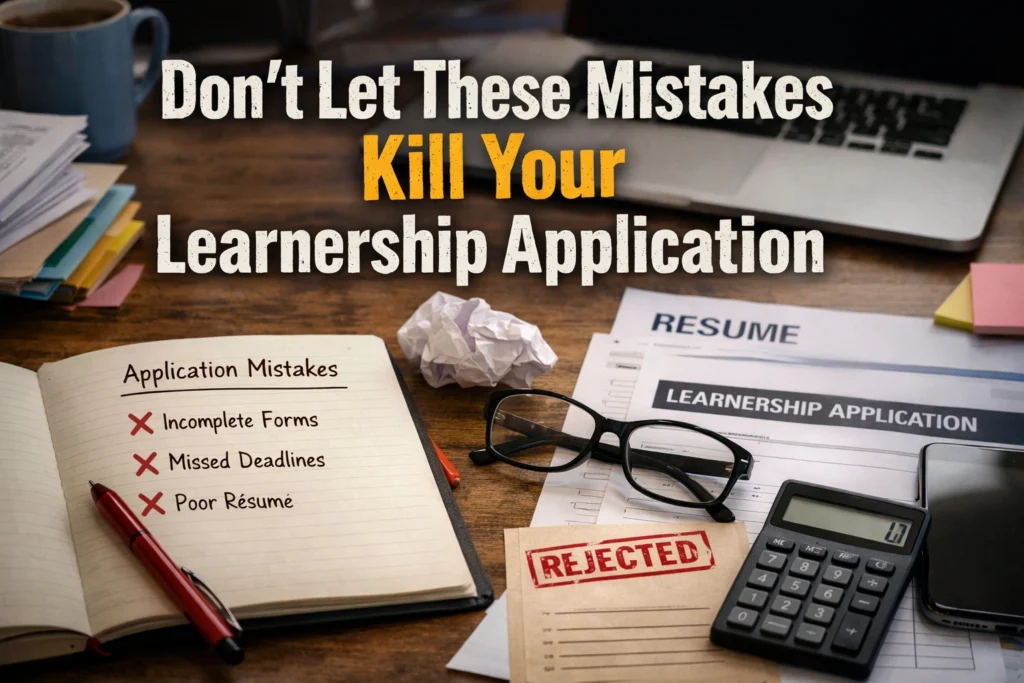
The biggest reason applications fail is not because candidates are unqualified—it’s because they don’t follow instructions, submit incomplete information, or fail to present themselves professionally.
Key idea: A strong learnership application is about attention to detail, preparation, and clarity. Small mistakes can cost you big opportunities.
Why Learnership Applications Get Rejected So Easily
Before diving into specific mistakes, it helps to understand how employers review applications.
Most organisations:
- Receive hundreds (or thousands) of applications
- Use quick screening methods to filter candidates
- Eliminate applications with errors immediately
This means recruiters often spend less than a minute scanning your application before deciding whether to continue.
If your application has mistakes, it’s likely rejected instantly—without a second chance.
ALSO APPLY FOR: Pepkor Learnership 2026
ALSO APPLY FOR: YES4Youth 12 Months Sales Learnership 2026
Mistake #1: Not Following Instructions
Why this matters
Every learnership application comes with specific instructions:
- Required documents
- File format (PDF, Word, etc.)
- Email subject line
- Application deadline
Ignoring these details signals one thing to employers: you can’t follow instructions.
Example
If a learnership requires:
“Submit your CV and certified ID in PDF format with the subject line ‘Marketing Learnership 2026’”
But you:
- Send a Word document
- Forget the subject line
- Attach extra documents
Your application may be rejected automatically.
How to avoid it
- Read the application twice before submitting
- Create a checklist of requirements
- Double-check everything before clicking send
Mistake #2: Submitting an Incomplete Application
What counts as incomplete?
- Missing CV
- No certified ID copy
- No academic results
- Blank sections in forms
Even one missing document can disqualify you.
Step-by-step fix
- Gather all required documents early
- Scan and save them clearly
- Label files properly (e.g., “Sizwe_ID.pdf”)
- Confirm everything is attached before submission
Mistake #3: Using a Poorly Written CV
Your CV is your first impression—and many applicants fail here.
Common CV problems
- Spelling and grammar errors
- No structure or formatting
- Missing contact details
- Too long or too short
Example of a weak CV
“i worked at shoprite and i did stuff like helping customers”
This lacks detail, professionalism, and clarity.
Improved version
“Assisted customers with product selection, handled queries, and maintained store cleanliness at Shoprite (2023–2024)”
How to improve your CV
- Use simple, clear language
- Keep it 1–2 pages
- Use bullet points
- Highlight skills and responsibilities
Mistake #4: Applying for Everything Without Focus
Many applicants apply for every learnership they find, regardless of relevance.
Why this hurts your chances
Employers can tell when your application is generic.
If you apply for:
- Engineering
- Marketing
- Finance
…with the same CV, it shows lack of direction.
Better approach
- Choose a career path
- Tailor your CV to that field
- Apply strategically, not randomly
Mistake #5: Missing the Deadline
This might seem obvious, but it’s one of the most common mistakes.
Why deadlines are strict
Learnership programmes follow fixed schedules. Late applications:
- Disrupt planning
- Show poor time management
Simple strategy
- Apply at least 2–3 days early
- Set reminders on your phone
- Avoid last-minute submissions
Mistake #6: Using an Unprofessional Email Address
Your email address is part of your personal brand.
Bad examples
These create a negative impression.
Good example
Quick fix
If needed, create a new email account just for job applications.
Mistake #7: Not Preparing Supporting Documents Properly
Common document issues
- Uncertified copies
- Blurry scans
- Incorrect file formats
- Large file sizes
What employers expect
- Clear, readable documents
- Proper certification (if required)
- Correct format (usually PDF)
Pro tip
Visit a local internet café or library if you don’t have access to a scanner.
Mistake #8: Ignoring the Cover Letter
Some applicants skip the cover letter—but this is a missed opportunity.
Why it matters
A cover letter allows you to:
- Explain why you want the learnership
- Show motivation
- Highlight relevant skills
Simple structure
- Introduction
- Why you’re interested
- Your strengths
- Closing statement
Example opening
“I am applying for the Business Administration Learnership as I am passionate about developing practical workplace skills and building a career in administration.”
Mistake #9: Providing False Information
It may be tempting to exaggerate experience—but this can backfire.
Risks
- Background checks
- Interview questions exposing inconsistencies
- Immediate disqualification
Best approach
Be honest and focus on:
- Your willingness to learn
- Your potential
- Your attitude
Mistake #10: Not Checking Your Application Before Sending
Rushing leads to mistakes.
Common last-minute errors
- Wrong attachments
- Typos
- Missing information
Final checklist
Before submitting:
- ✔ All documents attached
- ✔ Correct file format
- ✔ Proper subject line
- ✔ No spelling errors
ALSO APPLY FOR: Pepkor Learnership 2026
ALSO APPLY FOR: YES4Youth 12 Months Sales Learnership 2026
Common Misunderstandings About Don’t Let These Mistakes Kill Your Learnership Application
“I need experience to get a learnership”
Not true. Learnerships are designed for beginners. Employers value potential and attitude more than experience.
“A long CV is better”
Wrong. Recruiters prefer concise, clear CVs. Quality matters more than length.
“If I apply to many programmes, I’ll get one”
Applying blindly reduces your chances. Targeted applications are far more effective.
“Small mistakes don’t matter”
In competitive applications, small mistakes are often the reason for rejection.
How to Build a Strong Learnership Application (Step-by-Step)
Step 1: Understand the Requirements
Read the advert carefully and identify:
- Required documents
- Qualifications
- Skills
Step 2: Prepare Your Documents
Ensure you have:
- Updated CV
- Certified ID copy
- Academic records
Step 3: Tailor Your Application
Adjust your CV and cover letter to match the specific learnership.
Step 4: Review Everything
Check for:
- Errors
- Missing information
- Correct formatting
Step 5: Submit Early
Avoid technical issues and last-minute stress.
Key Takeaways
- Small mistakes can instantly disqualify your application
- Always follow instructions carefully
- Submit complete and well-prepared documents
- Keep your CV clear, concise, and professional
- Apply strategically, not randomly
- Double-check everything before submitting
- Honesty and attention to detail are critical
Frequently Asked Questions (FAQs)
1. How do I make my learnership application stand out?
Focus on clarity, accuracy, and relevance. Tailor your CV and include a strong cover letter showing your motivation.
2. Can I apply for multiple learnerships at once?
Yes, but make sure each application is tailored. Avoid sending the same generic CV everywhere.
3. What documents are usually required?
Typically: CV, Certified ID copy, Academic results, and Sometimes a cover letter
4. What happens after I submit my application?
If shortlisted, you may be invited for: Assessments, Interviews, and Background checks
Final Thoughts
A learnership application is more than just submitting documents—it’s your opportunity to prove that you are serious, capable, and ready to learn. The difference between rejection and success often comes down to simple details.
By avoiding the mistakes outlined in this guide and approaching your application with care and intention, you significantly increase your chances of getting selected.
Take your time, prepare properly, and treat every application as a valuable opportunity—because it is.
ALSO APPLY FOR:Pepkor Learnership 2026
ALSO APPLY FOR: YES4Youth 12 Months Sales Learnership 2026
ALSO READ ABOUT: 2026 Free Online Courses That Boost Learnership Applications