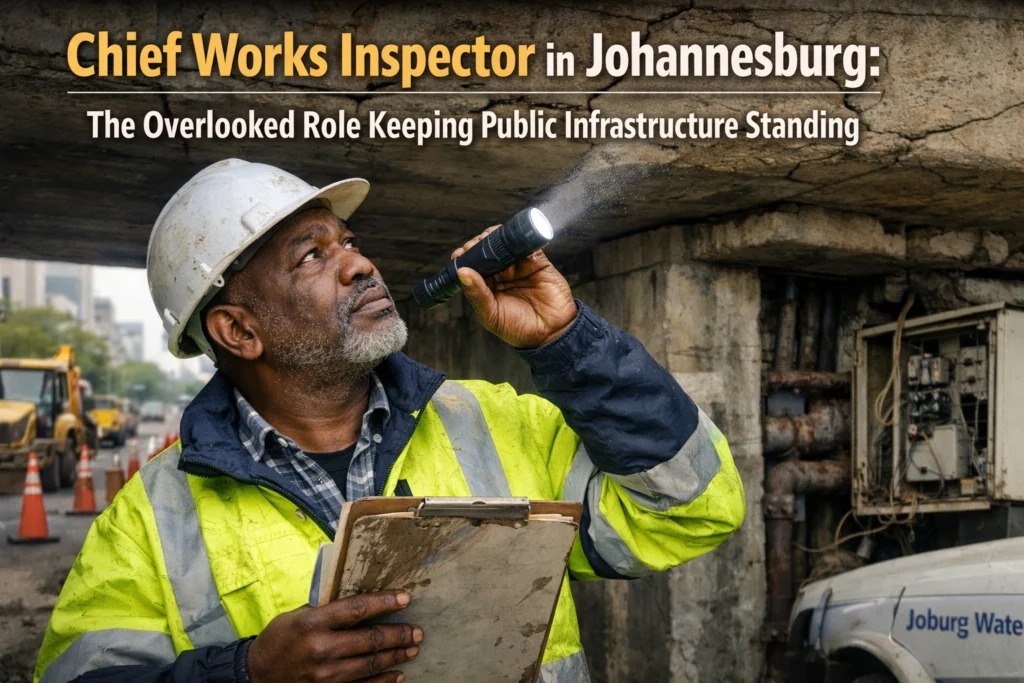

Chief Works Inspector: On a chilly morning in downtown Johannesburg, long before most offices open, a government inspector walks through a half-renovated public building. The walls are still exposed, wiring snakes across concrete, and a contractor argues over deadlines. But the inspector isn’t there to negotiate schedules—he’s there to make sure the building won’t become tomorrow’s safety headline.
This is the daily reality of a CHIEF WORKS INSPECTOR—a role that rarely makes news headlines but quietly shapes the safety, compliance, and longevity of South Africa’s public infrastructure.
With the Department of Environment now advertising a CHIEF WORKS INSPECTOR position at its Johannesburg Head Office, the spotlight returns to a profession that sits at the intersection of engineering, governance, and public accountability.
The Role Behind the Title: What a CHIEF WORKS INSPECTOR Really Does
At first glance, the title may sound administrative. It isn’t.
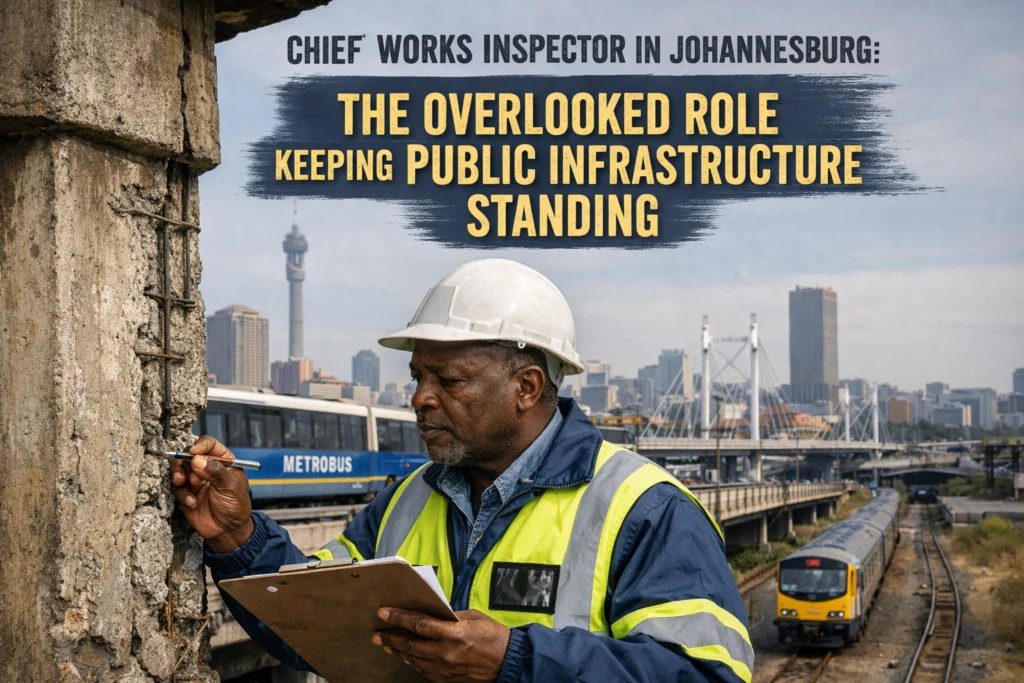
A CHIEF WORKS INSPECTOR operates as a technical authority within government infrastructure projects. They don’t just review paperwork—they oversee how public buildings are maintained, repaired, and sometimes rebuilt.
From drafting specifications and bills of quantities to verifying contractor invoices, the role is both hands-on and highly analytical. On any given week, the inspector might:
- Visit multiple sites to ensure maintenance complies with legal standards
- Compile cost estimates for repairs or upgrades
- Review contractor performance and certify payments
- Resolve disputes around timelines, quality, or safety compliance
This isn’t a desk job with occasional fieldwork—it’s a constant balancing act between technical oversight and administrative control.
And in a city like Johannesburg, where aging infrastructure meets rapid urban demand, that balance matters more than ever.
Apply via Gauteng Professional Job Centre
Why the CHIEF WORKS INSPECTOR Role Matters Now
South Africa’s public infrastructure faces mounting pressure. Schools need repairs, government offices require upgrades, and environmental compliance standards are tightening.
In this environment, the CHIEF WORKS INSPECTOR becomes a gatekeeper of quality and accountability.
Legislation such as the National Building Standards Act of 1977, the Occupational Health and Safety Act of 1993, and the Public Finance Management Act of 1999 sets strict requirements—but laws alone don’t enforce themselves.
Inspectors do.
Without this role functioning effectively:
- Maintenance budgets risk being misused
- Safety violations could go unnoticed
- Contractors may cut corners without consequence
In short, the CHIEF WORKS INSPECTOR protects both public funds and public safety.
From Qualification to Competence: What the Job Demands
The job requirements reflect the complexity of the role.
Candidates must hold a National Diploma (NQF Level 6) in fields such as building, mechanical, or electrical engineering—qualifications recognized by the South African Qualifications Authority.
But qualifications alone are not enough.
The role demands 3–5 years of post-qualification experience, a valid driver’s license, and a strong command of legislation, including:
- National Building Standards Act
- Government Immovable Asset Management Act
- Occupational Health and Safety Act
- Public Finance Management Act
This legal knowledge isn’t theoretical—it directly informs decisions on-site.
For example, approving a contractor’s work without proper compliance checks could expose the department to legal and financial risk. The inspector must understand not just what is being built or repaired, but whether it meets regulatory expectations.
Inside the Work: A Day Between Sites and Systems
Unlike many government roles, this position requires both mobility and precision.
One part of the day may involve physically inspecting a maintenance project—checking whether materials meet specifications or whether safety measures are in place. Another part may involve compiling digital records, analyzing cost reports, or preparing documentation for procurement processes.
A key responsibility is developing and maintaining electronic record systems. These systems track:
- Work requests
- Planned and completed maintenance
- Outstanding repairs
- Financial expenditures
In a government environment where accountability is critical, documentation is as important as inspection.
The CHIEF WORKS INSPECTOR doesn’t just ensure work is done—they ensure there is a traceable record of how and why it was done.
Apply via Gauteng Professional Job Centre
Leadership Beyond Technical Skills
What often goes unnoticed is the leadership dimension of the role.
The inspector supervises teams, allocates work, and identifies training needs among subordinates. They also interact with contractors, consultants, and internal stakeholders.
This means the job requires:
- Clear communication
- Conflict resolution skills
- The ability to interpret technical plans for non-technical audiences
In many cases, the inspector becomes the bridge between policy and practice—translating government regulations into actionable steps on the ground.
Applying for the Role: Process and Practical Realities
The application process reflects the formal nature of public service recruitment.
Applicants must submit their applications through the official Gauteng Professional Job Centre portal or deliver them in person at Umnotho House in Johannesburg. A correctly completed Z83 form, along with a detailed CV, is mandatory.
Notably:
- Certified documents are only required for shortlisted candidates
- Foreign qualifications must be evaluated by SAQA
- Late or incomplete applications are automatically disqualified
The closing date—31 March 2026—leaves little room for delay.
But beyond paperwork, applicants must also prepare for a rigorous selection process, including security clearance and performance agreements.
Apply via Gauteng Professional Job Centre
ALSO APPLY FOR: Transport Clerk
Expert Insight: Why Infrastructure Oversight Is Becoming More Critical
Across South Africa, infrastructure challenges are no longer just about funding—they’re about execution.
A growing concern among public sector analysts is that maintenance failures often stem from weak oversight rather than lack of resources.
This is where the CHIEF WORKS INSPECTOR becomes strategically important.
By enforcing compliance, verifying quality, and ensuring proper documentation, the role directly influences whether infrastructure investments deliver long-term value.
In other words, the inspector doesn’t just manage projects—they protect the integrity of public spending.
The Skills That Set Strong Candidates Apart
While the minimum requirements are clear, successful candidates often bring more to the table.
Some distinguishing strengths include:
- Advanced report writing and documentation skills
- Experience with infrastructure procurement frameworks
- Strong understanding of the GP IDMS Framework
- Ability to manage multiple projects simultaneously
Equally important is the ability to produce thorough, timely reports—a requirement emphasized in the job description.
In a role where decisions can impact budgets and safety, clarity and accuracy are non-negotiable.
A Career Path with Long-Term Potential
For many professionals in engineering or building sciences, the CHIEF WORKS INSPECTOR role can serve as a stepping stone to higher-level positions in:
- Infrastructure management
- Project leadership within government departments
- Policy advisory roles
The salary package—R397,116 per annum plus benefits—reflects mid-level seniority, but the experience gained can open doors to more strategic roles over time.
In a country investing heavily in infrastructure renewal, this career path remains both relevant and resilient.
Frequently Asked Questions
1. What does a CHIEF WORKS INSPECTOR earn in this role?
The advertised package is approximately R397,116 per year, excluding additional benefits such as pension contributions and medical aid.
2. Do I need engineering experience to apply?
Yes. A National Diploma in a relevant field (building, mechanical, or electrical engineering) and 3–5 years of post-qualification experience are required.
3. Is this a field-based or office-based job?
It’s a combination of both. The role involves site inspections as well as office-based reporting, documentation, and administrative work
The Bigger Picture: More Than Just a Vacancy
At a glance, this job advertisement might seem like just another government post.
But in reality, it reflects something larger.
South Africa’s infrastructure challenges—from maintenance backlogs to compliance issues—require more than funding. They require skilled professionals who can enforce standards, manage resources, and ensure accountability.
The CHIEF WORKS INSPECTOR sits at the center of that effort.
In Johannesburg, where infrastructure demands are constant and complex, the role carries real responsibility—and real impact.
For the right candidate, it’s not just a job. It’s a chance to shape how public infrastructure is maintained, protected, and improved for years to come.