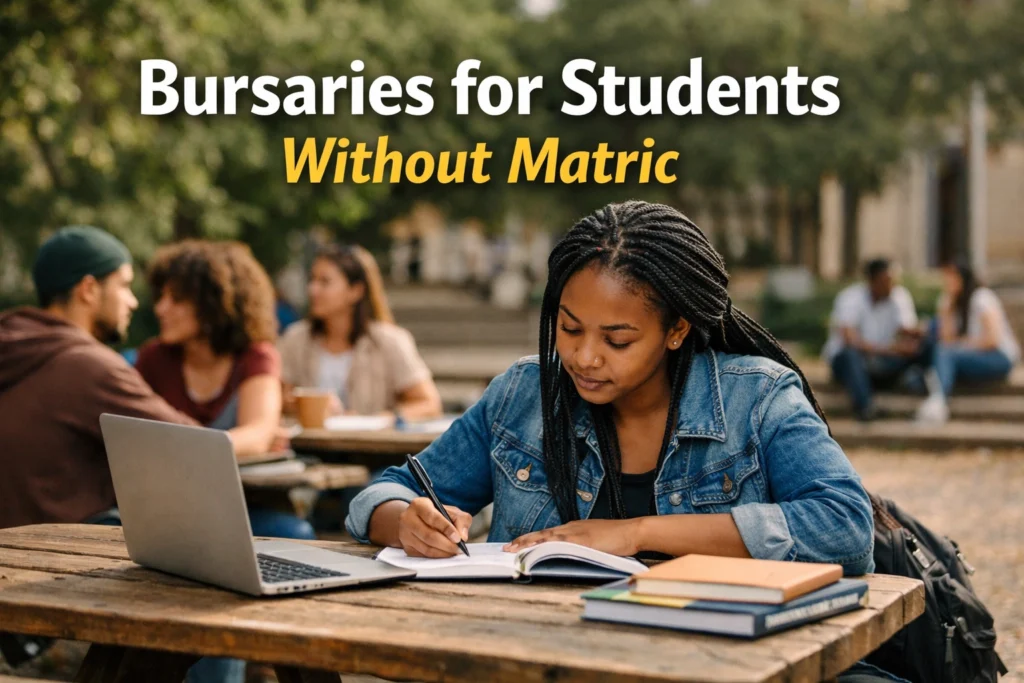

On a quiet weekday morning in Soweto, 22-year-old Thabo sits outside a community library scrolling through job listings on his phone. Every second listing seems to ask for the same thing: Grade 12 required. He never finished matric. Life got complicated—family responsibilities, money, timing. Now, like thousands of young South Africans, he finds himself stuck in a space that feels invisible: not quite unskilled, but not formally qualified either.
But something has begun to shift in recent years. Quietly, and often without much publicity, new pathways are emerging. Among them is a growing conversation around Bursaries for Students Without Matric—a concept that would have seemed almost contradictory a decade ago.
This is not just about funding. It’s about redefining who gets a second chance.
A System Built Around Matric — and Who It Leaves Behind
For decades, the South African education and employment system has treated matric as a gatekeeper. Without it, access to higher education, formal training, and funding opportunities becomes severely limited.
According to national data trends, thousands of learners leave school before completing Grade 12 each year. The reasons are rarely simple: poverty, family obligations, school quality gaps, or personal circumstances all play a role.
What makes the situation more complex is that most traditional bursary programmes are structured around academic pipelines—matric leads to university, which leads to funding.
But reality doesn’t always follow that neat progression.
And that’s where alternative bursary models are beginning to emerge.
Rethinking “Bursaries for Students Without Matric”
The phrase itself challenges conventional thinking. How can someone receive a bursary without meeting the most basic academic requirement?
The answer lies in expanding what “education” means.
In 2026, bursaries are no longer limited to university degrees. They now increasingly fund:
- Vocational training programmes
- Skills-based certifications
- Bridging courses and Adult Education and Training (AET)
- Learnerships tied to industry needs
In many cases, these programmes do not require a completed matric certificate—but they do require commitment, aptitude, and often a willingness to start at foundational levels.
This shift reflects a broader recognition: economic participation doesn’t always begin in a lecture hall.
Where Opportunities Are Opening Up
Across South Africa, a mix of government initiatives, private sector programmes, and NGOs are quietly expanding access for students without matric.
Skills Development Bursaries
Industries facing skills shortages—like construction, manufacturing, and logistics—are increasingly funding training directly. These bursaries often support:
- Artisan development programmes
- Technical training in fields like welding, plumbing, or electrical work
- Short-term certifications linked to immediate employment
Unlike traditional bursaries, these programmes focus less on academic history and more on practical ability and work readiness.
TVET and Bridging Pathways
Technical and Vocational Education and Training (TVET) colleges have become a key entry point.
Some bursary schemes now fund:
- NQF Level 2–4 qualifications (equivalent pathways toward matric)
- Foundational learning programmes
- Skills programmes that lead to formal accreditation over time
This allows students to “build up” qualifications gradually rather than being excluded entirely.
NGO and Community-Based Support
Non-profit organisations are playing an increasingly important role, especially in townships and rural areas.
These programmes often combine funding with:
- Mentorship
- Life skills training
- Career guidance
In many cases, they are more flexible than formal institutions and better equipped to support students who don’t fit traditional academic profiles.
ALSO READ ABOUT: The 2026 Learnership Document Checklist (SA)
Why This Matters Now More Than Ever
The conversation around Bursaries for Students Without Matric is not happening in isolation. It’s tied to broader economic and social realities.
South Africa continues to face high youth unemployment, particularly among those without formal qualifications. At the same time, industries are struggling to find skilled workers in technical fields.
There is a mismatch.
By opening bursary opportunities beyond matric requirements, the system begins to address both sides of the problem:
- Young people gain access to training and income pathways
- Industries develop the workforce they need
It’s not a perfect solution—but it’s a practical one.
The Hidden Barriers No One Talks About
Even as opportunities expand, access remains uneven.
One of the biggest challenges is information.
Many students without matric simply don’t know these bursaries exist. Unlike university funding, which is widely advertised, alternative bursaries are often:
- Localised
- Poorly marketed
- Dependent on word-of-mouth
There’s also a perception barrier. Some young people assume that without matric, further education is no longer possible. That belief alone can shut down opportunities before they’re even explored.
Then there’s the issue of confidence.
Returning to learning—especially after time away from school—can be intimidating. Without proper support systems, many students struggle to take that first step.
What Makes These Bursaries Different?
Not all bursaries are created equal. Those designed for students without matric tend to operate on a different philosophy.
Instead of selecting only the highest achievers, they often look for:
- Motivation and willingness to learn
- Basic literacy and numeracy
- Interest in a specific trade or field
Assessment methods may include interviews, aptitude tests, or practical demonstrations rather than academic transcripts.
This approach recognises something important: potential doesn’t always show up in exam results.
Expert Insight: A Quiet Shift in How Talent Is Defined
There is a deeper implication behind the rise of alternative bursaries.
For years, the education system has used academic performance as the primary measure of ability. But in doing so, it has overlooked a large segment of the population with untapped potential.
What we’re seeing now is a gradual shift toward a more inclusive definition of talent—one that values skills, adaptability, and real-world capability.
If this trend continues, it could reshape not just education funding, but hiring practices as well.
Employers are already beginning to prioritise demonstrated skills over formal qualifications in certain sectors. Bursaries that support non-traditional pathways are accelerating that change.
In the long term, this could lead to a more flexible and responsive labour market.
A Short Guide: How to Approach These Opportunities
For students considering this route, the process can feel unclear. But a few practical steps can make a difference:
- Start locally: Community centres, TVET colleges, and municipal offices often have information on available programmes
- Look for accredited training: Ensure the programme leads to recognised certification
- Prepare for interviews: Motivation and attitude often matter more than academic history
- Stay consistent: Many programmes require ongoing commitment to qualify for full funding
These steps may seem simple, but they can significantly improve access.
ALSO READ ABOUT: Write a Winning Bursary Application
The Role of Policy and the Road Ahead
Government policy is slowly catching up with reality.
There is increasing emphasis on:
- Skills development over purely academic pathways
- Expanding access to vocational training
- Supporting youth who fall outside traditional education systems
However, implementation remains uneven. Funding gaps, administrative delays, and limited awareness continue to limit impact.
What’s clear is that the demand exists. Young people like Thabo are actively searching for ways forward.
The question is whether the system can scale these opportunities fast enough.
FAQ
1. Can you really get a bursary without matric?
Yes, but these bursaries usually fund vocational training, skills programmes, or bridging courses rather than university degrees.
2. What types of courses are available?
Common options include technical trades, short skills programmes, and foundational education pathways through TVET colleges.
3. Do these bursaries guarantee a job?
Not always, but many are linked to industries with skills shortages, which improves employment prospects significantly
A Different Kind of Opportunity
Back in Soweto, Thabo eventually finds something promising: a skills development programme offering training in electrical work, funded through a local initiative. It doesn’t require matric—just a basic assessment and an interview.
It’s not the path he originally imagined. But it’s a path forward.
That’s what makes Bursaries for Students Without Matric so significant. They don’t just offer funding—they offer direction in situations where options often feel limited.
They challenge a long-standing assumption that one missed milestone defines the rest of your life.
And while these opportunities are still evolving, they represent something important: a system slowly learning to recognise potential in places it once overlooked.
Conclusion: Beyond the Certificate
The conversation around education in South Africa is changing. Slowly, unevenly, but undeniably.
Matric will likely remain an important benchmark. But it is no longer the only gateway to opportunity.
Bursaries that support students without matric are part of a broader shift toward inclusivity, practicality, and economic relevance. They acknowledge that life doesn’t always follow a straight line—and that second chances are not just necessary, but valuable.
For individuals, these programmes offer a chance to rebuild momentum.
For the economy, they unlock skills that might otherwise remain hidden.
And for the system as a whole, they signal a move toward something more flexible—and perhaps more fair.
ALSO READ ABOUT: Write a Winning Bursary Application
ALSO READ ABOUT: The 2026 Learnership Document Checklist (SA)