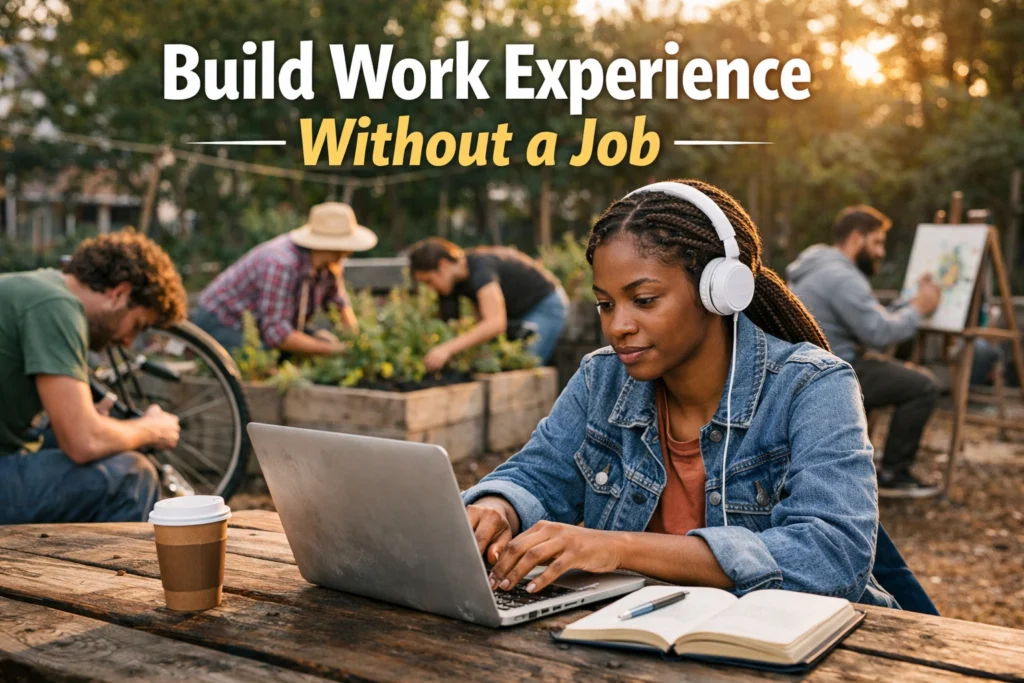

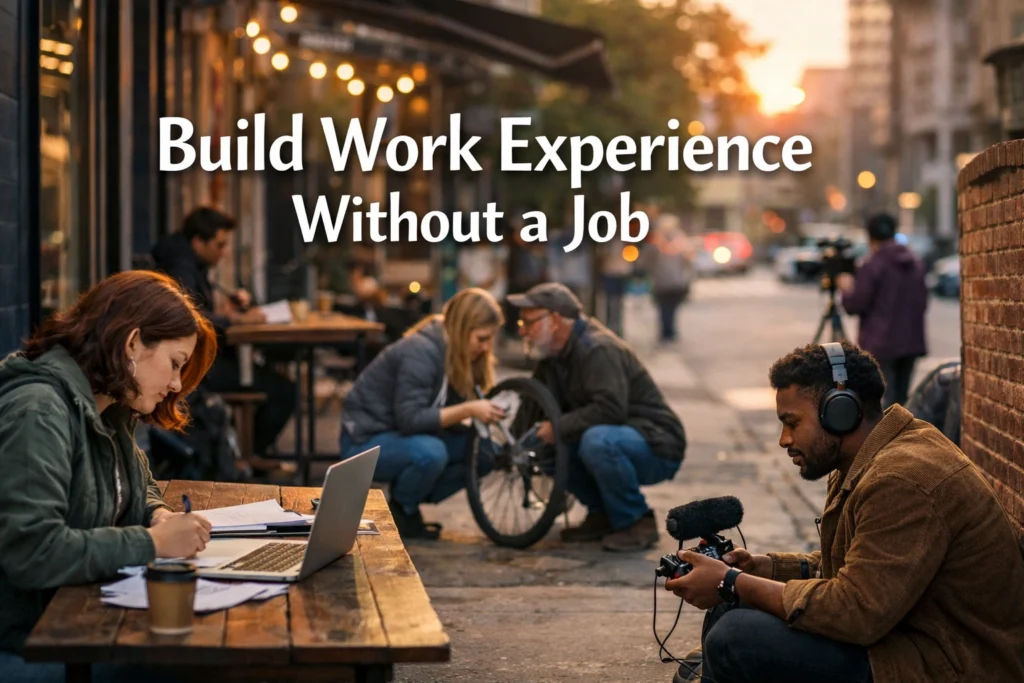
In 2026, the paradox facing job seekers—especially young people and recent graduates—has become more pronounced than ever: employers demand experience, yet opportunities to gain that experience are increasingly limited. As economic uncertainty, automation, and evolving hiring practices reshape the labour market, the traditional pathway of “get a job to gain experience” no longer works for millions.
This is precisely why understanding how to build work experience without a job has become not just useful, but essential. It is no longer a workaround; it is a core career strategy.
Across industries, employers are quietly shifting their focus from formal job history to demonstrable capability. Portfolios, project-based evidence, and real-world problem-solving are beginning to outweigh traditional CV bullet points. For job seekers who understand this shift, the absence of formal employment is no longer a dead end—it is an opportunity to build experience in unconventional but highly effective ways.
The Experience Gap: Why It Exists and Why It’s Growing
The “experience gap” is not new, but its causes have evolved significantly in recent years.
Historically, entry-level roles served as training grounds. Today, many of those roles have either disappeared or been redefined. Companies expect new hires to contribute immediately, reducing the willingness to invest in training. At the same time, digital transformation has raised the baseline for what counts as “basic skills.”
In South Africa and similar economies, the situation is compounded by high youth unemployment. Thousands of graduates enter the market each year, competing for a limited number of roles. The result is a bottleneck where even junior positions require prior exposure.
However, this gap is not purely a structural failure—it also reflects a mismatch between how experience is defined by employers and how candidates interpret it.
Employers increasingly view “experience” as:
- Evidence of applied skills
- Ability to solve real-world problems
- Familiarity with tools, workflows, and collaboration
- Demonstrated initiative
This broader definition opens the door to alternative pathways. Understanding how to build work experience without a job requires aligning with this modern interpretation rather than relying on outdated assumptions.
Rethinking Experience: From Employment to Evidence
One of the most important mindset shifts is recognizing that experience is not synonymous with employment.
Experience is, fundamentally, proof of capability. Employment is just one way to obtain that proof.
This distinction matters because it expands the range of activities that can legitimately count as experience:
- Independent projects
- Volunteer work
- Freelance assignments
- Academic or self-initiated research
- Community-based initiatives
For example, a candidate who builds a functioning website for a local business, manages a social media campaign for a community group, or develops a small mobile app has created tangible evidence of skill. In many cases, this evidence is more compelling than a generic entry-level role with limited responsibility.
Employers are increasingly receptive to this shift, particularly in fields like marketing, IT, design, and data analysis. Even in more traditional sectors, practical exposure is gaining importance.
The implication is clear: learning how to build work experience without a job is less about waiting for permission and more about actively creating value.
APPLY FOR: HEINEKEN Learnerships 2026
APPLY FOR: Dis-Chem Dispensary Support Learnerships 2026
The Rise of Project-Based Experience
One of the most effective ways to bridge the experience gap is through project-based work.
Projects simulate real-world conditions. They require planning, execution, problem-solving, and often collaboration—exactly the competencies employers seek.
There are several categories of projects that can serve this purpose:
1. Personal Projects
These are self-initiated and driven by curiosity or career goals. Examples include:
- Building a portfolio website
- Creating a blog or content platform
- Developing software tools or apps
- Conducting independent research or case studies
Personal projects demonstrate initiative, which is a highly valued trait. They also allow individuals to control the scope and complexity of their work.
2. Community Projects
Working with local organizations, NGOs, or small businesses can provide real-world exposure. Many organizations lack resources and are open to assistance in areas like:
- Digital marketing
- Administrative systems
- Data management
- Event coordination
These projects carry additional weight because they involve external stakeholders and measurable impact.
3. Collaborative Projects
Joining online communities or peer groups to work on shared initiatives can simulate workplace collaboration. This is particularly relevant in tech, design, and content creation fields.
The key advantage of project-based experience is that it produces tangible outputs—portfolios, case studies, and references—that can be presented to employers.
ALSO READ ABOUT: Track Your Learnership Applications
Freelancing and the Informal Economy as Experience Builders
Another critical pathway in understanding how to build work experience without a job is leveraging freelance and informal work opportunities.
The gig economy has expanded rapidly, lowering the barrier to entry for many types of work. Platforms and local networks allow individuals to offer services such as:
- Graphic design
- Writing and editing
- Tutoring
- Basic IT support
- Social media management
While these opportunities may not always provide stable income, they offer something equally valuable: real client interaction.
Freelancing teaches:
- Communication with clients
- Managing expectations and deadlines
- Pricing and negotiating work
- Delivering outcomes under pressure
These are core workplace competencies that are difficult to learn in purely academic settings.
In the South African context, informal work—helping small businesses, assisting family enterprises, or offering services within communities—can also serve as meaningful experience. The challenge is not the lack of experience, but the failure to articulate it effectively.
Candidates who can translate these activities into structured, results-oriented descriptions gain a significant advantage.
Digital Platforms and Self-Directed Learning
The digital economy has fundamentally changed how skills are acquired and demonstrated.
Online platforms now allow individuals to:
- Learn new skills through structured courses
- Participate in global competitions or challenges
- Showcase work through portfolios and profiles
- Build personal brands
This ecosystem supports a self-directed approach to experience building.
For instance, someone interested in data analysis can:
- Complete online courses in relevant tools
- Work on publicly available datasets
- Publish insights and visualizations
- Share their work on professional platforms
This process creates a narrative of continuous learning and application.
Importantly, employers increasingly verify skills through demonstrated output rather than certificates alone. A well-documented portfolio often carries more weight than formal qualifications without practical evidence.
Understanding how to build work experience without a job in this context means leveraging digital tools not just for learning, but for visibility and credibility.
APPLY FOR: HEINEKEN Learnerships 2026
Networking as an Experience Multiplier
Experience is not built in isolation. Networks play a critical role in amplifying opportunities.
Many opportunities—especially informal or project-based ones—are not advertised. They emerge through relationships, conversations, and referrals.
Networking does not necessarily mean attending formal events. It includes:
- Engaging with professionals on online platforms
- Participating in industry discussions
- Reaching out for informational interviews
- Collaborating with peers
These interactions can lead to:
- Short-term projects
- Mentorship opportunities
- Exposure to real-world challenges
- Recommendations and references
In many cases, a single connection can unlock multiple pathways to gaining experience.
The analytical insight here is that networking reduces friction. It shortens the distance between capability and opportunity. For individuals learning how to build work experience without a job, this can be the difference between stagnation and momentum.
Translating Experience into Employability
Building experience is only half the equation. The other half is communicating it effectively.
Many candidates engage in valuable activities but fail to present them in a way that resonates with employers.
The key is framing.
Instead of listing tasks, candidates should highlight:
- Problems addressed
- Actions taken
- Results achieved
For example:
- “Managed social media for a local business” becomes
- “Increased social media engagement by 40% over three months through targeted content strategy”
This results-oriented approach aligns with how employers evaluate candidates.
Portfolios, case studies, and structured CV entries are essential tools in this process. They transform informal or unconventional experience into credible professional evidence.
What This Means Going Forward
The concept of experience is undergoing a fundamental transformation.
As technology continues to reshape industries, and as traditional employment pathways become less predictable, the ability to independently build and demonstrate skills will become a core competency.
For job seekers, this means:
- Waiting for opportunities is no longer viable
- Proactive experience-building is essential
- Adaptability and initiative are key differentiators
For employers, it signals a shift toward more inclusive hiring practices that recognize diverse forms of experience.
In the long term, the distinction between “employed” and “experienced” will continue to blur. Careers will increasingly be defined by portfolios of work rather than linear job histories.
Understanding how to build work experience without a job is therefore not just a short-term solution—it is a future-proof strategy.
Conclusion
The challenge of gaining experience without formal employment is real, but it is not insurmountable. In fact, it reveals an important truth about the modern labour market: experience is no longer confined to the workplace.
By embracing project-based work, leveraging freelance opportunities, utilizing digital platforms, and building strong networks, individuals can create meaningful, credible experience on their own terms.
The shift requires initiative, discipline, and strategic thinking. But for those who adapt, it offers something powerful—the ability to take control of their own career development.
In a world where opportunity is no longer guaranteed, the ability to create your own experience may be the most valuable skill of all.
APPLY FOR: HEINEKEN Learnerships 2026