For many young South Africans, getting into a technical career can be difficult for one simple reason: employers often want experience before offering an opportunity to someone who has never worked in the industry.
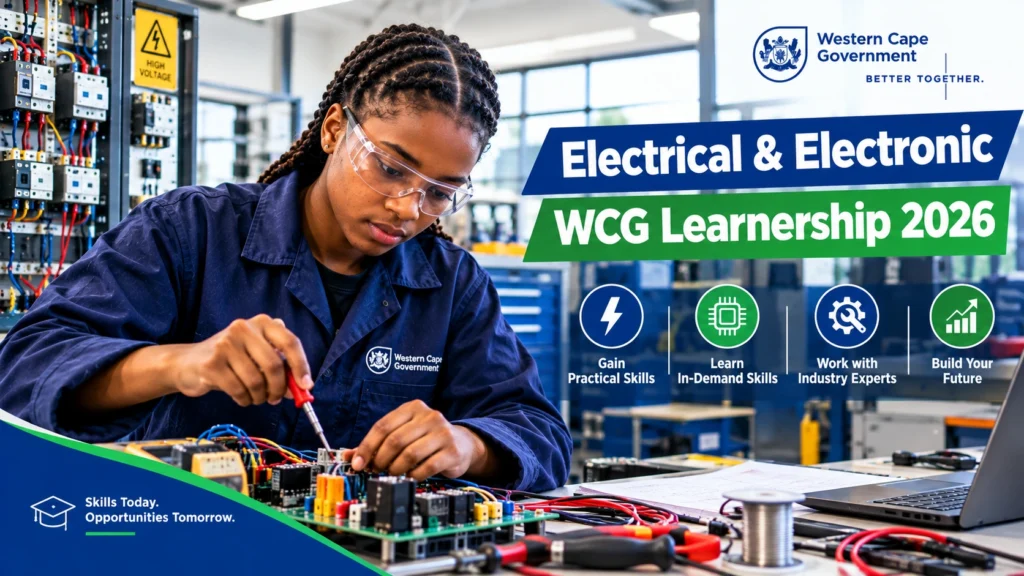
The WCG Learnership 2026 could help address that gap for young people in the Cape Metro who are interested in electronics, appliance repair and practical technical work.
The programme offers three months of free appliance-repair training, followed by a nine-month paid learnership focused on repairing and refurbishing electrical and electronic appliances. The full programme runs for 12 months, and applications close on 25 September 2026.
Importantly, this is not simply a programme for people who already know how to repair appliances. The training is designed to develop practical skills, meaning applicants with a genuine interest in electronics and a willingness to learn should consider applying.
The opportunity also connects technical training with the circular economy, where products are repaired, reused and refurbished rather than immediately becoming waste.
Here is what prospective applicants need to know before submitting an application.
WCG Learnership 2026: What Does the Programme Offer?
The WCG Repair and Refurbishment Learnership is structured around two stages.
The first stage provides three months of free appliance-repair training. Learners can use this period to develop basic technical knowledge and become familiar with repair and refurbishment work.
The second stage is a nine-month paid learnership. During this period, participants gain practical experience working with electrical and electronic appliances.
The programme therefore lasts 12 months in total. The published information confirms that the stipend applies to the nine-month learnership component, but the specific stipend amount has not been published.
Programme at a glance
| Programme detail | Information |
|---|---|
| Programme | WCG Repair and Refurbishment Learnership 2026 |
| Duration | 12 months |
| Initial training | 3 months |
| Training cost | Free |
| Paid learnership | 9 months |
| Stipend | Yes, during the learnership component |
| Stipend amount | Not publicly specified |
| Age | 18–35 |
| Location | Cape Metro |
| Mathematics | Pure Mathematics, Mathematical Literacy or Technical Mathematics |
| Matric | Preferred |
| Application | Online |
| Closing date | 25 September 2026 |
The programme is aimed at people who are interested in electronics, appliance repair, electrical equipment, refurbishment and practical technical skills.
Why This Issue Matters
Learning how to repair an appliance may sound like a small skill, but it can have wider value in a country where many households and businesses rely on electrical and electronic equipment every day.
A broken appliance does not necessarily need to become waste.
Sometimes the problem may involve a component, connection, power supply, mechanical part or another fault that can be diagnosed and repaired. Developing the ability to identify these problems can give a learner a practical skill that is useful beyond the classroom.
There is also an environmental side to the programme.
The circular economy focuses on keeping products and materials useful for longer through activities such as repairing, reusing, refurbishing and recycling. The WCG programme introduces participants to this approach through appliance repair and refurbishment.
For a young person, this creates an interesting combination:
- Technical training
- Practical workplace exposure
- Electronics and appliance repair
- Problem-solving skills
- Repair and refurbishment experience
- Exposure to circular-economy principles
- Potential preparation for future technical opportunities
The important point is that applicants should look beyond the stipend. The practical ability gained during the programme may become one of the most useful assets to carry into future employment, further training or self-employment.
Who Can Apply for the WCG Learnership 2026?
The published requirements indicate that applicants must meet several conditions.
You should:
- Be between 18 and 35 years old.
- Live within the Cape Metro.
- Have studied Pure Mathematics, Mathematical Literacy or Technical Mathematics.
- Have a genuine interest in electronics.
- Be able to travel to the training venue.
- Be prepared to commit to the complete 12-month programme.
- Provide accurate personal and educational information.
Matric is preferred, but the programme information does not present it as an absolute requirement. Applicants should therefore provide their actual education details rather than assuming they are automatically excluded.
A useful point about Mathematics
One of the more accessible aspects of the requirements is that applicants do not necessarily need Pure Mathematics.
The programme accepts applicants who studied:
- Pure Mathematics
- Mathematical Literacy
- Technical Mathematics
This matters because some young people interested in technical careers may incorrectly assume that Mathematical Literacy automatically disqualifies them.
It does not, according to the published programme requirements.
What Will You Actually Learn?
The programme is centred on practical technical development rather than simply providing a certificate.
Participants can expect exposure to areas such as:
- Electrical appliance repair
- Fault identification
- Basic troubleshooting
- Practical electronics
- Appliance refurbishment
- Safe use of equipment
- Technical problem-solving
- Repair and reuse practices
- Workplace responsibility
One of the most important skills in repair work is learning how to diagnose a fault.
Replacing a component without understanding why an appliance stopped working is not the same as properly diagnosing the problem.
A good repair technician learns to approach a fault systematically: observe the symptoms, investigate possible causes, test the relevant components and determine the appropriate repair.
That problem-solving mindset can become valuable in many technical environments.
How the 12-Month Programme Can Help Your Career
A common mistake among young job seekers is to judge an opportunity only by its immediate income.
The nine-month paid component is obviously important, particularly for unemployed youth who need financial support while gaining experience. However, the longer-term value can come from the combination of training and practical exposure.
After completing the programme, participants may have a clearer understanding of whether they want to pursue areas such as:
- Appliance repair
- Electronics
- Electrical work
- Maintenance
- Technical support
- Refurbishment
- E-waste management
- Further artisan or technical training
The programme does not guarantee a permanent job or a successful business.
However, practical experience can make it easier for a learner to explain what they can actually do when applying for another opportunity.
Could You Eventually Start a Repair Business?
Potentially, yes.
Appliance repair is one of those technical skills that can eventually be used in an employment environment or, with additional experience and business knowledge, in self-employment.
A person who becomes skilled at diagnosing and repairing appliances could eventually offer services to customers.
But applicants should have realistic expectations.
Completing the WCG Learnership 2026 does not automatically create a profitable business.
A sustainable repair business would also require:
- Reliable technical workmanship
- Customer service
- Correct pricing
- Basic bookkeeping
- Tools and equipment
- Transport
- Spare-parts sourcing
- Marketing
- Understanding customer demand
- Safe working practices
The learnership can provide a technical foundation, but building a business is a separate process.
Best Practices Experts Recommend
If you are considering applying, do more than simply complete the online form.
1. Check your eligibility first
Before applying, confirm your age, residential location and Mathematics subject.
Do not rely on assumptions.
2. Prepare your information
Have your identification, education details and contact information available before starting the application.
Most importantly, make sure your cellphone number and email address are correct.
3. Think about transport
Living in the Cape Metro is not enough if you cannot realistically travel to the training venue.
The published information states that applicants must be able to travel to the venue, while the final venue has not been confirmed.
Think about:
- Taxi routes
- Train or bus availability
- Daily transport costs
- Travel time
- Early-morning journeys
This should be considered before accepting a place.
4. Take the screening process seriously
Applicants should be prepared for a screening workshop, followed by interviews for shortlisted candidates.
Treat the workshop as part of the selection process.
You may be assessed on qualities such as:
- Interest in electronics
- Willingness to learn
- Ability to follow instructions
- Basic problem-solving
- Professional behaviour
- Commitment
- Communication
You do not need to pretend that you already know everything.
If this is an entry-level training programme, showing genuine curiosity can be more useful than exaggerating your experience.
5. Keep your communication channels active
After applying, check your phone and email regularly.
A missed call or email could mean missing important information about the screening workshop or interview.
How to Apply for the WCG Learnership 2026
Applications are completed online through the WCG Repair and Refurbishment Learnership application form.
Step 1: Check the requirements
Confirm that you are aged 18–35, live in the Cape Metro and studied one of the accepted Mathematics subjects.
Step 2: Prepare your details
Have your personal, contact and educational information ready.
Make sure your information matches your actual documents.
Step 3: Complete the online application
Use the official application form and answer every question accurately.
APPLY HERE: WCG Learnership 2026
Do not invent qualifications, work experience or technical skills.
Step 4: Review before submitting
Check your:
- Name
- ID information
- Phone number
- Email address
- Residential details
- Education information
A simple typing error in contact details can create unnecessary problems later.
Step 5: Submit before 25 September 2026
The closing date is 25 September 2026. Applicants should avoid leaving the application until the final hours.
Step 6: Monitor your communication
After applying, watch for information about the screening workshop and any subsequent interview.
The application itself is free. Be particularly cautious of anyone asking for money in exchange for selection or promising to guarantee you a place.
ALSO APPLY FOR: Dwarsrivier Chrome Learnership 2026
What Documents Should You Prepare?
The exact application requirements should always be checked on the application form, but applicants can make the process easier by having their basic information and education records available.
Depending on what the application asks for, you may need information relating to:
- South African ID
- Residential address
- Matric or school results
- Mathematics subject
- Contact details
- Education history
Do not upload or submit documents simply because somebody on social media tells you they are required.
Follow the official application instructions.
Mistakes People Often Make
Waiting until the deadline
The closing date is 25 September 2026. Waiting until the last day creates unnecessary pressure.
Assuming Mathematical Literacy is not accepted
It is listed among the accepted Mathematics subjects.
Focusing only on the stipend
The stipend is important, but the practical technical skills may be the more valuable long-term benefit.
Claiming experience you do not have
If you have never repaired an appliance professionally, say so.
A training programme is an opportunity to learn.
Ignoring transport
A programme can look attractive on paper but become difficult if travelling to the venue every day is unaffordable or impractical.
Paying a recruitment fee
Applications are free. Never pay someone who claims they can guarantee your selection.
Frequently Asked Questions
1. How long is the WCG Learnership 2026?
The programme runs for 12 months: three months of free appliance-repair training followed by nine months of paid learnership experience.
2. Is the WCG Learnership 2026 paid?
The nine-month learnership component includes a stipend. However, the specific stipend amount has not been published in the available programme information.
3. Can someone who studied Mathematical Literacy apply?
Yes. The published requirements list Pure Mathematics, Mathematical Literacy or Technical Mathematics as accepted subjects.
4. When does the application close?
Applications close on 25 September 2026. Applicants should submit their applications before the deadline and monitor their communication channels afterwards.
Final Summary
The WCG Learnership 2026 offers a different route into technical work for young people who enjoy understanding how things work and fixing problems.
Instead of requiring applicants to arrive with years of technical experience, the programme starts with three months of free appliance-repair training and then moves into a nine-month paid learnership.
The opportunity is aimed at people aged 18 to 35 living in the Cape Metro, with Pure Mathematics, Mathematical Literacy or Technical Mathematics accepted as the relevant school subject requirement. Matric is preferred.
The bigger story is the practical skill.
Learning to diagnose faults, repair equipment and refurbish appliances can provide useful exposure to electronics and technical work. The programme also introduces the circular economy, where repairing and reusing products can help keep equipment in service and reduce unnecessary electronic waste.
If you are considering applying, start with the basics: check your eligibility, prepare your information, consider transport, complete the application accurately and submit it before 25 September 2026.
Most importantly, do not apply simply because there is a stipend. Apply if you are genuinely interested in learning a practical technical skill that you can continue developing after the 12-month programme ends.