
A young person can spend years studying Mechanical Engineering, complete N6 and pass the required theory, yet still struggle to enter the engineering industry.
The reason is frustratingly simple: theory alone does not make someone a qualified artisan. Many technical graduates still need structured workplace training before they can complete their journey towards a trade qualification.
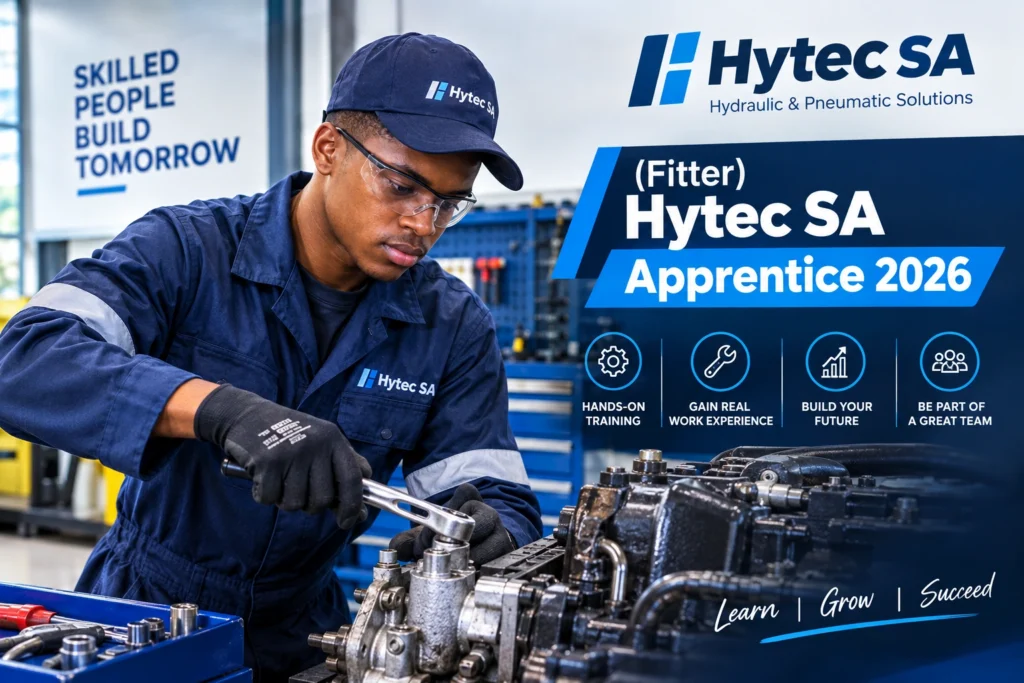
That is why the Hytec SA Apprentice 2026 opportunity in Kempton Park, Gauteng, deserves attention from suitably qualified technical graduates.
Hytec SA, part of the Bosch Rexroth Africa Group, is offering two Apprentice Fitter positions for candidates who have completed the theory component of the Fitter course. The apprenticeship is designed to provide practical workplace training needed to develop the skills of a Fitter.
For a TVET graduate who has been searching for that first serious opportunity, this is not simply another vacancy. It could provide the practical bridge between classroom learning and an engineering career.
Why this apprenticeship matters for TVET graduates
Consider the situation facing many young technical graduates.
You have completed your subjects. You may have N6 Mechanical Engineering. You may even have passed your trade theory examinations. But when you search for jobs, employers frequently ask for practical experience.
Where are you supposed to get that experience if nobody gives you an opportunity to start?
Apprenticeships exist partly to address this gap.
Instead of expecting a candidate to arrive as a fully experienced artisan, an apprenticeship provides structured workplace exposure under supervision. The apprentice learns how technical knowledge is applied to real equipment, real maintenance problems and real production environments.
That distinction is particularly important in mechanical engineering.
A textbook can explain tolerances, components and mechanical systems. A workshop teaches you how carefully those principles must be applied when working with actual machinery.
Hytec operates in an industrial environment involving hydraulics, pneumatics and automation. Bosch Rexroth Africa describes its business as providing technologies and solutions for industries including mining and manufacturing.
For a Fitter apprentice, that can create an environment where mechanical skills are connected to sophisticated industrial equipment rather than being limited to classroom exercises.
Hytec SA Apprentice 2026 at a glance
| Detail | Information |
|---|---|
| Position | Apprentice: Fitter |
| Company | Hytec SA |
| Group | Bosch Rexroth Africa |
| Location | Kempton Park, Gauteng |
| Positions | 2 |
| Programme | Apprenticeship / practical training |
| Main objective | Practical training towards qualifying as a Fitter |
| Key requirement supplied | Completed theory for the Fitter course |
| Application | Online through the Bosch Rexroth Africa careers portal |
Applicants should check the official vacancy for the complete and latest requirements before submitting an application.
What makes Hytec a useful training environment?
The company behind this apprenticeship is important because the quality of an apprenticeship is influenced by the environment in which practical learning takes place.
Hytec South Africa is associated with hydraulic and pneumatic systems and provides products and services to industrial customers. Bosch Rexroth Africa also operates technical training facilities in Kempton Park, including training relating to mechanical engineering and fluid power.
This gives the apprenticeship a useful industrial context.
A Fitter working in this type of environment may encounter mechanical assemblies, hydraulic equipment, maintenance activities, technical drawings, measuring equipment and fault-finding processes.
The exact duties of the advertised apprentice must, however, be confirmed from the official vacancy.
For applicants, the bigger lesson is this: do not judge an apprenticeship only by the job title.
Look at the technology, industries, equipment and training environment surrounding the position.
An apprenticeship in a company involved in industrial hydraulics can expose a developing artisan to systems that are widely used in sectors such as mining, manufacturing and heavy industry.
What should an Apprentice Fitter be prepared to learn?
The purpose of practical training is to turn technical knowledge into repeatable workplace skills.
Depending on the training programme and assigned duties, this may include learning how to:
- interpret mechanical drawings and technical information;
- use hand and workshop tools correctly;
- measure components accurately;
- assemble and dismantle mechanical equipment;
- identify mechanical faults;
- perform maintenance activities;
- follow workplace safety procedures;
- work under the direction of qualified technical personnel;
- maintain accurate records of work performed; and
- apply theoretical knowledge to practical engineering problems.
The hydraulic environment adds another useful dimension.
Bosch Rexroth Africa’s published services include hydraulic equipment repair, testing, troubleshooting and maintenance. Its technical operations cover components such as pumps, motors, valves and cylinders.
That does not mean an apprentice will automatically work on every type of equipment listed by the company. Instead, it shows the breadth of technology within the wider organisation.
Expert insight: the most valuable part may be the workplace exposure
For technical graduates, the value of an apprenticeship is often underestimated because people focus only on the word “apprentice”.
The bigger issue is workplace competence.
A candidate can understand mechanical theory but still need experience working safely around industrial equipment, following maintenance procedures, interpreting instructions and solving practical problems.
That experience cannot be developed entirely from a textbook.
A structured apprenticeship gives the learner an opportunity to observe experienced artisans, perform practical tasks under supervision and gradually take on greater responsibility.
For someone who wants to build a long-term career in fitting, maintenance or industrial engineering, that practical foundation can become an important part of their professional development.
Who should apply for the Hytec SA Apprentice 2026 opportunity?
The information supplied for the vacancy specifically identifies candidates who have completed the theory for the Fitter course.
This means the opportunity is not aimed at every person who has simply completed Grade 12.
Before applying, candidates should compare their qualifications against the complete vacancy requirements.
You should be able to clearly explain:
What did you study?
For example, if you completed Mechanical Engineering N6, make this prominent on your CV.
What practical training have you completed?
Mention relevant workshop projects, college practicals or technical exposure where applicable.
What trade theory have you completed?
If you have passed relevant examinations, clearly state this and include supporting documentation when requested.
Why do you want to become a Fitter?
Your application should demonstrate that fitting is part of your intended career path rather than simply being another vacancy you found online.

How to apply for the Hytec SA Apprentice 2026 position
The supplied information indicates that applications are submitted online through the Bosch Rexroth Africa careers portal.
Follow these steps carefully.
Step 1: Go to the official careers page
Start with the Bosch Rexroth Africa careers website rather than a WhatsApp message, Facebook post or unofficial recruitment page.
APPLY HERE: Hytec SA Apprentice 2026
Search for the Hytec SA Apprentice or Apprentice: Fitter vacancy.
Step 2: Read the complete vacancy
Do not stop after seeing the words “completed theory”.
Read the entire advertisement and check:
- qualification requirements;
- location;
- contract details;
- experience requirements, if any;
- closing date;
- documents required; and
- any additional employment conditions.
If your qualification does not match the requirement, do not alter your CV to make it appear as though you have a qualification you do not possess.
Step 3: Prepare a technical CV
Your CV should make it easy for a recruiter to identify your technical background.
A useful order is:
- Name and contact details
- Professional profile
- Mechanical Engineering qualifications
- Fitter/trade theory information
- Practical or workshop experience
- Technical skills
- Additional qualifications
- References, if requested
Avoid filling the CV with unrelated information.
For this type of position, your mechanical training should be immediately visible.
Step 4: Prepare your documents
Keep clear copies of the documents requested by the employer.
Depending on the vacancy requirements, these may include qualification certificates, academic records and identification documents.
Do not upload unnecessary sensitive information unless it is specifically requested through the legitimate recruitment process.
Step 5: Complete the online application
Enter your information carefully.
Pay particular attention to:
- telephone number;
- email address;
- qualification dates;
- institution names;
- work experience;
- uploaded documents; and
- spelling of your name.
A simple error in contact information can make it difficult for a recruiter to reach you.
Step 6: Save your confirmation
If the recruitment system provides an application confirmation or reference number, save it.
Keep the vacancy details as well. This gives you a record of what you applied for and makes it easier to recognise legitimate communication later.
ALSO APPLY FOR: Cummins Engine Apprentice 2026
How to make your application stronger
Meeting the minimum requirement is only the beginning.
With only two positions listed, applicants should make their technical background easy to understand.
One practical improvement is to replace vague statements with evidence.
Instead of writing:
“I am passionate about engineering.”
Explain what demonstrates that interest.
For example, mention relevant college workshop projects, mechanical equipment you have worked with, technical drawings you have interpreted or practical tasks completed during your studies—but only where those claims are accurate.
Also remember that apprenticeships require more than technical knowledge.
Employers need people who can follow instructions, work safely, arrive reliably, communicate with colleagues and learn from supervision.
These qualities can be demonstrated through your CV, interview examples and the way you communicate during the recruitment process.
Avoid these common mistakes
A technically qualified applicant can weaken their application through avoidable mistakes.
Applying without checking the requirement:
Do not assume that every Mechanical Engineering qualification automatically satisfies the Fitter requirement.
Sending a generic CV:
A CV written for an office job may fail to highlight your mechanical training.
Exaggerating practical experience:
Do not claim to be an experienced artisan if your experience comes mainly from college training.
Ignoring location:
Kempton Park is in Gauteng. Candidates should consider transport, accommodation and the practical realities of reporting to the workplace.
Using unofficial application channels:
Where an official careers portal is provided, use it.
Waiting until the last moment:
Technical recruitment opportunities can attract many applications. Preparing your documents early gives you time to correct errors.
Frequently asked questions
1. How many positions are available?
The supplied vacancy information lists two Apprentice Fitter positions at Hytec SA in Kempton Park.
2. Do I need completed Fitter theory?
Yes. The key requirement supplied for this opportunity is completed theory for the Fitter course. Applicants should verify the complete requirements on the official vacancy.
3. Where do I apply?
The opportunity information indicates an online application through the Bosch Rexroth Africa careers portal. Use the official recruitment website and follow the instructions attached to the live vacancy.
The bigger opportunity behind the vacancy
For South Africa’s technical graduates, the difficult transition from college to workplace remains an important part of the skills-development journey.
The Hytec SA Apprentice 2026 opportunity illustrates why practical training matters.
A person who has completed their theory may already have the foundation. What they need next is the opportunity to apply that knowledge, learn workplace standards and develop practical competence under experienced supervision.
Hytec’s connection to Bosch Rexroth Africa also places the opportunity within a wider industrial technology environment involving hydraulics, pneumatics and automation. Bosch Rexroth Africa says it operates across multiple African countries and supports industries that depend on engineering technology.
For a prospective Fitter, that context is worth considering carefully.
An apprenticeship should not be viewed simply as a temporary way to get onto a payroll. It is an opportunity to develop the practical habits, technical judgement and workplace discipline that underpin a trade career.