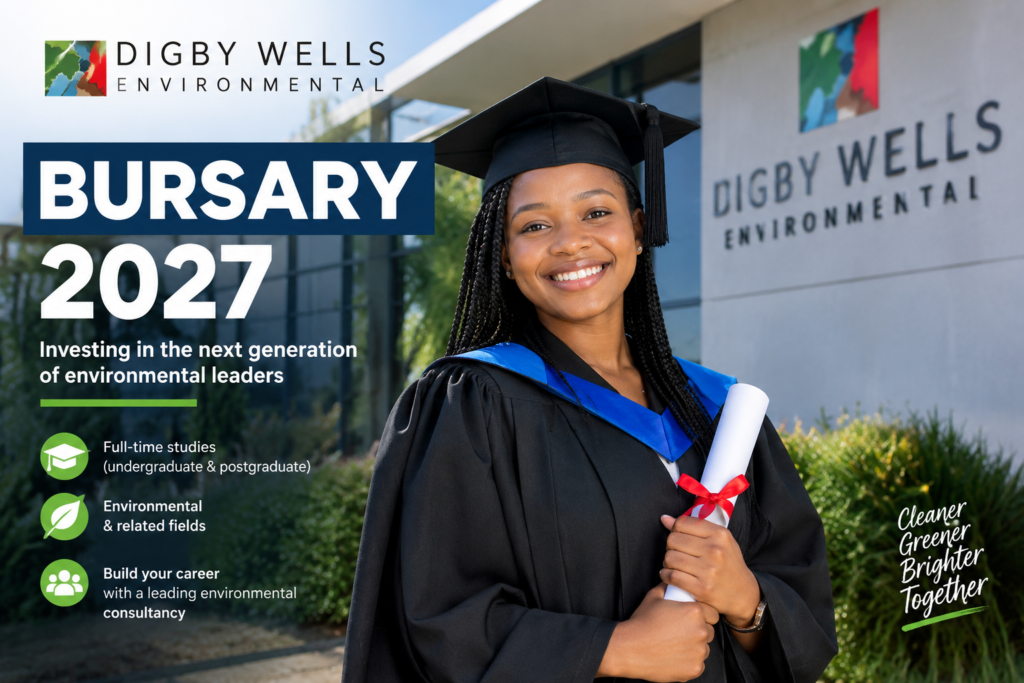

Paying for tertiary education can be difficult, particularly for students studying specialised degrees that lead to careers in environmental science, hydrology, geography and community development. The Digby Wells Environmental (DWE) Bursary 2027 gives qualifying South African students an opportunity to receive financial support while building an academic path connected to the environmental and social consulting industry.
The bursary is aimed at passionate, dedicated and high-achieving students who want to develop careers in areas that can contribute to environmental sustainability and responsible development.
What makes this opportunity particularly interesting is the connection between the funding and Digby Wells Environmental’s work. The company operates as a multidisciplinary environmental and social consultancy, meaning students in several different fields may find a potential career connection beyond simply receiving financial assistance.
This guide explains the important information applicants should understand before applying, including the qualifying fields, eligibility requirements, the potential importance of the service obligation, and practical steps for preparing a strong application.
What You Should Know First
The Digby Wells Environmental (DWE) Bursary 2027 is intended for South African students pursuing or planning to pursue selected qualifications at recognised tertiary institutions in South Africa.
The covered disciplines include:
- B.Sc. Environmental Sciences
- B.Sc. Geography
- B.Sc. Zoology
- B.Sc. Hydrogeology
- B.Sc. Hydrology
- B.A. Community Development
- B.Sc. Research Psychology
The opportunity is therefore broader than environmental science alone. It includes scientific, geographical, water-related and social disciplines that can contribute to environmental and community-focused projects.
Before submitting an application, however, students should carefully check the official bursary requirements and application instructions. Meeting the basic academic and citizenship requirements does not automatically mean that an applicant will be selected.
About Digby Wells Environmental
Digby Wells Environmental is an employee-owned consultancy that provides environmental and social services across Africa and other markets.
Its work is connected to industries such as:
- Mining
- Oil and gas
- Infrastructure
- Renewable energy
- Agriculture
The company’s work involves helping clients understand and manage environmental and social risks, support permitting processes and engage with affected stakeholders.
That background is important for bursary applicants because it gives some context to the study fields being supported.
For example, a student studying hydrology may eventually work on water-related environmental assessments, while a geography student could contribute to spatial analysis and environmental planning. A community development or research psychology student could potentially bring social research and stakeholder-engagement skills into projects involving communities.
The bursary therefore appears to support skills that can contribute to the wider environmental and social consulting ecosystem.
Which Fields of Study Are Covered?
One of the first things prospective applicants should check is whether their qualification appears on the approved list.
The Digby Wells Environmental Bursary Programme 2027 covers the following fields:
| Qualification | Possible area of application |
|---|---|
| B.Sc. Environmental Sciences | Environmental assessment and sustainability |
| B.Sc. Geography | Spatial planning, environmental analysis and GIS-related work |
| B.Sc. Zoology | Biodiversity, ecology and environmental studies |
| B.Sc. Hydrogeology | Groundwater and water-resource investigations |
| B.Sc. Hydrology | Water systems and environmental assessments |
| B.A. Community Development | Community and stakeholder-focused work |
| B.Sc. Research Psychology | Social research and understanding human behaviour |
This list is particularly useful for students who may not initially think of themselves as environmental-sector candidates.
For instance, someone studying community development might assume that an environmental consultancy would only be interested in science students. However, environmental projects often involve communities, land users and other stakeholders. Understanding social issues can therefore be important alongside technical environmental knowledge.
Similarly, geography can provide skills relevant to spatial analysis and Geographic Information Systems, commonly known as GIS.
Who Can Apply for the DWE Bursary?
The information provided for the 2027 programme indicates that applicants must meet key eligibility requirements.
You must:
- Be a South African citizen.
- Be enrolled or intending to enrol at a recognised tertiary institution in South Africa.
- Be pursuing one of the specified fields of study.
- Demonstrate strong academic commitment and achievement.
- Have a genuine interest in developing a career connected to the environmental or social sector.
Applicants should not assume that simply studying at a tertiary institution makes them eligible.
The course itself matters.
For example, if you are studying a qualification that is closely related to environmental work but is not one of the listed disciplines, you should verify with the official bursary information before applying. A similar-sounding degree is not necessarily an automatically qualifying degree.
Why the Service Obligation Matters
One of the most important points applicants should investigate before accepting a bursary is the service obligation.
A bursary with a service obligation is different from funding that simply pays for your studies without any future commitment.
In practical terms, a service obligation can mean that a successful bursary recipient may be expected to work for the sponsoring organisation for an agreed period after completing their studies.
This is significant because it creates both an opportunity and a responsibility.
The opportunity
For a student, a service obligation can potentially provide a pathway from university into employment or workplace exposure.
Instead of finishing your qualification and immediately starting from scratch in the job market, you may have an opportunity to develop experience within an organisation operating in your field.
The responsibility
The commitment should not be treated as a minor condition.
Before accepting funding, read the bursary agreement carefully and establish:
- How long the service obligation lasts.
- When the obligation begins.
- What happens if you do not complete your qualification.
- What happens if you decide not to work for the organisation.
- Whether repayment conditions apply in certain circumstances.
- Whether employment after graduation is guaranteed or simply part of the potential pathway.
Do not rely on assumptions. The written bursary agreement should be the document you use to understand your obligations.
How to Decide Whether This Bursary Is Right for You
A useful way to approach a bursary is to ask whether it fits both your financial situation and your career plans.
The DWE opportunity may be worth considering if you:
- Are interested in environmental or social-impact work.
- Are studying one of the listed qualifications.
- Want to develop practical knowledge beyond your academic coursework.
- Are comfortable with the possibility of a post-study service commitment.
- Want to explore careers in environmental consulting.
- Meet the stated citizenship and tertiary-institution requirements.
On the other hand, you should think carefully before applying if your career plans are completely unrelated to the environmental and social sectors or if you are unwilling to consider the obligations attached to the funding.
A bursary should not be selected simply because it offers financial assistance. The long-term conditions matter too.
What Could Students Gain From the Opportunity?
Financial support is obviously one of the biggest attractions of a bursary, but the potential value can go beyond money.
For students entering a competitive graduate employment market, exposure to an industry can be extremely useful.
Depending on the programme and the terms of the bursary, the broader value could include:
- Reduced pressure from education costs.
- Exposure to a professional environmental organisation.
- A clearer understanding of possible career paths.
- Opportunities to develop industry knowledge.
- Potential workplace exposure after graduation.
- Networking with professionals.
- Greater understanding of environmental and social consulting.
Consider a geography student interested in GIS.
University may provide the theoretical foundation, but professional environmental projects can show how spatial information is used to understand real-world problems. Likewise, a hydrology student can learn how water-related knowledge contributes to environmental assessments and development decisions.
This is why applicants should think beyond the question, “How much funding will I receive?”
A better question is:
“Where could this opportunity take me after university?”
How to Prepare a Strong Application
A strong bursary application is not simply about attaching documents and pressing submit.
Start by checking your eligibility.
Step 1: Confirm your qualification
Make sure your degree is one of the fields specifically covered by the programme.
APPLY HERE: (DWE) Bursary 2027
Do not change or misrepresent the name of your qualification simply to make it appear to fit.
Step 2: Confirm your tertiary institution
Check that your university or other institution meets the programme’s definition of a recognised tertiary institution.
Step 3: Prepare your academic information
Have your latest academic results available and make sure your personal details are consistent across your documents.
Strong academic performance is particularly important because the programme is aimed at high-achieving students.
Step 4: Prepare a convincing motivation
Your motivation should explain more than why you need money.
A useful motivation can connect three things:
Your studies → your career goal → the environmental/social impact you want to make.
For example, a hydrology student could explain an interest in sustainable water management and how the qualification can contribute to responsible development.
A community development student might discuss an interest in helping communities participate meaningfully in development projects.
The strongest motivations are specific rather than generic.
Step 5: Check every requirement
Before submitting, compare your application against the official requirements.
Check:
- Citizenship requirement.
- Qualification.
- Academic information.
- Tertiary institution.
- Required supporting documents.
- Application instructions.
- Closing date.
- Any service-obligation conditions.
ALSO APPLY FOR: KZN Tourism and Film Bursary 2027
Common Misunderstandings About Digby Wells Environmental (DWE) Bursary 2027
“Only Environmental Science students can apply.”
Not necessarily. The listed fields include geography, zoology, hydrogeology, hydrology, community development and research psychology.
“A bursary means I owe nothing after graduation.”
Not always. Applicants must pay close attention to any service obligation and other conditions contained in the bursary agreement.
“If I meet the requirements, I will automatically receive funding.”
Meeting the eligibility requirements generally means you can be considered. It does not necessarily mean that every eligible applicant will be selected.
“A related qualification is automatically accepted.”
This is risky to assume. If your course is not explicitly listed, check the official requirements before submitting an application.
“The bursary is only useful because it helps pay for university.”
Financial support is important, but an opportunity connected to an industry employer can also have career-development value. Applicants should consider the full opportunity rather than focusing only on funding.
Frequently Asked Questions
1. Who is the Digby Wells Environmental Bursary aimed at?
It is aimed at eligible South African students studying or intending to study selected environmental, geographical, water-related and social disciplines at recognised tertiary institutions in South Africa.
2. Which qualifications are covered?
The listed fields include Environmental Sciences, Geography, Zoology, Hydrogeology, Hydrology, Community Development and Research Psychology.
3. Can a student apply if their qualification is not listed?
Applicants should not assume that an unlisted qualification qualifies simply because it is related to environmental studies. Check the official programme requirements for confirmation.
4. Does the bursary involve a service obligation?
The programme includes a service-obligation component that applicants should understand before accepting funding. Carefully review the official bursary agreement for the exact conditions, duration and consequences of non-compliance.
Key Takeaways
The Digby Wells Environmental (DWE) Bursary 2027 is worth considering for South African students who want to build careers connected to environmental and social consulting.
The most important points are:
- The bursary targets selected environmental and social-related fields.
- South African citizenship is a key eligibility requirement.
- Applicants must be enrolled or intending to enrol at a recognised tertiary institution in South Africa.
- The programme covers more than just Environmental Sciences.
- Academic achievement and genuine career interest are important.
- A service obligation means applicants should consider the long-term commitment before accepting funding.
- A strong application should connect your qualification, career ambitions and interest in environmental or social impact.
- Applicants should use official application channels and remain alert to bursary scams.
Final Thoughts
Choosing a bursary is about more than finding someone to help pay your university fees. The best opportunity is one that supports your studies while moving you closer to the career you actually want.
For students interested in environmental science, water resources, geography, biodiversity or community-focused work, the Digby Wells Environmental Bursary 2027 could provide an important stepping stone.
Before applying, take the time to confirm every eligibility requirement, prepare your documents carefully and understand the service obligation. Most importantly, make sure the opportunity fits your long-term career plans.
If it does, submitting a thoughtful and complete application could be a valuable step towards building a career in South Africa’s environmental and social consulting sector.