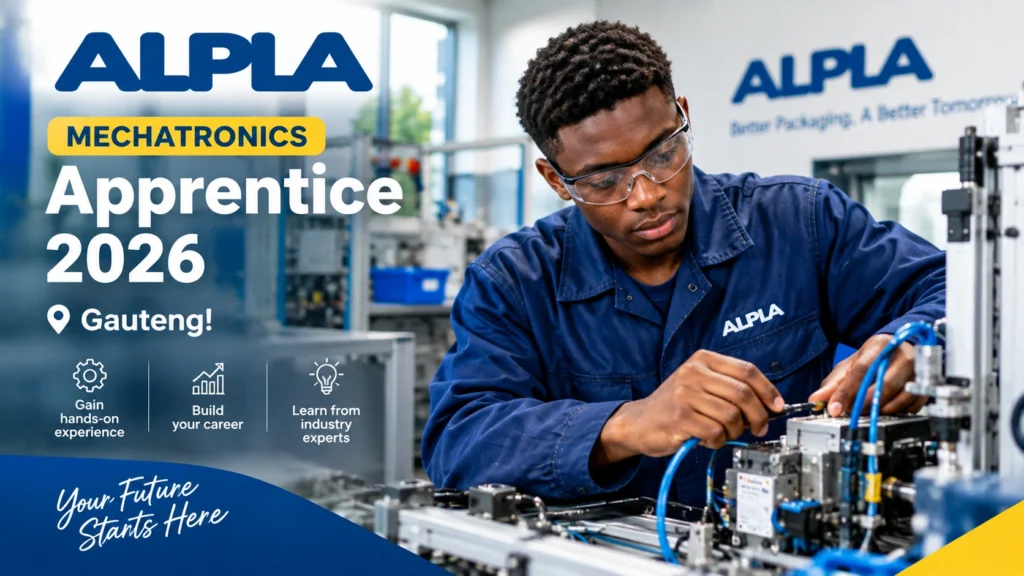

When a machine stops, bottles and containers stop moving, production targets are affected and technicians have to find the problem. Behind that process are skilled workers who understand mechanical equipment, electrical systems, sensors, automation and control technology.
That is the world a young apprentice can enter through the ALPLA Apprentice 2026 opportunity in Gauteng.
ALPLA Packaging is recruiting for a Mechatronics Apprenticeship Programme based at its Lanseria facility. According to the current vacancy information, the programme is designed to provide structured workplace training and practical experience, with successful candidates participating for a maximum period of 4.5 years.
For South Africans who have completed Matric and are interested in technical careers, this is more than an opportunity to add another qualification to a CV. It is a chance to learn inside a real manufacturing environment while developing skills that can be useful across industrial maintenance, automation and engineering-related careers.
The current vacancy lists a 31 October 2026 closing date, making preparation particularly important for applicants who still need to organise their documents.
Why the ALPLA Apprentice 2026 opportunity stands out
Mechatronics is sometimes difficult to explain to someone who has never worked around industrial machinery.
Put simply, it brings different technical disciplines together.
A mechatronics technician can work with mechanical components, electrical and electronic systems, pneumatic or hydraulic equipment, automation and control systems. ALPLA’s own apprenticeship information describes mechatronics as combining electrotechnical, pneumatic/hydraulic and mechanical components, with technicians involved in operating systems, programming and troubleshooting.
That combination is increasingly important in manufacturing.
Consider an automated packaging line. A problem that looks mechanical could actually be caused by a sensor. A machine that refuses to start could have an electrical or control-system fault. A conveyor that stops unexpectedly may require someone who understands both the physical equipment and the automated system controlling it.
This is why mechatronics training can be valuable.
The current South African ALPLA vacancy specifically requires Matric/Grade 12 with passes in Mathematics and Physical Science, states that Mathematics Literacy is not applicable, and requires minimum N3 Electrical Engineering studies. ALPLA says CVs accompanied by statements of results or certificates will be considered.
Those requirements immediately tell applicants something important: this is a technical apprenticeship, not a general workplace programme.
What you could learn
The programme can expose an apprentice to the type of technical thinking required in industrial manufacturing.
Depending on the training structure and workplace duties, this can include areas such as:
- Mechanical systems and industrial equipment
- Electrical principles
- Electronics
- Automation and control systems
- PLC-related technology
- Fault-finding and troubleshooting
- Preventative maintenance
- Safe use of tools and equipment
- Technical communication and documentation
The biggest benefit is the opportunity to connect theory with practical situations.
A textbook can explain how a motor works. A workplace teaches you what happens when that motor does not work and production is waiting.
That difference matters.
The four-and-a-half-year journey is part of the value
One of the easiest mistakes applicants make is looking at the length of an apprenticeship and thinking, “That is too long.”
A better question is: What can I become capable of during those years?
The ALPLA South African programme is structured for a maximum of 4.5 years.
Technical competence cannot be developed overnight. An apprentice needs time to learn concepts, practise procedures, understand equipment, work under supervision and gradually become more confident with increasingly complicated tasks.
ALPLA’s global apprenticeship material also describes apprenticeships as combining practical workplace experience with structured learning. The company’s international apprenticeship programme highlights troubleshooting, machine operation and the interaction between mechanical and electrotechnical systems.
For a young person entering manufacturing, this can provide something that many unemployed graduates struggle to obtain: actual workplace exposure.
You are not simply saying that you studied a technical subject.
You are building evidence that you have worked in a technical environment.
That distinction can become important when competing for future opportunities.
A useful career mindset
Do not enter an apprenticeship thinking only about the first job after completion.
Think about the skills that can remain useful for years.
An apprentice who becomes comfortable with fault-finding, maintenance, automation and industrial equipment can potentially build towards different technical career paths, depending on their qualifications, experience and future training.
The apprenticeship can therefore be viewed as a foundation rather than the final destination.
Who should apply for this opportunity?
The ALPLA opportunity is most appropriate for candidates who meet the stated academic and technical requirements and genuinely want to work with machinery and industrial technology.
The published requirements are important.
You should pay particular attention to:
- Matric/Grade 12
- Mathematics passed
- Physical Science passed
- Mathematics Literacy does not meet the stated requirement
- Minimum N3 Electrical Engineering studies
- Supporting certificates or statements of results
- Ability to meet the programme and workplace requirements
The vacancy also makes clear that ALPLA expects candidates to demonstrate behaviours aligned with its workplace identity, including reliability, problem-solving, decision-making and effective communication.
This gives applicants an important clue about what to emphasise in their CV.
Do not simply write, “I am hardworking.”
Show evidence.
If you repaired equipment at school, completed a technical project, worked with tools, participated in a practical engineering activity or solved a technical problem, explain it clearly.
For an apprenticeship, practical curiosity can be more meaningful than a CV filled with generic phrases.
How to apply for the ALPLA Apprentice 2026 opportunity
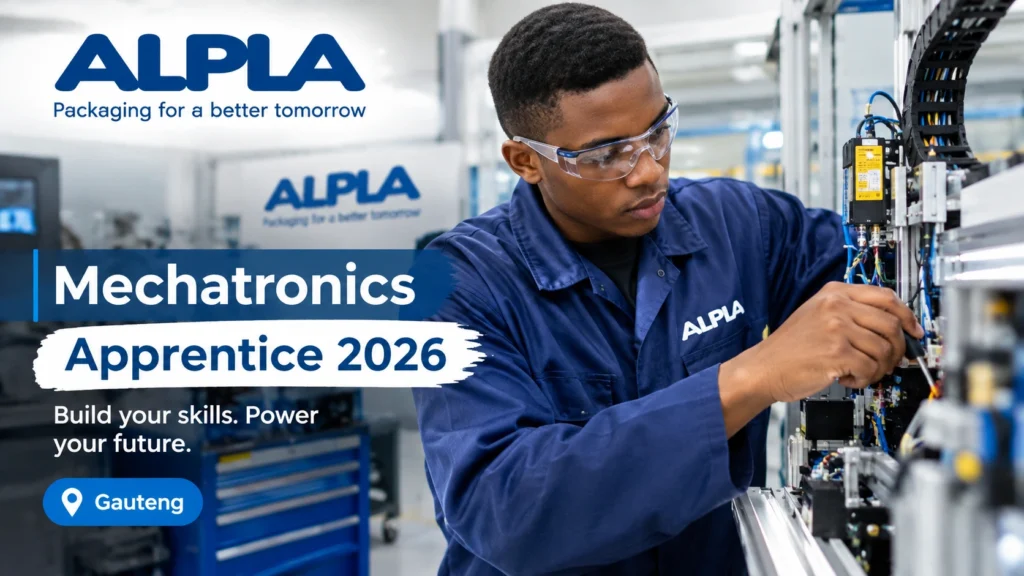
Applicants should follow the official application instructions attached to the current ALPLA vacancy. The opportunity is listed as a Mechatronics Apprenticeship Programme in Gauteng, with the successful candidates based at ALPLA Lanseria.
Step 1: Confirm that you qualify
Before submitting anything, compare your qualifications against the vacancy.
Do not apply assuming that Mathematics Literacy is acceptable when the advert specifically says it is not.
Also confirm that you have the required N3 Electrical Engineering studies.
This simple check can save you from submitting an application that does not meet the basic requirements.
Step 2: Prepare your supporting documents
Make sure your educational information is ready.
The vacancy states that CVs with statements of results or certificates will be considered.
Keep your documents clear and readable.
A useful application file should contain the documents specifically requested by the employer. Do not overload an application with irrelevant documents unless they are requested.
Step 3: Build a technical CV
Your CV should quickly answer three questions:
What have you studied?
List your relevant subjects and technical qualifications.
What can you do?
Mention practical skills, projects, technical exposure and computer skills that are genuinely relevant.
Why do you want this apprenticeship?
Your application should make it clear that you understand the nature of the opportunity.
For example, someone interested in machinery and automation should explain that interest rather than simply writing that they “need a job.”
Step 4: Check your contact details
This sounds basic, but it is important.
Use a professional email address and make sure your telephone number is correct. If an employer cannot reach you, a strong application can still go nowhere.
Check your CV for spelling errors before submitting it.
Step 5: Submit through the official recruitment process
Use the official ALPLA application route associated with the vacancy.
APPLY HERE: ALPLA Apprentice 2026
Do not pay a person claiming to have access to the ALPLA recruitment team. A legitimate job application should not require you to pay a “registration fee”, “processing fee” or “guaranteed placement fee.”
ALPLA maintains an official global careers platform where vacancies can be searched.
Step 6: Keep a record of your application
Save a copy of your CV and supporting documents.
Also record the position title and closing date.
The current vacancy states that applicants who do not receive a response within five days after the closing date can assume their application was unsuccessful.
ALSO APPLY FOR: Siemens Energy Apprentice 2026
Expert insight: the real advantage is not just the qualification
Technical-career insight: The strongest outcome of an apprenticeship is the combination of qualification, workplace discipline and problem-solving ability.
South Africa does not simply need people who have passed examinations. Manufacturing businesses need people who can diagnose problems, follow safety procedures, understand equipment and communicate effectively when something goes wrong.
That is why the ALPLA opportunity is interesting.
A person entering the programme is learning inside the environment where those skills are actually used.
There is also a longer-term shift taking place in manufacturing. Industrial systems are becoming more automated, meaning technicians increasingly need to understand the relationship between physical machinery and digital controls.
ALPLA’s international apprenticeship material reflects this multidisciplinary approach, describing mechatronics technicians as people who work across mechanical, electrical and automated systems and troubleshoot production equipment.
For a young South African entering the technical field, learning how these systems interact can create a stronger foundation than learning one narrow skill in isolation.
Common mistakes applicants should avoid
A good opportunity can be lost through a poor application.
Avoid these mistakes:
- Applying without checking the Mathematics and Physical Science requirements.
- Ignoring the N3 Electrical Engineering requirement.
- Sending a CV without relevant academic evidence.
- Using an unprofessional email address.
- Submitting an application with spelling and formatting errors.
- Copying a generic motivation that could have been written for any company.
- Paying someone who promises to secure the apprenticeship.
- Waiting until the final day to discover that documents are missing.
The current closing date is 31 October 2026, so applicants have an opportunity to prepare properly rather than rushing an incomplete application.
Frequently asked questions
1. Where is the ALPLA apprenticeship based?
The successful candidates will be based at ALPLA Lanseria in Gauteng.
2. What qualifications are required?
The current vacancy requires Matric/Grade 12 with passes in Mathematics and Physical Science, does not accept Mathematics Literacy as the stated mathematics requirement, and requires a minimum of N3 Electrical Engineering studies.
3. When does the ALPLA Apprentice 2026 application close?
The published closing date is 31 October 2026. Applicants who do not receive a response within five days after the closing date can assume their application was unsuccessful.
Final thoughts
For a young person standing at the beginning of a career, an apprenticeship can be easy to underestimate.
There is no glamorous shortcut. The learning happens gradually: understanding a component, making a mistake, correcting it, learning a procedure, asking questions, solving a fault and becoming more confident the next time.
That is precisely why the ALPLA Apprentice 2026 opportunity deserves attention.
It offers eligible candidates a route into a technical field where mechanical systems, electrical technology and automation meet. More importantly, it can help transform academic knowledge into practical workplace competence.
For applicants who meet the requirements, the smartest approach is not simply to send a CV and hope.
Read the requirements carefully. Prepare your documents. Build a focused technical CV. Apply through the correct channel. And understand what you are applying for.
The goal should not merely be to become an apprentice.
It should be to emerge from the programme as a more capable technician, problem-solver and professional than the person who walked through the door on day one.