
For many South African students and graduates, getting practical workplace experience can be surprisingly confusing. You may see an opportunity described as Work Integrated Learning (WIL), while another company advertises an internship, graduate programme or workplace experience opportunity.
At first glance, they may appear to be the same thing.
They are not always the same.
This creates an important problem. A student who needs workplace experience to complete a qualification could accept an opportunity that does not meet their institution’s WIL requirements. A graduate, meanwhile, might spend too much time searching specifically for WIL when they should be targeting graduate internships, trainee programmes and entry-level jobs.
Understanding WIL vs Internship Explained is therefore not just about knowing two definitions. It is about understanding which opportunity is appropriate for your current situation, what you should gain from it and how to make the experience useful for your future career.
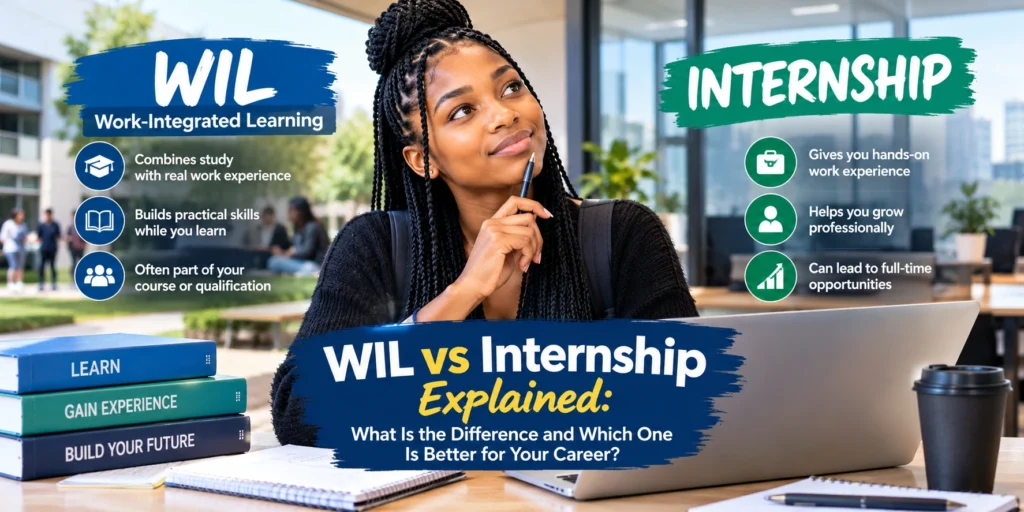
WIL vs Internship Explained: What Is WIL?
Work Integrated Learning (WIL) is a structured approach that gives students an opportunity to apply what they have learned in an educational environment to a real workplace.
Instead of learning only through lectures, assignments and examinations, students gain practical exposure to how their chosen field operates.
WIL can be particularly important for students studying qualifications that require practical workplace experience.
Depending on the qualification and institution, WIL may involve:
- Working for a company or organisation.
- Completing practical tasks related to your qualification.
- Being supervised by a workplace mentor or manager.
- Recording activities or learning outcomes.
- Completing reports or assessments.
- Receiving feedback on workplace performance.
- Meeting a specified number of hours or months of practical experience.
The exact requirements are not identical across South African institutions or qualifications.
That is why students should never assume that any job or internship automatically qualifies as WIL.
A simple example
Imagine a student studying Information Technology.
They may learn programming, databases and networking at college or university. During WIL, they could be placed in an organisation where they assist with:
- IT support;
- troubleshooting;
- system administration;
- database-related tasks;
- documentation; or
- software projects.
The purpose is to connect classroom knowledge with real workplace situations.
ALSO APPLY FOR: UBS Off-Cycle Intern 2027
ALSO APPLY FOR: SLR Consulting Corporate Intern 2026-2027
What Is an Internship?
An internship is a structured period of workplace experience intended to help someone develop professional skills and gain exposure to an industry.
Internships can target different groups depending on the programme.
Some are designed for:
- Current students;
- final-year students;
- recent graduates;
- unemployed graduates;
- TVET graduates; or
- people entering a particular profession.
Unlike WIL, an internship is not necessarily a formal requirement of your qualification.
An employer might create an internship because it wants to develop young talent, provide graduates with experience or build a future recruitment pipeline.
For example, a finance graduate could join an internship and gain experience in:
- financial reporting;
- reconciliations;
- data analysis;
- customer service;
- administration; or
- accounting systems.
The graduate finishes the programme with something more valuable than simply having “been an intern”: they have actual workplace examples to discuss during future interviews.
WIL vs Internship: The Difference at a Glance
| Feature | WIL | Internship |
|---|---|---|
| Main purpose | Connect academic learning with workplace practice | Develop professional experience and workplace skills |
| Typical participant | Current student | Student or graduate, depending on programme |
| Linked to qualification | Often yes | Not necessarily |
| Can be compulsory? | Sometimes | Usually not |
| Academic involvement | Often involved | Usually limited |
| Employer involvement | Important | Central |
| Assessment | May include institutional assessment | Usually employer/programme assessment |
| Payment | Depends on arrangement | Depends on employer/programme |
| Main outcome | Practical learning linked to studies | Workplace experience and employability |
| Can lead to permanent employment? | Sometimes | Sometimes |
| Automatically counts toward a qualification? | No — confirm requirements | No — confirm with institution |
The key distinction is this:
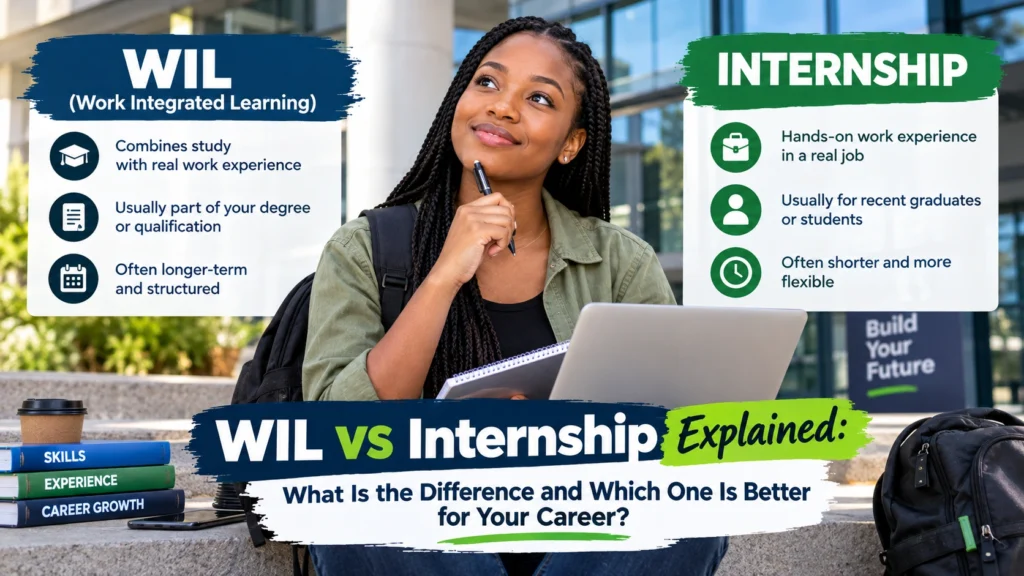
WIL is generally about integrating your studies with workplace learning, while an internship is generally about gaining structured professional experience.
There can be overlap, but the terms should not automatically be treated as interchangeable.
ALSO READ ABOUT: Before Accepting an Internship, Ask These Questions
Why This Issue Matters
Understanding the difference can save you time, money and frustration.
1. Your qualification may have specific requirements
Some students cannot simply choose any workplace.
Their institution may require:
- A specific number of hours;
- A particular type of employer;
- Certain workplace duties;
- An approved supervisor;
- Workplace reports;
- Assessment forms; or
- Proof of completion.
If you accept an opportunity without checking these requirements, you could discover later that the placement does not satisfy your academic needs.
2. Experience affects your employability
A qualification is important, but employers may also want evidence that you can function in a workplace.
Practical experience can demonstrate that you know how to:
- Communicate professionally;
- Meet deadlines;
- Work in a team;
- Solve problems;
- Follow procedures;
- Use workplace technology;
- Handle responsibility; and
- Apply theoretical knowledge.
3. The wrong opportunity can waste valuable time
Suppose you have already completed your qualification.
Searching exclusively for WIL opportunities may unnecessarily narrow your options.
You could instead be applying for:
- Graduate internships;
- Graduate programmes;
- Learnerships;
- Trainee programmes;
- Entry-level jobs;
- Workplace experience programmes; and
- Contract positions.
Knowing where you stand academically helps determine where to focus your search.
ALSO READ ABOUT: Low-Paying Learnership for the Experience
Which One Should You Choose?
There is no universal winner.
The better choice depends on what you need right now.
Choose WIL if you are a student who needs workplace learning
WIL should be your priority if your qualification requires practical workplace exposure.
Before accepting a placement, confirm:
- How many hours are required;
- Whether the employer must be approved;
- Whether the duties must relate directly to your qualification;
- Who will supervise you;
- What documents must be completed;
- Whether your institution recognises externally sourced placements.
Do not rely on the employer’s description alone.
Your institution decides whether a placement satisfies its academic requirements.
Consider an internship if you need professional experience
An internship can be especially useful when you are a recent graduate trying to enter the labour market.
It can help you answer an important interview question:
“What practical experience do you have?”
Instead of saying:
“I have a qualification but no workplace experience.”
you may eventually be able to explain:
“During my internship, I worked on customer queries, maintained records, used the company’s systems and assisted the team with daily operations.”
That gives an interviewer something concrete to evaluate.
A Practical Decision Guide
Use this quick test before applying.
If you are still studying:
Ask:
- Does my qualification require WIL?
- How much workplace experience do I need?
- Will this opportunity be recognised by my institution?
- Are the duties relevant to my qualification?
If the answer to the first question is yes, confirm the WIL requirements before accepting another type of placement.
If you have graduated:
Ask:
- Does the programme accept graduates?
- Will I develop skills relevant to my career?
- Does the employer provide training?
- Will I work on real projects?
- Can I build professional references?
- Is there a possibility of further employment?
This can help you determine whether an internship is worth pursuing.
ALSO READ ABOUT: Are Learnerships Worth It in 2026
How to Get More Value From Your WIL or Internship
Getting accepted is only the beginning.
Two people can complete the same programme and leave with completely different outcomes.
One may leave with a generic statement saying, “I completed an internship.”
The other may leave with:
- Several practical skills;
- A professional reference;
- Documented achievements;
- Industry contacts;
- Improved interview confidence;
- Examples of projects completed; and
- A much stronger CV.
Here is how to become the second person.
1. Set learning goals before you start
Identify skills you want to develop.
For example:
IT student
- Troubleshooting
- Networking
- Cloud computing
- Technical support
HR student
- Recruitment administration
- Employee records
- HR systems
- Interview coordination
Accounting student
- Reconciliations
- Excel
- Financial records
- Accounting software
This gives your placement direction.
2. Keep a workplace learning journal
Write down what you learn throughout the programme.
You can record:
- Tasks completed;
- New systems used;
- Problems solved;
- Training attended;
- Projects contributed to;
- Skills developed; and
- Feedback received.
This becomes extremely useful when updating your CV or preparing for interviews.
3. Turn duties into achievements
Do not simply copy your job description onto your CV.
For example:
Weak:
Assisted the HR department.
Stronger:
Assisted with employee record administration, interview scheduling and updating HR documentation.
The second version gives employers a much clearer picture of what you actually did.
4. Ask for feedback
Do not wait until the end of the programme.
Ask your supervisor:
- What am I doing well?
- What should I improve?
- Which skills should I develop?
- What could I do differently?
Constructive feedback can help you improve before the placement ends.
ALSO READ ABOUT: Things to Secure After Internship Completion
Best Practices Experts Recommend
Whether you are completing WIL or an internship, treat the opportunity like the beginning of your professional career.
Build these habits:
- Arrive on time.
- Dress appropriately for the workplace.
- Communicate professionally.
- Keep track of deadlines.
- Ask questions when instructions are unclear.
- Take notes during training.
- Volunteer for appropriate learning opportunities.
- Respect confidentiality.
- Keep your supervisor informed of progress.
- Build professional relationships.
- Ask for feedback.
- Keep evidence of legitimate achievements.
- Update your CV while the experience is still fresh.
Most importantly, don’t measure success only by the stipend.
A programme offering a slightly lower stipend could sometimes provide significantly better career-related experience than another opportunity offering more money but little relevant exposure.
The right question is:
“What will I be able to do after completing this programme that I could not do before?”
How to Evaluate an Opportunity Before Accepting It
Use this checklist.
| Question | Why it matters |
|---|---|
| Is the opportunity legitimate? | Protects you from scams |
| Am I eligible? | Prevents wasted applications |
| Is the work related to my field? | Builds relevant experience |
| Does my institution recognise it? | Important for WIL students |
| What skills will I learn? | Determines career value |
| Who will supervise me? | Good supervision improves learning |
| How long is the programme? | Helps with planning |
| Is there a stipend? | Helps you understand financial expectations |
| Where is the workplace? | Consider transport and accommodation |
| What documents are required? | Prevents application delays |
| Is there a possibility of further employment? | May create a pathway into the industry |
Mistakes People Often Make
Mistake 1: Thinking every internship counts as WIL
This is one of the biggest mistakes students can make.
An internship may provide excellent experience but still not satisfy your institution’s formal WIL requirements.
Always confirm first.
Mistake 2: Applying without checking eligibility
Some programmes are restricted to specific qualifications, academic years, institutions, age groups or locations.
Read the requirements carefully.
Mistake 3: Choosing based only on the company name
A famous company may look impressive on your CV, but what matters is also the work you actually perform.
A smaller organisation can sometimes provide excellent hands-on experience.
Mistake 4: Ignoring workplace relationships
Your supervisor and colleagues may become valuable professional contacts.
Be respectful and professional.
Mistake 5: Leaving with nothing to show for your experience
Keep track of your accomplishments throughout the programme.
Otherwise, months later you may struggle to remember exactly what you did.
Mistake 6: Paying for an opportunity
Be extremely cautious if someone claims you must pay a fee to secure a job, internship, learnership or workplace placement.
A demand for payment should be treated as a major warning sign.
Verify opportunities through official employer or institutional channels.
ALSO READ ABOUT: Why Thousands of South Africans Are Struggling to Find Internships
What If You Have No Workplace Experience?
Do not assume you have nothing to offer.
Your qualification may already have given you transferable skills.
You may have experience from:
- University projects;
- TVET practical assignments;
- Group projects;
- Volunteering;
- Student organisations;
- Freelance work;
- Community projects;
- Research assignments; or
- Part-time employment.
The goal is to connect those experiences to the job you want.
For example, a student who completed a group software project can discuss teamwork, planning, problem-solving and technical skills even before securing their first internship.
WIL and Internship Scam Warning
Students and graduates are often targeted by fake job and internship advertisements.
Before submitting documents, check:
- Is the opportunity published on an official employer website?
- Does the contact information match the organisation’s official details?
- Is the application process clearly explained?
- Is there a legitimate reference number?
- Are you being asked to pay money?
- Are you being pressured to send sensitive information through WhatsApp?
- Does the opportunity make unrealistic promises?
Never send banking passwords, PINs or other security credentials to someone claiming to be recruiting you.
For legitimate opportunities, start with the employer’s official careers page or your educational institution.
Frequently Asked Questions
Is WIL better than an internship?
Not necessarily. WIL may be better for a student who needs practical experience linked to a qualification, while an internship may be more useful for someone seeking broader professional exposure. Your circumstances determine which is more appropriate.
Can a graduate do WIL?
It depends on the institution and programme. WIL is generally associated with students completing qualifications, while graduate internships are often designed specifically for people who have completed their studies. Always check the specific programme requirements.
Can an internship help me get a permanent job?
Yes, it can. There is no guarantee, but an internship can help you build relevant experience, demonstrate your abilities and develop professional relationships that may support future employment.
Should I accept an unpaid internship or WIL placement?
Consider the complete picture. Check whether the opportunity is legitimate, whether it provides meaningful learning, how long it lasts, the costs involved in travelling to the workplace and whether it meets your academic requirements if you need WIL.
Final Advice: Don’t Just Complete the Programme — Build Your Career
The debate around WIL vs Internship Explained should not be about finding one option that is automatically “better.”
The real question is:
Which opportunity gives you the experience you need at this stage of your education or career?
If you are a student and WIL is required for your qualification, start by understanding your institution’s requirements. Do not assume that an internship automatically qualifies.
If you are a graduate, broaden your search. Look beyond WIL and consider internships, graduate programmes, learnerships, trainee opportunities and entry-level positions.
And when you finally get a placement, don’t treat it as something you simply need to finish.
Use it to build:
- Practical skills;
- Professional confidence;
- Industry knowledge;
- References;
- Career contacts;
- Interview examples; and
- Evidence for your CV.
Your first workplace experience does not have to be perfect. It needs to move you forward.
Before accepting your next opportunity, ask three questions:
- Will this experience help me meet my academic or career goal?
- Will I learn skills that employers value?
- Will I be able to explain what I achieved when I apply for my next opportunity?
If you can answer yes to all three, you are not simply gaining workplace experience — you are building your pathway into employment.