

For many young graduates in South Africa, the most frustrating part of finishing a qualification is not passing the final exam. It is what comes afterwards.
You have the certificate. You have spent years studying. You may even have built a respectable CV through projects, assignments and volunteer work. Yet when employers ask for “workplace experience”, you suddenly find yourself caught in a familiar cycle: you need experience to get a job, but you need a job to get experience.
That is where graduate internships can make a meaningful difference.
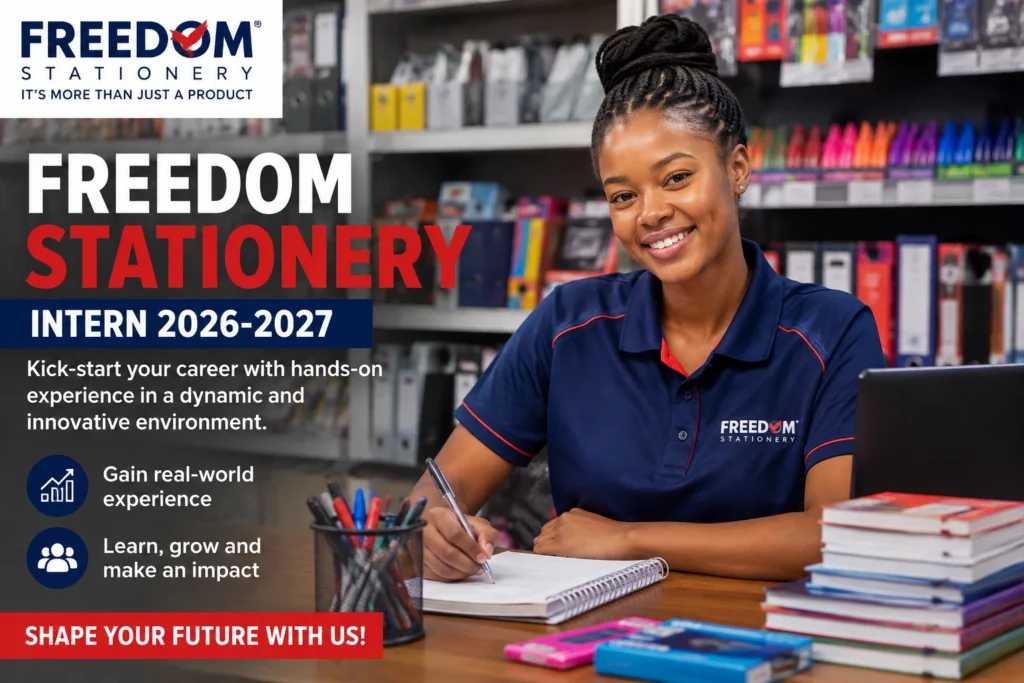
The Freedom Stationery Intern 2026-2027 opportunity is aimed at unemployed South African graduates who want to move from academic learning into a real working environment. Rather than simply adding another certificate to a CV, an internship can introduce a graduate to workplace systems, professional expectations, deadlines, teamwork and the practical problems businesses deal with every day.
Freedom Stationery has established itself as a familiar name in South African homes, schools, offices and retail environments. Behind the products consumers see on shelves, however, is a much larger operation involving manufacturing, supply, administration, logistics, sales, finance and other business functions.
For an intern, that broader environment can be just as valuable as the qualification they already hold.
Why a Freedom Stationery internship can matter after graduation
Imagine a graduate arriving at work on their first Monday morning.
At university or college, they were assessed on whether they understood a particular subject. In the workplace, the question changes. Can they communicate with colleagues? Can they follow a process? Can they work accurately when several tasks arrive at once? Can they use company systems? Can they ask sensible questions when they do not understand something?
These are difficult skills to learn entirely from textbooks.
This is one reason workplace-based programmes remain important in South Africa. The transition between education and employment is not always straightforward, particularly for young people who have qualifications but limited formal work experience.
Freedom Stationery’s graduate internship programme is designed around that transition. The programme provides unemployed graduates with exposure to the working world while offering mentorship and skills development.
That distinction is important.
An internship should not be viewed simply as “something to put on your CV”. The real value lies in learning how an organisation functions and demonstrating that you can contribute within that environment.
For a graduate, even relatively ordinary workplace responsibilities can become valuable evidence of employability.
Learning how to prepare a professional report, communicate with another department, maintain accurate records, work with internal systems or meet a deadline may sound basic. But those are precisely the practical habits employers often expect from someone entering the workplace.
The company behind the opportunity
Freedom Stationery is associated with the manufacturing and supply of stationery products used across South Africa. Its operations extend across important economic regions, including KwaZulu-Natal, Gauteng and the Western Cape.
That geographic footprint gives the internship context that is easy to overlook.
A graduate joining a company involved in physical products can potentially see how different parts of a business connect. A product has to be sourced or manufactured, managed, stored, distributed and ultimately supplied to customers. Behind that process are people working across numerous business functions.
This means an intern’s experience is not necessarily limited to one narrow task.
Depending on the specific position and department, workplace exposure can help graduates understand how administration, customer service, finance, operations, supply chains and other functions interact.
For someone entering employment for the first time, that broader understanding can be surprisingly valuable.
What You Will Gain from the Freedom Stationery Internship
An internship is most valuable when you leave with something more than a line on your CV. The Freedom Stationery graduate programme can give successful candidates an opportunity to build practical skills while learning how a professional business operates.
For a graduate who has never held a formal full-time position, this experience can make the transition into employment much easier.
1. Practical workplace experience
One of the biggest advantages is the opportunity to move beyond classroom theory and experience real workplace processes.
You may learn how tasks are allocated, how departments communicate, how information is recorded and how deadlines are managed. This exposure helps graduates understand the expectations that come with working in a professional environment.
2. Mentorship and guidance
The programme includes mentorship, which can be particularly useful for graduates entering the workplace for the first time.
Having experienced colleagues around you can help you understand professional standards, workplace communication and how to approach unfamiliar responsibilities. Good mentorship can also help identify areas where you need further development.
3. Industry-related systems and processes
Modern employers expect new employees to be comfortable learning technology and business systems.
Through workplace exposure, interns can develop familiarity with systems and processes used in a professional environment. Even when a particular system is specific to the company, the ability to learn new tools quickly is a transferable skill that can benefit you when applying for future jobs.
4. Stronger communication skills
Workplace communication is different from communicating with classmates.
You may need to write professional emails, participate in meetings, communicate with colleagues from different departments or explain information clearly to a supervisor.
These everyday interactions can gradually build confidence and professionalism.
5. Better understanding of how businesses operate
Freedom Stationery operates within a broader manufacturing and supply environment. This gives interns an opportunity to see that a company is not made up of isolated departments.
Sales, administration, finance, manufacturing, logistics, customer service and other functions can depend on one another.
Understanding these connections can help a graduate develop a more realistic picture of how organisations work.
6. A stronger CV
Completing meaningful workplace experience can strengthen your CV because you can describe what you actually did rather than simply listing your qualification.
For example, instead of saying that you are “a good team player”, you may eventually be able to explain how you worked with colleagues to complete a specific task or support a departmental objective.
That distinction can make your future applications more credible.
7. Greater confidence in future interviews
Internship experience can also give you real examples to discuss during interviews.
Recruiters frequently ask questions such as:
“Tell us about a time you worked under pressure.”
“How did you handle a mistake?”
“Describe a situation where you had to work with other people.”
Workplace experience gives you genuine situations from which to construct your answers.
How to Apply for the Freedom Stationery Intern 2026-2027 Opportunity
Step 1: Find the vacancy
The company’s official recruitment channels or the recruitment platform
APPLY HERE: Freedom Stationery Intern 2026-2027
Before preparing your application, check the eligibility criteria.
Pay particular attention to:
- Citizenship requirements.
- Qualification requirements.
- Whether graduates must be unemployed.
- Required field of study.
- Location of the position.
- Any required documents.
- Application closing date.
- The specific method of submitting your application.
If you do not meet a mandatory requirement, applying anyway is unlikely to improve your chances.
Step 3: Prepare an updated CV
Your CV should be clear, accurate and easy to read.
Include your:
- Full name and contact details.
- Education and qualification.
- Institution attended.
- Relevant skills.
- Academic or practical projects.
- Previous work experience, if applicable.
- Volunteer or leadership experience where relevant.
Do not inflate your experience. A simple, truthful CV is more useful than a CV filled with skills you cannot demonstrate.
Step 4: Prepare supporting documents
Check the vacancy carefully to determine which documents are requested.
Where applicable, have electronic copies of your relevant qualification documents and other requested supporting information ready before starting the online application.
Make sure your documents are readable and use sensible file names.
For example:
Firstname_Surname_CV.pdf
is considerably easier to identify than:
document123.pdf
Step 5: Complete the application form
Enter your information carefully.
Do not rush through sections simply because they appear straightforward. A mistake in your contact details could create an unnecessary problem if the recruitment team needs to contact you.
Double-check your phone number and email address before submitting.
Step 6: Tailor your application to the opportunity
Where the application provides an opportunity to describe your skills or motivation, explain why the internship is relevant to your career plans.
A strong answer should connect three things:
your qualification → your skills → the opportunity
For example, if your studies developed your analytical, administrative, financial, technical or communication abilities, explain how those abilities could be useful in a workplace environment.
Avoid copying generic statements such as “I have always wanted to work for a leading company” without explaining what you hope to learn and contribute.
Step 7: Review everything before submitting
Before clicking the final submit button, check:
- Is your CV attached?
- Are the requested documents included?
- Is your contact information correct?
- Does your qualification match the requirements?
- Have you answered all mandatory questions?
- Is the application being submitted through the correct channel?
Only submit once you are satisfied that the information is accurate.
ALSO APPLY FOR: Cross-Border Road Intern 2026-2027
What Makes a Strong Internship Applicant?
A graduate does not need to have an extraordinary career history to be considered for an internship.
What matters is demonstrating potential.
Recruiters are likely to value candidates who can show that they are:
Willing to learn: You do not need to know everything before entering an internship. You do need to be willing to learn.
Reliable: Employers need people who arrive on time, complete tasks and take responsibility.
Adaptable: Workplace priorities can change. The ability to adjust without losing focus is valuable.
Professional: Communication, attitude and respect for colleagues matter from the first day.
Curious: Asking thoughtful questions can help you learn faster and understand why a process exists.
Accurate: Small errors can have consequences, particularly in administration, finance, customer service and operational environments.
The strongest candidate is not necessarily the person with the longest CV. It can be the person who demonstrates the clearest willingness to learn and contribute.
Important Safety Check Before Applying
Job seekers should also protect themselves from recruitment scams.
A legitimate internship application should not require you to pay someone to secure your position.
Be cautious if someone:
- Requests money in exchange for an interview or appointment.
- Asks for banking details unnecessarily during the early application stage.
- Guarantees that you will be hired.
- Contacts you from an unofficial account and refuses to provide verifiable recruitment information.
- Pressures you to make an immediate payment.
- Sends you suspicious links or documents.
When in doubt, return to the original company’s recruitment information and verify the vacancy independently.
Your qualification, CV and personal information are valuable. Do not hand them over simply because someone claims to represent a company.
Common mistakes applicants should avoid
Internship applicants sometimes undermine otherwise good applications through preventable errors.
Avoid:
- Applying without checking whether your qualification matches the vacancy.
- Sending a CV containing inaccurate information.
- Ignoring the specified application process.
- Using an unprofessional email address.
- Submitting incomplete documents.
- Assuming an internship guarantees permanent employment.
- Paying someone who promises to “secure” the position.
- Waiting until the final hours before applying.
The last point is particularly practical. Online application systems can experience technical problems, and documents may take time to prepare. Applying early gives you room to correct an error.
Frequently asked questions
Is the Freedom Stationery internship suitable for unemployed graduates?
Yes. The graduate internship programme is intended to provide unemployed South African graduates with workplace exposure, mentorship and skills development. Applicants should still check the requirements of the specific vacancy before applying.
Where are Freedom Stationery opportunities available?
Freedom Stationery has operations and career opportunities associated with KwaZulu-Natal, Gauteng and the Western Cape. The exact location depends on the individual vacancy, so applicants should confirm the location before applying.
Does completing the internship guarantee a permanent job?
No. An internship should not be treated as a guaranteed route into permanent employment. Its value is in developing practical experience, workplace skills and evidence that can strengthen your future applications.
The bigger picture for South African graduates
The importance of opportunities such as the Freedom Stationery Intern 2026-2027 programme extends beyond one company.
South Africa’s graduate employment challenge is partly about the difficult transition from education into practical work. A graduate may possess knowledge but still need to learn how that knowledge operates inside a business.
That is why workplace exposure matters.
A successful internship can change the way a young professional approaches future employment. The graduate begins to understand workplace expectations, becomes more confident communicating with colleagues and gains examples they can discuss during future interviews.