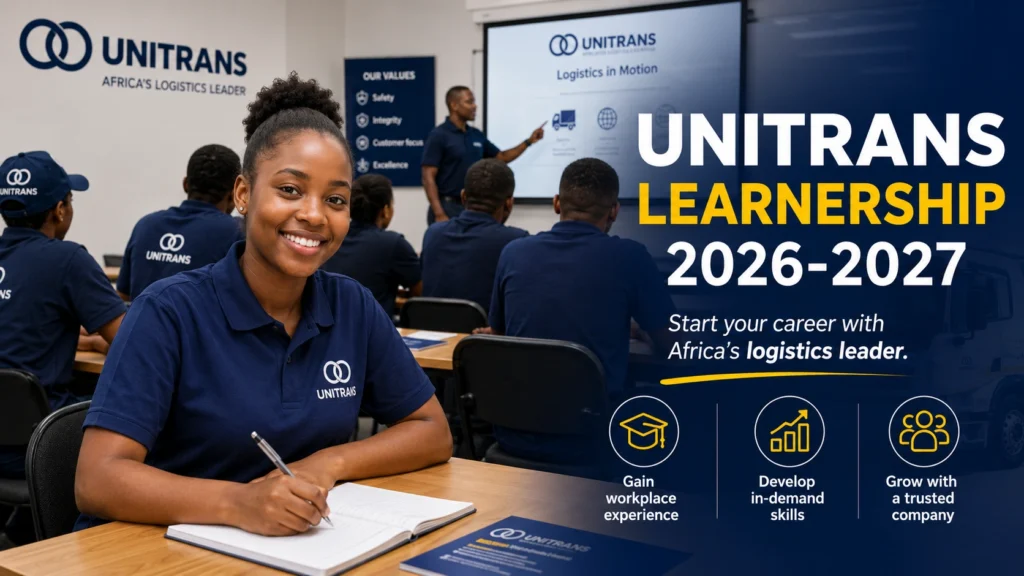

Finding a job without experience is difficult, but finding a transport-sector opportunity can be even harder when employers expect applicants to already have the right driving licence, professional permit and practical skills. For unemployed South African youth who already hold the necessary truck-driving credentials, however, the Unitrans Learnership 2026-2027 provides a potentially valuable route into professional driving and logistics.
The opportunity is aimed at unemployed South African youth and leads to an Occupational Certificate: Truck Driver at NQF Level 3. The programme combines classroom learning, workplace training and practical driving experience rather than simply placing candidates behind the wheel. The advertised locations include KwaZulu-Natal, Cape Town and Gauteng, while the programme is described as a temporary learnership lasting approximately 12 to 18 months.
But there is an important detail applicants should not overlook: this is not an entry-level driving opportunity for someone who only has a Code B licence. The advertised requirements include a valid Code EC driver’s licence and PrDP, together with Grade 12/National Certificate and other requirements.
There is also a deadline discrepancy worth highlighting. The information supplied for this article states 7 September 2026, while the latest available vacancy listings for reference UNI260817-8 state 28 August 2026. Because the latter date has already passed, prospective applicants should check whether the vacancy has been extended or remains available on the official recruitment system before spending time preparing an application.
Unitrans Learnership 2026-2027 at a Glance
| Detail | Information |
|---|---|
| Company | Unitrans |
| Opportunity | Truck Driver Learnership |
| Reference | UNI260817-8 |
| Qualification | Occupational Certificate: Truck Driver |
| NQF Level | Level 3 |
| Duration | Approximately 12–18 months |
| Type | Temporary learnership |
| Locations | KwaZulu-Natal, Cape Town and Gauteng |
| Minimum education | Grade 12 / National Certificate |
| Licence | Valid Code EC |
| PrDP | Required |
| Practical training | At least 100 driving hours reported in the vacancy information |
| Stipend | Not confirmed in the vacancy information |
| Permanent job after completion | Not guaranteed |
| Reference number | UNI260817-8 |
The programme information indicates that learners must complete practical workplace training, including a minimum of 100 practical driving hours before progressing towards assessment.
What Is the Unitrans Truck Driver Learnership?
A learnership is different from simply applying for a truck-driver vacancy.
Instead of expecting a candidate to arrive as a fully experienced professional, a structured learnership combines theoretical education with workplace-based learning. In this case, the objective is to develop candidates towards the Occupational Certificate: Truck Driver at NQF Level 3.
The programme is particularly relevant to people who want professional driving to become a long-term career rather than simply looking for temporary work.
The training information associated with the opportunity includes:
- Classroom-based learning
- Workplace training
- Supervised practical driving
- Road-safety practices
- Efficient vehicle operation
- Exposure to modern vehicle technology
- Telematics and onboard systems
- Practical driving hours
- Competency assessment
- External assessment requirements
This is important because modern truck driving involves considerably more than steering a vehicle from one destination to another.
Drivers increasingly interact with electronic systems, vehicle monitoring technology, fleet-management processes and safety procedures.
What could you actually learn?
A successful learner may gain exposure to:
Professional driving: Understanding how to operate heavy vehicles safely in a commercial environment.
Road safety: Applying defensive and responsible driving principles.
Vehicle technology: Becoming comfortable with computerised trucks, telematics and onboard systems.
Operational discipline: Understanding schedules, vehicle checks and workplace procedures.
Customer service: Professional drivers represent their employer when interacting with customers, depots and other road users.
Energy-efficient driving: Learning driving practices that can contribute to more efficient vehicle operation.
That combination can make the opportunity more useful than simply gaining additional time behind the wheel.
Why This Issue Matters
South Africa’s logistics industry depends heavily on people who can move goods safely between suppliers, warehouses, businesses and customers.
For an unemployed young person, entering this industry can also be challenging because professional driving requires specific licences, permits, training and experience. Simply possessing a matric certificate is not enough for a professional truck-driving position.
That is why a structured opportunity such as the Unitrans Truck Driver Learnership can matter.
It gives qualifying candidates a pathway to combine formal learning with workplace exposure.
However, applicants should approach the opportunity realistically.
A learnership is not automatically a permanent job. It is also not an instant route to a high salary. The value lies in developing recognised skills, practical experience and occupational competence that may improve future employability.
The transport industry is also becoming increasingly technology-driven. The ability to operate modern trucks while understanding telematics and onboard systems can therefore become an important part of a professional driver’s skill set.
Who Qualifies for the Unitrans Learnership?
The available vacancy information indicates that applicants should meet several requirements.
You should carefully check that you have:
- South African citizenship
- Unemployed status
- Grade 12 / Matric or National Certificate
- A valid Code EC driver’s licence
- The required Professional Driving Permit
- Medical fitness for professional driving
- Availability for compulsory face-to-face training
- Willingness to work shifts
- Willingness to work weekends and public holidays
- Ability to complete the full learnership programme
The vacancy information identifies PrDP categories D, G and P as part of the requirement.
One important point: do not assume that having any heavy-vehicle licence automatically makes you eligible. Check the exact licence and PrDP requirements before applying.
The available information also does not establish a specific age range, so applicants should avoid assuming that an age restriction exists unless it appears on the live vacancy.
Who Should Apply?
This opportunity is best suited to someone who genuinely wants to build a career in professional driving.
You may be a strong fit if you:
- Enjoy driving and working around vehicles.
- Take road safety seriously.
- Can remain calm under pressure.
- Are reliable and punctual.
- Are comfortable working independently.
- Can communicate professionally.
- Are prepared to work shifts.
- Are willing to learn technology.
- Want to develop within transport and logistics.
- Already meet the professional licensing requirements.
It may not be suitable for someone who dislikes irregular working hours, cannot attend face-to-face training or is only interested in an immediate permanent position.
How Competitive Is the Opportunity?
Competition level: High.
There are several reasons.
First, professional truck-driving opportunities attract applicants from across multiple provinces. Secondly, the opportunity combines training with workplace exposure, making it attractive to unemployed candidates seeking industry experience.
Most importantly, the eligibility requirements significantly narrow the applicant pool. Someone who already has the required Code EC licence and PrDP has completed an important step that many job seekers have not.
That means your application should make it easy for the recruiter to establish that you meet the requirements.

How to Apply for the Unitrans Learnership Step by Step
If the vacancy remains open or has been extended, use the following process.
Step 1: Confirm the vacancy is still active
Before preparing your application, check the official Unitrans recruitment platform.
APPLY HERE: Unitrans Learnership 2026-2027
Step 2: Check your licence
Make sure your Code EC licence is valid.
Then check your PrDP carefully.
Do not wait until the application stage to discover that your documents do not meet the advertised requirements.
Step 3: Prepare your documents
The vacancy information indicates that applicants should prepare certified copies of documents including:
- South African ID
- Matric certificate
- Code EC driver’s licence
- PrDP
- Other relevant qualifications, where applicable
Available application guidance states that certifications should not be older than three months.
Step 4: Update your CV
Your CV should be short, accurate and focused on the opportunity.
Include:
- Full name and contact details
- Matric qualification
- Driver’s licence information
- PrDP information
- Driving experience
- Previous employment
- Relevant training
- Safety-related experience
- Transport or logistics exposure
- References, where appropriate
Do not exaggerate your driving experience.
Step 5: Create or access your candidate profile
Follow the recruitment portal’s instructions to register or sign into your candidate account.
Use an email address and telephone number that you check regularly.
Step 7: Complete every field carefully
Enter your personal information exactly as it appears on your official documents.
Pay particular attention to:
- ID number
- Contact details
- Education
- Licence details
- PrDP information
- Employment history
ALSO APPLY FOR: Dis-Chem Learnerships 2026-2027
Best Practices Experts Recommend
1. Apply with evidence, not just enthusiasm
Saying that you “love trucks” is not enough.
Show the recruiter that you already meet the practical requirements.
2. Make your licence information obvious
Because the opportunity is specifically for professional truck driving, your licence and PrDP information should be easy to find on your CV.
3. Demonstrate safety awareness
Professional driving is a safety-critical occupation.
Highlight relevant experience that demonstrates responsibility, discipline and attention to safety.
4. Prepare before applying
Do not start searching for your Matric certificate and licence documents five minutes before the deadline.
Have everything ready first.
5. Be honest
Never claim to have experience, qualifications or permits that you do not possess.
False information can damage your application and potentially create serious consequences later.
Mistakes People Often Make
Several mistakes can weaken an otherwise suitable application.
Applying with the wrong licence: A Code B licence is not a substitute for the advertised Code EC requirement.
Ignoring the PrDP requirement: Having a heavy-vehicle licence alone does not necessarily satisfy the professional-driving requirement.
Submitting old certification: Check the certification dates before uploading documents.
Using a generic CV: Your CV should clearly show your driving credentials.
Ignoring shift requirements: Professional driving may require flexibility around working hours.
Assuming a stipend: The available vacancy information does not confirm a stipend amount. Do not publish or rely on an unofficial figure.
Assuming permanent employment is guaranteed: Completing a learnership does not automatically mean receiving a permanent Unitrans position.
Waiting until the last day: Recruitment portals can experience technical problems, and missing documents may take time to correct.
Safety and Scam Warning
Job seekers should be particularly careful when applying for driving opportunities.
A legitimate recruitment process should not require you to pay someone to “secure” a learnership.
Be suspicious if somebody:
- Promises guaranteed selection.
- Requests money for an interview.
- Requests payment for placement.
- Asks for your banking PIN.
- Requests an OTP.
- Tells you to send documents to an unknown WhatsApp number.
- Claims they can bypass the normal recruitment process.
Use the official Unitrans recruitment process and verify suspicious communication independently.
Frequently Asked Questions
1. What qualification does the Unitrans Learnership offer?
The programme leads to an Occupational Certificate: Truck Driver at NQF Level 3, subject to successful completion of the required training and assessments
2. Do I need a Code EC licence?
Yes. The available vacancy information specifies a valid Code EC driver’s licence, together with the required PrDP.
3. How long is the learnership?
The opportunity is described as approximately 12 to 18 months, combining classroom, workplace and practical training.
4. Is permanent employment guaranteed after completion?
No. Applicants should not assume that completing the learnership guarantees permanent employment unless Unitrans specifically confirms this.
Final Assessment
For an unemployed South African who already has the required Code EC licence, PrDP and Grade 12 qualification, the Unitrans Truck Driver Learnership is potentially a strong career-development opportunity.
Its biggest advantage is the combination of formal occupational training, practical driving experience and workplace exposure. The programme also reflects the changing nature of the logistics industry by introducing learners to technology, telematics and modern fleet systems.
However, applicants should approach it with realistic expectations. It is a temporary learnership, not a guaranteed permanent job, and the available vacancy information does not confirm a stipend amount.
Most importantly, verify the closing date before applying. The supplied information says 7 September 2026, but the latest available listings for reference UNI260817-8 state 28 August 2026. Because 28 August has passed as of 31 August 2026, the live recruitment portal should be treated as the final authority on whether applications are still being accepted.
If the vacancy has been extended, prepare your documents, confirm your licence and PrDP, update your CV and submit through the official recruitment channel as soon as possible.
Practical takeaway: don’t apply simply because you want to become a truck driver. Apply because you have checked the requirements, prepared the evidence and understand what the 12–18-month training commitment involves.