

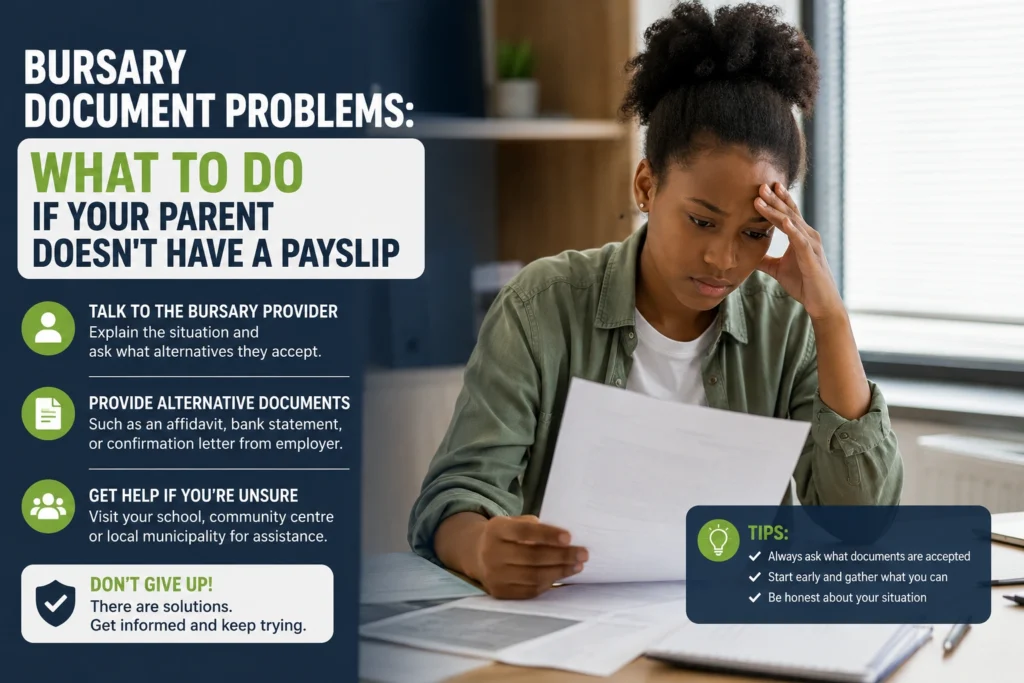
Bursary Document Problems: One of the most stressful parts of applying for a bursary is reaching the document-upload section and discovering that your parent or guardian does not have a payslip.
Perhaps your mother is unemployed. Maybe your father works for himself, earns cash from informal work, receives a social grant, does casual jobs, or is paid without receiving a formal salary slip. You may then see a bursary requirement asking for a “parent’s latest payslip” and wonder: Will my application be rejected because I cannot provide one?
Not necessarily.
The important thing is to understand that a payslip is normally requested as evidence of income, not because every South African household has a formal employer-issued payslip. When a payslip genuinely does not exist, your responsibility is to provide another legitimate way of explaining the parent’s financial circumstances — but only if that alternative is accepted by the particular bursary provider.
This is where many applicants make mistakes. Some upload the wrong document, some leave the requirement unexplained, while others are tempted to create or edit a payslip. The last option is particularly dangerous.
This guide explains exactly what to do, depending on your parent’s situation, what alternative documents may be useful, how to deal with an application portal that insists on a payslip, and how to make your financial documentation stronger and more credible.
First: Why Does the Bursary Want a Payslip?
Before looking for a replacement document, understand what the bursary provider is trying to establish.
Many bursaries use household income as part of their financial-need assessment. The provider wants to understand the resources available to the household and whether the student meets its financial criteria.
A payslip can provide evidence of:
- The parent’s employer
- Employment status
- Gross salary
- Net salary
- Deductions
- Pay frequency
- The date of payment
- The employee’s identity
But a payslip only works when someone is formally employed and receives one.
If your parent is unemployed, self-employed or working informally, asking for a payslip may not accurately reflect their circumstances.
The real question is therefore not “Where can I find a payslip?” but “How can I legitimately prove or explain my parent’s income situation?”
That distinction can prevent you from submitting the wrong paperwork.
ALSO APPLY FOR: Bowmans Bursary 2027
ALSO APPLY FOR: SANZAF SEED Bursary 2027
Why This Issue Matters
A missing financial document can affect an otherwise strong bursary application.
A student may have:
- Good academic results
- The correct qualification
- The required age
- South African citizenship
- Proof of registration
- A strong motivation
…but the application can still become problematic if the financial documents are incomplete or contradictory.
This matters because bursary administrators need enough information to assess applicants consistently.
For example, imagine two applications.
Applicant A states that their parent is unemployed and provides an appropriate supporting declaration explaining the situation.
Applicant B also states that the parent is unemployed but uploads an old payslip showing a substantial salary without explaining why the parent is no longer employed.
Applicant B’s documents create questions that Applicant A’s documents may not.
Your financial documentation should therefore tell a clear and believable story about your household.
What Should You Submit If There Is No Payslip?
There is no single document that automatically replaces a payslip for every bursary.
The correct alternative depends on why the payslip is unavailable.
| Parent’s situation | Possible supporting evidence | What you should do |
|---|---|---|
| Unemployed | Affidavit/declaration confirming unemployment, where accepted | Explain that there is no current employment income |
| Self-employed | Affidavit, business records, bank statements or other accepted evidence | Explain that income is generated independently |
| Informal worker | Affidavit and other evidence of earnings, if requested | Describe the type of work and irregular income |
| Paid in cash | Employer letter or other accepted proof | Ask employer for written income confirmation |
| Social grant recipient | Official grant-related documentation | Submit the relevant proof requested |
| Recently retrenched | Last payslip plus termination/retrenchment evidence, where relevant | Explain that the old salary is no longer current |
| Casual worker | Income declaration and supporting evidence where available | Explain that earnings fluctuate |
| Pensioner | Pension documentation or other accepted proof | Follow the funder’s specific requirements |
| No income whatsoever | Appropriate affidavit/declaration, where accepted | Clearly state that there is no current income |
Important: This table is a practical guide, not a universal rule. A bursary provider may require a specific document or its own affidavit template. Always follow the instructions of the organisation offering the bursary.
1. If Your Parent Is Unemployed
This is one of the most common situations.
If your parent does not currently work and therefore has no salary, they cannot provide a current payslip.
Depending on the bursary’s requirements, an affidavit or declaration confirming unemployment may be appropriate.
The document should clearly explain:
- The parent’s full name
- Their relationship to the student
- Their current employment status
- That they do not receive a regular salary
- Any relevant income source, if applicable
- The date of the declaration
Do not simply write “No payslip.”
The bursary administrator needs to understand why there is no payslip.
If your parent receives another form of income, that should also be declared accurately.
2. If Your Parent Is Self-Employed
Being self-employed does not mean having no income.
A parent could operate:
- A small retail business
- A food business
- A transport business
- A farming operation
- A repair service
- A beauty business
- A construction service
- A freelance business
Such a person may have income without receiving an employer-generated payslip.
Depending on the bursary requirements, supporting evidence could include:
- An affidavit declaring income
- Business records
- Bank statements
- Invoices
- Receipts
- Tax documentation, where applicable
- Business registration documentation, where relevant
The biggest mistake here is inventing a monthly salary simply because the form has a box labelled “monthly income.”
If income varies, explain that it varies.
For example, a self-employed person might earn R4,000 in one month and R7,000 in another. A bursary provider may need an honest explanation of the household’s actual circumstances rather than a manufactured fixed salary.
3. If Your Parent Works Informally
Informal employment is another reason a conventional payslip may not exist.
A parent could earn money by:
- Selling goods
- Doing domestic work
- Gardening
- Construction work
- Hairdressing
- Catering
- Agricultural work
- Driving
- Performing occasional services
If there is no formal employer or payroll system, ask the bursary provider what evidence it accepts.
An affidavit or declaration may be appropriate in some cases.
Where other records exist, they may also help establish the financial circumstances.
The key principle is:
Do not confuse “no payslip” with “no income.”
A person can have income without having a payslip.
ALSO READ ABOUT: 7 Bursary Application Mistakes
4. If Your Parent Is Paid in Cash
Cash payment creates a documentation problem, but there may still be a solution.
If your parent works for an identifiable employer, ask whether the employer can provide an employment or income confirmation letter.
Where accepted, it could state:
- Employee’s full name
- Position
- Employer’s name
- Employment start date
- Approximate earnings
- Payment arrangement
- Employer contact details
- Date and signature
However, do not assume that this letter automatically replaces a payslip.
Ask the bursary provider first.
If the employer refuses to provide a letter, explain the situation to the bursary administrator and ask what alternative evidence is acceptable.
5. If Your Parent Receives a Social Grant
A social grant is not the same as employment income, so there may be no payslip.
Instead of trying to obtain a salary slip that does not exist, look for the official documentation that demonstrates the grant income.
The exact document required can differ between bursaries.
When completing the application, make sure the income information matches the supporting documentation.
6. If Your Parent Recently Lost Their Job
This situation requires particular attention.
Suppose your parent worked until recently and still has their final payslip.
That document may show income that is no longer being received.
Do not simply upload the old payslip and leave the bursary provider to assume the parent is still employed.
Where appropriate, provide:
- The latest available payslip
- Proof or confirmation that employment ended, if available
- An affidavit or explanation if requested
- Other relevant financial documentation
The important issue is to distinguish previous income from current household income.
ALSO READ ABOUT: Corporate Bursaries in South Africa
The “Document Story” Test
Here’s a simple way to check whether your financial documents make sense.
Imagine you are the bursary administrator looking at your application.
Ask:
“If I knew nothing about this family, would these documents allow me to understand their financial situation?”
For example:
Declaration: Parent is unemployed.
Supporting evidence: Appropriate unemployment declaration.
Application: Parent’s current income stated as R0.
That tells a consistent story.
But:
Declaration: Parent is unemployed.
Supporting document: Recent payslip showing a monthly salary.
Application: Parent’s income stated as R0.
That creates a contradiction.
Before submitting your application, perform this check across every financial document.
ALSO READ ABOUT: Bursary Backup Plan
What If the Bursary Portal Only Accepts a Payslip?
This is one of the most frustrating problems.
You may reach the upload section and see:
“Upload parent’s latest payslip.”
There may be no obvious option for an affidavit.
Do not immediately upload an unrelated document.
Instead, follow these steps.
Step 1: Check the entire application
Look for:
- Additional documents
- Supporting documents
- Other
- Financial information
- Affidavit
- Comments
- Declaration
There may be another place where supporting evidence can be uploaded.
Step 2: Read the bursary’s FAQ
The provider may already explain what unemployed or self-employed applicants should submit.
Step 3: Contact the bursary provider
Use the official email address, telephone number or application contact details supplied by the provider.
Ask a precise question:
“My parent is not formally employed and therefore does not receive a payslip. What document should I upload as proof of household income?”
Step 4: Follow the response exactly
If they tell you to submit an affidavit, do that.
If they provide a template, use their template.
If they instruct you to upload a particular alternative, follow that instruction.
Step 5: Keep proof of communication
Save:
- Emails
- Reference numbers
- Screenshots of instructions
- Submitted documents
This can be useful if there is later a question about why a conventional payslip was not included.
ALSO READ ABOUT: Low-Paying Learnership for the Experience
A Practical Document Checklist
Before submitting a bursary application, create a folder containing:
Identity documents
- Applicant’s ID
- Parent/guardian ID where required
- Other identity documents requested by the provider
Academic documents
- Latest academic results
- Matric certificate or statement of results
- Proof of registration, if required
- Admission or acceptance letter where applicable
Financial documents
- Parent’s payslip, if available
- Alternative proof of income where accepted
- Affidavit/declaration where required
- Grant or pension documentation where applicable
- Other household-income evidence requested by the provider
Application documents
- Completed application form
- Motivation letter, if required
- Consent/declaration forms
- Any bursary-specific forms
Do not upload everything you have simply because you have it. Upload the documents the provider asks for and relevant supporting evidence.
Best Practices Experts Recommend
A strong bursary application is about accuracy, consistency and completeness.
1. Start collecting documents before the closing date
Do not wait until the final evening to discover that a parent needs to sign an affidavit.
2. Ask questions early
If the application instructions are unclear, contact the bursary provider while there is still time to correct the problem.
3. Use the provider’s template where one exists
If a bursary supplies a specific declaration or affidavit template, use it rather than creating your own version.
4. Make your scans readable
Check every page before uploading.
A document should not have:
- Cropped names
- Missing signatures
- Blurry text
- Cut-off dates
- Hidden pages
5. Keep information consistent
Check names, income figures and employment status across the entire application.
6. Never falsify financial information
Your family’s circumstances should be represented honestly, even if they do not fit neatly into the application form.
7. Keep copies after submitting
Create a folder containing the final application and all supporting documents.
This makes future follow-up much easier.
Mistakes People Often Make
Mistake 1: Creating a fake payslip
Never do this.
A fake document is not a legitimate solution to a missing-document problem.
Mistake 2: Uploading a random bank statement
A bank statement might contain useful financial information, but it does not automatically become an acceptable substitute for a payslip.
Only use it when the bursary provider accepts it or requests it.
Mistake 3: Declaring R0 when the parent actually earns money
Unemployment and irregular income are different situations.
If the parent earns money from casual or informal work, do not automatically describe them as having no income.
Mistake 4: Uploading an old payslip without explaining it
If employment ended, an old payslip could be misleading without context.
Mistake 5: Waiting until the closing date
If an affidavit is required, you may need time to arrange it.
Start early.
Mistake 6: Assuming one bursary’s rules apply everywhere
Different funders have different requirements.
Always read the instructions for the bursary you are applying for.
ALSO READ ABOUT: Bursaries vs Student Loans
A 10-Minute Final Check Before You Submit
Before clicking the final submission button, check:
Identity
- Names match across documents.
- ID copies are readable.
Income
- Parent’s actual employment status is correctly stated.
- Income figures are truthful.
- Alternative evidence has been included where required.
Documents
- Every mandatory document has been uploaded.
- No pages are missing.
- Files open correctly.
- Documents are readable.
Consistency
- The application does not contradict the supporting documents.
- Recent changes in employment or income have been explained where necessary.
Submission
- The application has actually been submitted.
- Confirmation has been saved.
- Copies of documents have been retained.
ALSO READ ABOUT: Write a Winning Bursary Application
Frequently Asked Questions
1. Can I apply for a bursary if my parent has no payslip?
Yes. A parent not having a payslip does not automatically mean you cannot apply. The important question is what the bursary provider accepts as evidence of the parent’s financial circumstances.
2. Is an affidavit always accepted instead of a payslip?
No. An affidavit may be accepted in certain circumstances, but requirements differ between bursaries. Check the specific provider’s instructions before submitting one.
3. What if my parent is unemployed and has no income?
Explain the situation honestly. Where required or accepted, an affidavit or unemployment declaration can help establish that the parent has no current employment income.
4. What if my parent is self-employed?
Do not create a payslip. Ask the bursary provider which evidence it accepts for self-employed applicants. Depending on the provider, this may involve an affidavit, business records, bank statements or other financial evidence.
The Bottom Line
A missing payslip does not have to derail your bursary application.
The solution is to stop thinking of the payslip as the objective and start thinking about proof of the family’s actual financial circumstances.
If your parent is unemployed, document the unemployment. If they are self-employed, explain the self-employment and provide accepted evidence. If they work informally, explain how they earn money. If they recently lost their job, make the change in income clear.
Most importantly, never manufacture a payslip.
When the application instructions do not clearly explain what to do, contact the bursary provider before submitting an unsuitable document. A few minutes spent asking the correct question can save you from an incomplete or misleading application.
Your strongest approach is simple:
Tell the truth. Provide relevant evidence. Explain unusual circumstances. Follow the specific bursary’s instructions. Keep copies of everything.
That is how you turn a potentially confusing document problem into a manageable part of the bursary application process.