
For a recent graduate, the first year after university can feel strangely quiet. You have the qualification, the completed assignments and perhaps a CV that looks respectable on paper, but employers keep asking for the one thing many graduates do not yet have: experience.
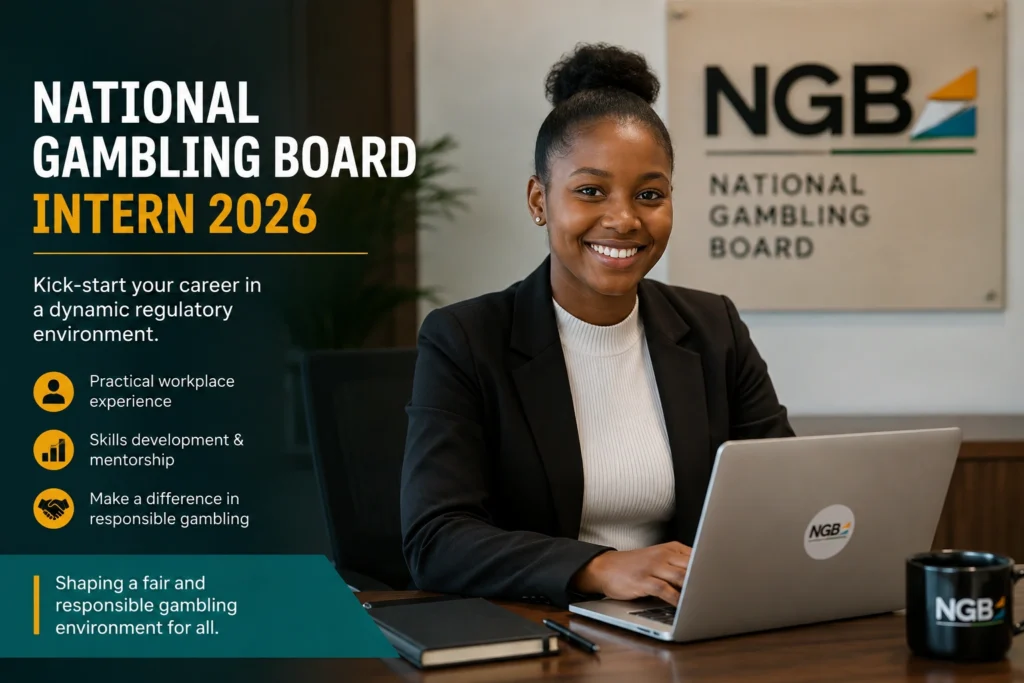
That is what makes the National Gambling Board Intern 2026 opportunity worth examining closely. The National Gambling Board of South Africa is inviting unemployed graduates to apply for two 12-month internship opportunities in Pretoria: Legal Services and Marketing and Communications.
According to the opportunity information, each successful intern will receive a R12,000 monthly stipend, with applications closing on 21 August 2026. The positions are contract appointments and are described as non-renewable.
The opportunity is particularly relevant for graduates who want exposure to the public-sector environment rather than simply adding another short course to their CV. The NGB is a national public entity responsible for important aspects of gambling regulation and coordination in South Africa, making these internships more specialised than a generic graduate placement.
What makes the National Gambling Board Intern 2026 opportunity different?
At first glance, an internship at a regulatory organisation might sound narrower than an opportunity at a large commercial company. In practice, it can expose a graduate to an unusual combination of law, public policy, communications, governance, stakeholder engagement and regulatory work.
The National Gambling Board is established under the National Gambling Act, 2004 (Act 7 of 2004) and operates as a Schedule 3A public entity under the Public Finance Management Act. Its role includes coordinating aspects of gambling regulation and establishing uniform norms and standards in areas where national and provincial responsibilities overlap.
That background matters when considering these internships.
A Legal Services intern, for example, is not simply entering an office to perform routine administration. The NGB says its Legal Services function provides corporate legal services including legal opinions, legal advice, legislative drafting, litigation, and drafting and vetting contracts. It also has responsibilities around records management and ensuring that the organisation operates within the law.
The Marketing and Communications side has a similarly practical setting. The NGB’s work involves public education, awareness and engagement around gambling-related issues. In 2026, the organisation has continued to place emphasis on responsible gambling awareness and combating illegal gambling, including the launch of a portal allowing members of the public to identify verified licensed gambling operators.
For a graduate, that creates a valuable learning environment: communication is not merely about promoting a product, while legal work is connected to an active regulatory mandate.
The two internships at a glance
The advertised opportunities are:
- Legal Services Internship – NGB-7: one position for a graduate with a Bachelor’s Degree in Law or an LLB.
- Marketing and Communications Internship – NGB-8: one position for a graduate with a three-year National Diploma or Bachelor’s Degree in Marketing Communications, Public Relations or Journalism.
Both opportunities are based in Pretoria, run for 12 months, and offer a reported R12,000 monthly stipend.
The closing date is 21 August 2026.
Because there are only two positions in total, applicants should not treat this as an opportunity where meeting the minimum qualification automatically means an interview.
National Gambling Board Intern 2026: what graduates should understand about the roles
The strongest applicants will probably be those who understand what their chosen department actually does.
For the Legal Services internship, the qualification requirement is relatively straightforward: applicants need a Bachelor’s Degree in Law or an LLB.
But the more interesting question is what a graduate can learn from such an environment.
Public-sector legal work often requires an understanding of legislation, governance, contracts, institutional procedures and regulatory responsibilities. The NGB’s own description of Legal Services shows that the department deals with legal opinions, advice, legislative drafting, litigation and contracts.
That means an applicant should not present themselves merely as someone who “likes law”. A stronger application would demonstrate attention to detail, legal research ability, written communication and an interest in how legislation affects an organisation’s everyday decisions.
For the Marketing and Communications internship, the qualification requirement is a three-year National Diploma or Bachelor’s Degree in Marketing Communications, Public Relations or Journalism.
This role is particularly interesting because communications within a regulatory institution has a public-interest dimension.
The NGB’s corporate services and research functions include broad public education and awareness programmes. Its strategic work also involves stakeholder engagement and communication around the social and economic consequences associated with gambling.
A communications graduate could therefore encounter work involving public information, stakeholder communication, campaigns, written material and organisational messaging.
That distinction should influence how applicants prepare their CVs.
A Journalism graduate, for instance, could highlight research, writing, interviewing and editing experience. A Public Relations graduate might emphasise stakeholder engagement, event support and communication planning. A Marketing Communications graduate could draw attention to campaign development, digital communication and audience analysis.
The point is not to exaggerate experience. It is to make existing academic and practical experience relevant to the department.
Why this opportunity matters in South Africa’s current gambling environment
The timing of these internships is worth noting.
Gambling regulation in South Africa is not an abstract administrative issue. The sector sits at the intersection of entertainment, technology, consumer protection, taxation, economic activity and social responsibility.
Online gambling has also made the regulatory environment more complicated. In June and July 2026, the NGB published information concerning efforts to detect and prevent illicit gambling activities online, including monitoring and blocking solutions for illegal gambling websites.
The organisation also launched a verified gambling operators portal in April 2026, intended to help the public identify legal and licensed gambling operators.
For graduates, this is important context. The work taking place inside the NGB is connected to real changes in how South Africans encounter gambling, particularly through digital platforms.
Expert-style insight: The biggest value of these internships may be the intersection between a graduate’s academic discipline and public-sector responsibility. A law graduate learns how legal principles operate inside a regulator, while a communications graduate learns how public information must be accurate, responsible and understandable. That kind of exposure can be more useful in the long term than simply having another organisation’s name on a CV.
There is also a broader lesson here. Regulatory organisations increasingly need graduates who can understand both technical information and the public consequences of institutional decisions. Legal, communications, research and technology skills are becoming interconnected.

Who should seriously consider applying?
The opportunity is best suited to graduates who want more than a temporary income source.
A strong candidate should be comfortable working in a structured organisation, dealing with deadlines and learning from experienced professionals. The applicant should also be prepared for a public-sector environment where documentation, compliance and accuracy matter.
For the Legal Services position, applicants should think about whether they genuinely want exposure to regulatory and corporate legal work.
For Marketing and Communications, applicants should consider whether they enjoy writing, public communication, stakeholder interaction and turning complicated subjects into information that ordinary members of the public can understand.
The stipend of R12,000 per month is certainly relevant to unemployed graduates, but it should not be the only reason to apply. The more valuable question is whether the 12-month placement can move you closer to the career you want.
APPLY HERE: National Gambling Board Intern 2026
ALSO APPLY FOR: Amazon Internship 2027
How to prepare an application that does not look generic
With only one position advertised in each discipline, small details can matter.
Start by tailoring your CV to the internship rather than sending the same document you use for every application. Put the relevant qualification and skills where they can be found quickly.
For Legal Services, emphasise relevant academic modules, legal research, drafting, moot court participation, university legal clinics or other legitimate experience.
For Marketing and Communications, highlight writing, editing, communications projects, campaigns, social media work, journalism assignments, public relations projects or other relevant portfolio work.
Do not invent employment experience. University projects can demonstrate useful skills when they are described clearly.
It is also worth checking every document before submitting. An incorrect qualification title, missing attachment or poorly named document can create unnecessary problems.
Most importantly, use the official NGB recruitment route. The NGB’s career page states that recruitment and selection processes are aligned with its employment equity policy and relevant labour legislation. Its current vacancies page directs applicants to the organisation’s advertised recruitment opportunities.
The NGB has previously required internship applicants to submit supporting documents such as a comprehensive CV, academic records, certified qualification copies or a letter of completion, and a certified identity document. Because document requirements can vary between advertisements, applicants should check the current vacancy instructions carefully before submission.
A sensible final check is:
- Confirm that your qualification matches the exact internship.
- Use the correct reference number: NGB-7 for Legal Services or NGB-8 for Marketing and Communications.
- Check that your CV contains accurate contact details.
- Attach every document requested in the current advertisement.
- Submit before 21 August 2026, rather than waiting until the final hours.
A 12-month internship can be more valuable than it looks
It is easy to look at an internship simply as a line between university and permanent employment. That misses part of the point.
A year inside an organisation can teach graduates how meetings work, how documents move through approval processes, how managers communicate, how regulatory decisions are supported and how professional standards are maintained.
Those lessons are difficult to learn from a classroom alone.
For a Legal Services intern, exposure to regulatory and corporate legal processes could help clarify whether the graduate wants to pursue public-sector law, compliance, governance or another legal specialisation.
For a Marketing and Communications intern, working within a public institution could provide experience that translates into communications agencies, government departments, NGOs, corporate communications teams and other stakeholder-focused environments.
The fact that the contract is non-renewable should also be viewed realistically. This is not a promise of permanent employment at the end of 12 months. Instead, applicants should approach it as a defined opportunity to build evidence of professional competence.
That mindset changes how an intern should use the placement. Arriving on time is not enough. The goal should be to leave with stronger writing, better professional judgement, practical examples of work and credible references where possible.
Frequently asked questions
1. What is the closing date for the National Gambling Board Intern 2026 programme?
The stated application closing date is 21 August 2026. Applicants should submit before the deadline and verify the current vacancy instructions on the official NGB recruitment platform.
2. How much does the NGB internship pay?
The internship information states a monthly stipend of R12,000 for successful interns.
3. Which qualifications are required?
The Legal Services internship requires a Bachelor’s Degree in Law or LLB. The Marketing and Communications internship requires a three-year National Diploma or Bachelor’s Degree in Marketing Communications, Public Relations or Journalism.
Final assessment
The National Gambling Board Intern 2026 programme is a relatively focused opportunity, but that is precisely why eligible graduates should pay attention to it.
There are only two advertised opportunities: one in Legal Services and one in Marketing and Communications. That makes the competition potentially strong, but it also makes the opportunity clearly defined. Applicants know what qualifications are being sought, where the internships are based, how long the contracts run and what stipend is offered.
More importantly, the work sits inside an organisation dealing with issues that are increasingly relevant to South Africa’s digital and regulatory landscape. The NGB’s recent focus on responsible gambling, licensed operators and illegal online gambling demonstrates that its mandate continues to evolve alongside the industry.
For an unemployed graduate in Law, Journalism, Public Relations or Marketing Communications, the decision should therefore go beyond asking, “How much is the stipend?”
The better question is: What could I learn in these 12 months that would make me more employable afterwards?
For the right graduate, the answer could be substantial. A year of structured experience in a national regulatory institution can provide practical knowledge, professional discipline and a clearer understanding of how an academic qualification works in the real world.