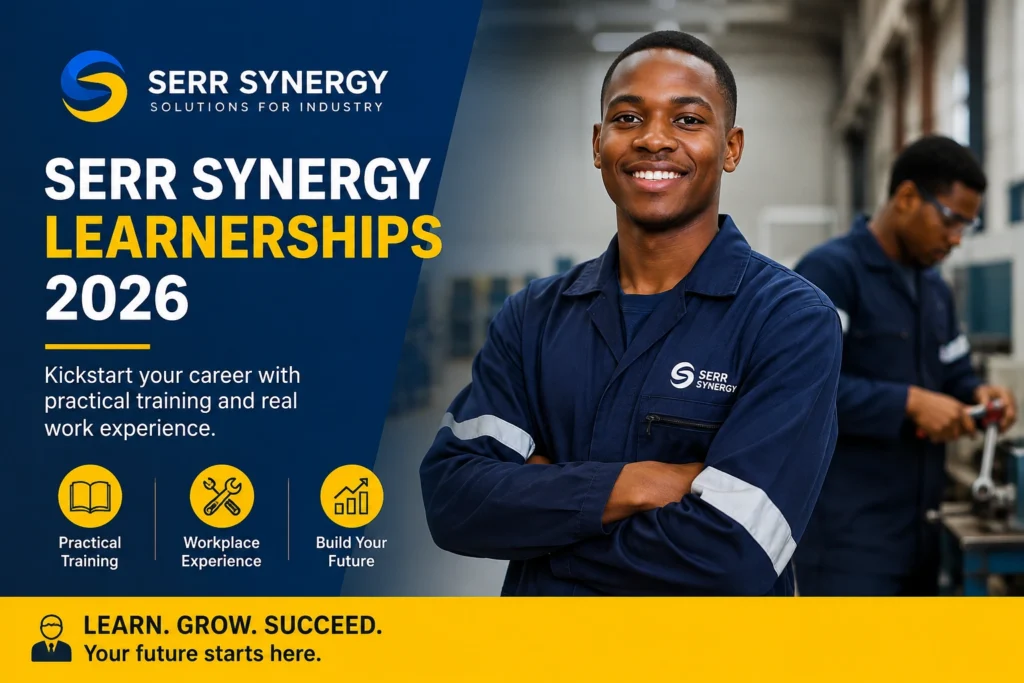

Finding a learnership in South Africa can be frustrating. Many opportunities shared online look promising, but applicants often discover that the advertised programme is actually a short skills course, an employer-specific intake, or an old training listing rather than a currently open learner vacancy.
That is an important distinction when researching SERR Synergy Learnerships 2026.
SERR Synergy has a broad training portfolio covering areas such as business administration, management, information technology, supply chain management, transport, freight handling, retail and workplace development. Its published training material includes both accredited learnership qualifications and non-accredited or shorter skills-development programmes.
However, applicants should not interpret programme counts or qualification lists as proof that every programme currently has an open intake. Availability can depend on employer arrangements, workplace requirements, funding and the specific qualification being offered.
This guide explains how the SERR Synergy training model works, which career fields are represented, what applicants should check before applying, and how to avoid common mistakes.
What Are SERR Synergy Learnerships 2026?
SERR Synergy is a South African business services and skills-development organisation that provides training alongside services related to skills development, B-BBEE compliance, labour matters and workplace development.
Its training portfolio includes industry-specific and generic learnerships, as well as accredited and non-accredited courses. Published SERR Synergy training schedules show qualifications linked to several SETAs and occupational areas.
Examples from its published material include:
- Business Administration Services
- Information Technology: End User Computing
- Information Technology: Technical Support
- Systems Development
- Generic Management
- Supply Chain Management
- Project Management
- Retail
- Transport
- Freight Handling
- Production-related occupations
- Occupational Health and Safety
- Marketing
- Artificial Intelligence Software Development
The exact portfolio can change as qualifications, accreditation arrangements and training needs change, so applicants should verify the current programme directly with SERR Synergy rather than relying exclusively on an old brochure.
Why This Issue Matters
The biggest misunderstanding surrounding SERR Synergy Learnerships 2026 is the assumption that every qualification listed online represents a job vacancy that anyone can immediately apply for.
It does not.
SERR Synergy’s published training documents are designed around skills-development services, including programmes that businesses can use to train their employees or meet workplace skills requirements. Its materials therefore contain qualification information that does not necessarily correspond to a public youth recruitment campaign.
This matters because a learner may see a qualification such as Systems Development or Business Administration and assume applications are currently open.
The more reliable approach is to ask three questions:
- Is this qualification currently being offered?
- Is there an active learner intake?
- What are the employer, workplace and qualification requirements?
Only after those questions have been answered should you treat the programme as an application opportunity.
Which Career Fields Are Covered?
One of the strengths of the SERR Synergy portfolio is its variety.
Business Administration and Management
Business-focused qualifications include programmes such as National Certificate: Business Administration Services, National Certificate: Management, Further Education and Training Certificate: Generic Management and Further Education and Training Certificate: Business Administration Services.
These pathways may suit candidates interested in:
- Office administration
- Customer service
- General business operations
- Team supervision
- Management support
- Workplace communication
- Organisational administration
For someone who wants an office-based career, a business administration qualification can provide a useful foundation.
Information Technology
Technology is another significant area.
Published SERR Synergy material lists qualifications including Information Technology: End User Computing, Technical Support, Systems Support and Systems Development.
These are not identical career paths.
End User Computing is more closely connected to everyday digital workplace competence, while Technical Support and Systems Support can move candidates towards troubleshooting, user assistance and IT environments.
Systems Development is more technical and can appeal to learners interested in software and application development.
SERR Synergy also highlights Fourth Industrial Revolution skills in its wider training portfolio, reflecting the increasing importance of digital capabilities in South African workplaces.
Logistics, Transport and Supply Chain
Applicants interested in logistics can also find relevant programmes within the published portfolio.
These include areas such as Supply Chain Management, Transport, Freight Handling and related operational qualifications. A later SERR Synergy training schedule also lists qualifications such as Supply Chain Practitioner, Supply and Distribution Manager, Truck Driver and Freight Handler.
This makes the portfolio relevant to careers involving:
- Warehousing
- Distribution
- Transport operations
- Freight movement
- Stock and inventory
- Supply-chain coordination
The entry requirement can vary considerably between qualifications, so candidates should never assume that a Grade 12 certificate automatically qualifies them for every logistics programme.
What Qualifications Do You Need?
There is no universal entry requirement for all SERR Synergy programmes.
Requirements depend on the qualification and its NQF level.
For example, SERR Synergy’s published training material has listed some NQF Level 2 programmes with Grade 10 requirements, while certain NQF Level 3 programmes have required Grade 11 and some NQF Level 4 qualifications have required Grade 12. Higher-level programmes may require tertiary education.
Examples from the published schedule include:
- Business Administration Services — Grade 10
- Information Technology: End User Computing — Grade 11
- Generic Management — Grade 12
- Technical Support — Grade 12
- Systems Development — Grade 12
- Some NQF Level 5 programmes — tertiary education
These requirements should be treated as qualification-specific rather than as a single SERR Synergy rule.
How Do the Learnerships Work?
A learnership is designed to connect structured learning with workplace development.
For learners, that can be valuable because classroom knowledge alone does not always provide enough preparation for employment.
A well-structured learnership can expose participants to practical workplace expectations while they work towards a qualification.
SERR Synergy also provides training to businesses as part of broader workplace skills-development strategies. Its skills-development services cover learnerships, accredited training and other learning programmes.
This explains why some SERR Synergy programmes may be employer-driven rather than advertised as conventional public vacancies.
How Long Are the Programmes?
The supplied information describes SERR Synergy’s generic and industry-specific learnerships as programmes that can run for approximately 12 months.
However, applicants should confirm the duration of the particular intake before making plans.
The duration, start date, delivery method and workplace arrangements can depend on the qualification and participating employer.
Do not assume that every programme has the same timetable simply because it appears in the same training catalogue.
Step-by-Step: How to Find a Suitable SERR Synergy Opportunity
Step 1: Choose your career direction
Start with the occupation you want rather than simply searching for the word “learnership”.
If you enjoy computers, investigate IT-related qualifications.
If you prefer office work, consider business administration or management.
If you are interested in logistics, investigate supply chain, transport and freight-related options.
APPLY HERE: SERR Synergy Learnerships 2026
Step 2: Check the NQF level
The NQF level gives you an indication of the qualification’s position within the South African qualifications framework.
Do not apply for a programme simply because the subject sounds interesting. First confirm that your educational background meets its entry requirement.
Step 3: Confirm whether it is an actual intake
This is the most important step.
A qualification appearing in a SERR Synergy brochure does not automatically mean applications are open.
Look for an official intake notice, employer-supported opportunity or direct confirmation from SERR Synergy.
Step 4: Check the workplace requirement
A learnership normally involves more than studying.
Find out where practical learning will take place, who the participating employer is and whether you need to be employed or placed before the programme starts.
Step 5: Prepare your documents
Keep commonly requested documents ready, including:
- Updated CV
- South African ID
- Matric certificate or latest school results
- Relevant tertiary qualification, where applicable
- Proof of residence if requested
- Other certificates relevant to the programme
Only submit documents through a legitimate application channel.
Step 6: Ask about the stipend
Do not assume there is a universal SERR Synergy stipend.
The supplied programme information does not establish one standard monthly allowance for every programme. Any allowance, salary or learner support should be confirmed for the specific intake.
Step 7: Confirm the closing date
There is also no single closing date covering every SERR Synergy training programme.
If an advertisement gives a closing date, verify that it belongs to the specific opportunity you intend to pursue.
ALSO APPLY FOR: Foster-Melliar Learnerships 2026
Best Practices Experts Recommend
The smartest approach is to treat SERR Synergy’s training catalogue as a career-planning resource, not a vacancy list.
First, identify a qualification that matches your career objective. Second, verify the NQF and entry requirements. Third, establish whether a current intake exists.
Candidates should also keep their CV focused. An applicant interested in IT support should highlight computer skills, technical coursework, troubleshooting experience and relevant projects rather than submitting a generic CV containing unrelated information.
Another useful strategy is to research the SETA connected to the qualification. SERR Synergy’s published schedules show programmes linked to different SETAs, including MICTSETA, Services SETA, TETA, MERSETA and QCTO occupational qualifications.
This can help candidates understand the occupational environment surrounding the programme.
Finally, do not confuse SERR Synergy’s YES Programme with a learnership. SERR Synergy explicitly states that YES is not a learnership, internship or apprenticeship.
Are All the Listed Programmes Learnerships?
No.
This is another important point.
SERR Synergy’s wider training portfolio includes accredited learnerships as well as accredited and non-accredited skills-development programmes.
Its published material describes training in areas including administration, leadership, customer service, financial skills, communication, teamwork, conflict resolution, workplace safety, digital skills and Fourth Industrial Revolution capabilities.
A short workplace skills course is therefore not necessarily equivalent to a full learnership leading to an occupational or national qualification.
Applicants should always identify the type of programme, qualification, NQF level, accrediting body and duration before enrolling.
Mistakes People Often Make
Mistake 1: Assuming every listed programme is open
A training catalogue can contain qualifications that are available to employers rather than an active public intake.
Mistake 2: Treating programme numbers as vacancies
Numbers attached to training schedules should not automatically be interpreted as the number of available learner positions.
Mistake 3: Ignoring the NQF requirement
A qualification may sound perfect but still be unsuitable because the applicant does not meet its academic requirements.
Mistake 4: Expecting a universal stipend
There is no reliable basis for assuming every SERR Synergy learner receives the same monthly amount.
Mistake 5: Paying an unofficial “application fee”
Be cautious if someone asks you to transfer money to secure a learner position. Verify the opportunity through official SERR Synergy channels before providing personal information or making any payment.
Mistake 6: Confusing training with employment
Completing a qualification can improve your skills, but it does not automatically guarantee permanent employment.
Frequently Asked Questions
1. Are SERR Synergy Learnerships 2026 open to everyone?
No. Eligibility depends on the specific qualification, intake and workplace arrangement. Some programmes have lower entry requirements, while others require Grade 12 or tertiary education.
2. Does SERR Synergy offer IT learnerships?
Yes. Published training material includes IT pathways such as End User Computing, Technical Support, Systems Support and Systems Development.
3. Are there logistics-related programmes?
Yes. The portfolio includes supply chain, transport and freight-related programmes, although the qualification and entry requirements differ between options.
4. Does every SERR Synergy learnership pay a stipend?
Not necessarily. Applicants should confirm the financial arrangements for the specific intake rather than relying on a generic stipend figure.
Final Summary
SERR Synergy Learnerships 2026 can be worth investigating for South Africans looking for structured skills development across business, IT, management, logistics, transport and other occupational areas.
The most important lesson, however, is to distinguish between a qualification listed in a training catalogue and an active learner vacancy.
SERR Synergy’s published materials demonstrate a broad portfolio of qualifications and workplace training options, but they do not mean that every listed programme is recruiting learners at the same time.
Your best strategy is therefore straightforward:
Choose a career field → identify the qualification → check the NQF requirement → confirm the current intake → verify the workplace arrangement → prepare your documents → apply only through a legitimate channel.
That approach will save applicants from chasing outdated adverts and help them focus on programmes that genuinely match their education and career plans.